








Vancouver, BC, May 12, 2026: Altamira Gold Corp.’s (TSX-V: ALTA) (FSE: T6UP) (OTCQB: EQTRF) is pleased to report assay results from an exploration diamond drill hole outside the Maria Bonita mineral resource.
Highlights:
CEO Mike Bennett commented; “The drill results from MBA036 are important because they indicate that the Maria Bonita mineralized porphyry system extends further west than previously known. A surface grab sample* 60m south of the western limit of the Maria Bonita mineral resource returned an anomalous gold value of 0.6g/t in altered porphyry and MBA036 was designed to target this surface mineralization at depth. The presence of strong quartz veining and consistent gold mineralization in this hole indicates that the mineralized porphyry system is open to the west. Further drilling will be required to determine the western limit to the mineralization.”
CAJUEIRO DISTRICT
The Cajueiro district is located approximately 75km NW of the town of Alta Floresta in the state of Mato Grosso (Figure 1) in central western Brazil. The project is easily accessible by road, lies on open farmland and has grid power and a local water supply. Cajueiro is the most advanced of the key projects that Altamira controls in the region (Figure1).
*By their nature, grab samples are not representative of the bulk grade of the source material
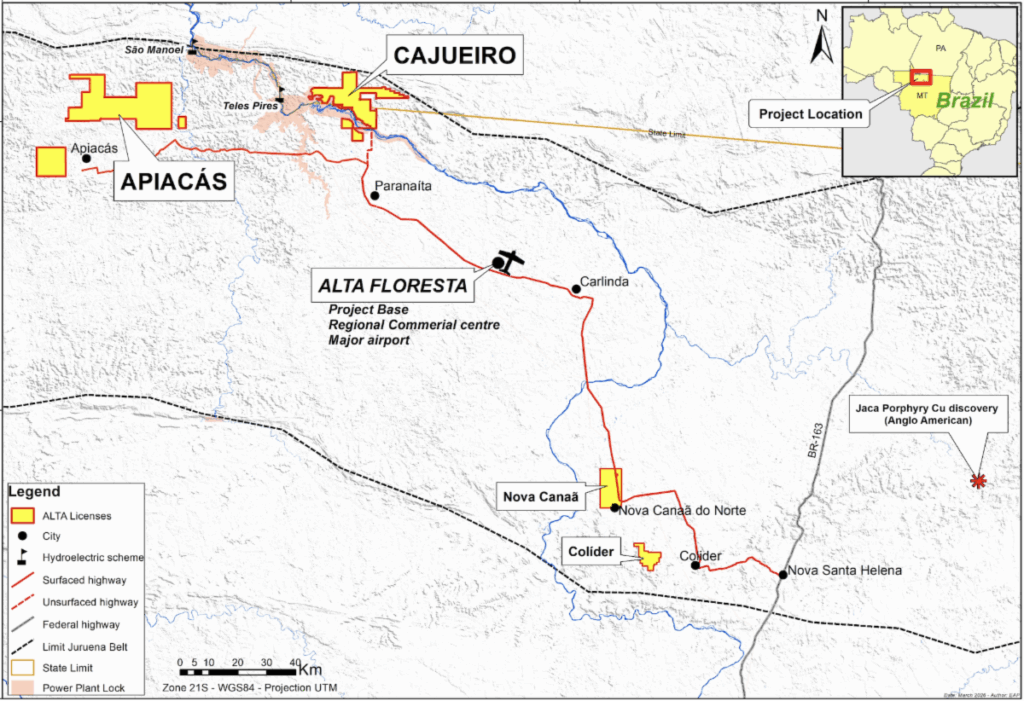
Figure 1: Location of Altamira Gold’s projects in the Alta Floresta Belt.
The Cajueiro district consists of two independently estimated gold mineral resources at Cajueiro Central and Maria Bonita, plus a series of eight additional untested exploration targets within a radius of 8km of Cajueiro Central.
The Cajueiro Central area has a current open pit resource1 of 5.66Mt @ 1.02 g/t gold (185,000 oz) in the Indicated Resource category and 12.66Mt @ 1.26 g/t gold (515,000 oz) in the Inferred Resource category (estimated using a cut-off grade of 0.25g/t Au and a gold price of US$1,500/oz).
The Maria Bonita open-pit resource consists of Indicated Resources of 24.19Mt @ 0.46g/t gold (357,800 oz) and Inferred Resources of 25.64Mt @ 0.44g/t gold (362,400oz)2. These resources were calculated using a 0.2 g/t gold cut-off grade and a gold price of US$2,780/oz. These resources include near-surface saprolite Indicated Resources of 2.02Mt @ 0.59g/t gold (38,000oz) and Inferred Resources of 0.68Mt @ 0.40g/t gold (8,700oz).
The Maria Bonita porphyry gold deposit forms part of a district-scale portfolio of prospects that are interpreted as having a similar geological origin (Figure 2). The Cajueiro area is characterized by a 15km stretch of former alluvial gold workings along the Teles Pires river. The source of some of this alluvial gold is related to a pronounced east-west corridor of gold anomalies in soils and rock chips and a set of sub-cropping intrusions extending east-west over 8km, implying the presence of a long-standing and deep-seated reactivated crustal structure
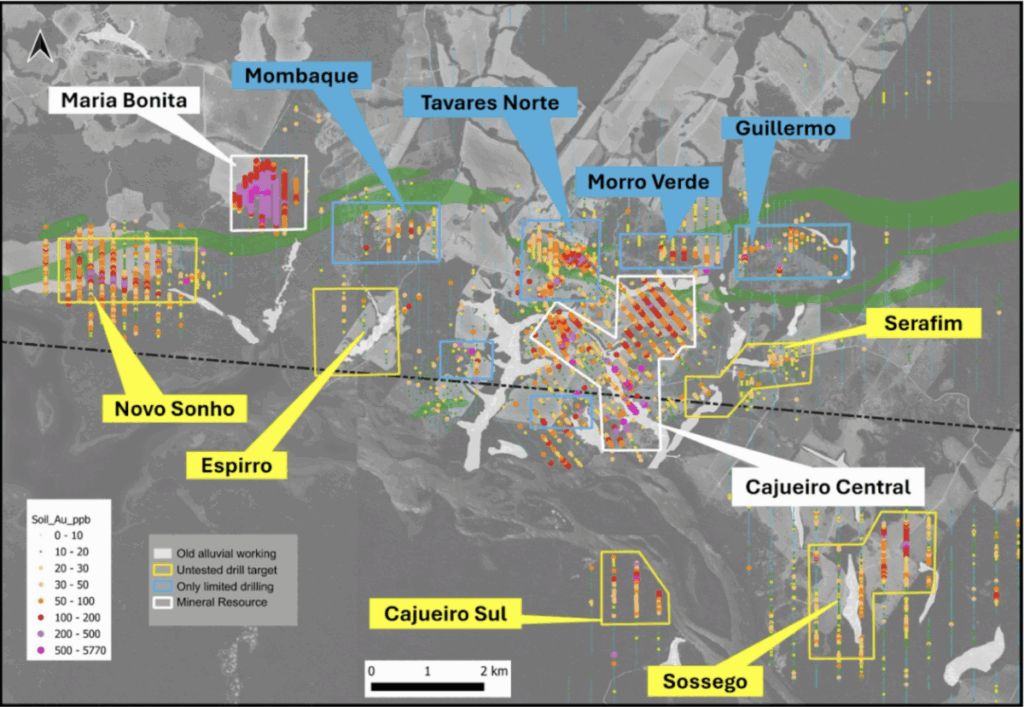
Figure 2: Cajueiro district mineral resources at Cajueiro Central and Maria Bonita (white labels) and prospects (blue labels with scout drilling, yellow labels not yet drilled). An alignment of six of the targets occur in close spatial association to a pronounced east-west fault corridor marked by later gabbroic dykes
Maria Bonita Drilling Update
Recent drilling at Maria Bonita has focused on testing the westerly extension of the resource area. Hole MBA036 was collared south of the western end of the optimised pit containing the current mineral resource. A shallow pit excavated in this area to extract local road fill material exposed altered porphyry intrusives. A grab sample from this pit returned a value of 0.6g/t gold.
The drill hole, with an azimuth of 00° and a dip of 55°, was completed to a depth of 348m. The hole transects the Maria Bonita porphyry complex comprising at least three phases of rhyolite porphyry, plus later dykes of felspar porphyry and mafic dolerite.
The evolving geological model for Maria Bonita, infers at least three phases of felsic porphyry intrusion (Figure 3). The wall-rocks to the porphyry complex are tuffs.
The initial porphyry phase is interpreted as the best mineralized and is generally associated with the highest intensity of hydrothermal quartz veins. Where these veins form sheeted veins sets or stockworks, more consistent elevated bulk gold grades are expected, generally in the range 0.7-1g/t. Early quartz veins may contain accessory magnetite as part of the potassic alteration assemblage.
Subsequent porphyry phases, although broadly similar in chemistry and appearance, have lesser veining and generally carry bulk gold grades that are in the range 0.1-0.5g/t gold. The intensity of gold mineralization is interpreted to decrease with the evolution of the intrusive system i.e. successive pulses of rhyolite porphyry.
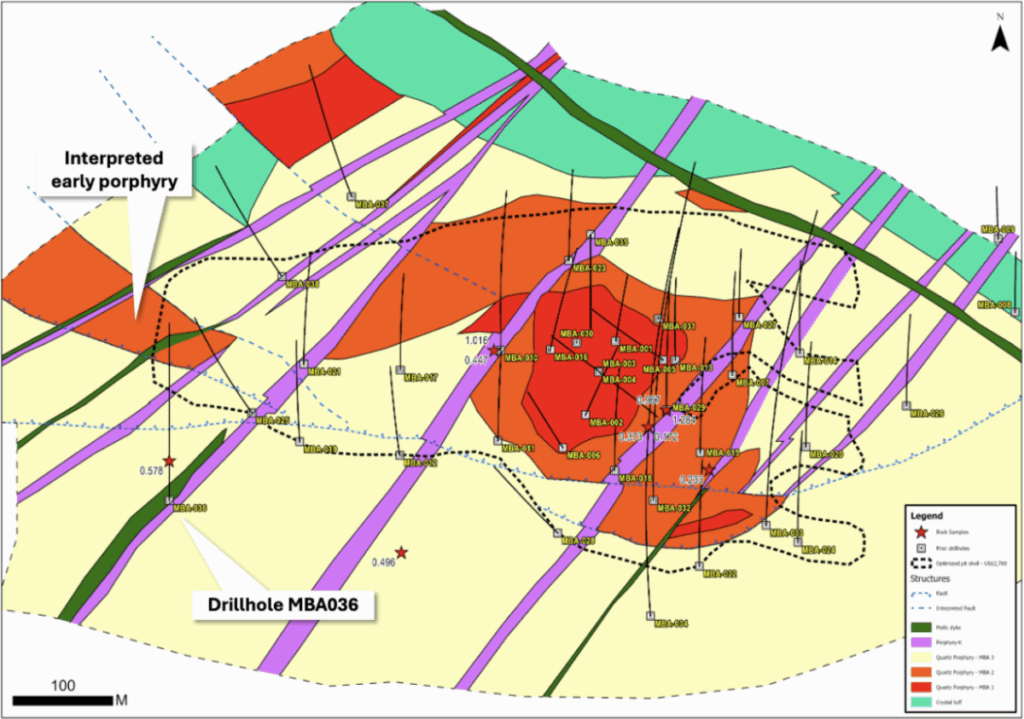
Figure 3: Geology of the Maria Bonita porphyry interpreted from drilling to date. There is no significant outcrop in the area. Volcanic wall rocks to the intrusive suite have been intersected to the north and north-west at depth. Later felspar porphyry dykes and mafic intrusive dykes transect the porphyry. The outline of the optimised pit developed on the mineral resource is shown.
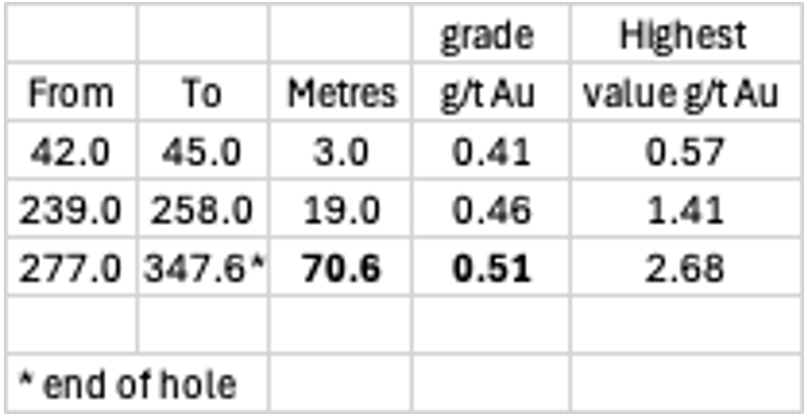
Table 1: Summary of results from drill holes MBA036 at the Maria Bonita target.
Gold values in the better mineralized intervals are consistent, as illustrated by the peak values for 1m assay intervals (Table 1).
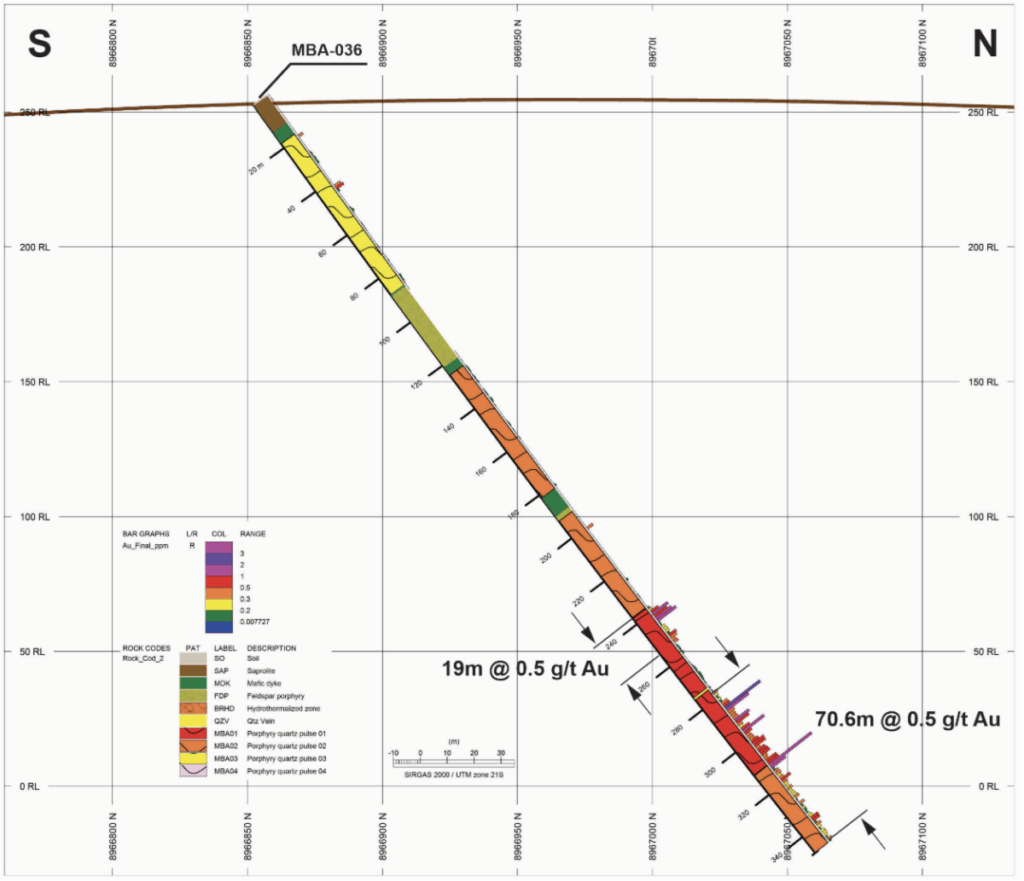
Figure 4: Cross section of drill hole MBA036.
The drill cross section (Figure 4) shows the deeper intercept in early-stage porphyry of 70.6m @ 0.5g/t gold. Mineralization continues to the bottom of the hole, above the cut-off grade applied to the mineral resource of 0.2g/t gold.
The later rhyolite porphyry pulses in this section do not contain significant gold above the mineral resource cut-off.
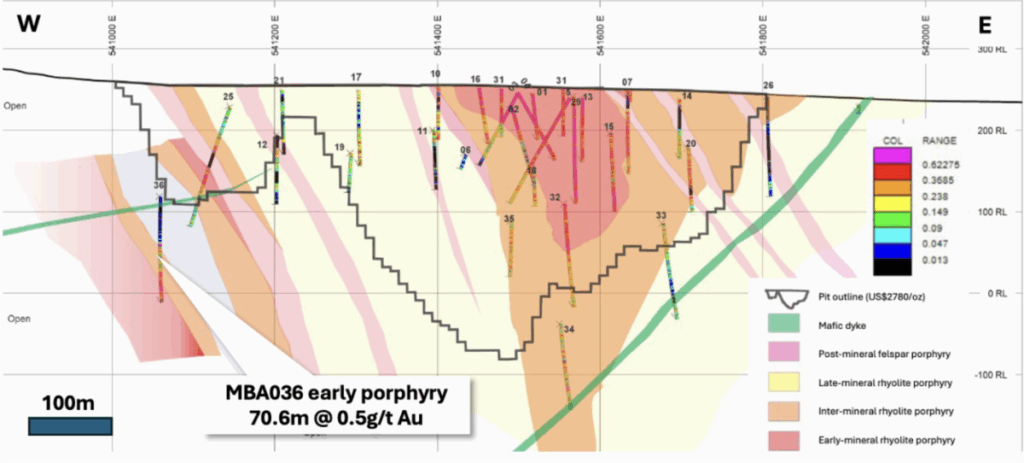
Figure 5: East-West section across the Maria Bonita mineral resource showing the position of the early porphyry extension.
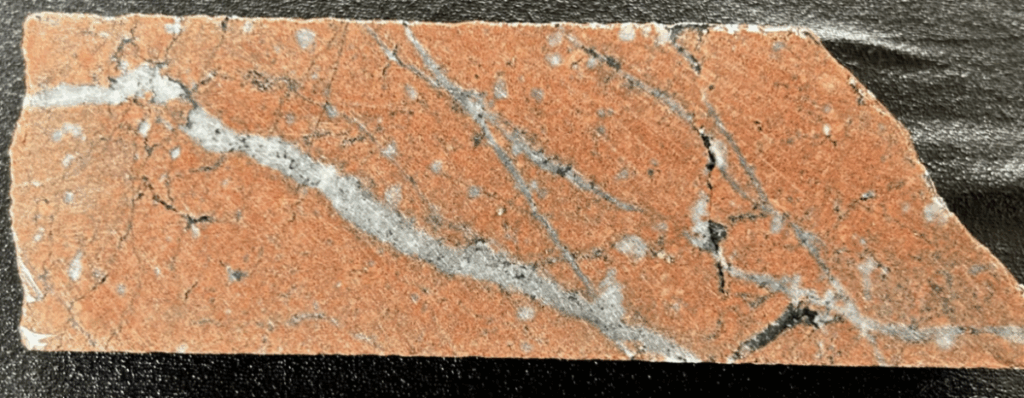
Figure 6: Typical quartz veining within the early porphyry MBA036: 295m. Assay interval 1m @ 1.61g/t gold.
Next Steps
The Company plans to extend the scout drilling of the newly discovered porphyry at Maria Bonita in tandem with the ongoing resource infill drilling at the Cajueiro Central mineral resource.
Samples of both oxide and sulphide mineralization from Cajueiro Central have been prepared for further metallurgical test work to refine the earlier results that showed a recovery of 94% using an agitated leach process and up to 96% recovery using a combination of gravity and agitated leach.
Qualified Person
Fernando Benegas, FAusIMM, a consultant to the Company as well as a Qualified Person as defined by National Instrument 43-101, supervised and approved the preparation of the technical information in this news release.
Gunesch, PE; -MMSA
About Altamira Gold Corp.
The Company is focused on the exploration and development of gold projects within western central Brazil, strategically advancing four projects spanning over 100,000 hectares within the prolific Juruena Gold Belt—an area that has historically yielded over 6 million ounces of placer gold3. The Company’s advanced Cajueiro project contains two gold deposits. Ongoing exploration and fieldwork at Cajueiro indicate the presence of multiple hard rock gold occurrences, traceable from historical alluvial gold production, highlighting the region’s exceptional gold endowment and potential scalability. With two independently established mineral resources, a highly prospective geological setting and a track record of significant discoveries, the Company is well-positioned to unlock further value across its extensive land package.
1NI 43-101 Technical Report, Cajueiro Project, Mineral Resource Estimate: Global Resource Engineering, Denver Colorado USA, 10thOctober 2019; Authors K. Gunesch, PE; H. Samari, QP-MMSA; T. Harvey, QP-MMSA
2 NI43-101 Technical Report, Mineral Resource for the Maria Bonita Prospect: VMG Consultoria, Belo Horizonte, Minas Gerais, Brazil. 12th June 2025; Author V. Myadzel
3 Juliani, C. et al; Gold in Paleoproterozoic (2.1 to 1.77 Ga) Continental Magmatic Arcs at the Tapajós and Juruena Mineral Provinces (Amazonian Craton, Brazil): A New Frontier for the Exploration of Epithermal-Porphyry and Related Deposits. Minerals 2021, 11, 714. https://doi.org/10.3390/min11070714
Brutus Mining Inc. (CSE: BRU) (FSE: ZI3) is pleased to announce that it has closed its non-brokered ... READ MORE
Jaguar Uranium Corp. (NYSE American: JAGU) is pleased to announce an independent Mineral Resource E... READ MORE
Auro Metals Inc. (TSX-V: AURO) (OTCQB: AURFF), is pleased to announce the assay results of the fina... READ MORE
Endeavour Silver Corp. (NYSE: EXK) (TSX: EDR) is pleased to announce that repairs to the primary bal... READ MORE
Scorpio Gold Corp. (NASDAQ: SGLD) (TSX-V: SGLD) (OTCQB: SRCRF) (FSE: RY9) is pleased to announce re... READ MORE