








Shallow Oxide-Hosted Gold Confirmed 4 km North of Oculto; Copper Intersected at Depth
AbraSilver Resource Corp. (TSX: ABRA) (OTCQX: ABBRF) is pleased to report new assay results from five holes completed at the Cerro Viejo target as part of the ongoing Phase VI exploration drill program at its wholly-owned Diablillos project in Argentina.
Cerro Viejo is located approximately 4 km north of the Oculto deposit, where surface channel sampling and earlier reconnaissance drilling identified gold mineralization associated with extensive east-west trending silicified structures extending for approximately 1.5 km. Initial reconnaissance drilling at Cerro Viejo conducted in 2024 returned 36.0 metres grading 1.91 g/t gold from a downhole depth of only 87 m in hole DDH 24-056, including 5.0 m grading 7.22 g/t gold (see the Company’s news release dated January 27, 2025). Follow-up drilling has now confirmed broad zones of shallow, oxide-hosted gold mineralization beginning close to surface, together with copper mineralization in sulphides at depth.
These results further highlight the exploration potential of the Diablillos property beyond the Mineral Resources and Mineral Reserves that underpin the recently completed Definitive Feasibility Study.
Highlight Drill Results: Widths are reported as drilled; true widths are not yet known.
Table 1 – Summary of Key Drill Intercepts
| Drill Hole | Area | From (m) |
To (m) |
Type | Interval (m) |
Ag (g/t) |
Au (g/t) |
Cu (%) |
| DDH-26-037 | Cerro Viejo | 23.0 | 50.0 | Oxides | 27.0 | 4.6 | 0.58 | – |
| DDH-26-043 | Cerro Viejo | 97.0 | 104.0 | Sulphides | 7.0 | – | – | 0.53 |
| 112.0 | 117.0 | Sulphides | 5.0 | – | – | 0.15 | ||
| 187.0 | 190.0 | Sulphides | 3.0 | 12.5 | 0.17 | 0.57 | ||
| DDH-26-046 | Cerro Viejo | 82.0 | 97.5 | Sulphides | 15.5 | – | – | 0.10 |
| DDH-26-047 | Cerro Viejo | 9.0 | 41.0 | Oxides | 32.0 | 2.8 | 0.29 | – |
| 54.0 | 68.0 | Oxides | 14.0 | 6.2 | 1.50 | – | ||
| DDH-26-048 | Cerro Viejo | 37.5 | 50.5 | Sulphides | 13.0 | – | – | 0.10 |
| 81.5 | 102.5 | Sulphides | 21.0 | 1.9 | 0.12 | 0.10 | ||
| 212.0 | 230.0 | Sulphides | 18.0 | 1.5 | 0.13 | 0.06 |
Note: All results in this news release are rounded. Assays are uncut & undiluted. Widths are drilled widths, not true widths. True widths are unknown
John Miniotis, President and CEO, commented, “These initial results from Cerro Viejo are encouraging, with broad zones of gold mineralization starting close to surface within the oxide zone. With the Diablillos DFS now complete and the Project advancing toward a construction decision, our exploration efforts have returned to unlocking the longer-term growth potential, and Cerro Viejo is emerging as an exciting target within the broader district.”
Dave O’Connor, Chief Geologist, commented, “What stands out from these results is the continuity of shallow gold mineralization, with mineralization beginning essentially at surface in several holes. The copper mineralization encountered beneath the oxide zone is also consistent with the upper levels of the larger porphyry system interpreted to underlie this area. Continued drilling will help us better define the scale and potential of this emerging target.”
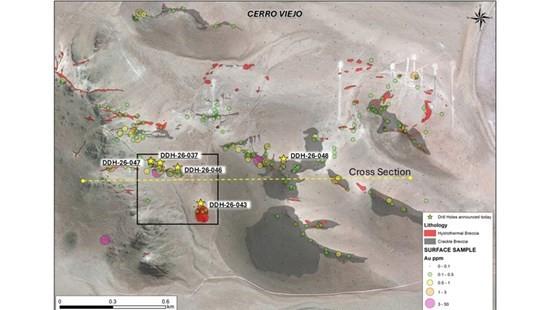
Figure 1 – Plan View of Cerro Viejo Drill Results & Surface Sample Results
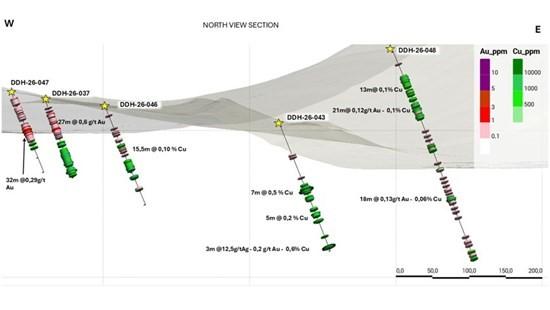
Figure 2 – Cerro Viejo Cross-Section
Additional Details on Drill Results
Cerro Viejo is one of several new exploration areas being systematically tested within the Diablillos property and is located approximately 4 km north of the Oculto deposit. Gold mineralization at Cerro Viejo is hosted within extensive, east-west trending silicified structures that have been traced at surface within a band approximately 0.5 kilometres wide over a strike length of approximately 1.5 kilometres. The mineralization occurs in an epithermal environment interpreted to represent the upper levels of a major porphyry system.
Initial reconnaissance drilling at Cerro Viejo in 2024 intersected widespread gold mineralization, including 36.0 m grading 1.91 g/t gold from a downhole depth of only 87 m in hole DDH 24-056, with a higher-grade interval of 5.0 m grading 7.22 g/t gold. Surface chip and channel samples from the associated siliceous outcrops returned gold values including 16.36 g/t, 12.14 g/t, 3.2 g/t and 2.3 g/t gold. Together these results outlined a large zone with potential for shallow gold mineralization, which is the target of the current drill program. For further details, see the Company’s news release dated January 27, 2025.
The mineralized structures occur within zones of silicification in granitoid rocks that host the underlying porphyry system. The gold-bearing silicification includes areas of vuggy silica and brecciation with alunite-jarosite alteration and appears to be steeply dipping. Oxidation in the area is shallow, and preliminary mineralogical work indicates that gold associated with sulphides (pyrite) largely occurs as fine native metal. Metallurgical testwork has not been completed on mineralization from Cerro Viejo.
Cerro Viejo – Near-Surface Oxide Gold Zone (Holes DDH 26-037 and DDH 26-047)
Holes DDH 26-037 and DDH 26-047 both intersected broad zones of gold mineralization within the oxide zone from close to surface, with mineralization in hole DDH 26-047 commencing at a downhole depth of only 9 m. Oxidation across the area tested to date is shallow, and the mineralization intersected in these holes is oxide-hosted throughout.
Cerro Viejo – Copper Mineralization at Depth (Holes DDH 26-043 and DDH 26-048)
Copper values in holes DDH 26-043 and DDH 26-048 occur within sulphides below the oxide zone and are interpreted to represent the deeper parts of steeply dipping mineralized structures. Hole DDH 26-048 is located approximately 500 m northeast of hole DDH 26-043, indicating that mineralization of this style is developed across a substantial area of the property.
Phase VI Exploration Update:
A total of approximately 12,000 m have been completed in 54 diamond drill holes under the Phase VI exploration program since it commenced in January 2026, of which approximately 1,000 m have been drilled at Cerro Viejo. Two drill rigs remain active on the Project, and a third drill rig is expected to be mobilized later in September.
Drilling continues to test extensions of the known mineralization at Oculto West, Oculto East and along the JAC–Oculto trend, in parallel with first-pass and follow-up drilling on new targets including Cerro Viejo and the adjacent Condoryacu property, where initial drilling returned 72 m grading 18.7 g/t gold, 117 g/t silver and 2.06% copper from surface (see the Company’s news release dated March 30, 2026).
The Company has recently completed a drone-based magnetic survey at Condoryacu, which shows a distinct north-south character that may reflect structures controlling mineralization. The results will be used to guide follow-up drilling at Condoryacu, which is expected to commence shortly.
The Company is currently conducting a CSAMT survey across the broader Oculto and JAC areas and the intervening trend, with the objective of identifying additional drill targets for the balance of the Phase VI program and for future exploration. The survey comprises northwest-southeast lines, approximately perpendicular to the main structural trends of mineralization, covering an area of 3.5 km northeast-southwest by 2 km northwest-southeast. A historical CSAMT survey over the area showed a strong vertical contrast in resistivity, interpreted to reflect an alteration zone associated with the main feeder system to the Oculto mineralization.
Additional assay results from the ongoing Phase VI drill program are pending and will be released as they become available.
Collar Data
| Hole Number | UTM Coordinates | Elevation | Azimuth | Dip | Depth (m) | Area | |
| DDH 26-037 | 722233 | 7202291 | 4,192 | 180 | -60 | 119 | Cerro Viejo |
| DDH 26-043 | 722462 | 7202066 | 4,157 | 178 | -60 | 194 | Cerro Viejo |
| DDH 26-046 | 722328 | 7202269 | 4,176 | 180 | -60 | 150 | Cerro Viejo |
| DDH 26-047 | 722179 | 7202302 | 4,202 | 180 | -60 | 122 | Cerro Viejo |
| DDH 26-048 | 720171 | 7199283 | 4,254 | 180 | -60 | 323 | Cerro Viejo |
About Diablillos
The Diablillos property is located within the Puna region of Argentina, in the southern part of Salta Province along the border with Catamarca Province, approximately 160 km southwest of the city of Salta and 375 km northwest of the city of Catamarca. AbraSilver acquired the property in 2016, which comprises 15 contiguous and overlapping mineral concessions with excellent year-round road access.
Exploration to date has outlined multiple occurrences of silver-gold oxide mineralization at Oculto, JAC, Laderas, and Fantasma, located within a 500 m to 1.5 km distance surrounding the Oculto/JAC epicentre. To date, over 170,000 metres have been drilled on the property, which continues to demonstrate the strong growth potential of shallow, oxide-hosted silver and gold resources. In addition, a large porphyry complex is centered approximately 4 km northeast of Oculto which includes outcropping porphyry intrusions within a major zone of alteration and associated gold rich epithermal mineralization.
Comparatively nearby examples of high sulphidation epithermal deposits include: La Coipa (Chile); Yanacocha (Peru); El Indio (Chile); Lagunas Nortes/Alto Chicama (Peru) Veladero (Argentina); and Filo del Sol (Argentina). The most recent tank and heap leach Mineral Resource estimate for Diablillos is shown in Table 2. Following completion of the DFS in June 2026, the Project also hosts Proven and Probable Mineral Reserves of 77.9 Mt grading 146 g/t silver equivalent, containing 184 Moz of silver and 1.8 Moz of gold (366 Moz AgEq). For additional details, please refer to the “NI 43-101 Mineral Resource Estimate, Diablillos Silver-Gold Project” dated June 19, 2026, available on SEDAR+ and the Company’s website.
Table 2 – Diablillos Mineral Resource Estimate – As of April 30, 2026
| Zone | Category | Tonnes (000 t) |
Ag (g/t) |
Au (g/t) |
AgEq (g/t) |
Contained Ag (000 Oz) |
Contained Au (000 Oz ) |
Contained AgEq (000 Oz) |
|||
| Tank Leach |
Oxides | Measured | 41,042 | 100 | 0.68 | 159 | 131,668 | 896 | 209,281 | ||
| Indicated | 60,978 | 41 | 0.58 | 92 | 81,060 | 1,143 | 180,078 | ||||
| Measured & | 102,021 | 65 | 0.62 | 119 | 212,728 | 2,039 | 389,359 | ||||
| Indicated | |||||||||||
| Inferred | 14,400 | 25 | 0.57 | 74 | 11,468 | 262 | 34,187 | ||||
| Heap Leach |
Oxides | Measured | 25,469 | 13 | 0.09 | 19 | 10,997 | 76 | 15,425 | ||
| Indicated | 104,491 | 7 | 0.13 | 15 | 24,328 | 428 | 49,342 | ||||
| Measured & | 129,960 | 8 | 0.12 | 16 | 35,325 | 503 | 64,767 | ||||
| Indicated | |||||||||||
| Inferred | 34,947 | 6 | 0.14 | 14 | 6,939 | 158 | 16,153 | ||||
| Total | Oxides | Measured | 66,512 | 67 | 0.45 | 105 | 142,665 | 971 | 224,706 | ||
| Indicated | 165,469 | 20 | 0.30 | 43 | 105,388 | 1,570 | 229,420 | ||||
| Measured & | 231,981 | 33 | 0.34 | 61 | 248,053 | 2,542 | 454,127 | ||||
| Indicated | |||||||||||
| Inferred | 49,347 | 12 | 0.26 | 32 | 18,406 | 420 | 50,340 |
QA/QC and Core Sampling Protocols
AbraSilver applies industry standard exploration methodologies and techniques, and all drill core samples are collected under the supervision of the Company’s geologists in accordance with industry best practices. Drill core is transported from the drill platform to the logging facility where drill data is compared and verified with the core in the trays. Thereafter, it is logged, photographed, and split by diamond saw prior to being sampled. Samples are then bagged, and quality control materials are inserted at regular intervals at site; these include blanks and certified reference materials as well as duplicate core samples which are collected in order to assess sampling precision and reproducibility. Groups of samples are then placed in large bags which are sealed with numbered tags in order to maintain a chain-of-custody during the transport of the samples from the project site to the laboratory.
All samples are received by the ASA (Alex Stewart Argentina) preparation laboratory in Salta, where they are prepared, then the pulp sachet is directly dispatched to its facility in Mendoza, Argentina, where they are analyzed. All samples are analyzed using a multi-element technique consisting of a four-acid digestion followed by ICP/AES detection, and gold is analyzed by 50g Fire Assay with an AAS finish. Silver results greater than 100g/t are re-analyzed using four acid digestion with an ore grade AAS finish.
Qualified Persons
David O’Connor P.Geo., Chief Geologist for AbraSilver, is the Qualified Person as defined by National Instrument 43-101 Standards of Disclosure for Mineral Projects, and he has reviewed and approved the scientific and technical information in this news release.
About AbraSilver
AbraSilver is a leading silver-gold development company focused on advancing its 100%-owned Diablillos Project in the mining-friendly provinces of Salta and Catamarca, Argentina. The recently completed Definitive Feasibility Study highlights Diablillos as a robust, high-margin, long-life precious metals project with a strong production profile and substantial exploration upside. In addition, the Company has entered into an earn-in option and joint venture agreement with Teck on the La Coipita project, located in the San Juan province of Argentina.
Brutus Mining Inc. (CSE: BRU) (FSE: ZI3) is pleased to announce that it has closed its non-brokered ... READ MORE
Jaguar Uranium Corp. (NYSE American: JAGU) is pleased to announce an independent Mineral Resource E... READ MORE
Auro Metals Inc. (TSX-V: AURO) (OTCQB: AURFF), is pleased to announce the assay results of the fina... READ MORE
Endeavour Silver Corp. (NYSE: EXK) (TSX: EDR) is pleased to announce that repairs to the primary bal... READ MORE
Scorpio Gold Corp. (NASDAQ: SGLD) (TSX-V: SGLD) (OTCQB: SRCRF) (FSE: RY9) is pleased to announce re... READ MORE