







Leviathan Metals Corp. (LVX:TSX-V) (LVXFF:OTC) (0GP:FSE) is pleased to announce the receipt of results from its 2025 mechanical trenching program at the Vrela-Kremin trend within the Marevo license area of the company’s Foča Project, Republika Srpska, Bosnia and Herzegovina. The best intervals from this program are presented in Table 1. Trenching was completed using a lightweight rubber-tracked excavator to an average bedrock depth of approximately 0.7 meters in the manner shown in Figure 4. A total of 1298 samples were collected from 2215 meters of such trenches.
| Table 1: Selected composite assay results from trenching at the Vrela-Kremin trend | |||||||||||
| Trench ID |
Length (m) |
Zn (%) |
Ag (ppm) |
Pb (%) |
ZnEq (%)1 |
||||||
| T24MAR012 | 6 | 5.66 | 16.90 | 1.22 | 6.43 | ||||||
| T24VRE01 | 5 | 6.23 | 73.00 | 3.42 | 8.41 | ||||||
| T25MAR04 | 27 | 4.18 | 16.30 | 0.70 | 4.63 | ||||||
| Including | 14 | 7.00 | 27.30 | 1.22 | 7.78 | ||||||
| T25MAR11 | 29 | 4.19 | 19.90 | 0.75 | 4.67 | ||||||
| Including | 12 | 8.15 | 27.90 | 1.21 | 8.92 | ||||||
| T25MAR32 | 16 | 1.61 | 29.50 | 0.87 | 2.21 | ||||||
| Including | 1 | 3.25 | 95.00 | 1.70 | 4.34 | ||||||
| Including | 2 | 7.08 | 103.50 | 3.76 | 9.47 | ||||||
| Including | 2 | 3.91 | 47.50 | 0.96 | 4.52 | ||||||
| T25MAR34 | 7 | 2.52 | 10.50 | 0.25 | 2.68 | ||||||
| Including | 1 | 11.40 | 30.00 | 0.24 | 11.55 | ||||||
Trenches were targeted in follow up of a combination of high-grade rock-chip samples previously collected by Leviathan’s geological team, gossanous breccia occurrences recorded at surface, and surface zinc-lead anomalism arising from Leviathan’s property-wide reconnaissance, and subsequent follow up soil surveys. This surface anomalism is seen to occur repeatedly over a strike length of approximately 2.6 kilometers – the so called Vrela-Kremin trend – in apparent association with an ENE-trending fault system (Figure 1), the WSW end of which is marked by historic Yugoslav diamond drilling, from which an average mineralized thickness of 15 meters at 13.25% Pb+Zn between three holes completed in 1967 was reported. Leviathan’s 2025 trenching results are presented in the context of this clear, linear geochemical anomalism and historic drilling in Figure 1. Lead in soil anomalism associated with the Rupice mine, Dundee Precious Metals, approximately 100 kilometres to the northwest of Vrela-Kremin and hosted in stratigraphy of similar age and character is shown to scale.
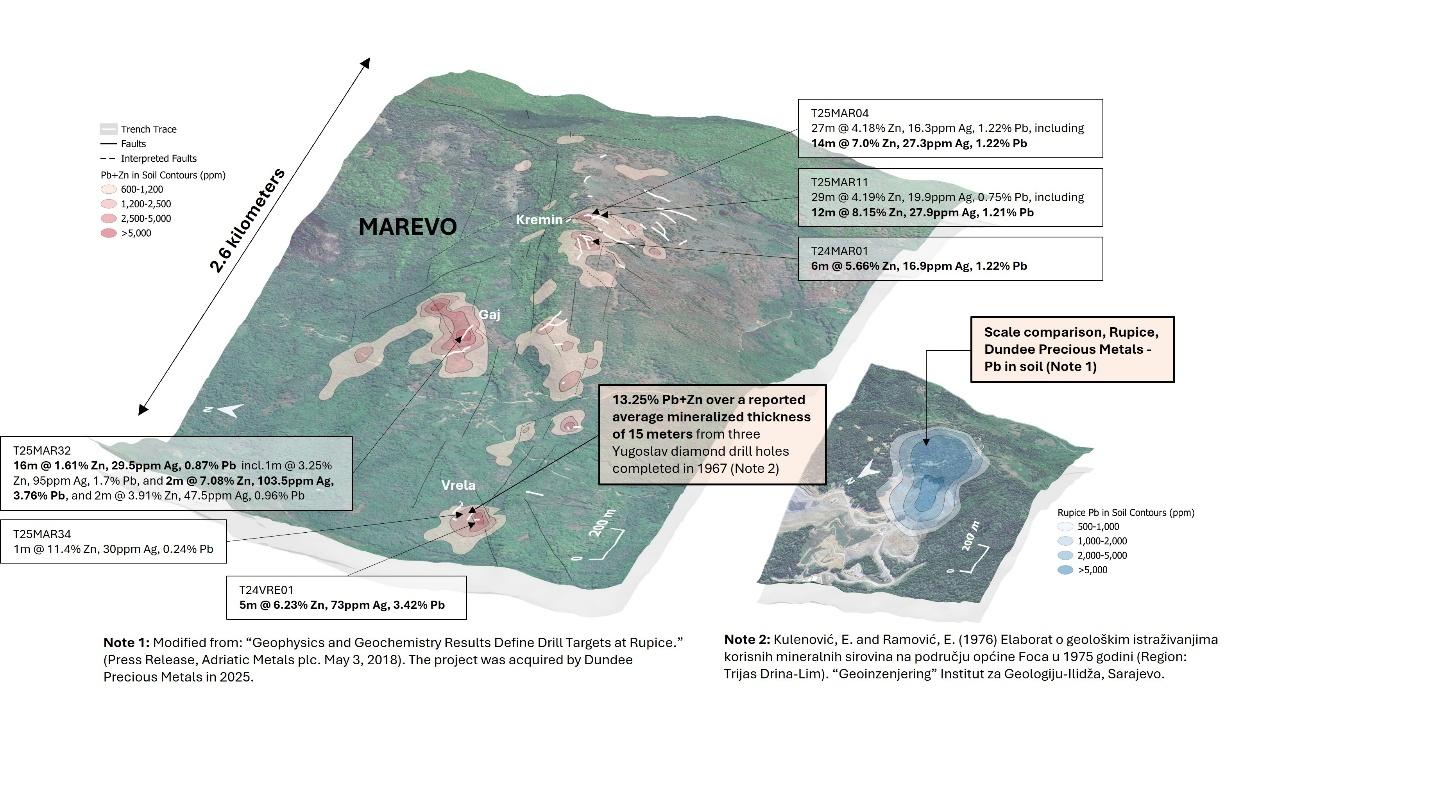
Figure 1: The Vrela-Kremin Trend as characterized by high grade surface trench results concordant with zinc and lead anomalism in soil. Lead anomalism in soil at Rupice, Dundee Precious Metals is presented at the same scale.
Leviathan Chief Executive Officer, Luke Norman, remarked: “Our trenching results from Vrela-Kremin demonstrate high grade, near-surface silver, lead and zinc mineralization over prominent widths, within the footprint of a broader structural and geochemical corridor striking over 2.6 kilometers – all of it within Leviathan tenure. Southern Bosnia having seen almost no modern systematic exploration, this positions Leviathan as a leader in unlocking what could potentially be the next major silver-base metal system in the district, and sets the stage for drilling at Foča during the 2026 exploration season.
We thank the people and government of Foča and Republika Srpska for their continued support in the advancement of our business in this emerging district, and we look forward continually building on this highly constructive relationship as the project advances.”
Mineralization at the Vrela-Kremin trend is hosted by rocks of Permo-Triassic age, dominated by metacarbonates interbedded with coarse to fine grained metasediments, with mineralization preferentially hosted in tectonized carbonates. Field mapping indicates that mineralization is structurally-controlled, predominantly occurring within antiforms. The mineralized carbonates typically appear as brecciated marbles, reflecting intense fracturing and fluid infiltration, often associated with hydraulic fracturing and brecciation processes. Fracture-controlled brecciation appears to have facilitated the circulation of hydrothermal fluids, promoting metal precipitation within structurally and chemically favorable horizons. Soil samples proximal to mineralization are especially enriched in in zinc, followed by lead. A SEDEX model for primary mineral emplacement, followed by later fracturing and fluid remobilization of this mineralization is tentatively inferred. Structural mapping of the Vrela-Kremin trend and its surroundings suggest that study area was affected by NE-SW compression which resulted in the intensive folding and faulting. Observed fold planes are generally dipping either SW or NE, while fold axes are gently dipping either NW or SE. Structural mapping and interpretation at the Project is ongoing.
A total of 1529 soil, and 241 rock chip samples have been collected by Leviathan at the Project, as summarized in Figure 2, from which the Vrela-Kremin trend, within the Marevo license area, is readily evident. A plan view of trenching completed by Leviathan at the Vrela-Kremin trend is provided in Figure 3.
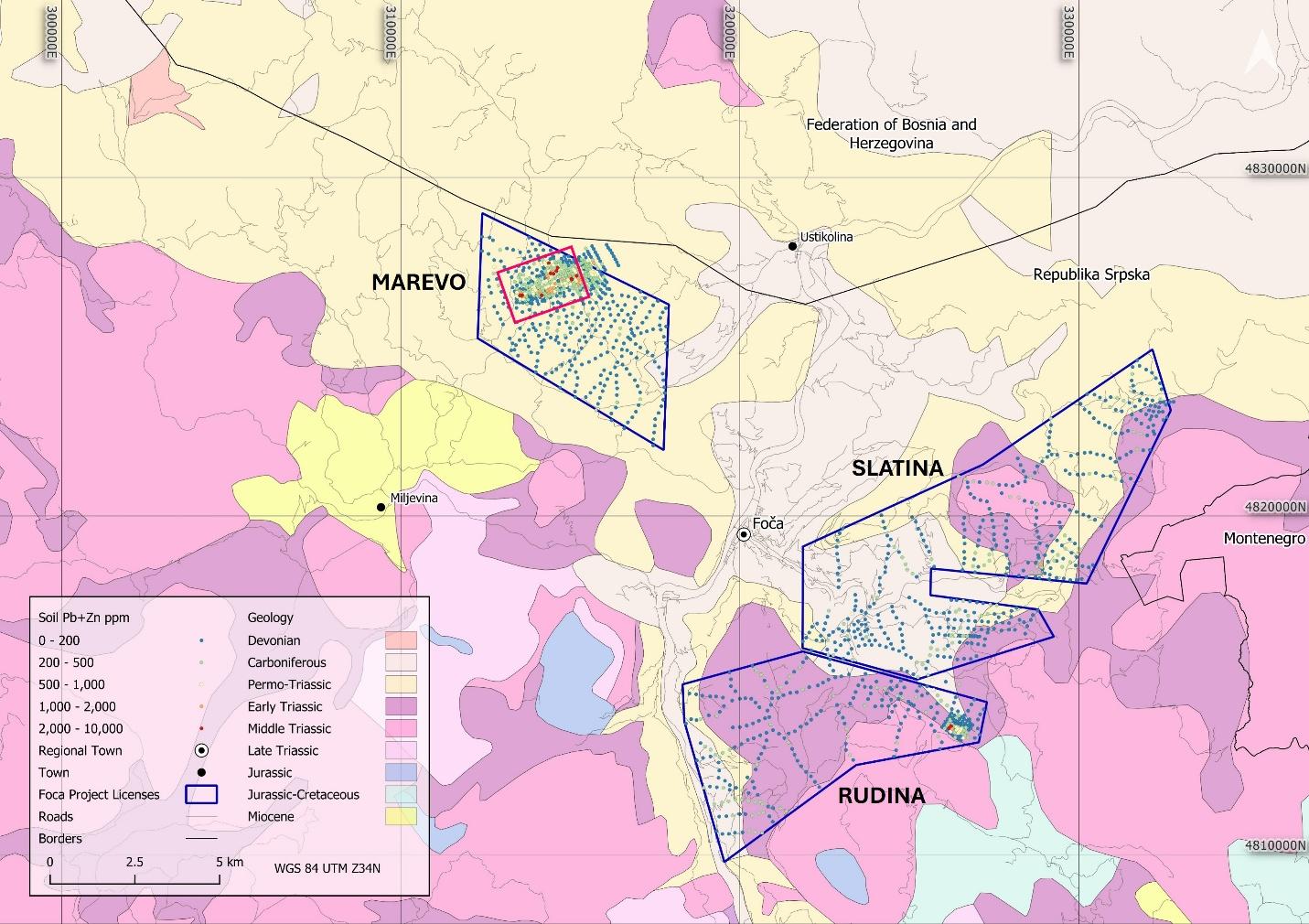
Figure 2: Geology of the Foča Project, overlain by results of regional and follow up soil sampling. The Vrela-Kremin trend, and the area of Figure 1 are together outlined in red.
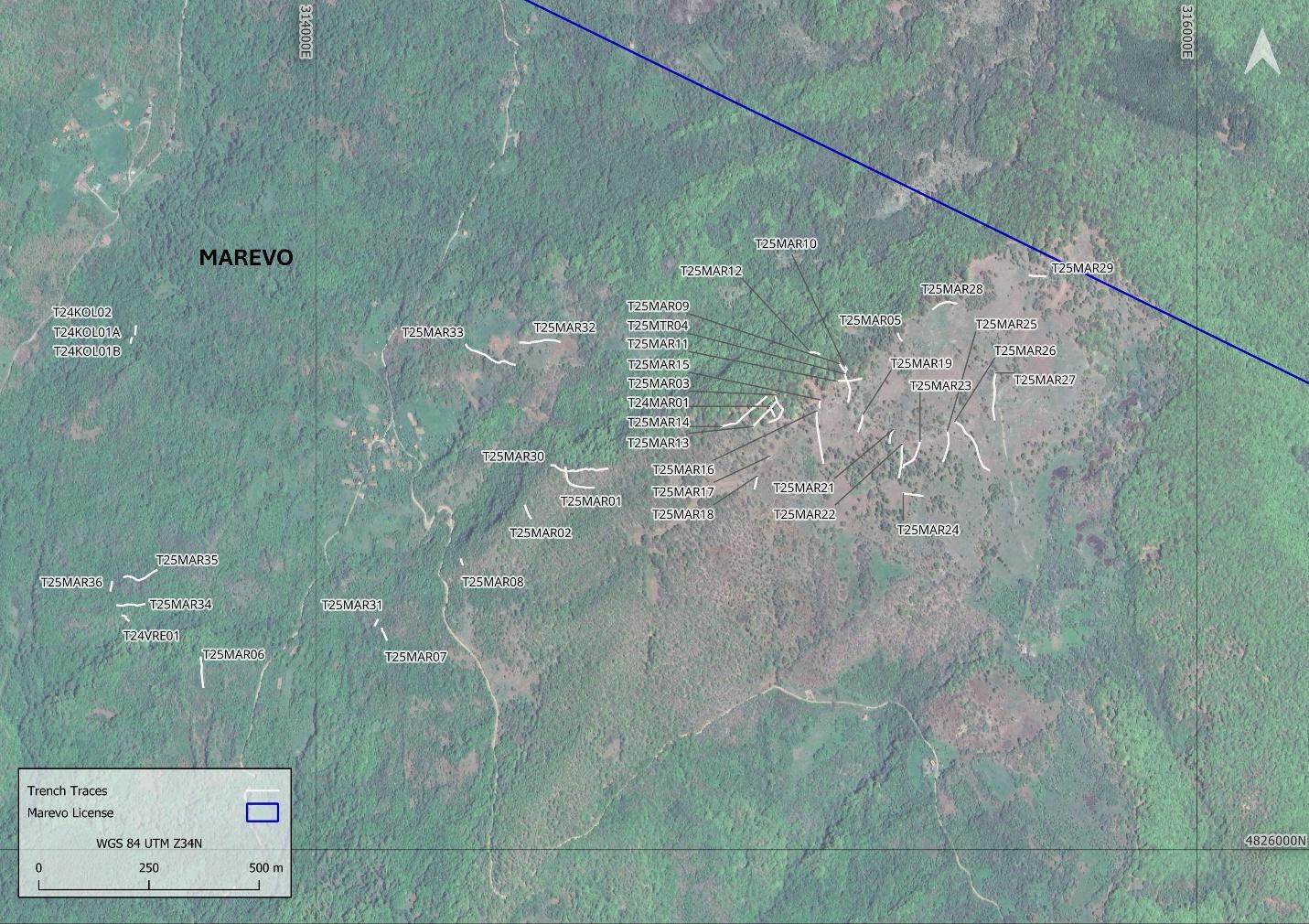
Figure 3: Trenching plan at the Vrela-Kremin trend, Marevo license area.
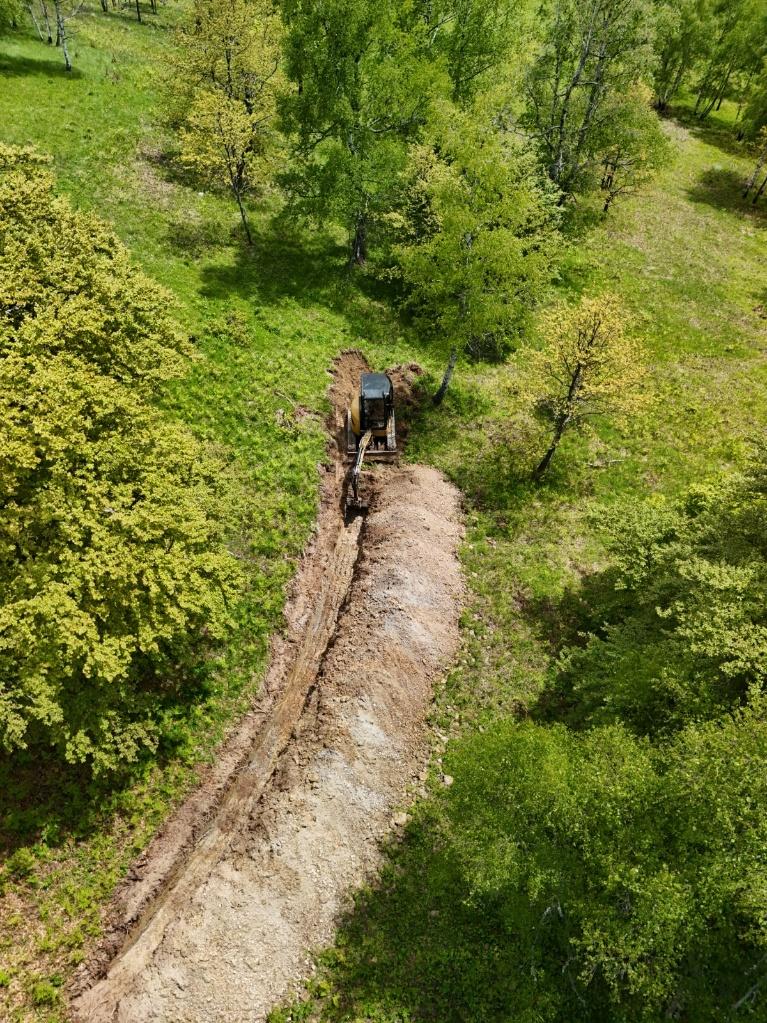
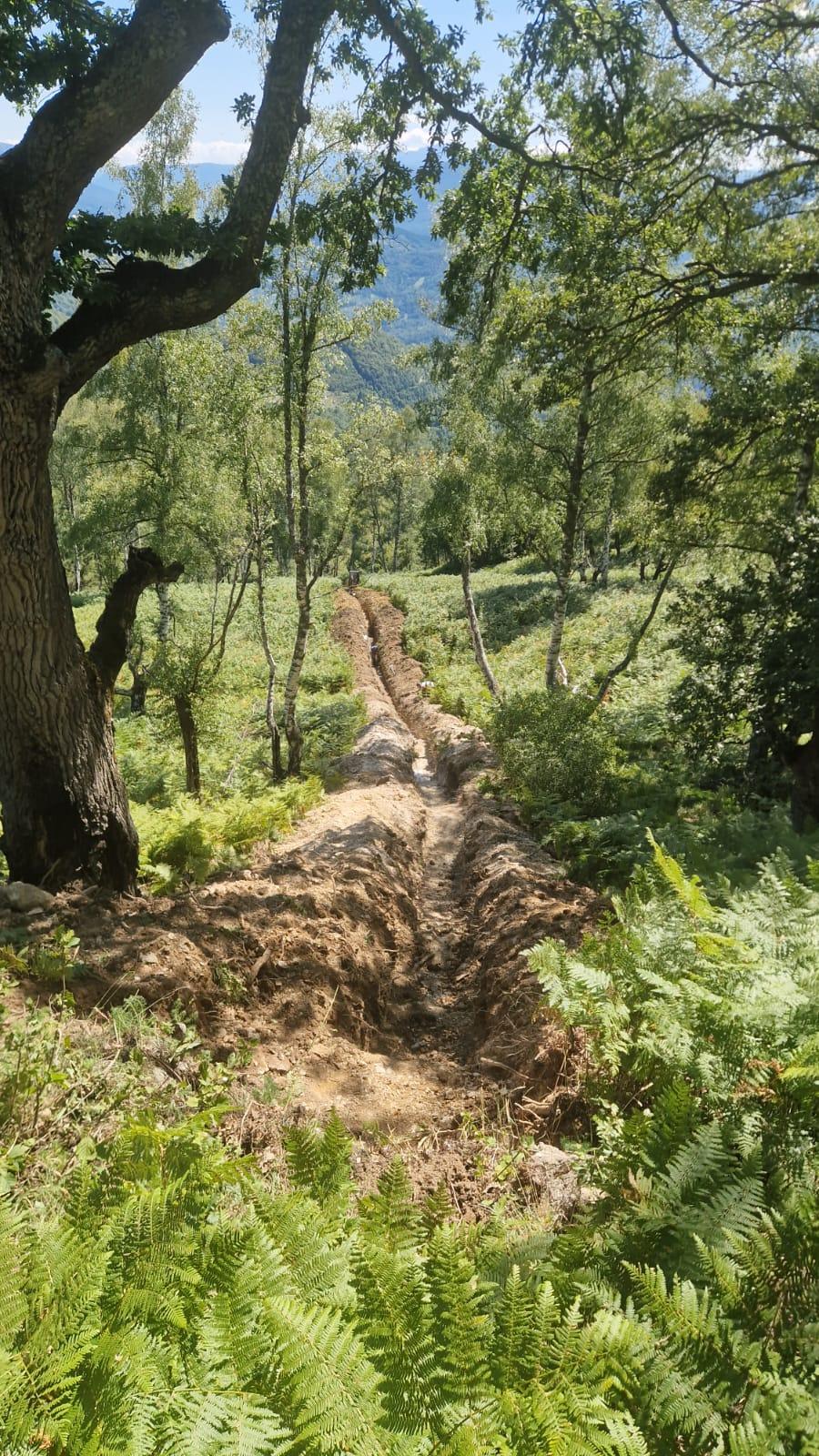
Figure 4: Mechanical trenching under way during the 2025 field season at the Vrela-Kremin trend.
About the Foča Project
The Project covers 100.7 square kilometres across three active exploration licenses, includes a series of silver and base metal targets tentatively interpreted to be of SEDEX origin, and lies approximately 100 kilometres southeast of the Vareš project of Dundee Precious Metals. Vareš hosts Indicated Mineral Resources of 18.3 Mt at 168 g/t Ag, 1.3 g/t Au, 4.6% Zn, 2.9% Pb, 0.4% Cu and 30% BaSO4 and Inferred Mineral Resources of 2.8 Mt at 75 g/t Ag, 0.5 g/t Au, 2.4% Zn, 1.6% Pb, 0.2% Cu and 13% BaSO43 in rocks of closely comparable age and host lithology to those at Foča – within the so-called Central Dinaride metallogenic zone of the Western Tethyan Belt.
Another prominent group of Central Dinaride polymetallic deposits is the Trepča Mines complex in Kosovo, which falls approximately 300 kilometres southeast of the Project at which historic production of 60.5 Mt at 8% Pb+Zn and more than 4,500 tons of Ag4 is documented, and which in the 1980’s reportedly employed 20,000 people, supposedly accounting for 70% of all Yugoslavia’s mineral wealth5. A number of other polymetallic mineral occurrences including past and current producing mines fall in closer proximity to Foča, and provide a broader indication of the potential metal endowment of this highly under-explored mineral district, which is almost entirely untouched by modern, systematic exploration.
Key targets at Foča presently include:
Changes to the Law on Geological Exploration in Republika Srpska, which came into force on July 24, 2024, are viewed by the Company as mining friendly, and consistent with the legal provisions of other leading international mining jurisdictions.
The Geology of the Foča District
The Foča district is located in the Durmitor Nappe, a thrusted, folded and faulted geological succession of Palaeozoic basement, with overlying Triassic and Jurassic-Cretaceous aged rocks consisting of carbonate, flysch volcanogenic-sedimentary formations deposited in response to rifting on the margin of Gondwana and the opening of the Neo-Tethys ocean, and subsequently deformed by the Late Palaeozoic age Alpine Orogeny.
By way of analogy, the Vareš district reportedly lies near the western closure of the Durmitor Nappe, with geology of the area consisting of Lower Triassic, Middle Triassic and undifferentiated Jurassic-Cretaceous formations7. The polymetallic mineralization is predominately hosted in the matrix of a polymictic breccia of banded shale, siltstone or sandstone clasts, both overlain and underlain by a succession of sandstone, siltstone, shale or limestone. Mineralogy across the various mineral occurrences reportedly includes sphalerite, galena, chalcopyrite, barite, minor tetrahedrite, and pyrite, with associated silver and gold.
About Leviathan Metals Corp.
Leviathan Metals Corp., previously known as Leviathan Gold Ltd., is a Canadian-based mineral exploration company listed on the TSX-V (LVX) and Germany (0GP).
On behalf of the Company
Luke Norman, Chief Executive Officer and Director
For further information, please visit the Company website www.leviathanmetals.com, the Company’s profile on SEDAR+ at www.sedarplus.com, or contact:
Luke Norman,
Direct: (778) 238-2333
Toll Free: 1(833) 923-3334
Email: info@leviathanmeatls.com
Scandium Canada Ltd. (TSX-V: SCD) is pleased to announce additional assay results from the 2... READ MORE
Search Minerals Inc. (TSX-V: SMY) (OTC Pink: SHCMF) is pleased to announce that it has closed the th... READ MORE
Golden Spike Resources Corp. (CSE: GLDS) (OTCQB: GSPRF) (FSE: L5Y) is pleased to announce the... READ MORE
GoldHaven Resources Corp. (CSE: GOH) (OTCQB: GHVNF) (FSE: 4QS) is pleased to announce that it has cl... READ MORE
Independence Gold Corp. (TSX-V: IGO) (OTCQB: IEGCF) (FSE: 625) is pleased to announce assay r... READ MORE