






The development of Graphite One’s (TSX-V:GPH) (OTCQX:GPHOF) Graphite Creek Project is ‘Under the Spotlight.’
As the potential mine moves from the always mandated basic Environment Assessment Study (EAS) to the almost always next step for all major mines in Alaska, an Environmental Impact Statement (EIS), it brings into focus different perspectives from all the interested parties in the Seward Peninsula project: the priorities of the local villagers, the various investors priorities and Graphite One’s thoughts.
But the mine’s story also focuses on the subject of, can engineers build an Arctic mine, and accompanying infrastructure, that successfully mitigates environmental risk on the peninsula.
Graphite One’s Graphite Creek Project is also ‘Under the Spotlight’ because it highlights a very serious push by the Trump administration towards one of its admin’s major US national priorities: Department of Defense funding for critical mineral sovereignty.
Graphite One’s supply chain strategy
Graphite One aims to become the first vertically integrated producer to serve the US electric vehicle battery market and energy storage system markets. Its supply chain strategy involves mining, manufacturing and recycling, all done domestically.
The first link in what is known as the Graphite One Project, is Graphite One’s Graphite Creek Mine in Alaska, which completed a Bankable Feasibility Study in Q2 2025, mostly funded by a $37.5 million grant from the Department of Defense.
Meanwhile, Graphite One has chosen a site in Ohio for its Active Anode Materials (AAM) facility — the second link in its US-based graphite materials supply chain strategy.
Graphite One secures Ohio site for Active Anode Materials facility — Richard Mills
The plan’s third link is a recycling facility to reclaim graphite and other battery materials, to be co-located at the Ohio site.
The company has received strong bipartisan support from the US government, including EXIM Bank non-binding Letters of Interest exceeding USD$2 billion, prior Department of Defense Title III and Defense Logistics Agency funding totaling $42 million, and inclusion on the FAST-41 permitting dashboard.
The Bering Straits Native Corporation (BSNC) made an initial strategic investment of US$2 million, which increased to US$4.5 million after the exercise of share purchase warrants. Their agreement with Graphite One grants BSNC the option to invest up to an additional US$6.0 million.
Doyon Limited & Aleut Corporation are two other Alaska Native corporations that joined BSNC by closing a US$5 million strategic investment. Doyon subsequently exercise their share purchase warrants which brought in an additional US$3.9 million in proceeds. In total, the three Alaska Native corporations holds 9.2% of the company’s issued and outstanding shares.
Land ownership
Graphite One holds 176 Alaska State mining claims covering 23,680 acres. The state has the constitutional mandate to manage the land for multiple uses, which includes mineral development.
Alaska owns the surface and subsurface rights at the Graphite Creek deposit, along with the proposed mill site, tailings facilities and the 17-mile Mosquito Pass access road.
The Bering Straits Native Corporation (BSNC) owns the land running northwest along the Imuruk Basin. Graphite One is leasing a portion of BSNC’s land to build a temporary gravel staging pad.
Because the Graphite Creek deposit rests entirely on state land, it falls under the direct regulatory jurisdiction of the Alaska Department of Natural Resources (ADNR) and the Alaska Department of Environmental Conservation (ADEC). This means Alaska handles the bulk of the permitting, reclamation, and water rights processes for the mine itself.
Because no federal lands are crossed by the core mine site, Graphite One avoided the multi-agency federal land-use approvals (such as those from the Bureau of Land Management). The only federal trigger is the Clean Water Act Section 404 permit from the U.S. Army Corps of Engineers regarding wetlands.
Graphite One, BSNC welcome Environmental Impact Statement (EIS)
On July 9 Graphite one announced that, “following collaborative work with the U.S. Army Corps of Engineers (USACE) during the Environment Assessment Study (EAS) process, it has been determined that an Environmental Impact Statement (EIS) is the best option for all parties to progress the permitting effort for the Graphite Creek deposit.”
The main drivers behind supporting an EIS include:
The EIS, by mandating a comprehensive and transparent review process with considerable public consultation, ensures that First Nations’ subsistence rights are protected and shareholders and Graphite One are provided long-term regulatory certainty for their investments.
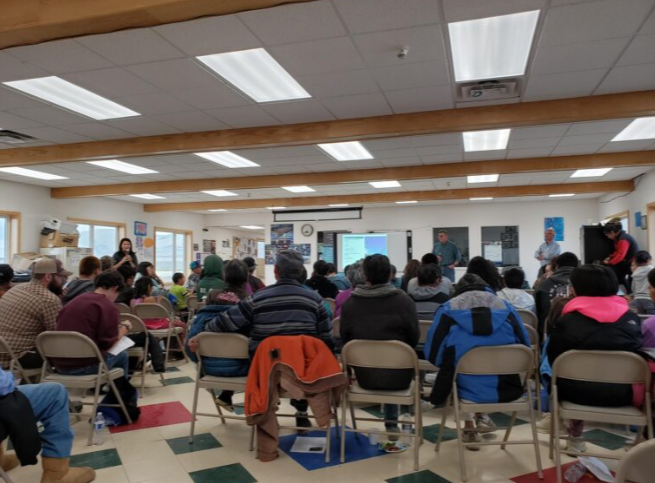
The thorough EIS process is the best way to address any local stakeholder and shareholder concerns while securing the project’s future.
“We fully support the Army Corps’ recommendation to conduct a comprehensive EIS review. This approach ensures transparency and provides the opportunity for all stakeholders — including local communities, Indigenous groups, and regulatory agencies — to have their voices heard and concerns addressed in a thorough manner,” said Anthony Huston, Graphite One’s President and CEO.
BSNC President Cindy Towarak Massie said, “We agree that evaluating the Graphite Creek Project under the full EIS process is in the best interest of everyone involved, Graphite One, investors like BSNC, and most importantly, our shareholders who call the areas near the project home.
Moving forward with an EIS is a more comprehensive approach. It provides additional regulatory clarity for Graphite One’s investors and more opportunities for those living near the project, whose families have subsisted on the Seward Peninsula for thousands of years, to have their concerns addressed.”
EAS and EIS
We need to step back and explain the difference between an Environmental Assessment Statement and an Environmental Impact Statement, and what is a Clean Water Act Section 404 permit.
Under the National Environmental Policy Act (NEPA), mining projects on federal land or needing federal permits such as the Clean Water Act Section 404 permit, require at least an environmental assessment. An Environmental Assessment (EA) is a shorter, preliminary review to determine if a project’s impacts could be significant. An Environmental Impact Statement (EIS) is a rigorous, comprehensive study reserved for projects with expected higher impacts.
A Clean Water Act Section 404 permit regulates the discharge of dredged or fill material into US waters, including wetlands. Administered by USACE and overseen by the EPA, mining companies need this permit for constructing projects affecting aquatic ecosystems.
What is the connection between a 404 permit and an EA or an EIS?
Because issuing a 404 permit is considered a federal action, the U.S. Army Corps of Engineers must evaluate the project’s environmental impacts via an Environment Assessment Study or Environmental Impact Statement before approving the permit. Graphite One agrees with the EIS process.
According to the July 9 news release:
“Graphite One concurs with this determination and reiterates its commitment to a public comment process that ensures that all voices are heard and that stakeholder concerns are comprehensively addressed. The Company has been conducting all permitting work at the level required for an EIS from the outset and has maintained a startup schedule structured to allow for the timely completion of an EIS.”
Addressing misinformation
Local media posted an article suggesting that Graphite One will, by completing a more thorough impact assessment, delay its permitting process by one year.
If the Army Corps required an EAS, it would take a year, if an EIS was needed it would take two years permitting time. But now, the company is filing for both state permits, a 12 month process, and a federal two year permit concurrently.
“Graphite One anticipates that the EIS schedule will align with State of Alaska permitting requirements and does not expect any delay to the proposed 2029 production startup date for the Graphite Creek Project. The Company appreciates the continued support of both the FAST-41 program and USACE in facilitating the completion of the EIS on schedule while thoroughly addressing all comments and concerns associated with the project.”
Permitting Dashboard Project page – Graphite Creek Project
It should again be noted that almost all major mining projects in Alaska require an EIS.
Bering Straits Native Corporation
The Bering Straits Native Corporation (BSNC), representing local shareholders, is a primary investor in the Graphite One Project.
BSNC made an initial investment of US$2 million in Graphite One and exercised their all their share purchase warrants that brought in an additional US$2.5 million proceeds. The agreement also includes an option for BSNC to invest an additional US$6.0 million, for a potential total investment of US$10.5 million.
The Doyon, Limited and Aleut corporations have also invested a combined US$8.9 million in GPH.
Native Corporation leaders champion the project because it brings high-paying jobs, infrastructure and housing to remote communities. Graphite One does have a “100% local hire” goal for its operations.
Living together, working together: Indigenous livelihoods vs. extraction
Some of the villagers are vehemently opposed to development of the mine.
Backed and organized by environmental NGOs and their powerful lawyers they have been voicing concerns. They say the mine will pollute the environment and destroy their livelihoods.
They point to the severe ecological degradation, water stress, and human rights violations seen in overseas graphite projects. They utilize these international examples to illustrate the risks to their own people’s subsistence livelihoods and local environment.
Graphite One believes local opposition is based on misplaced fears and sees the EIS as a means of allaying such fears.
“Indigenous leaders have been demanding corporations and countries respect their right to consent to mining projects on their land, regardless of the intended use of those minerals. As global demand for these minerals continues to rise, Indigenous communities say that state backing has fast-tracked approvals without essential environmental safeguards or meaningful consultation by companies.”
That is not at all what is happening with Graphite Creek, here, there is a full rigorous approval and transparent consultation EIS process currently ongoing that was started early and is going to continue.
Here is a link to 30 pages of listed meetings Graphite One has had with locals in different communities going back 12 years.
An intricate dynamic
Under the Alaska Native Claims Settlement Act (ANCSA), regional corporations like the BSNC are required to share 70% of their net revenues from resource development with other regional corporations and local village corporations.
The Bering Straits Native Corporation (BSNC) issues regular and special distributions through the Beringia Settlement Trust (BST). Because these payments flow through a settlement trust, they are completely non-taxable to the shareholders.
Shareholder dividends issued by BSNC serve as a critical financial lifeline for remote Arctic villages.
Reviewing BSNC Beringia Settlement Trust (BST) total annual distribution data; Regular Shares totaling ~US$8.4 million and Elder Distribution totaling ~US$2.1 million through the Beringia Settlement Trust. Geographically, this ANCSA region covers the Bering Strait region of northwest Alaska, including the Seward Peninsula, Norton Sound, and St. Lawrence Island.
The BSNC Board approved a multi-year strategy to grow the Beringia Settlement Trust Permanent Fund. This deliberate financial buffer ensures that individual benefit amounts do not dilute as the corporation expands its enrollment criteria to include descendants and missed original enrollees.
This sharing mechanism ensures rural communities benefit directly from development on native-owned lands.
That presents a uniquely complex situation. The Bering Straits Native Corporation is investing millions of dollars in the proposed Graphite Creek mine while paying out dividends from successful Alaskan mining projects they have invested in, while individual shareholders and some tribal groups are using a portion of their revenues to fund their opposition to the Graphite Creek mine. An intricate dynamic for local residents.
Bankable Feasibility Study
Graphite One’s Bankable Feasibility (BFS) study, released in 2025, is different than those typically released by junior resource companies. It is for both the Graphite Creek Mine in Alaska and the anode active material (AAM) facility proposed for Ohio, also known as the Secondary Treatment Plant (STP).
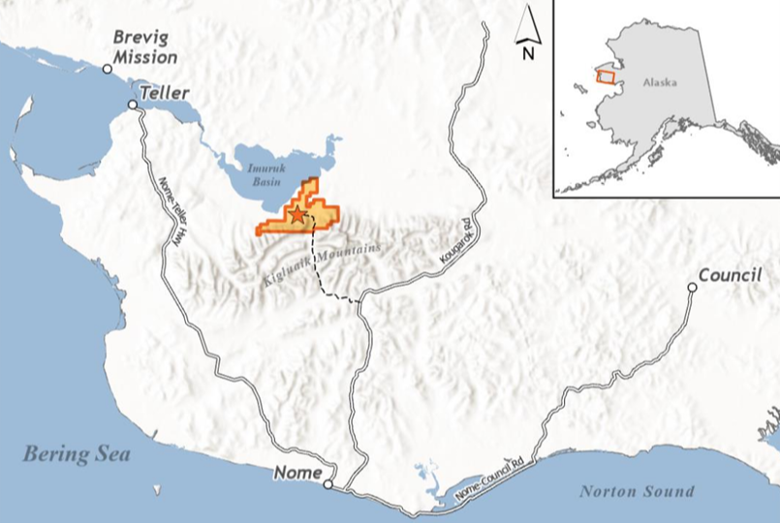
The proposed mine isn’t near a salmon fishery. It’s about 37 miles north of Nome, Alaska, which has a long history of resource extraction.
(In 1898, three prospectors discovered rich gold deposits on Anvil Creek, sparking a massive stampede that temporarily made Nome the largest city in Alaska. While early mining focused on easy-to-reach placer gold along the beaches, the region’s extraction history later evolved to include large-scale dredging, lode mining, and modern critical mineral development.)
The graphite mineral zone is exposed on the surface and strikes east/northeast along the north face of the Kigluaik Mountains.
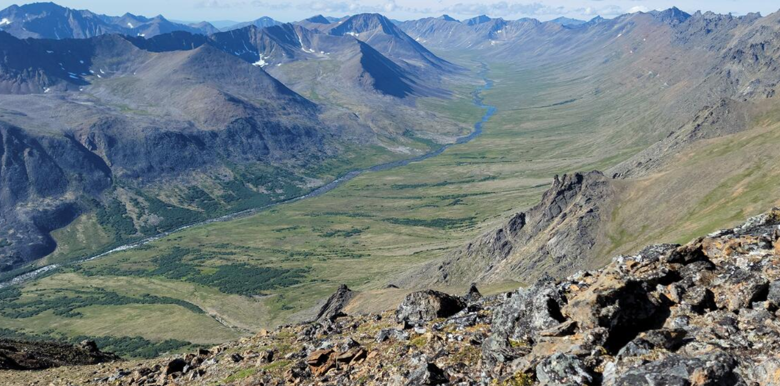
Source USGS, View of the Kigluaik Mountains gneiss dome which is the location of the Graphite Creek Deposit
The deposit would be mined with conventional open-pit mining methods including drilling, blasting, loading and hauling. The pit would be mined in five phases over two decades. Ore will be hauled to a process facility to be built adjacent to the pit.
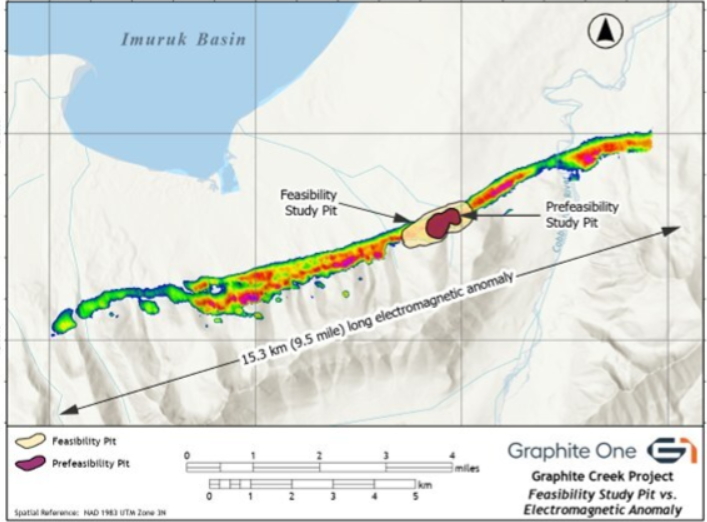
The graphite concentrate would be filtered and dried on site. The dried concentrate would be shipped by barge from Nome, Alaska to the STP in Ohio during the annual shipping season. The tails from the flotation circuit in the processing facility would be dewatered, comingled with the waste rock, and placed in a lined waste storage facility. Any drainage from the lined waste storage facility would be treated through a water treatment plant prior to discharge.
Graphite One will not be using sulfuric acid, cyanide or other harmful chemicals. There are no complex roasters, cyanide leaching or autoclaves.
During any milling, processing or truck transport severe dust control measures are necessary to protect nearby waterways, including the Imuruk Basin and Windy Bay streams, and other traditional subsistence areas of the local inhabitants.
Highway-legal semi-trailer trucks traveling on the 17-mile (27.3km) access road and dirt surfaces will be managed via a dust mitigation plan. This involves regularly applying water or non-toxic chemical dust suppressants to the access and haul roads.
Milling and concentrating will take place in enclosed facilities, and the resulting graphite concentrate will be packaged/sealed in 20 foot (6 meter) shipping containers for transport.
The transportation infrastructure for the mine is demanding but common practice in the north. The plan requires 12 double-trailer trucks making 24 round trips every day over a newly built 17-mile access road through Mosquito Pass and a re-engineered 30-mile (48.2 km) stretch of the state’s Kougarok Road.
Because the ground is laden with ice-rich permafrost, traditional road-building would cause catastrophic thawing. Driving heavy industrial trucks over it requires specific arctic engineering strategies.
The “Never Cut” Rule or aka Fill-Only Construction bars engineers from scraping or digging into the natural tundra surface. Removing the top layer of moss and organic soil destroys the natural insulation, causing the permafrost below to rapidly thaw into mud. Instead, the road must be entirely built on top of the existing landscape using successive layers of rock and gravel fill.
To protect the permafrost from the heat of the summer sun and the friction of heavy trucks, the road also requires thick gravel thermal embankments. These massive embankments—often 4 to 6 feet deep of crushed stone, acts as a structural thermal shield, keeping the freezing point locked safely below the original ground level.
Beneath the gravel, advanced synthetic fabric liners (geogrids) are rolled out directly over the tundra. This fabric distributes the weight of the double-trailer haul trucks evenly, preventing the heavy vehicles from rutting or sinking into sections of the road that experience minor “thaw settlement”.
And finally, and to also combat Arctic long-term warming, engineers use loose, large open-graded rocks on the road shoulders. In winter, dense cold air sinks into the gaps of these large rocks, pushing warmer air out and super-cooling the ground below. This extra winter freezing provides a thermal “buffer” that prevents the base from thawing during summer mining operations.
Which “never cut” foundation or insulation method is best suited for the area depends to a large part on the ice content of the soil. Some of the best known road uses of the “Never Cut” Rule or aka Fill-Only Construction are; Alaska Highway (Beaver Creek, Yukon), Nome & Utqiaġvik (Barrow) and the Alaska, Inuvik-Tuktoyaktuk Highway, NWT.
.
Community benefits
The proposed Graphite Creek Mine is projected to benefit local communities primarily through job creation, economic investment and regional infrastructure development.
The mine is expected to add roughly 250 skilled jobs to the local Alaskan workforce. In recent field and exploration programs, Graphite One hosted job fairs in nearby villages to fill seasonal roles with local residents. Field and environmental monitoring jobs are required to support site compliance and engineering. Roles, with skills training provided, include environmental technicians, geotechnicians/ geologic sample monitors, and logistics & expediter monitors.
Alaska Native regional and village corporations, including the Bering Straits Native Corporation, have made strategic investments in the project. These partnerships aim to foster regional development programs.
Developers maintain active community consultation and dialogue forums with the neighboring Iñupiaq communities of Teller, Mary’s Igloo, and Brevig Mission to address concerns and align mutual interests.
The mine is expected to have significant economic implications for Nome and its neighboring communities. The project will create a wide range of job opportunities in mining operations, administration, environmental monitoring, and other related fields. These jobs could help reduce local unemployment rates. In addition to direct employment, Graphite One has plans to offer local workforce training programs aimed at developing skills relevant to mining and processing activities. (Knom Radio Mission)
The Graphite Creek Mine would not only provide employment to local residents, but it could also substantially improve their quality of life and lower their cost of living.
Remote tribal villages near the proposed Graphite Creek mine—such as Teller and Brevig Mission—can struggle with profound infrastructure deficits.
Alongside the lack of piped water, these isolated communities can lack all-weather road access, reliable high-speed internet, modern medical/emergency facilities, and structural coastal erosion defenses.
The critical missing infrastructure elements for these communities include:
Due to their isolation, basic groceries, fuel and housing in Arctic communities are expensive. Living on the Seward Peninsula presents extreme logistical hurdles. With no road network connecting the peninsula to the rest of Alaska, nearly all goods, fuel, and building materials must be flown in or barged during the brief summer. This year-round reliance on remote supply chains drives costs to roughly 69% higher than the national average.
Building a home is particularly difficult. Every piece of lumber, drywall, and heavy machinery must be transported via Alaska Marine Lines or chartered air freight. Builders also have a short construction window and must navigate permafrost, which requires specialized foundation engineering.
(Many modern community housing and infrastructure projects in the Umiujaq, Nunavik region rely on “never dig” foam-raft foundations, placing rigid insulation and structural pads directly on top of the unexcavated Arctic ground to maintain stable thermal conditions.)
The Graphite Creek mine, along with it’s related infrastructure, presents a huge opportunity to make living standards better in all of these remote communities along the Seward Peninsula, and to drop the cost of living.
Graphite One will be sending ships full of graphite, in 20 foot containers, to a port on the north west coast of the US. No one likes the idea of sending empty boats back, so instead of coming back empty the ships could come back loaded with supplies during the summers graphite shipping season.
Graphite One could bring in materials and supplies including diesel fuel. The company already has plans to build new housing subdivisions.
Legally binding mitigations and socio-economic agreements
Major Arctic mines have successfully navigated rigorous Environmental Impact Statement (EIS) processes despite significant pushback from local and Indigenous communities. These EIS approvals were secured through strict legally binding mitigations and socio-economic agreements designed to minimize identified localized environmental and cultural risks while securing economic opportunities—such as jobs, preferential contracting, and revenue-sharing—for Indigenous groups in the Arctic.
Because the Arctic is highly sensitive to ecological changes, the Environmental Impact Statement (EIS) process establishes site-specific environmental monitoring committees, mandates spill response protocols, and protects subsistence hunting, fishing, trapping and gathering rights.
It can be used to set goals for Indigenous education, skills training, and preferential business contracting, helping communities develop lasting local workforces and independent enterprises.
For mining companies, an EIS demonstrates respect for Indigenous rights, principles of Free, Prior and Informed Consent (FPIC), and operationalizes the duty to consult (which Graphite One has been doing since 2014).
Conclusion
Nome, Alaska has a long history of resource extraction. Graphite Creek is about 37 miles north of Nome.
The open-pit mine’s beneficiation process — extracting the graphite from the host rocks — is done without harmful chemicals using a standard flotation circuit.
Milling and concentrating will take place in enclosed facilities, and the resulting graphite concentrate will be packaged/sealed in 20-foot shipping containers for transport.
An ambitious dust mitigation plan involves regularly applying water or non-toxic chemical dust suppressants to the arctic, and site, specific built access and haul roads.
Graphite One was always planning on doing an EIS level study, as evidence by work already directed towards mitigation and consultations.
The company is still targeting 2029 for delivering its domestic graphite supply chain project involving mining, manufacturing and recycling, all done in the United States.
At the start of this article I said, ‘Graphite Creek brings into focus different perspectives from all the interested parties in the Seward Peninsula project: the priorities of the native local villagers, investors priorities, Graphite One’s thoughts and can the complex engineering required to build an Arctic mine be successful in environmental risk mitigation.’
The EIS is a contract, an engineering-mitigated risk document signed by federal and state government’s and Graphite One versus the benefit/ reward promises of regional and local economic development projects in support of the mine. While making every effort possible to preserve the traditional fishing, hunting, trapping and gathering rights of the people.
Moving forward with an EIS is the sensible, comprehensive, transparent approach.
Only by having the fog of misinformation lifted, will the people be able to make the best decisions, for themselves and their families. Environmental protection and the continuance of traditional hunting, fishing, trapping and gathering is the top most priority of the EIS that Graphite One has agreed to.
From the completed EIS, with it’s strict guidelines of consultation, transparency and mitigation requirements comes enormous personal benefits to each of the people living in the area.
Graphite One Inc.
website
Legal Notice / Disclaimer
Ahead of the Herd newsletter, aheadoftheherd.com, hereafter known as AOTH.
Please read the entire Disclaimer carefully before you use this website or read the newsletter. If you do not agree to all the AOTH/Richard Mills Disclaimer, do not access/read this website/newsletter/article, or any of its pages. By reading/using this AOTH/Richard Mills website/newsletter/article, and whether you actually read this Disclaimer, you are deemed to have accepted it.
Any AOTH/Richard Mills document is not, and should not be, construed as an offer to sell or the solicitation of an offer to purchase or subscribe for any investment.
AOTH/Richard Mills has based this document on information obtained from sources he believes to be reliable, but which has not been independently verified.
AOTH/Richard Mills makes no guarantee, representation or warranty and accepts no responsibility or liability as to its accuracy or completeness.
Expressions of opinion are those of AOTH/Richard Mills only and are subject to change without notice.
AOTH/Richard Mills assumes no warranty, liability or guarantee for the current relevance, correctness or completeness of any information provided within this Report and will not be held liable for the consequence of reliance upon any opinion or statement contained herein or any omission.
Furthermore, AOTH/Richard Mills assumes no liability for any direct or indirect loss or damage for lost profit, which you may incur as a result of the use and existence of the information provided within this AOTH/Richard Mills Report.
Richard owns shares of Graphite One TSXV:GPH
Graphite One is a paid sponsor of his website aheadoftheherd.com
This article is issued on behalf of Graphite One
In this presentation, Jeffrey Christian of CPM Group discusses th... READ MORE
Semarule represents a large, at surface rare earth-bearing multi-... READ MORE
Blue Jay Gold Corp. (TSX-V: JAY) (OTCQB: JAYGF) (FSE: JAY) is ple... READ MORE
Expanded RapidSX™ program supports critical defense supply... READ MORE
Thunder Gold Corp. (TSX-V: TGOL) (FSE: Z25) (OTCQB: TGOLF) is ple... READ MORE