








Eastport Critical Metals Corp. (TSX-V: EVI) (OTCQB: EVIIF) is pleased to announce the very positive assay results from the first diamond drill hole reported at the Semarule Project prospective for rare-earth elements, in south-central Botswana. Semarule is located approximately 40km north-west of the capital city, Gaborone.
Drill Hole SEM005:
– 330m at 0.21% TREO from 20.0m downhole, including:
Daniel Major, Chief Executive Officer, commented;
“These first drill hole assay results for Semarule show the strong grade continuity potential reveal; structure, continuity, grade and critically the opportunity for material scale over a target area of ~15km2. This is a highly encouraging start to our Phase 1 Drill Campaign results. SEM005 highlights broad intersections of rare earth elements exceeding 320m, including a higher-grade 48m interval at 0.64% TREO from 20m depth and comprising 28% MREOs.
We look forward to receiving the results from the remaining diamond drill holes, which target various aspects of the gravity anomalies. I refer shareholders to review Figure 1, where appears that SEM005 has cut through the edge of the gravity feature to test structure.”
Background
The eight hole Semarule diamond drilling program was designed to target both the syenite geology and the gravity anomaly cross section (see Figure 1), with hole SEM005 drilled to the western extent and away from the gravity high. SEM005 was drilled at a -50o dip to a downhole depth of 349.9m.
The Semarule rare earths project hosts several sizeable mineralised syenite intrusions, including the Semarule Syenite Hill, exposed over a 5 x 3 km area and consisting of syenite with carbonatite dykes.
Archaean Gaborone granite underlies the Semarule area and is host to the syenite intrusions, suggesting that the Semarule syenite resulted from in situ metasomatism of the host granite, followed by intrusions of syenite. The syenites host the REE mineralisation, and the results to date confirm that the more mafic syenite intrusions report elevated REE concentrations.
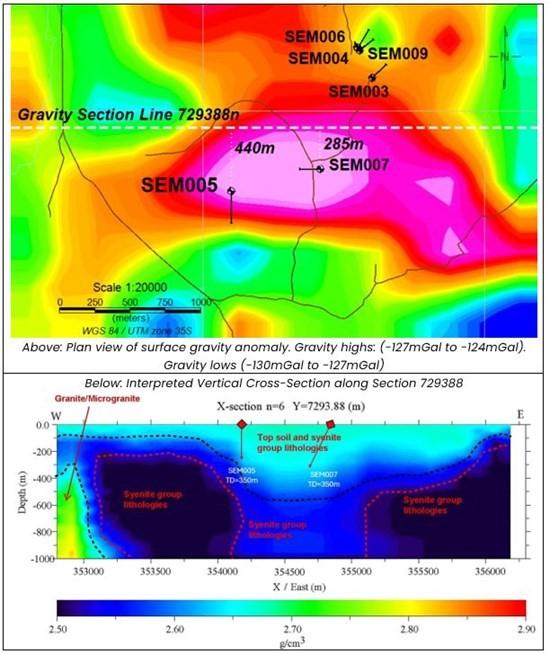
Figure 1: Ground Gravity Geophysics Survey and Cross-Section
SEM005 and SEM007 are projected onto the section and refer to plan view.
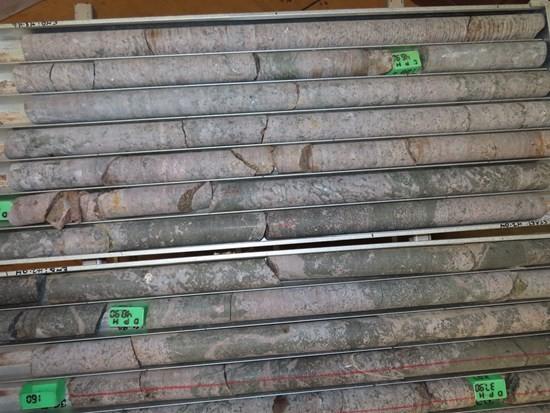
Figure 2: Photograph of drill hole SEM005 core, including a 10m wide interval averaging 0.46% TREO from 37.50m downhole depth
The significant calculated rare earth oxide downhole depth intersections for drill hole SEM005 are provided in Table 1.
Assay results provided by certified laboratory SGS South Africa Pty Ltd (“SGS”) using the ICP/IMS Combination Package (method codes ICP90A/IMS90A), for standard 2.5m length quartered NQ diameter (47.6mm) core samples, taken over the full length of the hole.
Table 1: Drill hole SEM005 significant calculated rare earth oxide downhole depth intersections
|
Table notes: Rare earth oxides calculated using element-to-stoichiometric oxide conversion factors provided by James Cook University (https://www.jcu.edu.au/advanced-analytical-centre/resources/element-to-stoichiometric-oxide-conversion-factors ).
LREO = Light Rare Earth Oxides ( La₂O₃ , CeO₂ , Pr₆O₁₁ , Nd₂O₃ , Sm₂O₃ , Eu₂O₃ )
HREO = Heavy Rare Earth Oxides ( Gd₂O₃ , Tb₄O₇ , Dy₂O₃, Ho₂O₃, Er₂O₃ , Tm₂O₃ , Yb₂O₃ , Lu₂O₃ , Y₂O₃ )
MREO = Magnetic Rare Earth Oxides ( Pr₆O₁₁ , Nd₂O₃ , Tb₄O₇ , Dy₂O₃ )
SEM005 collar location: UTM35S (WGS84) 0354198E, 72934326N. Collar elevation: 350m. Azimuth/dip: 180/ 50
QA/QC
Eastport’s Semarule diamond core drill program utilised a NQ size drill bit (47.6 mm core diameter). Collars are located using a hand-held GPS (projection: UTM zone 35 south, WGS84 datum). Core was captured and placed in aluminium core trays and then transported from site to Lobatse, Botswana by Eastport personnel. In Lobatse, the core was XRF scanned using a Vanta Evident hand-held XRF (serial number 994113), measured, logged, ¼ cut and sampled. All cutting used a diamond bladed rock saw.
Each ¼ core 2.5m sample was collected in unmarked clear plastic bags. Sample tags were stapled inside the plastic bag. Five samples were then placed inside a poly-weave bag, sealed and transported by Eastport personnel to Aramax Couriers in Gaborone, Botswana. The batches were then delivered overnight to the laboratory of SGS South Africa in Randfontein, RSA. All samples are export controlled by the Botswana Government using export permits.
Sample rejects are discarded but sample pulps will be returned to Eastport Ventures Botswana within sixty days of reporting the analytical results. These pulps will be used for quality control procedures.
At SGS South Africa, samples are checked against the submittal form and sample list. The company receives verification of the number and correct sequencing of the samples.
Each entire sample is crushed using a Boyd crusher. The crusher is cleaned using barren material and air after each sample. The crushed sample is then split using an RSD splitter and 250g is subsequently milled down to -75 micron passing 85%.
Five grams of the milled sample is used for ICP analysis using SGS procedure ICP90A/IMS90A. SGS South Africa is accredited to international quality standards of ISO17025.
Qualified Person
The technical information in this news release has been reviewed and approved by Nicholas O’Reilly MIMMM (QMR) MAusIMM MSc DIC, an independent consultant and Qualified Person under National Instrument 43-101 – Standards of Disclosure for Mineral Projects.
Board Update
Eastport Critical Metals Corp. announces that Herrick Lau has resigned as a director of the Company, effective September 9, 2026. The Company thanks Mr. Lau for his contribution and service and wishes him well in his future endeavours.
About Eastport Critical Metals Corp
Eastport is a critical minerals development company advancing five projects in Botswana, with cumulative historical and current expenditures approaching CAD$20 million. The Company’s most advanced asset is the Matsitama Copper Project, which hosts multiple sizeable targets across the Matsitama copper district.
The Company’s additional projects include Selebi East, a nickel-copper-cobalt project located seven kilometres east of the historic Selebi Mines; the Semarule Rare Earth Elements Project, positioned within the Gaborone-Molepolole corridor; the Foley Uranium Project, adjoining the Letlhakane uranium deposit; and the Keng Project, which targets nickel, copper and PGEs on the northern margin of the Molopo Farms Complex.
Botswana is widely regarded as one of Africa’s strongest mining jurisdictions, combining the continent’s highest GDP per capita with a 50-year track record of large-scale mineral development since the Orapa diamond discovery in 1967. The country ranks among the top performers globally on the Fraser Institute’s Investment Attractiveness Index and is the highest-rated jurisdiction in Africa on the Policy Perception Index. These rankings reflect Botswana’s stable regulatory environment, consistent rule of law, and long-standing support for responsible mineral development – factors that have underpinned significant investment and major M&A activity in the natural resources sector in recent years.
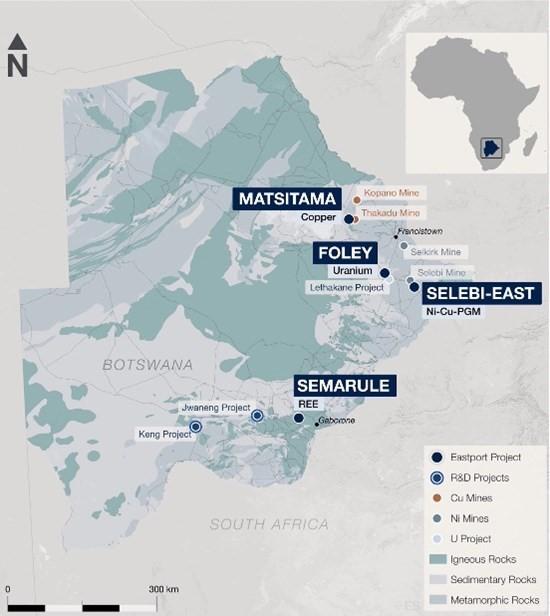
Figure 3
Brutus Mining Inc. (CSE: BRU) (FSE: ZI3) is pleased to announce that it has closed its non-brokered ... READ MORE
Jaguar Uranium Corp. (NYSE American: JAGU) is pleased to announce an independent Mineral Resource E... READ MORE
Auro Metals Inc. (TSX-V: AURO) (OTCQB: AURFF), is pleased to announce the assay results of the fina... READ MORE
Endeavour Silver Corp. (NYSE: EXK) (TSX: EDR) is pleased to announce that repairs to the primary bal... READ MORE
Scorpio Gold Corp. (NASDAQ: SGLD) (TSX-V: SGLD) (OTCQB: SRCRF) (FSE: RY9) is pleased to announce re... READ MORE