








Carolina Rush Corporation (TSX-V: RUSH) (OTCQB: PUCCF) reports results from Hole B26C-039 (“Hole 39”), the third and final hole of the initial deep drill program at the Brewer Gold-Copper Project in South Carolina, USA, funded under the Company’s earn-in agreement with OceanaGold Corporation (TSX: OGC) (NYSE: OGC). Hole 39 was drilled approximately 400 meters southeast of Hole 37 and collared just west of the former Brewer mine, intersecting significant gold-copper mineralization and demonstrating lateral continuity of the Brewer epithermal system in a previously untested area.
Hole 39 completes the initial three-hole deep porphyry exploration drilling campaign at Brewer. In conjunction with Holes 37 and 38, results from Hole 39 support the geologic model of a shallow northwest dipping alteration system and strengthens the Company’s interpretation that the core of the copper-gold porphyry system is located further west-northwest and remains untested by drilling.
Highlights
Carolina Rush CEO, Layton Croft, stated: “Hole 39 demonstrates that Brewer continues to offer opportunities for value creation. While recent drilling has advanced our understanding of the deeper hydrothermal system and potential porphyry targets, Hole 39 has intersected a significant gold-copper interval outside the current resource footprint, highlighting an additional opportunity to grow the existing resource. The completion of this initial drill campaign has substantially improved our understanding of Brewer’s geological architecture and provides a stronger foundation for evaluating both resource expansion opportunities and deeper exploration targets as the Company advances planning for the next phase of exploration.”
Hole 39 Result
Hole 39 was designed to test the southern margin of a large low-resistivity anomaly that was initially targeted in Hole 37 (see May 4, 2026 news release). The hole was collared just west of the former Brewer mine, which enabled it to also test the near surface breccia-hosted mineralization west of Brewer’s current mineral resource.
The hole intersected:
| Hole | From (m) | To (m) | Interval (m) | Au (g/t) | Cu (%) |
| B26C-039 | 214.0 | 265.15 | 51.15 | 0.62 | 0.22 |
| Including | 217.5 | 229.62 | 12.12 | 1.04 | 0.60 |
| Reported intervals are downhole lengths. True widths have not yet been determined. | |||||
Mineralization is hosted within a diatreme breccia and consists of gold and copper associated with sulfide-bearing hydrothermal alteration characteristic of the Brewer epithermal system. The primary copper bearing mineral identified in hole 39 is chalcocite (Figure 4). The intersection extended mineralization approximately 50 meters from the nearest drillhole (B23C-018) and demonstrates the potential for significant mineralization to extend beyond the limits of the existing Mineral Resource Estimate. Hole 39 was drilled to a total depth of 917m and confirmed that the low-resistivity anomaly below the former Brewer mine is not associated with an underlying intrusion.
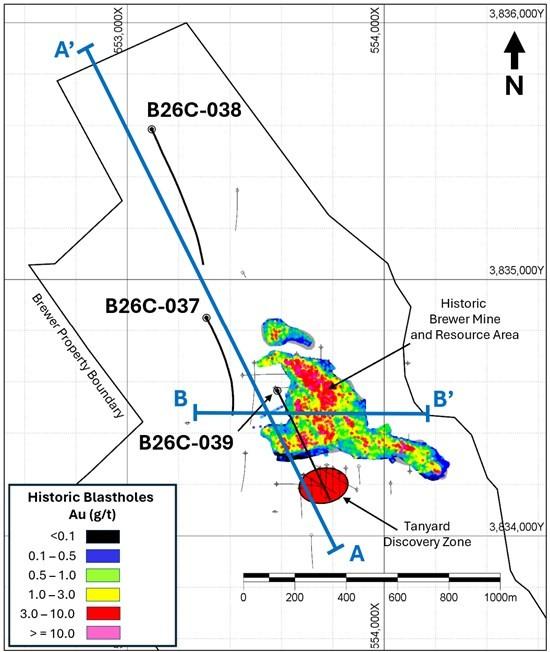
Figure 1. Location of Phase 1 Deep Drill Program Holes
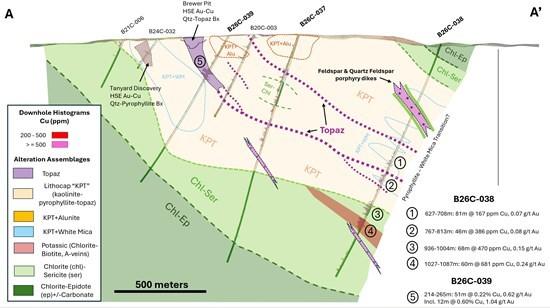
Figure 2. Cross Section A-A’ with Geologic Interpretation of Recently Completed Deep Drillholes (view to the west-southwest)
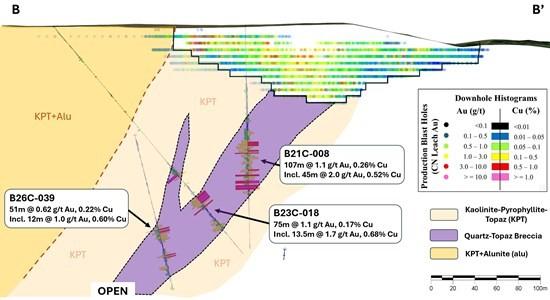
Figure 3. Cross Section B-B’ with Results from Hole 39 (view to the north)
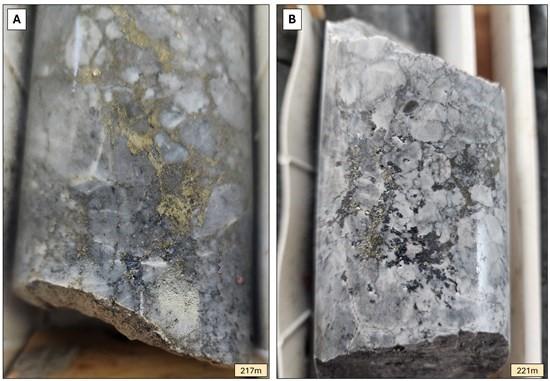
Figure 4. Examples of breccia hosted Au-Cu mineralization encountered in Hole 39.
Figure 4 description. A) Au-Cu mineralized breccia (1.5m @ 2.0 g/t Au, 0.8% Cu). B) Chalcocite mineralization (1.0m @ 1.7 g/t Au, 2.5% Cu)
Significance of the Results
The Brewer Project currently hosts a NI 43-101 Mineral Resource Estimate comprising:
The Mineral Resource Estimate is supported by a technical report entitled “NI 43-101 Technical Report and Mineral Resource Estimate – Brewer Project”, with an effective date of March 20, 2025. The report is filed on SEDAR+ (www.sedarplus.ca) and available on the Company’s website.
Hole 39 intersected gold-copper mineralization 50 meters beyond the nearest drill hole that was used in the 2025 resource estimate and confirms that mineralization remains open for expansion.
While Hole 39 was not designed as a resource delineation hole, the intersection confirms that significant gold-copper mineralization occurs beyond the boundaries of the current Mineral Resource Estimate and identifies areas for future follow-up drilling.
Completion of Initial Deep Drill Program
Hole 39 marks the completion of the initial three-hole deep drilling campaign conducted under the OceanaGold earn-in agreement.
Collectively, several important conclusions can be made from the recently completed program:
The Company will now integrate all geological, structural, geochemical, and alteration data from the recent program, which will inform prioritization of drill targets for a potential follow-up program. Any follow-up exploration will be conducted subject to OceanaGold’s earn-in funding commitment and the Company’s ongoing evaluation of Brewer’s broader exploration model.
The Company emphasizes that references to porphyry-style mineralization are conceptual and exploratory in nature, and there is no certainty that further drilling will define economic mineralization.
Quality Assurance and Quality Control Statement
The Company’s 2026 exploration diamond core drilling was HQ and/or NQ size. The core was logged and marked for sampling and assaying by geologists contracted by Rush. Samples, typically 2 meters in length, were sawn in half using a diamond core saw and one-half of the core was placed in sample bags and tagged with unique sample numbers, while the remaining half was kept in the core box for reference. Each bagged core sample was shipped to ALS Laboratory in Reno, NV where it was dried, crushed and pulverized to >80% passing -200 mesh. Gold was analyzed by fire assay (30 g) with an AA (atomic absorption) finish (method Au-AA23) with detection limits of 0.005 g/t gold. Samples containing greater than 10.0 g/t gold are analyzed by fire assay with a gravimetric finish (method Au-GRA21). Multielement analyses were analyzed with ICP-MS following a four-acid digestion (method ME-MS61) and samples containing >1.0% copper are reanalyzed using method Cu-OG62. ALS Minerals is accredited in accordance with International Standard ISO/IEC 17025:2017 and also inserts its own certified reference materials plus blanks and duplicates. Strict sampling and QA/QC protocols are followed, and assay integrity is monitored internally with a quality control program including the insertion of standards and blanks every 10th sample within the sample stream. Assay results are reviewed, and discrepancies are investigated prior to incorporation into the Company’s database.
Qualified Person Statement
The technical information in this news release has been prepared in accordance with Canadian regulatory requirements as set out in NI 43-101 and reviewed and approved by Patrick Quigley, MSc, CPG-12116, the Company’s Senior Geologist and Exploration Manager and a Qualified Person as defined by NI 43-101.
OceanaGold Partnership
The Brewer Gold-Copper Project is currently being explored in partnership with OceanaGold under an earn-in agreement whereby OceanaGold may earn up to an 80% interest in Brewer by funding US$20 million in exploration expenditures and exercising Carolina Rush’s underlying Brewer Option before the end of 2030. The Company confirms OceanaGold has satisfied its minimum US$1.5 million exploration expenditure commitment for Q2 2026 under the earn-in agreement. To earn a 50% interest in Brewer, OceanaGold must incur a total of US$8 million by December 31, 2027.
About Carolina Rush
Carolina Rush Corporation is a mineral exploration company focused on the discovery of gold and copper deposits in the southeastern United States. The Company is advancing the Brewer Gold-Copper Project in Chesterfield County, South Carolina – a large, underexplored hydrothermal system with a near-surface epithermal gold NI 43-101 mineral resource and compelling exploration potential for deeper porphyry copper-gold mineralization. Brewer is currently being explored in partnership with OceanaGold Corporation (TSX: OGC) (NYSE: OGC) under a US$20 million earn-in agreement. Brewer is located 13 km from OceanaGold’s producing Haile Gold Mine. Information from nearby properties is not necessarily indicative of the mineralization at Brewer.
Blue Jay Gold Corp. (TSX-V: JAY) (OTCQB: JAYGF) (FSE: JAY), today reported results from the metallur... READ MORE
Canagold Resources Ltd. (TSX: CCM) (OTCQB: CRCUF) (FSE: CANA) is pleased to announce it has arranged... READ MORE
DPM Metals Inc. (TSX: DPM) (ASX: DPM) is pleased to report results from delineation drilling at the ... READ MORE
Alpha Exploration Ltd. (TSX-V: ALEX) is pleased to announce a first batch of results from its ongo... READ MORE
Kingfisher Metals Corp. (TSX-V: KFR) (FSE: 9700) (OTCQX: KGFMF) reports that HW-26-015 contai... READ MORE