






Fathom Nickel Inc. (CSE: FNI) (FSE: 6Q5) (OTCQB: FNICF) is pleased to announce that nickel-copper-cobalt assays from metasedimentary-hosted mineralization suggest a new geologic model for the historic Gochager Lake deposit and a greatly expanded geological footprint. Phase-2 drilling currently underway is further testing this new discovery and new geologic model.
Ian Fraser, Fathom CEO and VP Exploration, stated, “Intersecting nickel-copper-cobalt in metasediments in drillhole GL26025 was a complete surprise. We have spent the last couple of weeks digesting this new information and have come to the realization that the metasedimentary rocks engulfing the “Gochager” intrusive rocks are now very prospective for nickel-copper-cobalt mineralization. The metasediment-hosted mineralization is the result of nickel-copper-cobalt being transposed from the original mafic intrusive rocks into the adjacent metasedimentary rocks. This makes the contact of mineralized metasediments with Gochager Lake intrusive rocks a new, very prospective exploration target. This development has introduced a new geological model for the historic Gochager Lake deposit and has expanded the project footprint tremendously. Specifically, this recent development is akin to a Thompson Nickel Belt geological model, where nickel-copper-cobalt mineralization occurs in both intrusive rocks and, in some instances, predominantly in metasedimentary rocks. We look forward to testing this new hypothesis during the current drill program.”
Table-1 GL26025 Metasedimentary-hosted Mineralization
| Drillhole | From (m) | To (m) | Interval (m)* | Ni wt%** | Cu wt% | Co wt% |
| GL26025 | 132.04 | 132.45 | 0.41 | 1.10 | 0.23 | 0.12 |
| within | 132.04 | 133.81 | 1.77 | 0.49 | 0.20 | 0.05 |
| within | 126.59 | 133.81 | 7.22 | 0.34 | 0.15 | 0.04 |
| GL26025 | 160.10 | 168.30 | 8.20 | 0.24 | 0.12 | 0.03 |
*Interval (m) are downhole intervals and not true thickness. Insufficient data currently to determine true thickness.
**A ≥ 2000 ppm Ni cut off was used to calculate mineralized interval.
The mineralized metasediments in GL26025 are in sharp contact with barren (<1000 ppm Ni) intrusive rock (gabbro) and form a metasedimentary package within gabbro measuring 79.10 meters (drillhole thickness). A strong borehole electromagnetic (BHEM) anomaly occurring at ~ 180 meters down the drillhole and positioned below and northeast of the drillhole is a high-priority Phase-2 drill target. The metasediments in the drillhole contain more nickel-copper-cobalt mineralization than the gabbroic rocks. This suggests the gabbro intrusive has been stripped of nickel-copper-cobalt and this mineralization now resides in the metasediments.
Refer to Table-2 and Figure 1 for Phase-1 drillhole locations. Table-3 summarizes Phase-1 drillholes GL26019 – GL26024.
Table-2 Drillhole Locations (NAD83 Zone 13)
| Drillhole | Easting | Northing | Elevation ASL (m) | Azimuth (°) | Dip (°) | Total Depth (m) |
| GL26019 | 504194 | 6181373 | 401 | 135 | -48 | 314 |
| GL26020 | 503967 | 6180843 | 405 | 312 | -48 | 347 |
| GL26021 | 503418 | 6180964 | 405 | 120 | -50 | 209 |
| GL26022 | 502753 | 6180473 | 404 | 135 | -48 | 302 |
| GL26023 | 502566 | 6180460 | 405 | 135 | -50 | 320 |
| GL26024 | 502462 | 6180436 | 417 | 135 | -50 | 400 |
| GL26025 | 502739 | 6180613 | 409 | 135 | -60 | 251 |
| Total | 2,143 meters |
Table-3 Drillholes GL26019 – GL26024 Summary
| Drillhole | Comments |
| GL26019 | Metasediments, no significant results, multiple strong off-hole conductors |
| GL26020 | Metasediments, no significant results, >80,000 Siemen off-hole conductor @ 160m to right of drillhole |
| GL26021 | Metasediments, no significant results, (up to 547 ppm Ni / 0.6m within mafic dyke @ 51.46-55.93m), weak off-hole conductor below hole @ 105m |
| GL26022 | Gabbro, no significant results, weakly mineralized zones (up to 3380 ppm Ni / 0.42m @ 75.37-75.79m), strong conductivity builds up to and beyond end of hole |
| GL26023 | Ultramafic intrusion and gabbro, no significant results, weakly mineralized zones (up to 5790 ppm Ni / 0.42m @ 178.28-178.7m), strong off-hole conductor located below hole @ 270m |
| GL26024 | Gabbro-metasediments, no significant results, weakly mineralized zones in gabbro (up to 2260 ppm Ni / 0.67m @36.27-36.94m) and in metasediments (1730 ppm Ni / 0.73m @132.8-133.53m and 1480 ppm Ni / 1.08m @ 355.13-356.21m), strong off-hole conductor below hole at 255m |
Drillholes GL26019 and GL26020 were designed to test the source of the high nickel-in-soil anomaly at Target A (see Fathom press release dated February 24, 2026). Current interpretation indicates that the nickel-copper-cobalt mineralization, along with elevated magnesium and chrome in these mafic metasediments-the likely source of Anomaly A, is more extensive across the property than previously recognized. Their spatial association with nearby mineralized ultramafic and gabbroic intrusions is significant, and their geochemistry is comparable to the Ospwagan host rocks of the Thompson Nickel Belt deposits.
Phase-1 drilling has expanded the Gochager mafic (gabbro)-ultramafic intrusive system to at least 1,500 metres of strike and further highlights its geological complexity. It also provided the first evidence that parts of the system were locally sulphur-saturated, and that post-saturation processes the nickel-copper-cobalt mineralization was stripped from the mafic-ultramafic intrusions and remobilized into the surrounding metasedimentary host rocks. This significantly increases the potential to discover mineralization along strike from the Gochager Lake deposit, with strong upside remaining at both the southwest and northeast ends of the intrusion. These results also improve our understanding of the mineralizing process and will help guide the search for major nickel-copper-cobalt concentrations within this expanding magmatic nickel sulphide system.
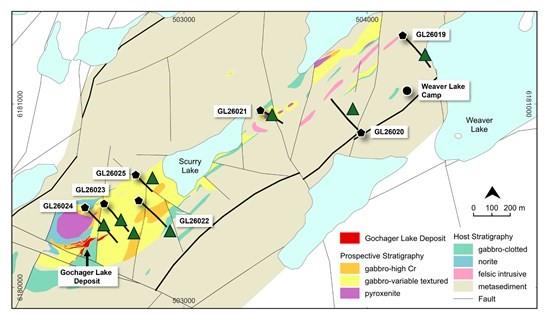
Figure-1: Phase-1 Drillhole Location Map illustrating areas of significant off-hole BHEM conductivity (green triangles)
Quality Assurance / Quality Control (QA/QC) Disclosure Statement
Fathom implements an industry-standard QA/QC protocol for all field and diamond drill programs. Fathom, through the services of TerraLogic Exploration Inc., inserts QA/QC samples in its diamond drill programs alternating standards and lab duplicates every 25 samples, and a blank approximately every 50 samples. Blanks were also inserted at the start of every sample batch and additionally after samples of anticipated high-grade or high sulphide content. Lab duplicates consist of coarse reject material. The standards are sourced from OREAS (OREAS-74B, OREAS-75A). The typical sample sequence consists of a QA/QC sample (OREAS sample, lab duplicate, or blank) at an insertion rate of no less than 1 in 15 samples.
Assaying is performed at ALS Canada Ltd. ALS is an accredited laboratory (SCC – CAN-P-1579 and CAN-P-4E ISO/IEC 17025) and is independent of Fathom. All drill core samples are analyzed using a 4-Acid digestion followed by 33 element ICP-AES analyses (Code ME-ICP61). Over limit Ni, Cu results are further analyzed by 4-Acid ore grade elements ICP-AES process (Code ME-OG62 and Ni-OG62). Analyses for Au, Pd and Pt utilized the ore grade Pt, Pd and Au by ICP-AES (Code PGM-ICP27). Total sulphur by (S-IR08) is used to determine overlimit S (>10%) as determined by the ICP analysis.
Qualified Person and Data Verification
Ian Fraser, P.Geo., CEO, VP Exploration and a Director of the Company and the “qualified person” as such term is defined by National Instrument 43-101, has verified the data disclosed in this news release, and has otherwise reviewed and approved the technical information in this news release on behalf of the Company.
About Fathom Nickel Inc.
Fathom is an exploration company that is targeting magmatic nickel sulphide discoveries to secure the supply of North American Critical Minerals and to support the global green energy transition. The Company now has a portfolio of three high-quality exploration projects located in the prolific Trans Hudson Corridor in Saskatchewan, Canada: 1) The Albert Lake Project, a 90,000+ hectare project that hosts the historic Rottenstone Mine; 2) The 33,000+ hectare Gochager Lake Project that hosts the historic Gochager Lake deposit, and 3) The 10,000+ hectare Friesen Lake Project located 40km southwest of the historic Rottenstone Mine and 30km northwest of the historic Gochager Lake deposit.
SAGA Metals Corp. (TSX-V: SAGA) (OTCQX: SAGMF) (FSE: 20H), a North American exploration company foc... READ MORE
Fredonia Mining Inc. (TSX-V: FRED) is pleased to announce that it has closed its previously announce... READ MORE
Legacy Gold Mines Ltd. (TSX-V: LEGY) is pleased to report assay results from core holes LG26-017 an... READ MORE
Inventus Mining Corp. (TSX-V: IVS) is pleased to report results from 100 drill holes from its now-... READ MORE
Abcourt Mines Inc. (TSX-V: ABI) (OTCQB: ABMBF) is pleased to present its operational report for the ... READ MORE