








Richard Mills, Editor/ Publisher, Ahead of the Herd:
Keith, what makes a good uranium exploration company?
Keith Bodnarchuk, President and CEO, Cosa Resources (TSX-V:COSA, OTCQB:COSAF):
That’s a great question, I think uranium exploration, especially in the Athabasca Basin and Saskatchewan can be tricky.
These are low-tonnage but super-high-grade deposits you’re going after, so they are somewhat difficult to find, but when you do find one, it’s really the world’s best treasure hunt. Companies like Fission and NexGen all started off as being small junior companies and turning into billion-dollar companies, even pre-resource, based on the results they got in the Athabasca Basin.
The things that I look for when I’m investing would first be the team — a team that’s done it before, a team that knows how to navigate in that specific area with experience as far as dealing with communities, logistics, obviously technical success, a team is a huge one for me.
Another thing is access to capital. It’s really important for exploration companies to continue to be able to access capital. Great teams may have great technical ideas, but if they can’t access the capital to execute them, they won’t have success. Those ideas will just remain good ideas. So that’s a big thing, especially for exploration companies.
Obviously, what are the drill targets they have? What are the projects they have? Does it seem like these are projects with a lot of blue-sky potential? Are they located in an area that a company that size can afford to be exploring, not in a super-remote area?
And then another thing I always look for is skin in the game. How are people incentivized? Do they continue to participate, put their own money into the company? I think that creates a different environment where people are hungrier to have success if they’re putting their own money into it.
Those are the main things that I look for, especially in a uranium exploration company.
RM: Let’s talk about your team’s experience. You’re ex-Denison, a lot of the team is, Gryphon deposit discovered, the core of the team was with IsoEnergy, the Hurricane deposit discovered. And now you’ve got two potential discoveries.
News yesterday from the Darby, and previously Murphy Lake North, looks amazing. The results so far show good potential. Why don’t you tell us about Cosa’s management team.
Let’s start with management, because I honestly believe that in real estate it’s location, location, location. Juniors, it doesn’t matter what they’re exploring for. Juniors, it’s management, management, management.
KB: I tend to agree with that, because I do believe the management will work to find the right assets, even if it’s not the first one that they have. They’ll continue, we’ve always taken that approach.
Our team really starts at the top with our chairman, Steve Blower. He was the VP of Exploration of Denison. After finding Gryphon and expanding Phoenix, he moved on and became the VP of Exploration of IsoEnergy and discovered the Hurricane deposit. So, he really has a top-tier track record of making these discoveries.
Another one would be Craig Parry, our strategic advisor. He was a founding director of NexGen. He moved on and became founding CEO and director of IsoEnergy.
He’s also had a lot of success at Skeena Resources and Viszla Silver and all these other different companies he’s been a part of. So, he’s a serially successful mining entrepreneur. And then coming down to the management team, we have Andy Carmichael, our VP of Exploration.
He’s part of the Hurricane discovery and has experience at Denison. He’s been in the Athabasca Basin a long time. Justin Rodko, our VP of Corporate Development, is also part of the Hurricane discovery.
So, the list goes on and on, and we’re a group that really enjoys working together. We’ve managed to have great success over the past 15 plus years. We have a recipe that’s been working for us.
I think this is the best version of the team that I’ve ever been a part of. When you factor in our strategic collaboration with Denison Mines, that opens up even more technical success, corporate success, and having access to David Cates, obviously the CEO of Denison who’s a strategic advisor for Cosa Resources.
Chad Sorba, technical advisor, was part of multiple discoveries at Denison. So, like I said, it is an exhaustive list, but it’s a group that really enjoys working together. We have our skill sets that we’re really good at, and we apply those to making a discovery.
We have a team that obsesses over the next discovery. Each step along the way we’ve obsessed over making discoveries, and we’d do anything to do it again. That’s why I think you’ve seen the success that we’re having right now, and it does seem like we’re on to some pretty good targets here.
And we have a good chance of hopefully expanding on that success, especially at Murphy Lake North and building that into something special.
RM: Give us a broad overview of where you are, your neighbors, the projects you have in that area and why that area.
KB: We started to piece together this company in a very competitive uranium market. But a good way to think about this is — this is what our chairman, Steve Blower says — is that locally these uranium deposits are very hard to find. But regionally, they have a pattern to them.
You have a string of pearls we can map down from McArthur River mine, down past Denison’s Griffin-Phoenix, down to the Key Lake mill. We like to call these big northeastern trends uranium corridors. When we started to acquire projects and stake projects, we got as much ground as we could within these uranium corridors to hopefully set ourselves up to make a discovery quicker with that approach.
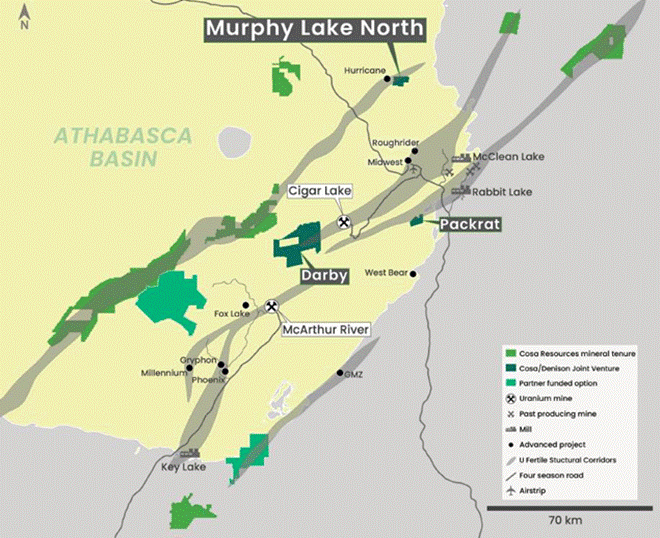
There are certain parts of the Athabasca Basin that are hard to access. The eastern area, from an acquisition standpoint, is almost impossible to get land in. And the eastern Athabasca Basin is where all the current mines and mills are.
It’s where the two largest highest grade uranium mines in the world are, McArthur River, Cigar Lake. And in and around those projects, it’s really controlled by Cameco, Orano, which is the French government, Denison Mines, and a little bit by IsoEnergy. And so, if you’re going to get a deal done and gain access to this really strategic area, you’ve got to deal with one of those large companies.
We were able to do that with Denison and we closed that transaction in January of last year. By doing that deal we gained access to this highly coveted area of the Athabasca Basin. The two main projects in the deal are Darby, which is right beside Cigar Lake, obviously one of the world’s largest uranium mines.
And Murphy Lake North, which is right beside the Hurricane deposit, which our team found in 2018 during our time at IsoEnergy. The Hurricane is the highest-grade indicated uranium resource in the world. And so, as simple as it sounds, the best place to be looking for uranium is by uranium.
And we’ve achieved that, especially with these transactions we did with Denison Mines. Acquiring projects that weren’t pin cushioned. These projects had lots of runway, lots of underexplored areas.
That’s how we set it up. I think you hit the nail on the head when you say management is a big thing for these exploration companies because we’ve always taken the approach of acquiring a pipeline of projects and then flipping through them as quick as we can until we ultimately make a discovery. Kind of that “drill it to kill it” mentality.
You know, at IsoEnergy, I think it was the seventh project before the team ultimately made a discovery. And so, you have to take that approach. You can’t get married to the one project, and you move through it as fast as you can.
RM: Tell us about your strategic partnership with Denison.
KB: As you mentioned at the start of the interview, a lot of us did have experience with Denison. We were sitting there as a small company with a team that had a track record of making several discoveries, that gave us the opportunities to pair up with great companies.
But the biggest thing with Denison was familiarity. We obviously knew that group and they had terrific projects that they weren’t going to get to during this uranium cycle.
In January of 2025 we acquired 70% interest in three projects and Denison became our largest shareholder at just under 20%. They than appointed two members to the board.
They’ve continued to maintain their interest in us through multiple financings. So it’s been a huge transaction for us and a huge milestone as well.
Those acquired projects are the ones where we’re having drilling success on over the past three months. And having Denison as our strategic is huge, because it also validates what we’re doing.
It helps de-risk financings and helps us with corporate strategy and even technical strategy. Having David Cates, the CEO, offering advice. It’s been absolutely a tremendous transaction for us.
RM: Yes, instant validation, and proved justified validation by drill results.
KB: From Denison’s perspective, they saw a team solely focused on making a discovery. And Denison wants that discovery pipeline because they’re busy putting Phoenix into production. Why not be a part of it with them? It was really a win-win.
RM: You mentioned skin in the game. Could you touch on ownership?
KB: Our management group controls close to 20% of Cosa stock. We obviously did well at IsoEnergy when it went from $0.30 to $6 in 18 months. We’ve deployed a lot of capital into Cosa. And we continue to support it.
You’ll see us participate in every financing and continue to buy on market because we really believe that this is still early days for what we’re building here. It’s important to us to continue to support the story, and we want to. We really believe that this is an undervalued company, and we’re just getting started on what we can build this into and so we’ll continue to participate.
RM: Cosa hasn’t made a bona fide discovery, but you’ve had some extremely interesting results from both of those projects you talked about earlier, both Darby, which you released yesterday, and we’re looking forward to Murphy Lake North drilling results soon. Can you go over each of the projects a little deeper, starting with Darby?
KB: Certainly. Darby is located 10 kilometers from Cigar Lake and it has multiple trends that haven’t seen enough drilling.
It’s a project that Denison has had for a long time but just never got around to drilling but they did do some geophysics. They had some great targets, some great ideas and you mix that in with what Andy Carmichael and the team wanted to do.
Well, that led to us coming up with some great ideas on how to properly test those trends. We completed our maiden drill program there in January, February of 2026 and had some significant results.
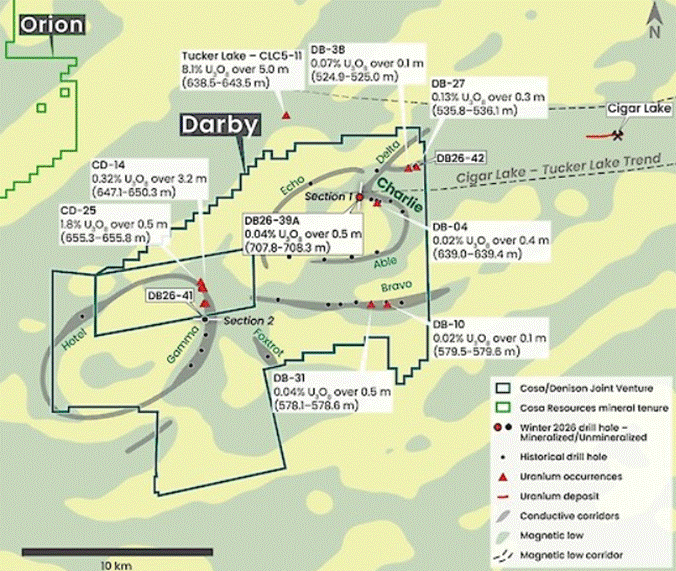
We upgraded the trends that we drilled by hitting anomalous uranium in the sandstone and a sniff of uranium just below the unconformity. It’s showing a lot of smoke and a lot of evidence that there could be something much larger nearby, especially the Charlie trend where we had that anomalous sandstone.
There’s also this Gamma trend close by where we hit the strongest sandstone structure and alteration that we’ve seen on the project. These deposits are small tonnage, super high grade and when they form, they require a lot of fluid.
When the fluid precipitates out the uranium it creates this large alteration halo in and around it. The uranium deposit itself might be a couple hundred meters long, but the alteration halo around it could be a kilometer or more long. When you start to look for these deposits, you often hit that alteration halo first and we’re seeing very strong alteration along that Gamma trend.
It just goes to show that there’s lots of potential on Darby so we’re going back there after Murphy Lake North.
The signs are already looking good at Darby and there’s still lots of exploration to do there. It really shows the strength of the projects we got from Denison.
RM: Let’s go to Murphy Lake North.
KB: Murphy Lake North was the most significant result for us as a company. When we completed the deal with Denison in January of last year, Murphy Lake North was really a prize because it is sitting right next to the Hurricane deposit.
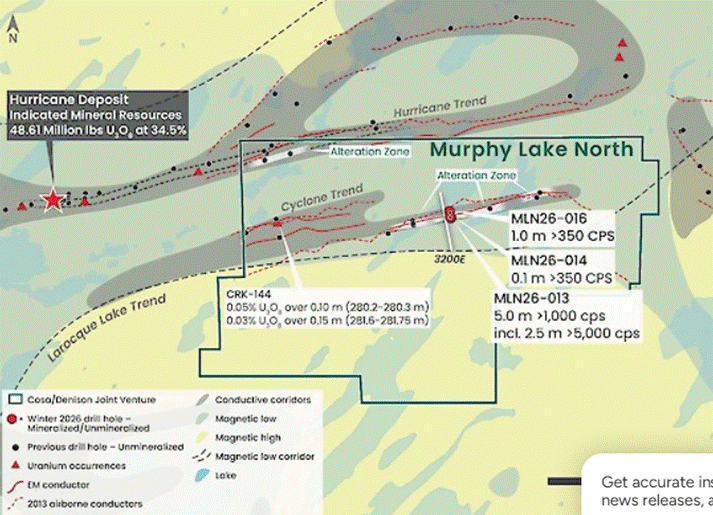
It’s very shallow for Athabasca Basin terms — 250, 260 meters down to the target depth. For perspective, the major mines in the area are all 400 meters-plus down. Shallow means cheaper exploration and also a lower economic threshold.
It importantly has two parallel trends, one being the Hurricane trend that continued onto the project.
The second one is another trend that we really like and we eventually named it the Cyclone trend. The main part of the Cyclone trend has never seen a drill hole. To have a multiple-kilometer trend that hasn’t seen any drilling sitting right next to a uranium deposit, those don’t really exist in the Athabasca Basin anymore.
We acquired it in January and had a drill on site in February of 2025, did a few holes.
We hit some good alteration and then we came back in the summer. We hit some more alteration on the Hurricane trend but realized there was not a huge amount of space left there; this isn’t the biggest project.
So, we moved down to this new trend, Cyclone, and we started to drill. And what we saw was a huge alteration halo, something that could potentially house a significant deposit.
We left in August of 2025, and we said, “We’ve got to get back here. It looks great.” But unfortunately, the assays and the geochem was suggesting that we didn’t have a near miss.
There’s not something 50 meters away or something like that which means we’ve got to remain disciplined when we go back. We went back in March of 2026, just over a couple months ago with a solid plan we stuck to.
We had a 1.2-kilometer gap between drill holes so we drilled right in the middle and hit 5 meters of radioactivity with a half meter that’s above 13,000 counts per second, which is very significant.
We followed it up with a few more holes, hit some more radioactivity 50 meters to the north. It’s wide open in the east-west direction, which would be the longitudinal direction of anything we’re looking for, a big result.
We saw our share price react accordingly. We’re waiting for assay results on a very rare result.
The radioactivity is significant but when you factor in everything else that’s happening, the alteration, the structure, where it’s located, how it’s really wide open in Athabasca Basin terms, that makes us very excited about what we’re seeing at Murphy Lake North. That is our focus to go back there in June and get drilling as fast as we can to build off those results and hopefully improve on them, because it does seem like we’re on the edge of a larger system there.
We think the company has a great opportunity to make a bona fide discovery at Murphy Lake North.
RM: What do you think we can expect from the uranium market over the next three to six months?
KB: The uranium market’s been building for the past 10 years. You can see it building from a supply and demand standpoint where you had demand increasing and you had supply not really coming online, not able to fulfill that demand. And then you fast-forward to today, we’re where any catalyst can really cause the uranium price to potentially catapult.
What’s happening in the Middle East is it’s reinforcing how much energy security matters. It’s rerating it in people’s minds. Like you’ve said diversification, escaping dependency on one source for your electricity. And that bodes well for uranium because it still remains a small portion of a lot of countries’ electrical grid.
The next three to six months, fundamentally, the uranium market is as strong as I think it’s ever been. And I think any sort of little catalyst could cause the price to make a big jump, back above $100 on the spot price. And it won’t take much, it’s so tightly held right now.
We just don’t know where that next catalyst is going to come from that. I just know that if any catalysts occur, that the price will have a significant jump.
RM: You talked about the supply chains and the structural supply deficit for uranium. One thing that the closure of the Strait has done to supply chains is that we no longer can function using just-in-time supply chains. Most places you have two or three days of supply, that’s not going to be sufficient anymore. The just-in-time supply chain has just been proven to no longer work.
I think what we’re going to see is massive stockpiling across the world of the most important commodities, probably up to six months, eight months supply because of one man, one missile. When a rogue nation can close the Strait and choke off so high a percentage of the world’s supply of much-needed chemicals and oil and metals it has to change the world’s supply chains to just-in-case instead of just-in-time. Do you agree with that?
KB: Yes I would, and I think uranium is a bit unique in that scenario because the material won’t be available. There’s just not enough. And so that will be interesting to watch that unfold. The next point, which is going to be coming to light shortly, will be that we’re so behind in exploration. Phoenix, which Denison is building, was found around 2008. I think NexGen’s Arrow was 2013. That’s a long time ago. We need those next great discoveries to happen now.
We need a lot of capital put into exploration because that’s the next layer that needs to be advanced. That’s how it works, right? The attention is starting to trickle down, and so is the capital.
To start bringing stuff closer to balance between supply and demand we need great discoveries in the Athabasca Basin, and Saskatchewan, because that’s where you get the highest grade uranium mines. Those are the mines that can really help stabilize markets and provide supply, you need them.
I think it’s probably the most unique time I’ve ever seen in the uranium market.
RM: The other concern for supply is the global move to electrification and decarbonization requires batteries. Wind and solar don’t provide baseload power.
The output is, to be polite, unreliable. I don’t think most people understand that a battery is simply an energy storage device. If you’re going to decarbonize and electrify, at least the transportation fleet or as much of it as you possibly can, you need that baseload power, which uranium excels at delivering.
I think there’s going to be a lot of demand driven from that side of the equation as well.
KB: I completely agree. You layer in anything additional. I think nobody counted that the demand would come in so rapidly from, like you said, the decarbonization, and the data centers, the Amazons of the world, the Microsofts of the world are all commenting on nuclear power. Nobody predicted that new demand coming in.
And that’s causing an already tightening up elastic band from a supply standpoint. It’s going to really go parabolic here if there’s that big, continued push and continued strain on the supply. And it feels like it’s heading that way. And it takes time to get supply online, to find these things, to build these things.
RM: With increased attention and capital flow into the uranium market junior uranium explorers in the Athabasca Basin are increasingly coming under scrutiny. Why does Cosa stand out in the basin from a lot of the other players that are competing for that same attention and capital?
KB: It goes back to how I answered that first question. We’re a team with a track record.
Recently, even with our success at IsoEnergy, we’re a team with a track record of making discoveries and creating a lot of significant gains for shareholders. We have a strategic collaboration with Denison Mines, our largest shareholder and they’ve maintained that through multiple financings.
Our team already had good access to capital because of our track record. That’s further strengthened with Denison’s support.
When the team and I built this company the entire message always started with team, team, team. And then we did the deal with Denison. We layered onto the team concept strategic collaboration with Denison, additional support from a strategic, good assets, and now great drill results we’re about to start following up on.
We’re going to be drilling soon and we are fully funded for that drill program.
This is the time you want to enter companies like Cosa, when they’re ticking all those boxes because when we were at Iso, before we got onto the high-grade portion of the Hurricane deposit, it’s important to remember we hit good results, but were still at trading at $0.30, $0.40.
But when we found the high-grade portion with follow-up drilling that’s where we went from $0.30 to $6 in 18 months pre-resource. That’s the value of the rock you can potentially intersect in the Athabasca Basin. And that’s the kind of reaction you can have to a stock if you’re getting that kind of drill-bit success. All of this is why I know Cosa is a great story to invest in, in the Athabasca Basin.
We believe in it. We continue to invest ourselves and we’re going to have a very exciting next 12 months following up some terrific drill results.
RM: I appreciate you taking the time to talk with us this morning.
KB: This was great I appreciate it, thank you.
Subscribe to AOTH’s free newsletter
Richard does not own shares of Cosa Resources (TSXV:COSA). COSA is a paid advertiser on his site aheadoftheherd.com This article is issued on behalf of COSA
Legal Notice / Disclaimer
Ahead of the Herd newsletter, aheadoftheherd.com, hereafter known as AOTH.
Please read the entire Disclaimer carefully before you use this website or read the newsletter. If you do not agree to all the AOTH/Richard Mills Disclaimer, do not access/read this website/newsletter/article, or any of its pages. By reading/using this AOTH/Richard Mills website/newsletter/article, and whether you actually read this Disclaimer, you are deemed to have accepted it.
Divests US$13.5M McEwen Copper Debt to Further Enhance Liquidity ... READ MORE
Aura Minerals Inc. (NASDAQ: AUGO) (B3: AURA33) is pleased to anno... READ MORE
Montero Mining and Exploration Ltd. (TSX-V: MON) (OTC Pink: MXTRF... READ MORE
Barksdale Resources Corp. (TSX-V: BRO) (OTCQB: BRKCF) (FSE: 2NZ) ... READ MORE
Getty Copper Inc. (TSX-V: GTC) (OTCQX: GTCDF) is pleased to an... READ MORE