







Zodiac Gold Inc. (TSX-V: ZAU) (OTCQB: ZAUIF) (FSE: K19) a West African gold exploration company, is pleased to report exceptional results from additional trenching at the Lewis North target, part of the Company’s 16-kilometre Monterra Trend at its flagship Todi Gold Project in Liberia. Trench LWT003 returned 58 metres at 3.15 g/t Au, including 11 metres at 15.40 g/t Au, with a 1 metre sample at 158 g/t Au. The result represents the strongest combination of width and grade reported to date from the Lewis target and materially advances the Company’s understanding of the emerging 1.8-kilometre anomalous trend. Importantly, LWT003 is located approximately 310 metres west of LWT001 (Map 1), extending mineralized zones interpreted from trenching along strike and providing further evidence of a laterally extensive mineralized system.
Highlights:
David Kol, President & CEO of Zodiac Gold, commented: “Trench LWT003 delivers a significant result for Lewis North because it brings together exceptional grade, substantial width and growing evidence of continuity along the trend. With three trenches now returning wide zones of gold mineralization across more than 700 metres of strike, a 1.8-kilometre gold-in-soil anomaly, favourable BIF and amphibolite host rocks, and additional trenching already completed farther west, Lewis North has emerged as an increasingly compelling priority target. These encouraging results strengthen our confidence in the scale and potential of Lewis North and provide a strong foundation for the upcoming drill program as we continue to systematically unlock the broader 16-kilometre Monterra Trend.”
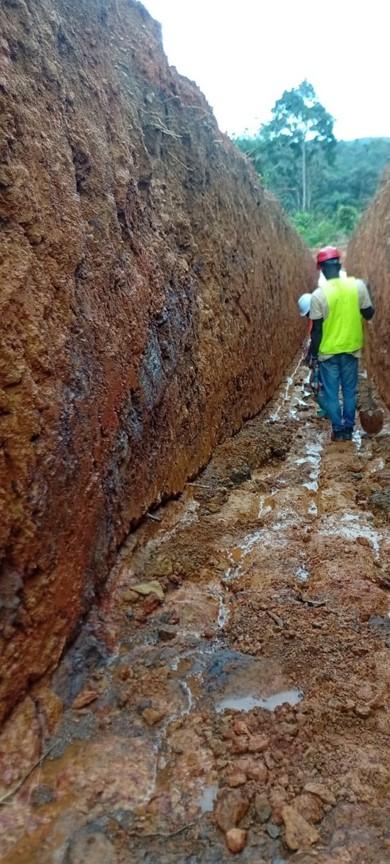
Image 1: Trenching at Lewis North where LWT003 returned 58 metres at 3.15 g/t Au, including 11 metres at 15.40 g/t Au, with a 1 metre sample at 158 g/t Au
Lewis Target Background
The Lewis target is located at the southeastern extent of the Company’s 16-kilometre Monterra Trend, a strongly continuous corridor of gold-in-soil anomalism that also hosts the Arthington discovery and the Ben Ben and Feh Feh targets. At Lewis, two parallel, approximately 1.8-kilometre east-west trending gold-in-soil anomalies have now demonstrated broad zones of surface gold mineralization in trenching. Lewis North has been tested by three trenches — LWT001, LWT002 and LWT003 — spanning more than 700 metres of strike, with each trench returning wide mineralized intervals and higher-grade internal zones. The latest LWT003 result materially strengthens the emerging picture of Lewis North as a laterally extensive mineralized trend. Immediately to the south, the parallel Lewis South trend previously returned 84m at 0.51 g/t Au, including 30m at 1.04 g/t Au, and is currently being tested by the Company’s inaugural Phase 1 diamond drilling at Lewis, which commenced on July 21, 2026. Collectively, the two parallel trends reinforce the scale and exploration significance of the Lewis target within the Monterra Trend.
Trenching
Trenching at Lewis North forms part of the Company’s 3,600 m trenching program along the Monterra Trend and is designed to systematically advance priority gold-in-soil anomalies toward drill testing. Trench LWT003 was excavated 310m along strike to the west of LWT001 and confirms that mineralization at Lewis North extends well beyond the two previously reported trenches. LWT005 has now been excavated and sampled a further 375m west of LWT003. Trench LWT004 tested a discrete gold-in-soil anomaly between the Lewis North and Lewis South trends.
The higher-grade interval of 11m at 15.40 g/t Au, including 1m at 158 g/t Au, was intersected within BIF which is considered a favourable chemical host for gold mineralization in greenstone terranes. Its iron-rich mineralogy can react with sulfur carried in gold-bearing hydrothermal fluids, destabilizing the fluid’s capacity to hold gold in solution and causing gold to precipitate directly within the iron formation. Other mineralized zones were identified in amphibolite, which is a common host of gold mineralization along the Monterra Trend. The competency and mineralogical contrasts between BIF and amphibolite make the contact zones between these rock types particularly favourable for gold mineralization.
Trench locations are shown on Map 1. Trench collar data is shown in Table 1 and significant intersections are shown in Table 2.
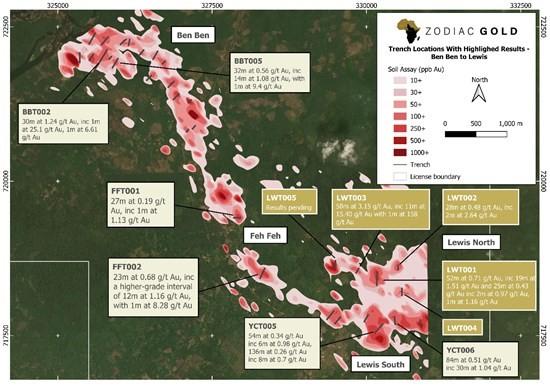
Map 1: Highlighted Trenching Results and Soil Anomalism from Ben Ben to Lewis
Table 1: 2026 trench collar data at the Lewis North target
| Trench ID |
Easting (UTM WGS84, 29N) | Northing (UTM WGS84, 29N) | Elevation (m) |
Azimuth (degrees) |
Dip (degrees) |
Length (m) |
| LWT001 | 330162 | 718306 | 50 | 0 | 0 | 198* |
| LWT002 | 330508 | 718573 | 54 | 0 | 0 | 63 |
| LWT003 | 329838 | 718474 | 105 | 23 | 0 | 103 |
| LWT004 | 330558 | 718150 | 75 | 0 | 0 | 115 |
*Note that trench LWT001 was not excavated between 173 and 193m due to the presence of an access road. This 20m interval was not included in the total trench length in Table 1.
Table 2: Intersections above 0.1 g/t Au in trenching at the Lewis North target and surrounding area
| Trench ID | From (m) | To (m) | Interval (m) | Au (g/t) |
| LWT001 | 36 | 45 | 9 | 0.1 |
| LWT001 | 52 | 57 | 5 | 0.11 |
| LWT001 | 60 | 75 | 15 | 0.14 |
| LWT001 | 78 | 130 | 52 | 0.71 |
| Including | 101 | 120 | 19 | 1.51 |
| Including | 104 | 107 | 3 | 3.33 |
| Including | 105 | 106 | 1 | 6.59 |
| Including | 113 | 118 | 5 | 2.71 |
| Including | 114 | 115 | 1 | 6.52 |
| LWT001 | 148 | 173 | 25* | 0.43 |
| Including | 159 | 161 | 2 | 0.97 |
| Including | 171 | 172 | 1 | 1.16 |
| LWT001 | 193 | 216 | 23* | 0.22 |
| LWT002 | 23 | 28 | 5 | 0.18 |
| LWT002 | 35 | 63 | 28 | 0.48 |
| Including | 54 | 56 | 2 | 2.64 |
| LWT003 | 33 | 91 | 58 | 3.15 |
| Including | 38 | 49 | 11 | 15.4 |
| Including | 41 | 46 | 5 | 33.32 |
| Including | 41 | 42 | 1 | 158 |
| Including | 57 | 75 | 18 | 0.56 |
| Including | 61 | 65 | 4 | 1.3 |
| LWT004 | 38 | 41 | 3 | 0.21 |
| LWT004 | 64 | 72 | 8 | 0.16 |
*Note that the intersections from 148 to 173m and 193 to 216m in LWT001 are located either side of the 20m interval that could not be excavated (173 to 193m). Drill testing will confirm whether these intersections are part of a single mineralized zone.
Significant intersections have been determined as intervals above 0.1 g/t Au, with a minimum length of 2m and a maximum of 2m of consecutive samples below 0.1 g/t Au. Intervals are trenched lengths rather than true thicknesses, which cannot be accurately estimated given the early stage of exploration at the Lewis North trend. No top cut was applied to the assays.
Sampling and QA/QC Procedures
Following excavation, the walls of the trenches were cleaned and samples were taken at 1m intervals in channels along one wall, with care being taken to avoid contamination between samples. QA/QC procedures included the addition of blank and duplicate samples to the sample sequence, all of which returned acceptable results.
All samples met the standards for chain of custody without the opportunity for third party access from Zodiac Gold’s exploration camp to the Liberia Geochemical Services Inc. sample preparation laboratory in Monrovia, Liberia. Each sample was dried and then crushed to 70% passing -2mm and a representative 1kg split was taken by riffle splitting. The split was then pulverized to 85% passing -75 micron and approximately 200g was bagged and labelled, with the remainder being returned to Zodiac Gold. Analysis was performed by 50g fire assay with an atomic absorption finish (method Au-AA26) at the ALS Geochemistry laboratory in Kumasi, Ghana. Samples returning grades in excess of 10 g/t Au by the initial fire assay analysis were re-assayed using fire assay with a gravimetric finish to provide a more accurate quantification at higher grades. The sample from the 41-42m interval in LWT003 initially assayed above the upper reporting limit of method Au-AA26 and was re-assayed by 50g fire assay with a gravimetric finish (method Au-GRA22), returning 158 g/t Au. ALS Geochemistry is independent of Zodiac Gold and is accredited for methods Au-AA26 and Au-GRA22.
Qualified Person
Tom Dowrick, Director of Exploration at Zodiac Gold, is a Chartered Geologist of the Geological Society of London and a Qualified Person as defined by NI 43-101. He has reviewed and approved the technical and scientific information contained in this release.
About Zodiac Gold
Zodiac Gold Inc. is a West African gold exploration company focused on its flagship Todi Gold Project in Liberia — an underexplored, politically stable, mining friendly jurisdiction hosting several large-scale gold and iron ore deposits. Strategically positioned along the fertile Todi Shear Zone, Zodiac Gold is developing a district-scale gold opportunity with additional iron ore potential, covering a vast 2,316 km² land package. The Todi Gold Project has undergone de-risking, showcasing proven gold occurrences at both surface and depth, with five drill-ready targets, three of which have been drilled, delivering high-grade gold intercepts.
Brutus Mining Inc. (CSE: BRU) (FSE: ZI3) is pleased to announce that it has closed its non-brokered ... READ MORE
Jaguar Uranium Corp. (NYSE American: JAGU) is pleased to announce an independent Mineral Resource E... READ MORE
Auro Metals Inc. (TSX-V: AURO) (OTCQB: AURFF), is pleased to announce the assay results of the fina... READ MORE
Endeavour Silver Corp. (NYSE: EXK) (TSX: EDR) is pleased to announce that repairs to the primary bal... READ MORE
Scorpio Gold Corp. (NASDAQ: SGLD) (TSX-V: SGLD) (OTCQB: SRCRF) (FSE: RY9) is pleased to announce re... READ MORE