








West Point Gold Corp. (TSX-V: WPG) (OTCQX: WPGCF) (FSE: LRA0) is pleased to announce drill results from 18 holes completed at the Tyro Main and adjacent Decimal Hill zones, at its flagship Gold Chain Project in Arizona. The results are highlighted by GC26-138 (core), which intersected 30.4 metres of 2.31 grams per tonne gold. This mineralized interval is bisected by a 2.8m void (Table 1) that is likely an adit (300 Level) driven on vein prior to 1920.
The results from 18 holes representing 4,304m are presented below. The remaining results from the 21,079m drill program represent 603m from the Black Dyke target. The Company plans to resume drilling in mid-September.
Highlights:
“Drilling in the upper levels of the Tyro Main Zone continues to produce consistent results and West Point Gold is well positioned for the Tyro maiden resource, which remains on track to be completed in late Q3 or early Q4 this year. Additionally, deeper drilling is guiding our efforts to expand the gold zone to depth comparable to the Northeast Tyro Zone. We plan to target below the entire 1.2km strike length of the Tyro Main and NE Tyro zones with the next drill program,” stated Derek Macpherson, President and CEO.
Table 1: Drill Results – Tyro Main Zone
| Holes | From (m) |
To (m) |
Width (m) |
Estimated True Width (m) |
Grade (g/t Au) |
| GC26-138 (core) | 49.2 | 56.9 | 7.7 | 7 | 2.18 |
| Including | 56.9 | 59.7 | 2.8 | VOID | |
| Including | 59.7 | 82.4 | 22.7 | 20 | 2.36 |
| GC26-152 (core) | 231.6 | 234.6 | 3.0 | 3 | 1.66 |
| GC26-153 (core) | No Significant Mineralization | ||||
| GC26-155 | 30.5 | 35.1 | 4.6 | 3 | 0.68 |
| and | 117.4 | 120.4 | 3.0 | 2 | 3.14 |
| and | 153.9 | 158.5 | 4.6 | 3 | 0.73 |
| GC26-156 | No Significant Mineralization | ||||
| GC26-162 | 166.1 | 225.6 | 59.5 | 37 | 0.68 |
| GC26-164 | 201.2 | 208.8 | 7.6 | 5 | 0.94 |
| GC26-167 | 33.5 | 35.0 | 1.5 | 1 | 2.22 |
| GC26-170 | No Significant Mineralization | ||||
| GC26-171 | No Significant Mineralization | ||||
| GC26-172 | No Significant Mineralization | ||||
Table 2: Drill Results – Decimal Hill Zone
| Holes | From (m) | To (m) | Width (m) | Grade (g/t Au) |
| GC26-129 | No Significant Mineralization | |||
| GC26-131 | 117.4 | 118.8 | 1.4 | 1.70 |
| GC26-133 | 176.8 | 178.3 | 1.5 | 0.82 |
| GC26-135 | 33.5 | 45.7 | 12.2 | 0.49 |
| GC26-139 | No Significant Mineralization | |||
| GC26-158 | No Significant Mineralization | |||
| GC26-160 | No Significant Mineralization | |||
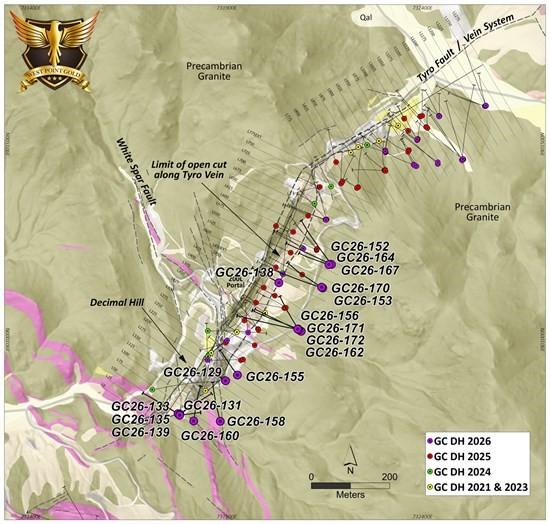
Figure 1: Plan view of the Main Tyro vein showing geology and drilling conducted in 2021, 2023, 2024, 2025, and 2026. Note the locations of Tyro Main Zone holes GC26-138, GC26-152, GC26-153, GC26-155, GC26-156, GC26-162, GC26-164, GC26-167, GC26-170, GC26-171, GC26-172, and Decimal Hill Zone holes GC26-129, GC26-131, GC26-133, GC26-135, GC26-139, GC26-158 and GC26-160.
Summary of Tyro Main Zone and Decimal Hill Drill Results
The latest drilling confirms broad mineralization in the upper Tyro Main Zone and provides additional information on the geometry of the mineralized system at depth. Widespread anomalous gold values, epithermal vein textures, and alteration observed in some of the deeper holes support continued evaluation of structurally displaced or stacked gold horizons. This remains a working geological interpretation. Future drilling will test the interpretation by chasing the deeper Northeast (NE) Tyro mineralization laterally toward Tyro Main and toward the Frisco Graben, while also following the priority target beneath the 300 Level.
Hole GC26-138 is a core hole designed to test the Main Tyro Zone about 100 to 150m below the surface and in proximity to the Tyro 300 Level (flooded), which drifted along the vein for about 300m. The mine working, represented by a 2.8m void, was likely driven along the vein, evidenced by vein in the adjacent walls ranging from 6.4 to 14.9 g/t Au. The high-grade encountered around the mine-working makes the area below this hole a likely zone to chase gold mineralization to depth, as shown in Figure 2.
Hole GC26-162 (RC) traversed 59.5m (TW = 37m) of 0.68 g/t Au at 166.1 to 225.6m. This brings the mineralized envelope down to about 160m below the surface. Hole GC26-164 (RC) cut 15.2m of 0.62 g/t Au from 193.6m to 208.8m, about 75m north of GC26-162. Both holes reveal that gold deposition is continuing at depth but likely reflects diminished ground preparation.
The remainder of the holes were designed to step-down about 50m below drilled mineralization, generally about 150 to 250m below the surface (Figure 2). The vein system appears to weaken and split into multiple narrower veinlets in some areas and remains open at depth in other areas (Figure 2).
Widespread anomalous gold values, epithermal vein textures, and alteration observed in some of the deeper holes support continued evaluation of structurally displaced or stacked gold horizons. This remains a working geological interpretation rather than a demonstrated continuity model. Future drilling will test the interpretation by tracing the deeper NE Tyro mineralization laterally toward Tyro Main and the Frisco Graben, while also following the priority target beneath the 300 Level.
At Decimal Hill, previous drilling was shallow, so the subject program tested down to about 100 to 150m below the surface. Drilling in the Decimal Hill area continues to intersect anomalous values (i.e. GC26-131; Table 2) but has yet to identify a coherent vein structure as observed to the north in the Tyro Main Zone and in the Footwall of the White Spar fault (Figure 2).
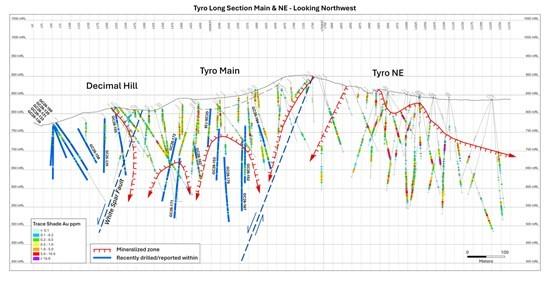
Figure 2. Longitudinal section of the Tyro Main and NE Zones showing drilling and intercepts to date along with gold assays; drill holes reported here are shown in blue. An approximate limit to quartz vein and gold mineralization (horizontally projected) is shown in red and provides some definition to near-term target areas.
Comparison of NE Tyro and Tyro Main Zone
The marked differences between the two zones may be best explained by multiple zones or stacked horizons of gold deposition. Another explanation may revolve around the importance of rhyolite dikes emplaced into the Tyro structural corridor. Intersecting structures must also be considered as well. Drilling proposed for the 2026-2027 drilling campaign will test both zones along strike and at depth.
Analysis of the core and RC chips reveals a pronounced increase in vein-related alteration at NE Tyro consisting of quartz-illite-pyrite relative to the Tyro Main Zone. In contrast, the mineralized intervals in the Tyro Main Zone contain relatively minor illite-pyrite with a greater proportion of early propylitic alteration (quartz-chlorite-pyrite). The alteration assemblages alone suggest that the two zones may have been deposited at distinct elevations, temperatures, or both.
Veining within both zones (Figure 2) consists of multiple quartz-calcite-adularia stages punctuated by breccia events. The widespread presence of quartz pseudomorphs after bladed calcite (“lattice texture”) deposited over several stages argues for telescoping and a migrating boiling horizon during gold deposition. This may not be surprising considering the complex structural history of the Tyro Vein and, in general, the Katherine district. Tectonic movements along the controlling structures during and after the suspected gold events can explain the juxtaposition of contrasting vein styles, textures and gold grades. Such tectonic movements or a combination of these can result in stacked gold shells or a vertical precious-metal range greater than normally encountered in low-sulfidation epithermal systems.
Figure 2 provides a longitudinal view of all drill holes into the Tyro Main and NE zones. Analytical results are also provided, allowing for the definition of ‘gold deposition’, structural blocks, wall rock alteration and vein styles. Future drill targeting also needs to consider structural rotation of the precious-metal horizon (relative to the original paleo-surface, post-mineral offsets, and rapid uplift). Experience gained so far along the Tyro vein system suggests focusing upon deep drilling at Tyro NE and moving laterally to the southwest (toward the Tyro Main Zone) and northeast (toward the Frisco Graben) with incremental step-outs.
Table 3: Drill Hole Locations and Descriptions – Tyro Main Zone
| Hole No. | Azimuth (degrees) |
Inclination (degrees) |
Easting | Northing | Length (m) |
| GC26-138 (core) | 300 | -55 | 732,439 | 3,901,450 | 349.0 |
| GC26-152 (core) | 295 | -60 | 732,439 | 3,901,454 | 330.7 |
| GC26-153 (core) | 290 | -55 | 732,145 | 3,901,133 | 304.8 |
| GC26-155 | 330 | -60 | 731,927 | 3,900,910 | 182.9 |
| GC26-156 | 290 | -60 | 732,090 | 3,901,022 | 294.1 |
| GC26-162 | 335 | -55 | 732,085 | 3,901,026 | 227.1 |
| GC26-164 | 325 | -45 | 732,168 | 3,901,193 | 243.8 |
| GC26-167 | 295 | -70 | 732,161 | 3,901,192 | 323.1 |
| GC26-170 | 300 | -70 | 732,142 | 3,901,135 | 349.0 |
| GC26-171 | 290 | -70 | 732,082 | 3,901,028 | 330.7 |
| GC26-172 | 275 | -60 | 732,081 | 3,901,028 | 304.8 |
Table 4: Drill Hole Locations and Descriptions – Decimal Hill Zone
| Hole No. | Azimuth (degrees) |
Inclination (degrees) |
Easting | Northing | Length (m) |
| GC26-129 | 305 | -75 | 731,897 | 3,900,896 | 152.4 |
| GC26-131 | 305 | -75 | 731,777 | 3,900,811 | 152.4 |
| GC26-133 | 305 | -50 | 731,776 | 3,900,811 | 152.4 |
| GC26-135 | 60 | -60 | 731,781 | 3,900,810 | 178.31 |
| GC26-139 | 90 | -60 | 731,780 | 3,900,808 | 105.16 |
| GC26-158 | 350 | -50 | 731,884 | 3,900,792 | 166.1 |
| GC26-160 | 10 | -50 | 731,816 | 3,900,793 | 157.0 |
Qualified Person
Robert Johansing, M.Sc. Econ. Geol., P. Geo., the Company’s Vice President, Exploration, is a qualified person as defined by NI 43-101 and has reviewed and approved the technical content of this press release. Mr. Johansing has also been responsible for overseeing all phases of the drilling program, including logging, labelling, bagging and transport from the project to American Assay Laboratories of Sparks, Nevada. Drillholes have a diameter of about 10cm, and samples have an approximate weight of 5 to 10kg. Core size is HQ (2.5″/63.5mm) and is logged, photographed and cut at the Company’s Bullhead City sampling facility including the insertion of blanks and standards. Samples were then dried, crushed and split, and pulp samples were prepared for analysis. Gold was determined by fire assay with an ICP finish, and over-limit samples were determined by fire assay and gravimetric finish. Silver plus 15 other elements were determined by Aqua Regia ICP-AES (IM-2A16), and over-limit samples were determined by fire assay and gravimetric finish. Both certified standards and blanks were inserted on site along with duplicates, standards and blanks inserted by American Assay. The results summarized above have been carefully reviewed with reference to the QA/QC results. Standard sample chain of custody procedures were employed during drilling and sampling campaigns until delivery to the analytical facility.
About West Point Gold Corp.
West Point Gold is an exploration and development company focused on unlocking value across four strategically located projects along the prolific Walker Lane Trend in Nevada and Arizona, USA, providing shareholders with exposure to multiple discovery opportunities across one of North America’s most productive gold regions. The Company’s near-term priority is advancing its flagship Gold Chain Project in Arizona.
Brutus Mining Inc. (CSE: BRU) (FSE: ZI3) is pleased to announce that it has closed its non-brokered ... READ MORE
Jaguar Uranium Corp. (NYSE American: JAGU) is pleased to announce an independent Mineral Resource E... READ MORE
Auro Metals Inc. (TSX-V: AURO) (OTCQB: AURFF), is pleased to announce the assay results of the fina... READ MORE
Endeavour Silver Corp. (NYSE: EXK) (TSX: EDR) is pleased to announce that repairs to the primary bal... READ MORE
Scorpio Gold Corp. (NASDAQ: SGLD) (TSX-V: SGLD) (OTCQB: SRCRF) (FSE: RY9) is pleased to announce re... READ MORE