








West Point Gold Corp. (TSX-V: WPG) (OTCQB: WPGCF) (FSE: LRA0) is pleased to announce drill results from the Tyro Main Zone at its flagship Gold Chain Project in Arizona. All the holes drilled intersected significant gold mineralization highlighted by 22.9 metres at 3.11 grams per tonne gold. Results reported in the release are from seven reverse circulation drill holes (1,419m), part of the recently expanded 20,000m drill program. These holes were drilled into the southern portion of the Tyro Main Zone and further confirm our interpretation of grades and structural controls within the zone. To date, 16,504m of the ongoing drill program at the Gold Chain project has been completed, with assays released for 1,419m of drilling. Results are pending from the Tyro Main Zone, NE Tyro, Bull 8 and Black Dyke targets, representing 24 holes (4,087m).
Highlights:
“Drill results from the Tyro Main zone continue to demonstrate this zone’s potential over its plus one-kilometre strike length. Confirmation of these en-echelon zones within the southern portion of the Tyro Main zone is expected to help with grade optimization in the ongoing effort to define a maiden resource at Tyro later this year. We continue to aggressively drill Gold Chain as we approach the completion of the current 20,000m drill program. Results are pending from multiple step-out targets, including holes focused on expanding the high-grade zone at NE Tyro to the northeast,” stated Derek Macpherson, President and CEO.
Table 1: Drill Results
| Holes | From (m) |
To (m) |
Width (m) |
Grade (g/t Au) |
| GC26-116 | 102.1 | 125.0 | 22.9 | 3.11 |
| GC26-118 | No Significant Intercepts | |||
| GC26-120 | 125.0 | 134.1 | 9.1 | 2.57 |
| GC26-122 | 0.0 | 7.6 | 7.6 | 2.33 |
| and | 29.0 | 32.0 | 3.0 | 2.62 |
| and | 106.7 | 120.4 | 13.7 | 1.39 |
| and | 141.7 | 152.4 | 10.7 | 1.08 |
| GC26-124 | 0.0 | 12.2 | 12.2 | 0.24 |
| GC26-125 | 0.0 | 184.4 | 184.4 | 1.00 |
| Including | 0.0 | 30.5 | 30.5 | 0.48 |
| Including | 30.5 | 96.0 | 65.5 | 0.25 |
| Including | 96.0 | 106.7 | 10.7 | 8.11 |
| Including | 106.7 | 141.7 | 35.1 | 1.31 |
| Including | 141.7 | 184.4 | 42.7 | 0.44 |
| GC26-127 | 71.6 | 160.0 | 88.6 | 0.80 |
| Including | 71.6 | 111.3 | 39.7 | 0.58 |
| Including | 111.3 | 128.0 | 16.8 | 2.14 |
| Including | 128.0 | 160.0 | 32.0 | 0.38 |
Note: All widths shown are downhole; true widths are variable (see text).
Summary
Holes GC26-116, GC26-118, GC26-120, GC26-122, GC26-124, GC26-125 and GC26-127 were designed to confirm internal trends within the Tyro Main Zone defined by higher gold grades and vein concentrations. Figure 2 reveals several discrete N60-65E trending zones, dominated by quartz-calcite-adularia-cemented breccia and stockwork, of elevated gold grades contained within a N20-25E structural corridor referred to as the Tyro Vein System. In comparison, the NE Tyro Zone hosts higher gold grades within a broad hanging wall quartz veinlet zone grading downward into a distinct vein/vein breccia with a sharp footwall contact, likely a fault.
The current effort is to define this mineralized structural corridor to a depth of 300m below the surface vein exposures and identify internal heterogeneities in width and grade. Current drilling is on schedule and focused on the Tyro Main Zort to define a maiden resource in late 2026.
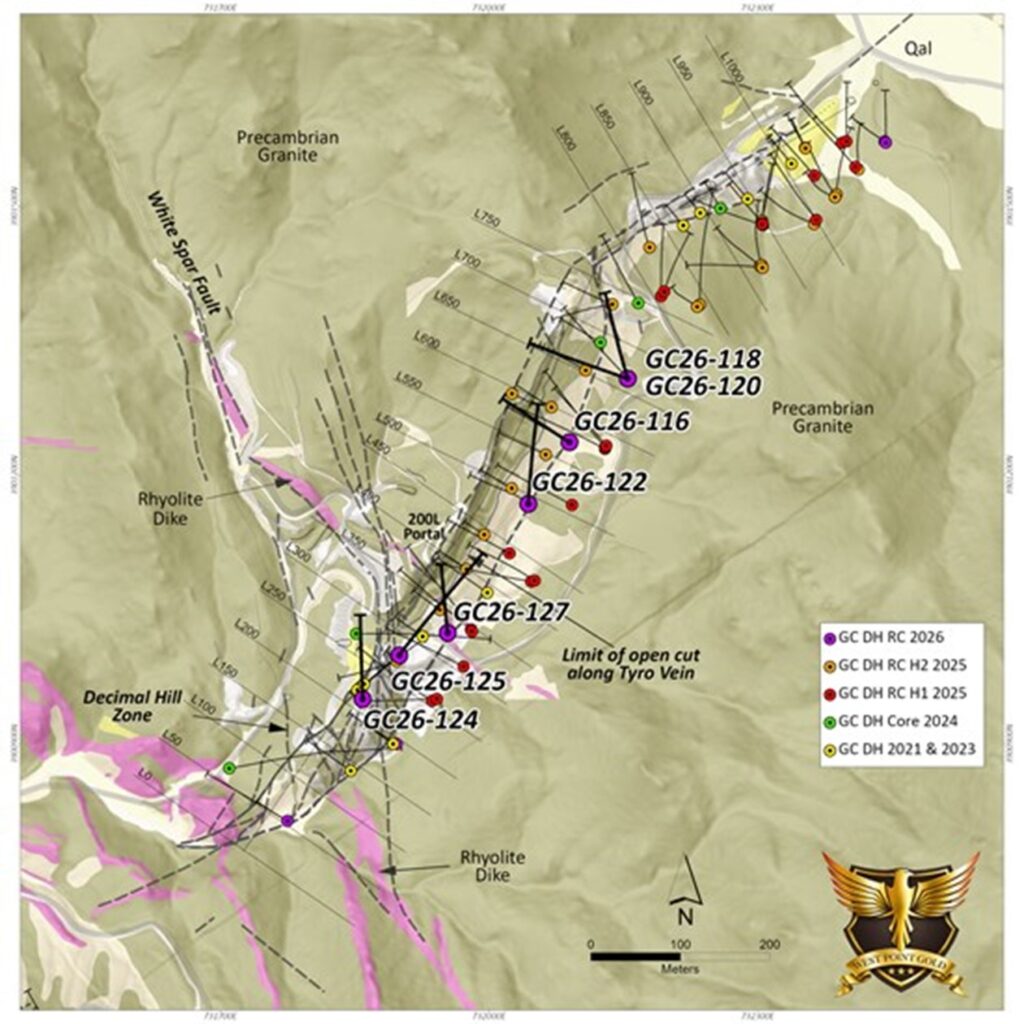
Figure 1: Plan view of the Main Tyro vein showing geology and drilling conducted in 2021, 2023, 2024, 2025, and 2026. Note the location of Hole Nos. GC26-116, GC26-118, GC26-120, GC26-122, GC26-124, GC26-125 and GC26-127.
GC26-116: This hole was designed to traverse the entire Tyro Main Zone (Figure 2) and encountered 22.9m of 3.11 g/t Au. The true width of this intercept should be about 18m hosted in Precambrian granite.
GC26-118: Hole GC26-118 was designed to drill northward to test continuity between the Tyro Main and Northeast zone. A broad zone of anomalous gold values was traversed, but all values were less than 0.7 g/t Au.
GC26-120: This hole was designed to traverse the entire Tyro Main Zone, where previous drilling suggests that the mineralized package has diminished in width. The hole encountered 9.1m at 2.57 g/t Au from 125.0 to 134.1m.
GC26-122: Hole GC26-122 was designed to test the model by drilling northerly at a shallow angle (-55 degrees) and encountered four distinct mineralized intervals summarized in Table 1.
GC26-124: This hole was drilled due north from the top of Decimal Hill (Figure 2) to provide additional testing of the footwall limit upon mineralization. The hole was collared in strong chalcedony-dominant veins and breccia, but quickly traversed the footwall structure beyond which little veining was observed (Table 1).
GC26-125: Hole GC26-125 was drilled in close proximity to the intersection with the White Spar fault (Figure 2) and was oriented NE and parallel to the Tyro Structural Corridor’s trend. The hole was moderately inclined (50 degrees) and designed to traverse all internal, mineralized zones. The hole encountered continuous veins and veinlets and cut 184m (0 – 184.4m) at 1.00 g/t Au (Table 1), including 10.7m at 8.11 g/t Au adjacent to 35.1m at 1.31 g/t Au.
GC26-127: This hole was drilled in close proximity to hole GC26-125 (Figure 2) but was oriented more perpendicular to the internal mineralized zones and achieved similar results to GC26-125. The hole cut 88.6m at 0.80 g/t Au, including 16.8m at 2.14 g/t at 111.3 to 128.0m.
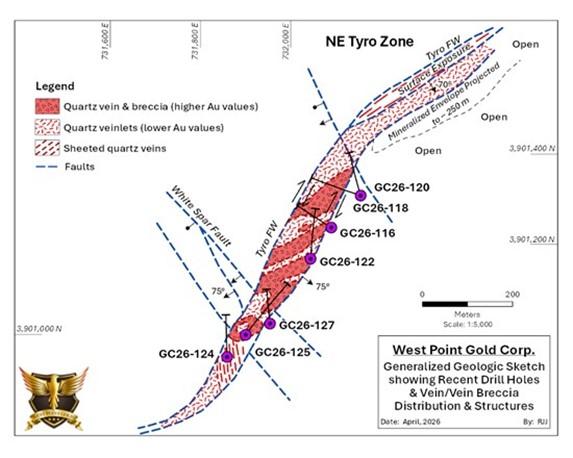
Figure 2. Generalized geologic sketch of the Tyro Main and Northeast zones showing Holes GC26-116, GC26-118, GC26-120, GC26-122, GC26-124, GC26-125 and GC26-127. These holes, along with previous holes (not shown), reveal a series of en-echelon mineralized zones within a pair of NE-trending faults (Tyro Structural Corridor).
Table 2: Drill Hole Locations and Descriptions
| Hole No. | Azimuth (degrees) | Inclination (degrees) | Easting | Northing | Length |
| GC26-116 | 300 | -60 | 732,096 | 3,901,233 | 178.3 |
| GC26-118 | 340 | -60 | 732,155 | 3,901,308 | 190.5 |
| GC26-120 | 295 | -60 | 732,154 | 3,901,306 | 225.6 |
| GC26-122 | 5 | -50 | 732,044 | 3,901,167 | 182.9 |
| GC26-124 | 0 | -50 | 731,851 | 3,900,949 | 150.9 |
| GC26-125 | 35 | -50 | 731,901 | 3,900,999 | 269.7 |
| GC26-127 | 350 | -70 | 731,955 | 3,901,019 | 221.0 |
Qualified Person
Robert Johansing, M.Sc. Econ. Geol., P. Geo., the Company’s Vice President, Exploration, is a qualified person as defined by NI 43-101 and has reviewed and approved the technical content of this press release. Mr. Johansing has also been responsible for overseeing all phases of the drilling program, including logging, labelling, bagging and transport from the project to American Assay Laboratories of Sparks, Nevada. Drillholes have a diameter of about 10cm, and samples have an approximate weight of 5 to 10kg. Samples were then dried, crushed and split, and pulp samples were prepared for analysis. Gold was determined by fire assay with an ICP finish, and over-limit samples were determined by fire assay and gravimetric finish. Silver plus 15 other elements were determined by Aqua Regia ICP-AES (IM-2A16), and over-limit samples were determined by fire assay and gravimetric finish. Both certified standards and blanks were inserted on site along with duplicates, standards and blanks inserted by American Assay. The results summarized above have been carefully reviewed with reference to the QA/QC results. Standard sample chain of custody procedures were employed during drilling and sampling campaigns until delivery to the analytical facility.
About West Point Gold Corp.
West Point Gold is an exploration and development company focused on unlocking value across four strategically located projects along the prolific Walker Lane Trend in Nevada and Arizona, USA, providing shareholders with exposure to multiple discovery opportunities across one of North America’s most productive gold regions. The Company’s near-term priority is advancing its flagship Gold Chain Project in Arizona.
Brutus Mining Inc. (CSE: BRU) (FSE: ZI3) is pleased to announce that it has closed its non-brokered ... READ MORE
Jaguar Uranium Corp. (NYSE American: JAGU) is pleased to announce an independent Mineral Resource E... READ MORE
Auro Metals Inc. (TSX-V: AURO) (OTCQB: AURFF), is pleased to announce the assay results of the fina... READ MORE
Endeavour Silver Corp. (NYSE: EXK) (TSX: EDR) is pleased to announce that repairs to the primary bal... READ MORE
Scorpio Gold Corp. (NASDAQ: SGLD) (TSX-V: SGLD) (OTCQB: SRCRF) (FSE: RY9) is pleased to announce re... READ MORE