






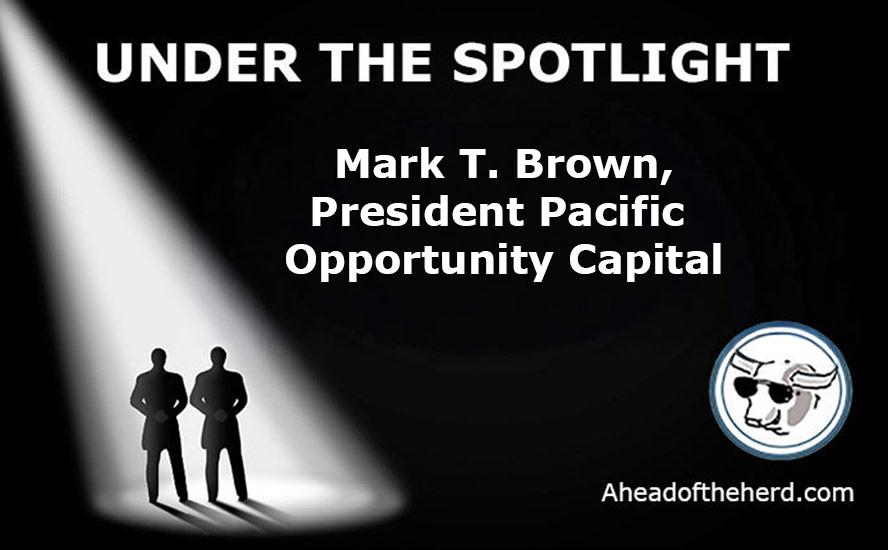
Rick Mills, Editor/ Publisher, Ahead of the Herd:
We’re with Mark Brown today. Mark’s the President of Pacific Opportunity Capital, a financial consulting and merchant banking firm, headquartered in Vancouver.
Mark, you’re active in the venture capital markets in North America. Can you introduce yourself to our readers and explain what you do? And we’ll get into some of the companies you’re involved with a little bit later.
Mark Brown, President, Pacific Opportunity Capital:
Sure. Happy to do that, Rick.
I started a long time ago, even in university. I knew I wanted to be on the entrepreneurial side of business. I was at business school at UBC.
Then I worked at Price Waterhouse, which is a great education of seeing a lot of different businesses and learning how they functioned and sometimes how they didn’t function very well. And then after that, I got a job at Miramar Mining as a controller there and followed that up with Eldorado Gold (TSX:ELD). Both those gold mining companies were 100,000-ounce-a-year producers.
And so, I learned a heck of a lot about the mining industry. Not only how it works on the exploration side, but also about production, because we had large operating mines in those companies. And so that kind of led me to the next thing.
I left Eldorado when gold was, I think, $280, $290. We were cutting everybody back. And I took a package and I walked across the street where my father was kind of playing with a company called Pacific Opportunity Capital in his retirement.
And I said, “let’s make something out of this.” Well, unfortunately, my father passed away two years later. And so, I took over the company and built it up with the idea that we could really help some of these companies, whether they were exploration or even a few tech companies and a few other private companies, but we could help them with our financial expertise.
And also, a lot of them needed money. So, we’d help them raising money. But we also had a little fund where we’d invest money into these companies.
So, every time we take on a company or clients, we help them as much as we can right down to the basic accounting, up to the public reporting, up to mergers and acquisitions and doing everything we can to help add value to these companies. Including investing our own capital and bringing in our network of investors as well. So that’s kind of how we operate. We work with a bunch of different companies and back them with our time and talent and our treasury as well.
RM: Can you give an example of one of your major successes and subsequent sale of a company you started?
MB: Sure. There’s a few that I worked with other groups on that did very well. But one of the ones that we started here in the office and actually incorporated in 1999 was a company called Rare Element Resources. And that one, we started as a CPC worth basically nothing, a 10-cent kind of deal.
And for 10 years, no one really was that interested in our rare earth project in Wyoming.
We liked our drill results, and I liked what was going on in the rare earth markets in those days. Fast forwarding to 2012, I got to ring the bell of the New York Stock Exchange, Rare Element Resources had become a half a billion-dollar company.
And because we’d been supporting it all along the way, that meant we were also investing in it. We were the largest shareholder of the company and we did extremely well.
RM: To do all of what you did and show all that patience you’re in the storage business, not the moving business, Mark.
MB: Well, that’s right. There’s a lot of people who are traders and that’s fine. That’s what they do. But we are very much into building long-term value. We’re not looking at making a 10% return on these things. We’re looking for five and 10-baggers, but it might take a few years. There’s a few companies in our stable that we’ve been working with for quite a long time that seem poised to do extremely well in these improved mining markets over the next few years here.
RM: It does take patience to get those five to 10-baggers. You’ve got to give the model they’re working from time to prove itself out. That does take time and it takes money. And it takes a lot of effort.
People hear about 10-baggers all the time, the magical home run. But they don’t seem to understand the amount of work that has gone on to make that an overnight success.
MB: Well, that’s very true. And there’s two parts to it, really. There’s the things you can control. You can control getting up and getting to the office on time and making the phone calls you need to make and working hard.
You can control where you drill and which geologists you work with. Those are all things you can control. But you can’t control the metal prices. You can’t control what the governments are doing in various places. You can’t control, particularly, the sentiment of the stock market. Like with Rare Elements, we had all those things going in our favor by 2012.
So, it was a long overnight success. But when it went, it traded at $15 for the better part of a couple of years. And people made tremendous amounts of money from backing us in that deal.
We obviously did well, but we were very happy to make lots of people that had backed us over many years a lot of money on that deal. If you can focus on things that you can control it’s much better. And then eventually, every once in a while, the things you can’t control line up and you do very well.
RM: Isn’t that what it’s all about, making people happy, making them money?
MB: That’s a big part of it. If you step back and look at what we’re doing, we’re trying to supply the world with the copper, lead, zinc, silver, gold that is used in all these modern technologies, that is used as a safe haven for financial reasons.
A lot of the world still doesn’t have electricity, and they need copper to run those lines. Silver is the very best conductor we have on the planet. So, it’s used in a lot of technologies that need to run at high efficiency levels.
Gold is also a very good conductor. And like silver, it’s one of the big monetary assets. Maybe in Canada, we don’t have to worry about it too much. Although we probably should. If you’re living in a country where the currency is constantly getting devalued, buying a little bit of gold is an extremely worthwhile thing to do.
RM: I agree. It’s a strange circumstance we’re going through right now. Gold, copper and silver, they’re all reaching highs at the exact same time. That’s a little bit of a new paradigm for people to try and wrap their head around, do you think?
MB: I agree. I think it has a lot to do with the fact that they’re quoted in the US dollar and the effects of the US dollar and the massive debts in the US have on those things.
On the other hand, you look at finding these things. If our goal is to go out and help supply the world with some of these critical elements that are needed, it’s very difficult to find them and getting harder and harder. You know, we have one project in Portugal where in the old days, the Romans would walk across it and find things outcropping and say, “dig there”.
They would dig up a big haul and make all sorts of things that they needed and ship it back to Rome. That doesn’t really happen anymore. You don’t walk across outcrops that are high grade deposits that much anymore.
Geologists are scouring the earth and we’re mining deeper and it’s getting more and more expensive. And it’s difficult. So, it’s harder and harder to find these elements that the world needs.
RM: It is. If you do some research and let’s just pick copper, gold and silver. And this is a fact. There’s just no denying it. Mine supply no longer meets demand. And that’s an incredible thing to say — it’s been years since mined supply has met demand.
Only by recycling can we meet the demand for copper, silver and gold. That’s an incredible stat because when you start looking at things, like Tavi Costa put out an excellent little piece and it was about aggregate capex. With gold at $4,200, silver at $60, you look at copper at $5.20 a pound. And then you look at capex, aggregate capex does not keep up. It’s very low. It’s hardly moving to supply us with the new mines. So, you start thinking about demand and supply. And you realize that this is not a short-term blip at all. It’s actually a very long-term here now structural supply deficit in all three metals.
MB: I agree. Recycling is hugely important. And you won’t find people in the mining industry who aren’t in favor of recycling because they know how hard it is not just to find a deposit, but then to find the chemical formula to process it and recover these elements. And you never recover all of them. So that’s super important.
The investment back in the industry into exploration has been underfunded for many years. I’m not sure people understand, but I think it’s five to 10 years to even find something that might be economic and probably another 10 years to put it in production. So, when you look at that supply-demand schedule, I’m not surprised mines aren’t meeting anywhere near what is needed.
I think we’ve got to up our game on recycling worldwide. Of course, Canada is pretty good at recycling, but a lot of other places aren’t. They still just throw stuff out and it ends up in a landfill.
I could imagine a point where these landfills are going to be mined for all the metals that are sitting in them at some point. We’re not there yet. But at some point, that may happen.
RM: I agree, because when you look at it, there’s a stat that I was just shocked to read. It’s that the US has the second longest timeline from discovery to actual mining and in Canada, the average is almost 20 years.
If you’re not building your mines now, we’re already looking at mine supply not meeting current demand. It’s only met by recycling. It’s setting us up for a long-term, what I would think is a commodities super cycle.
We’ve got another thing, too, that we need to look at here. It’s the world’s developing countries wanting what we want. Everybody wants to drive around in a car or a motorcycle or even a quad. They want washing machines and dryers. They want air conditioning.
They want power, cell phones. They want to live like we do. A startling statistic is by 2050, one in four people in the world will be an African.
You look at India and you start thinking about copper usage and you focus in on, oh, my God, how many people are actually going to be using copper in the future because they want what we’ve got and they’re going to try and get it. And it takes an enormous amount of copper.
I’ve been reading a book called ‘Red Metal, Blue Planet’. For the longest time we didn’t use a lot of copper, but there was something the author calls a digital accelerator. It began in the 1960s and then of course accelerated in the mid-1990s with the digital revolution. That was a widespread adoption of personal computers, the Internet, early mobile phones, and that created a significant demand for copper.
So, you’ve got two things working in conjunction to increase the demand for copper. You’ve got more people. But it’s not just about more people, it’s about more copper per person. And that’s what he’s talking about. He goes on to explain that each new electronic device and the data infrastructure to support it is all adding to the global copper requirement.
We had demand amplification by the rise of the new consumer in ’99 — China’s rapid industrialization and urbanization. You remember that starting in 2003, China’s GDP growing at double digits per year.
That started the super cycle and that pushed production levels higher. But we don’t have the supply flood from Chile today that happened back then.
Today’s supply growth is facing much tougher conditions, you can make the case it’s the same for gold and silver as copper. It’s much harder to find the high-grade deposits, ore grades are declining, and mine development takes longer due to regulatory hurdles. So, I just don’t see how mined copper, gold or silver supply is actually ever going to catch up to the demand,
MB: Well, that’s why we need more exploration and need to invest more in it. And that’s kind of what we do. it’s tough to find stuff, but you can’t find anything if you’re not out in the field looking for it. People have got to be paid to do that, and obviously, these higher metal prices are going to bring on a new boom of exploration.
But like we’ve said, it takes a long time to find something and get it in production. So, it’s definitely a challenge. And that could slow down the economy if metals aren’t available to supply all of the technologies that we have.
RM: I know the economy in northern BC and in southern BC too has changed. Our forests are no longer the support they used to be. You’re looking at mining coming in and people are welcoming the mining. it’s a real boost for a struggling economy to have that kind of exploration and development work going on.
MB: Our Canadian economy has always been very resource-based and various things have been done to try and change that to more, manufacturing and technology. That’s slowly happening. I don’t believe in the government programs that help that stuff. But I do believe in the people who want to do different things and more interesting things. There still will be lots of mining and forestry and fishing going on.
We’re blessed with all these natural resources. It’s our duty to manage them and treat them well and benefit all Canadians from having all those things.
RM: Let’s talk about a few companies. Let’s start with Silver North (TSX.V:SNAG). Tell us about that one and how you got involved with Jason Weber, the CEO. And just give us a rundown on where we are right now with that one.
MB: Well, way back, that was two names ago, actually. That company was brought to my office by Jeff Phillips and Rick Rule.
They wanted to put the company with a group that they trusted because there were some other issues in the company prior to that. And so, we got together and started working with that company, helping them finance.
Jeff and Rick were at the time doing the financings mostly. The company went through a number of exploration projects.
Fast forward to today, we have refocused the company just on silver because its two best projects we had were both silver projects in the Yukon. One is next to Coeur Mining, their mine up in northern BC, called Silver Tip.
The other one is next to Hecla, their Keno Hill mine.
Both those projects look very prospective for silver. We did this about two and a half years ago when we thought that silver was going to go for a run. And of course, luckily, we’ve been right on that.
It is over $60 today. And during that time, we’ve done these small little drill programs, and each one has had success. And so, the programs are getting larger and larger.
Not only that, but the silver that we’re hitting up there in the Keno Hill area is very high-grade silver. There’s many intercepts over 300 grams per tonne and lots of lead and zinc as well, and a little bit of gold here and there, too.
That company is off to the races. It’s got a good market in terms of the silver price. People are starting to look at it.
The share price has done very well this year. We are now able to raise money a lot easier to do larger programs, which means we get more results. And every drill program we’ve had, Rick, we’ve hit on about 80% of our holes.
We don’t have a resource estimate yet there. But at some point, we’ll have enough holes and we’ll scratch our heads and say we should do this at this point. That, of course, is a huge value-add for the company is when we get to that stage.
RM: I own shares in the company. I’ve talked to the CEO and you, about it a lot. I’m very excited about the future of that company.
I think Jason’s doing a hell of a job on it. They’ve got good, solid support on the financial side, strong shareholders and a really good geo. I do like that one.
MB: Jason and I work very well together. And Rob Duncan as well, our VP Exploration and CFO Winnie Wong as well. It’s a really strong team where we’ve got all these different facets covered.
And not only that, but we’re also having these super-high-grade results. So, it’s lots of fun working on that one.
RM: Tell us about Orestone Mining (TSX.V:ORS) and David Hottman, you’re the CFO of the company.
MB: Dave Hottman and I worked together at Eldorado Gold many years ago, worked on other companies since, one being Nevada Pacific Gold that was taken over by a Rob McEwen company. Orestone has got a copper gold project in northern BC, but more recently, they acquired a really prospective gold project down in Argentina.
Of course, Argentina’s economy has been improving quite a bit. They’re open for business. We’ve just raised about $2 million on a financing to do exploration work down there.
Crescat has come in and another couple of funds, actually. We’re really excited to get down there and start doing some work on the project. The geologist behind that is Gary Nordin, who’s one of the founders of Eldorado Gold and Bema Gold.
He’s a quiet guy. But boy, when he likes a project, we go right after it because we very much respect his opinion on things. There’ll be some drilling coming up soon on that, and that’ll be very exciting for us. So happy to be involved in that.
RM: I’ve talked to Marc Blythe of Au Gold (TSX.V:AUGC), and I was extremely impressed with the guy. As a matter of fact, I put some money in a private placement and bought some shares in the open market.
What do you think of that one and what’s happening with it?
MB: Marc, first of all, is the key guy in that company. They’ve got a project in BC, but he’s also looking for other projects worldwide, mostly focused on gold. The key to that whole thing is the fact that Marc is a mining engineer from Australia, worked at Placer Dome previously. He’s worked in a number of mining operations and actually still consults on mining operations.
When he’s looking at a project to acquire in AUGC, he’s looking at it from the point of view, is this something that could become a mine? Even though it’s early-stage exploration. So, it’s a good perspective. I like to look at projects through that lens. You’re not just finding a big deposit that’s completely uneconomic. He’s looking for stuff that’s large and economic. So, I’d stay tuned for that.
There’s lots of things going on. The company’s super-low value. Hopefully in the next year or so, we’ll be able to take advantage of the rising gold prices and get that company to be a lot more active and have some fun with it.
RM: Let’s move on to Gold Terra Resource Corp (TSX.V:YGT). They’re up in Yellowknife, the old Con mine, working underneath that in the Campbell shear zone. Tell us a little bit about that one.
MB: Gold Terra is interesting, because when I left Price Waterhouse and went to Miramar, we were operating the Con mine. That was back in the ‘90s. Here I am 30 years later. And now we have that whole project in Gold Terra. The mine was shut down. The company was taken over by Newmont. Newmont owns the ground up there, but we have an option to acquire it.
We have a gold resource up there of about 1.9 million ounces in not just on the Con ground, but also on other ground north of the Con mine area. One of the keys to that whole project is that it’s led by Gerald Panneton; he’s a bit of a mining legend in Canada.
He built the Detour mine when nobody said he could. We’re looking at a very similar situation here up in Yellowknife, because we’re doing a lot of drilling. We’ve been updating the MRE, the mineral resource estimate as we go. And there’s going to be a lot more drilling. Also, two key people just came in to back us on doing all this. One was Eric Sprott and the other one is David Harquail out of Franco-Nevada.
That’s kind of a key indicator of the fact that this company has very good support. It’s led by a guy who’s done this before and knows what he’s doing — Gerald Panetton. You know, the value of it’s been really low through the downturn, but all of a sudden, it’s starting to move and there’s a lot more interest coming in. So, it’s an exciting time to be involved in that company. And for me, I go up there and see the old Con mine and the mine is flooded. But I used to go underground there when I was a junior guy learning about mining. So, it’s very neat to be back in that area, knowing it’s actually a hugely prolific gold camp, too.
RM: With very good backing and a very strong management team.
MB: Absolutely, people who’ve done it before. It’s interesting and it’s got a lot of support from a lot of different people. I think right now there’s a lot more funds coming into the market to support the company as well.
RM: It’s a very good market for funding our junior exploration and development stories.
MB: This is my third downturn. The mid ‘90s wasn’t great. The 2010s weren’t great. And of course, 2012 to 2022 or whatever was pretty bad. You’ve seen these things and during those downturns, there’s certain things you do to get ready and you keep somehow getting work done and advancing the projects. But right now, it is much easier to finance these companies.
Doesn’t mean it’s still not a lot of work for all the executives to do it and to do it right. But there is a lot of financings going on right now, Rick.
RM: There’s one I want to talk about here. I’m really intrigued with this one, Avrupa Minerals (TSX.V:AVU). This one has a market cap of just $3.2 million. Why don’t you tell us about it?
MB: Avrupa’s been around and we’ve been backing it for a long time. We’re one of the largest shareholders, like all the companies I’m talking about. It’s run by a very accomplished geologist called Paul Kuhn. He lives in Lisbon, Portugal. The word Avrupa is actually Turkish for Europe. So, it’s a focus on European projects.
We’ve had projects in different locales there. Right now, we have a little gold project in Kosovo that we’re in the process of selling. It’s a discovery that we made. It turned out that it was only about 150,000 ounces, five grams per ton gold. Too small for what we were looking for but could be a nice little mine. So, there’s a local group that looking at putting it in the production and we’ll sell it to them over time.
Then in Portugal, there’s an area called the Iberian Pyrite Belt that’s had 80+ mines over many years back to Roman times, as I was mentioning earlier. We’ve been drilling one key project there called Alvalade. We’ve hit a lot of high-grade copper. We’ve had partners on it that have been funding the drilling, which has been great for us because it’s expensive drilling. But we’ve never done a mineral resource estimate and we’re thinking of doing that on that project coming up in the new year. We own 100% of that project right now, which is also really nice, considering we’ve had option agreements on it and a lot of work funded by third parties.
So that’s a way of avoiding dilution is getting third parties in to drill on it. We’re reassessing it right now, updating the license. We’ll do that mineral resource estimate early next year. And then we will see if we want to drill more ourselves or find a partner for it. In the meantime, we’ve acquired some projects up in Finland, which has been really opening up.
There’s a lot of great VMS, which is copper-lead-zinc-type projects out there and gold projects. We’ve teamed up with a gentleman called Jan Akkerman, who knows that area extremely well, worked for major companies up there. We’re going to do some exploration and see if there’s some projects that we can make a discovery on.
RM: Scandinavian countries are very open to mining. We were talking earlier about just how long it takes from discovery to actual mining in North America. Scandinavian countries, you can find something and put it into production in five years. They are great countries to do exploration and development, good move.
MB: Yes. And I mean those areas have lots of history of mining and some of the mines were shut down for odd reasons. We’re right in the shadow of the headframes in a couple of areas there. We think there’s major targets that were never explored and never drilled. So, there’s huge opportunity for us up there.
And of course, with Europe trying to secure their own metal supply as well. They have lots of history of mining in Europe. People don’t talk about it much, but they’re keen to have more mining in Europe and more processing in Europe as well. So that’s good for us there.
RM: I’ve got two more here. What about EGR Exploration (TSX.V:EGR)?
MB: Well, EGR has got a neat project. We were asked to come in and kind of clean that company up. It’s got a new project next to the Detour mine called Detour West. And EGR is run by a really good gentleman called Daniel Rodriguez.
We’re looking at what is the right thing to do on that project to advance it. It’s a different style of drilling there. We might fund a drill program there. But we’re also looking for other projects on that company. So, we kind of go back and forth between being an exploration company and/ or using it as a shell to find a bigger, better project. It’s a constant debate is what’s going to be the best thing to do for the shareholders to advance that company and add a lot of value there.
It’s lowly valued right now, just like Avrupa and a neat one to take a look at. You know, some of these ones, they’re highly risky speculation like most of the companies I work with. But every once in a while, they do extremely well and pay off. I really like the share structure on that one. We’ve cleaned it up for the last couple of years, so when we do put a new deal into it, it’ll have lots of upside if we can find something really good.
RM: Well, if you can trust the guys running the company and the guys backing it. When you look at a company in this kind of a market trading on a $1.6 million market cap, I mean, come on. I probably shouldn’t say it, but to me, that’s got money-maker written all over it. Put a project in, you’re going to get three or four times the market cap just on a project.
MB: I would hope so. Exactly.
RM: I’ve got one more. Do you want to talk about Cassiar Gold (TSX.V:GLDC).
MB: I don’t work directly with Cassiar, but a lot of the financial stuff is out of our office. I’ve known Marco Roque the CEO for many years and Jorge Ramiro Monroy, the group out of Hong Kong that set it up. They’ve done very well with Cassiar. I mean, they’re drilling a lot of gold. I look at it and I just think it’s way undervalued considering gold’s over $4,000/oz and what they’ve discovered there. So, I just think that’s an opportunity.
And I think they’ll kind of crack the nut on cleaning up the share structure and getting enough buying. I think it’s got lots of upside on it when people discover it.
RM: It’s certainly got the market for it, doesn’t it?
MB: Absolutely. It’s a good gold project in a good area with lots of potential upside. I think they drilled 8,000 meters or something this year. So, it’s quite large, potentially.
RM: Any other companies, Mark?
MB: There’s one I should mention, Copper Fox Metals (TSX.V:CUU). Copper Fox is a more advanced company that I’m on the board of and act as CFO of.
Copper Fox is a really neat company because it’s got one project that’s very large, being advanced by Teck, in a joint venture in Canada. People focus on that project. But the real value to me is the Van Dyke project down in Arizona.
The reason is because the Van Dyke project is an in-situ leach copper deposit where you pump fluids down and then you recover them and you get the copper out of the fluid. So, it’s an easy-on-the-environment-type project. There’s another similar project nearby that’s a little bit ahead of us, run by Taseko Mines (TSX:TKO), that’s being put into production using the same methods.
Anyway, that project has something like a US$650 million NPV; and that was calculated with much lower copper prices, too. It’s a neat opportunity.
Most of the company is owned by a gentleman out of Mexico called Ernesto Echavarria, who’s first class and backing the company with his own resources. I just think that company has so much upside. And at some point, I suspect that someone will buy it out for a lot more money than what it’s trading at today.
It’s just another neat opportunity that we’re working with and that we’re a shareholder of.
RM: Anything you want to add, as we, sum this up?
MB: I’m excited. The market’s so much better now. There’s so many opportunities to take a look at. If anyone ever wants to call me, I always answer my phone and talk about these companies.
We’ve got a big team that’s behind them and backs all the geologists and engineers that run these things. We’re excited to be involved. And you can see what I do with my trades on my insider reports, I put my money where my mouth is.
None of this stuff is hidden. It’s not like we’re some fund that you never see what they’re doing. You can see exactly what we’re doing.
So anyway, it’s an exciting time. And I really appreciate you taking the time to listen to all these stories, Rick.
RM: It’s been great talking to you again Mark.
MB: It’s been fantastic. Thanks, Rick.
Subscribe to AOTH’s free newsletter
Richard owns shares of SNAG, ORS and AUGD.
SNAG, ORS, AUGC and GLCD are paid advertisers on his site aheadoftheherd.com
This article is issued on behalf of SNAG, ORS, AUGC and GLCD.
Legal Notice / Disclaimer
Ahead of the Herd newsletter, aheadoftheherd.com, hereafter known as AOTH.
Please read the entire Disclaimer carefully before you use this website or read the newsletter. If you do not agree to all the AOTH/Richard Mills Disclaimer, do not access/read this website/newsletter/article, or any of its pages. By reading/using this AOTH/Richard Mills website/newsletter/article, and whether you actually read this Disclaimer, you are deemed to have accepted it.
Hudbay Minerals Inc. (TSX:HBM) (NYSE: HBM) today released its ann... READ MORE
Strategic acquisition of an established operating gold mine, loca... READ MORE
Cerro de Pasco Resources Inc. (TSX-V: CDPR) (OTCQB: GPPRF) (FRA: ... READ MORE
The Garneau Titanium Project Features Ilmenite-Rich Boulder with ... READ MORE
ValOre Metals Corp. (TSX‐V: VO) (OTCQB: KVLQF) (Frankfurt: KEQ0... READ MORE