








Tiger Gold Corp. (TSX-V: TIGR) (FSE: D150) (OTCQB: TGRGF) is pleased to report assay results from scissor holes CEDDH-020 and CEDDH-021 from its Ceibal target at its Quinchía Gold Project in Colombia’s prolific Mid-Cauca gold belt. Ceibal lies 1 kilometre south of the Miraflores deposit and southwest of the Tesorito deposit.
Highlights:
“We are peeling the layers of the onion at Ceibal in the right order. These scissor holes look at the system from a different direction, and each layer sharpens our understanding of its scope and scale,” commented Robert Vallis, President and CEO. “Drilling continues with three rigs at Ceibal as we work toward a maiden Mineral Resource estimate and an updated PEA.”
The results reported in this news release are summarized in Tables 1 and 2. Figure 1 is an illustrative section along CEDDH-020 and CEDDH-021. Figure 2 shows drillhole collar locations and the section. Figure 3, located near the end of this release, is a regional map of the Quinchía Gold Project. All reported intervals are downhole core lengths and true widths are unknown.
Scissor Holes Sample Ceibal from a New Direction
Most holes at Ceibal are drilled toward the southwest along parallel section lines. CEDDH-020 and CEDDH-021 were instead drilled toward each other from collars 276 metres apart, oblique to those lines, to test the lateral extent of the mineralization across those lines from a different direction. CEDDH-020 was drilled toward N100° from the western side of the drilled area, and CEDDH-021 toward N280° from the eastern side. Their traces cross about 180 metres below surface, at about 228 metres downhole in CEDDH-020 and 200 metres downhole in CEDDH-021 (Figure 1).
The scissor holes also provide oriented-core structural data from a new direction, complementing the southwest-directed holes. These the data are not yet sufficient to determine the orientation of the mineralization. Steeply dipping structures dominate the oriented-core data. Drilling has outlined a mineralized corridor with an apparent northwesterly trend. Its strike, true thickness, and continuity are not yet defined. Mineralization remains open at depth and to the west and southwest, and in the central part of the corridor it is also open across the apparent strike. A gap northeast of the drilled corridor also remains untested.
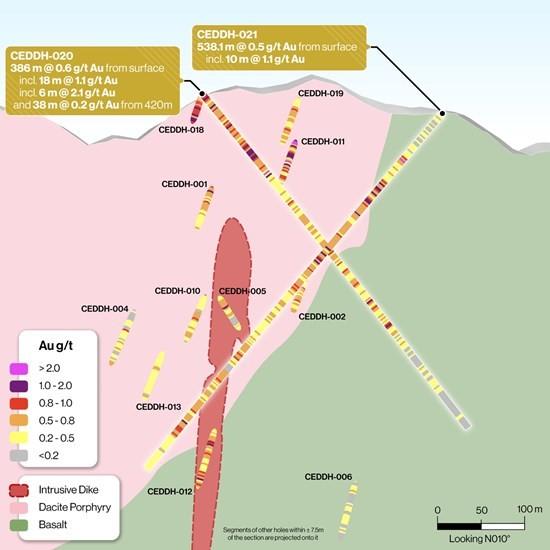
Figure 1: Ceibal Section Along CEDDH-020 and CEDDH-021 (looking N010°)
Both Holes Are Mineralized from Surface
CEDDH-021 intersected 538.1 metres grading 0.5 grams of gold per tonne (g/t Au) from surface to the end of the hole, including 10 metres grading 1.1 g/t Au from 112 metres downhole. CEDDH-020 intersected 386 metres grading 0.6 g/t Au from surface, including 18 metres grading 1.1 g/t Au from 78 metres downhole and 6 metres grading 2.1 g/t Au from 116 metres downhole (Table 1).
CEDDH-020 begins in a 53-metre oxide cap of porphyritic dacite with supergene argillic alteration, and CEDDH-021 in a 33.8-metre oxide cap of dacite and basalt saprolite. Grades in these upper parts may reflect supergene enrichment or depletion and are not necessarily representative of primary mineralization at depth.
Other holes shown in Figure 1 lie within 7.5 metres of the section and are projected onto it. Their results were reported in Tiger’s news releases dated March 17, June 2, July 23, and September 15, 2026.
Both holes cut porphyritic dacite and basalt, with intrusive breccia and intramineral diorite dykes (Figure 1). CEDDH-020 was collared in porphyritic dacite and entered basalt at 247.8 metres downhole. CEDDH-021 passed through saprolite and basalt before entering porphyritic dacite at 100.95 metres downhole, followed by intrusive breccia from 113.4 to 151.5 metres and mainly porphyritic dacite to the end of the hole. The veinlet types, alteration, and gold grades in both holes are similar to those in the southwest-directed holes.
In both holes, gold mineralization extends across the dacite-basalt contact, and grades are typically higher in the porphyritic dacite. The higher-grade intervals in CEDDH-020, from 78 to 96 metres (18 metres grading 1.1 g/t Au) and from 116 to 122 metres downhole (6 m grading 2.1 g/t Au), lie within about 100 metres of surface in porphyritic dacite with weak to moderate potassic alteration, overprinted by chlorite-sericite alteration.
Below 389 metres downhole, CEDDH-021 is mainly porphyritic dacite with moderate to strong potassic alteration, overprinted by chlorite-sericite alteration, with intrusive breccia from 405.1 to 411.6 metres. Strong potassic alteration was logged from 416.5 to 448.7 metres and from 499.1 to 519.2 metres, and potassic alteration continues to the end of the hole. CEDDH-021 ended about 70 metres west of the CEDDH-020 collar, and mineralization remains open at depth on the western side of the section. On the eastern side, CEDDH-020 remained mainly in basalt below 386 metres downhole.
CEDDH-021 also contains more persistent potassic alteration, a higher proportion of potassic-stage (QM-, M-, and B-type) veinlets than CEDDH-020. These features are interpreted to indicate that CEDDH-021 lies closer to a potassic core of the porphyry system than CEDDH-020.
More Results to Follow as Ceibal Drilling Continues with Three Rigs
Results are still to be reported for 13 holes: CEDDH-024 to CEDDH-036. Six of them (CEDDH-024, -025, -029, -031, -032, and -035) are testing the extent of mineralization to the southwest.
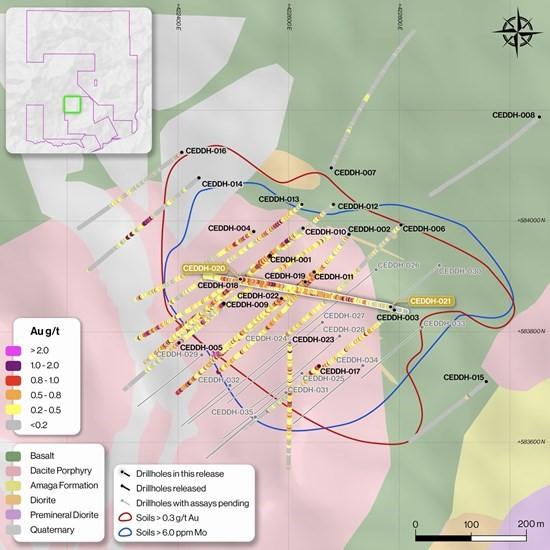
Figure 2: Ceibal Drillhole Collar and Section Location Plan Map
Three of Tiger’s drill rigs are drilling at Ceibal. Tiger has drilled more than 12,200 metres in 30 holes at Ceibal to date, as part of its ongoing drill program. Drilling at Ceibal is intended to support a maiden Mineral Resource estimate, which Tiger is targeting to report in the first quarter of 2027.
Results are also pending from 19 holes (3,484 metres) at Tesorito. These results are designed to support an updated Mineral Resource estimate for Tesorito in early 2027. That estimate is to be followed by a Preliminary Economic Assessment (PEA), targeted for near the end of the first quarter of 2027. The 2027 PEA is anticipated to incorporate Tesorito, Miraflores, and, subject to completion of a maiden Mineral Resource estimate, Ceibal.
Qualified Person
The pertinent scientific and technical information contained in this news release has been reviewed and approved by Jeremy Link, M.Eng., P.Eng., Tiger’s Vice-President, Corporate Development, and César García, M.Sc., FAusIMM, the Company’s Exploration Manager in Colombia, each of whom is a “qualified person” as defined by Canadian Securities Administrators within the meaning of National Instrument 43-101 Standards of Disclosure for Mineral Projects (“NI 43-101”). Neither Mr. Link nor Mr. García is independent of the Company. Drill programs at Ceibal are designed by Mr. Link and Mr. García. Exploration programs at the Quinchía Gold Project are directed and supervised by Mr. García.
Sampling, Quality Assurance, and Quality Control
All drilling was completed using HQ- and NQ-diameter diamond core. Drill core is logged by a Company geologist, photographed, cut in half, and sampled at the Company’s core facility in Quinchía, Colombia under the supervision of a geologist. One half of the core is bagged and sent to ALS’ laboratory in Medellín for sample preparation, with sub-samples sent to ALS’ laboratories in Lima, Perú or North Vancouver, British Columbia for analysis. The remaining half-core (or quarter-core if a core duplicate sample was taken) is retained onsite as a witness sample. Core was sampled over nominal 2-metre intervals, adjusted to geological boundaries. ALS’ Medellín, Lima, and North Vancouver laboratories are ISO/IEC 17025 accredited and are independent of the Company. All samples are analyzed for gold using 50 g fire assay with AAS finish (Au-AA26). Samples are also analyzed for a 48-element suite by ICP-AES and ICP-MS following a four-acid digestion (ME-MS61 or ME-MS61L). Where applicable, high-grade and overlimit assays are re-analyzed using an appropriate technique. In addition to the laboratory’s quality assurance and quality control (“QA/QC”) practices, certified reference materials, coarse blanks, and quarter-core duplicates are inserted into the sample stream to monitor analytical performance. Mr. García has verified the data underlying the results disclosed in this news release, including the sampling, analytical, and test data, by reviewing the certified reference material, blank, and duplicate QA/QC results against the assay database, and neither Mr. García nor Mr. Link is aware of any limitations on that verification. Other than as reported, no unreported significant core recovery or drilling issues were encountered during the program. Drill core was oriented, and downhole orientation surveys were collected at regular intervals. For data verification of the prior operator drilling results (CEDDH-001 to CEDDH-008) referenced in this news release, see Tiger’s news release titled “Tiger Gold Drills 120 m Step-out at Ceibal and Intersects 226 m @ 0.6 g/t Au, Including 10 m @ 3 g/t Au” dated May 13, 2026. Only results that meet Tiger’s QA/QC protocols are reported.
About Tiger Gold Corp.
Tiger is a growth-oriented gold exploration and mine development company focused on advancing its 100% owned flagship asset, the Quinchía Gold Project, in the prolific Mid-Cauca belt of Colombia. Tiger is led by a multidisciplinary team of exploration geologists, mine builders, engineers, metallurgists, ESG specialists, and corporate finance professionals with a track record of exploration success, project advancement, and bringing mines into production at globally recognized mining companies including AngloGold Ashanti, Barrick Mining, Yamana Gold, Detour Gold, New Gold, Pretium Resources, and others.
Galantas Gold Corporation (TSX-V: GAL) (AIM: GAL) announces posit... READ MORE
NevGold Corp. (TSX-V:NAU) (OTCQX:NAUFF) (Frankfurt:5E50) is pleas... READ MORE
Cambria Gold Mines Inc. (TSX-V: CAMB) (OTCQX: CAMVF) is pleased t... READ MORE
Standard Uranium Ltd. (TSX-V: STND) (OTCQB: STTDF) (FSE: 9SU0) ... READ MORE
St. Augustine Gold and Copper Limited (TSX: SAU) announces that i... READ MORE