







Spark Energy Minerals Inc. (CSE: SPRK) (OTC Pink: SPARF) (FSE: 8PC) reports assay results from nine reverse circulation drill holes at its 100% owned Arapaima Project in Minas Gerais, Brazil: eight holes at the Cruzeta target (ARA-RC-035 to ARA-RC-042) and ARA-RC-032, the first hole reported from the Domingos Gonçalves target.
At Cruzeta, 282 m of the 362 m drilled (78%) fall within main intervals grading 500 ppm total rare earth oxides or more. ARA-RC-036 returned 52 m at 1,906 ppm TREO from surface, including 6 m at 3,740 ppm, and ARA-RC-035 returned 76 m at 1,385 ppm TREO from surface. The highest 2 m sample of the nine holes returned 4,613 ppm TREO, of which 29.2% is magnet rare earth oxides. All eight Cruzeta holes ended in mineralization. All grades are in-situ analytical results; no metallurgical recovery is implied.
ARA-RC-032, drilled about 5 km east-southeast of the Boa Vista holes and about 11 km from the nearest Cruzeta hole, returned 34 m at 776 ppm TREO from 4 m and 12 m at 60 g/t gallium oxide from surface, consistent with the gallium-over-rare-earth profile seen at Cruzeta and Boa Vista.
Highlights
Reporting basis. Arapaima is an exploration-stage property. No mineral resource or mineral reserve has been estimated, no economic study has been completed and no metallurgical recovery of any element has been demonstrated. Results are in-situ analytical results from vertical RC holes; intervals are down-hole lengths and true widths are not known. The 500 ppm TREO, 50 g/t Ga2O3, 50 and 100 ppm Y2O3 and 15 g/t Sc2O3 thresholds used to define intervals are reporting criteria, not economic cut-off grades. This release should be read with the Technical Notes, the cautionary statements and the Qualified Persons statement below.
Comment from the Chairman and Chief Executive Officer
“Grade is what these nine holes add. In ARA-RC-036 we cut 52 m at 1,906 ppm TREO from surface, in ARA-RC-035 76 m at 1,385 ppm from surface, and in ARA-RC-038 a 2 m sample at 4,613 ppm in which 29% of the rare earth oxides are the magnet elements neodymium, praseodymium, dysprosium and terbium. Across the eight Cruzeta holes, 78% of samples grade 500 ppm TREO or more, every hole ends in mineralization, and the magnet share rises as the grade rises. Gallium sits in the same profile from surface, with 14 m at 67 g/t Ga2O3in ARA-RC-042, and yttrium and scandium are there too, scandium at a low level. Gallium, yttrium, scandium and the dysprosium and terbium of the magnet fraction are all subject to Chinese export licensing, and each is present in these holes.
“Supply security has moved from a policy discussion to a boardroom issue. China produced about 99% of the world’s primary low-purity gallium in 2025 and, according to the International Energy Agency, refined 91% of the world’s rare earths and made 94% of its sintered magnets in 2024. The G7 leaders have set the aim of reducing their dependence on a single supplier outside the G7 and its partners for rare earths and permanent magnets to under 60% by 2030. The difficulty is time. S&P Global Market Intelligence found that the mines that started producing between 2020 and 2023 took almost eighteen years on average from discovery to first production, while the IEA expects demand for magnet rare earths to expand by a further third by 2030. With lead times of that order, every year lost at the start is a year added at the end. That is why securing supply is a strategic matter, and why the agencies and governments weighing support for early-stage projects need to decide in months, not years. Our objective is to take Arapaima from discovery toward a mineral resource estimate and an economic study as quickly as capital allows,” said Dr. Fernando Tallarico, Chairman and Chief Executive Officer of Spark.
Grade and Thickness at Cruzeta
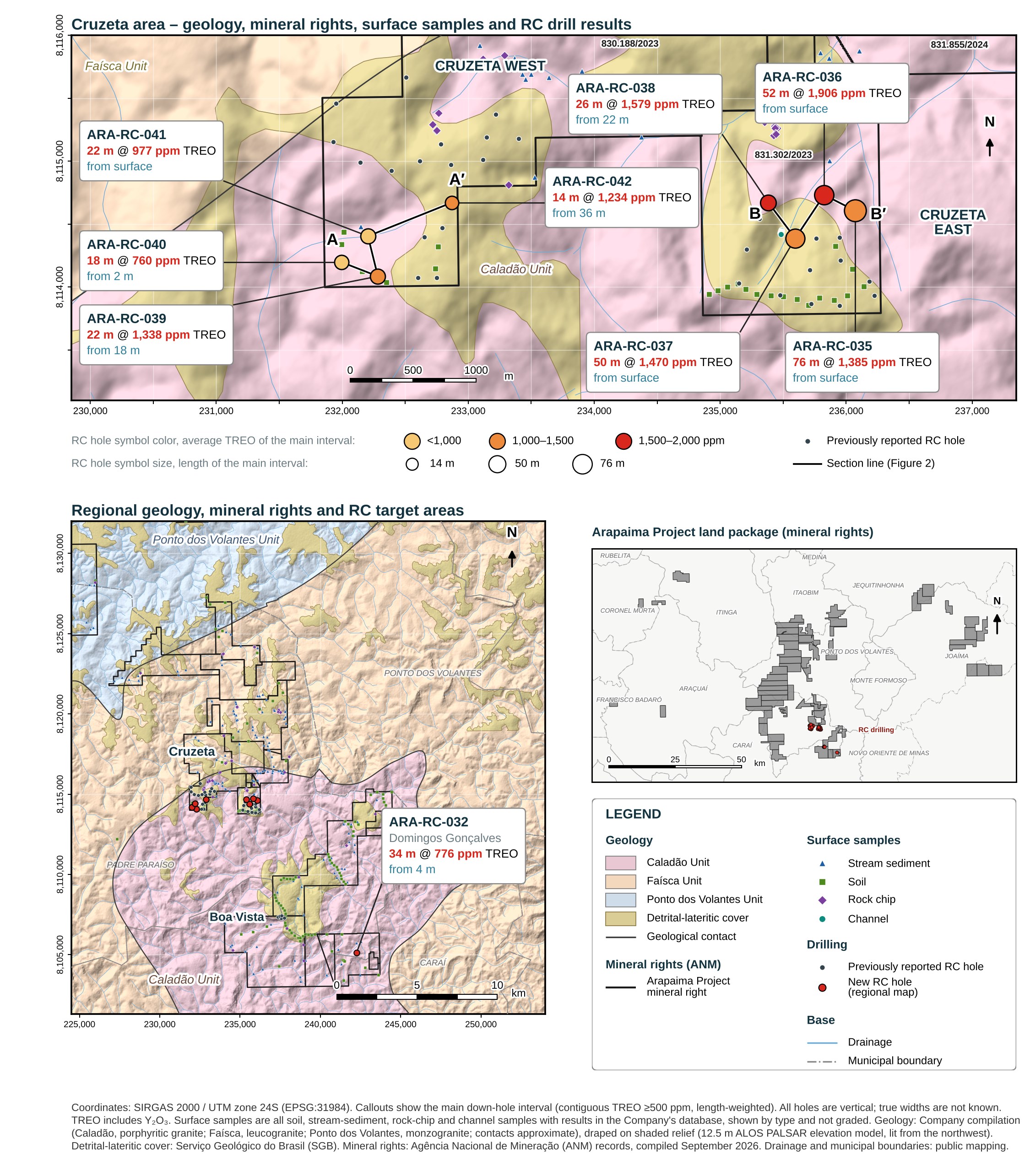
The eight holes were drilled inside the Cruzeta footprint reported on July 22, 2026, four in the eastern area (ARA-RC-035 to ARA-RC-038) and four in the western area (ARA-RC-039 to ARA-RC-042), 146 to 312 m from the nearest neighboring Cruzeta hole (Figure 1). Each hole intersected a main interval grading 500 ppm TREO or more, and all eight ended in mineralization, with final 2 m samples of 580 to 1,432 ppm TREO. The main intervals total 282 m of the 362 m drilled (78%).
Cruzeta East. The four eastern holes carry the thickest and highest-grade intervals of the program. ARA-RC-036 returned 52 m at 1,906 ppm TREO from surface, including 6 m at 3,740 ppm TREO from 12 m (22.0% MREO; 786 ppm neodymium and praseodymium oxides, “NdPr”) and 14 m at 2,403 ppm TREO from 30 m. ARA-RC-035 returned 76 m at 1,385 ppm TREO from surface, including 2 m at 2,256 ppm from 50 m and 2 m at 2,373 ppm from 66 m. ARA-RC-037 returned 50 m at 1,470 ppm TREO from surface, including 4 m at 2,437 ppm from 12 m, 2 m at 3,279 ppm (29.6% MREO) from 16 m and 6 m at 2,498 ppm from 24 m. ARA-RC-038 returned 26 m at 1,579 ppm TREO from 22 m to the end of the hole at 48 m, including 4 m at 2,473 ppm from 30 m and 2 m at 4,613 ppm from 34 m, the highest sample of the nine holes.
Figure 1. Geology, mineral rights, surface samples and RC drill results at Cruzeta (upper panel), regional geology and mineral rights around the drilled targets (lower left) and the Arapaima Project land package (lower right). The upper panel shows the eight holes reported in this release (ARA-RC-035 to ARA-RC-042) with their main intervals at 500 ppm TREO or more; the regional map also shows ARA-RC-032 at Domingos Gonçalves. All holes are vertical and true widths are not known. Geological units and contacts are the Company’s compilation and are approximate, shown on shaded relief (12.5 m elevation model); the detrital-lateritic cover is from the Serviço Geológico do Brasil (SGB); mineral rights are as registered with the Agência Nacional de Mineração (ANM), compiled in September 2026.
To view an enhanced version of this graphic, please visit:
https://images.newsfilecorp.com/files/10093/321338_8a258b3df48868d7_002full.jpg
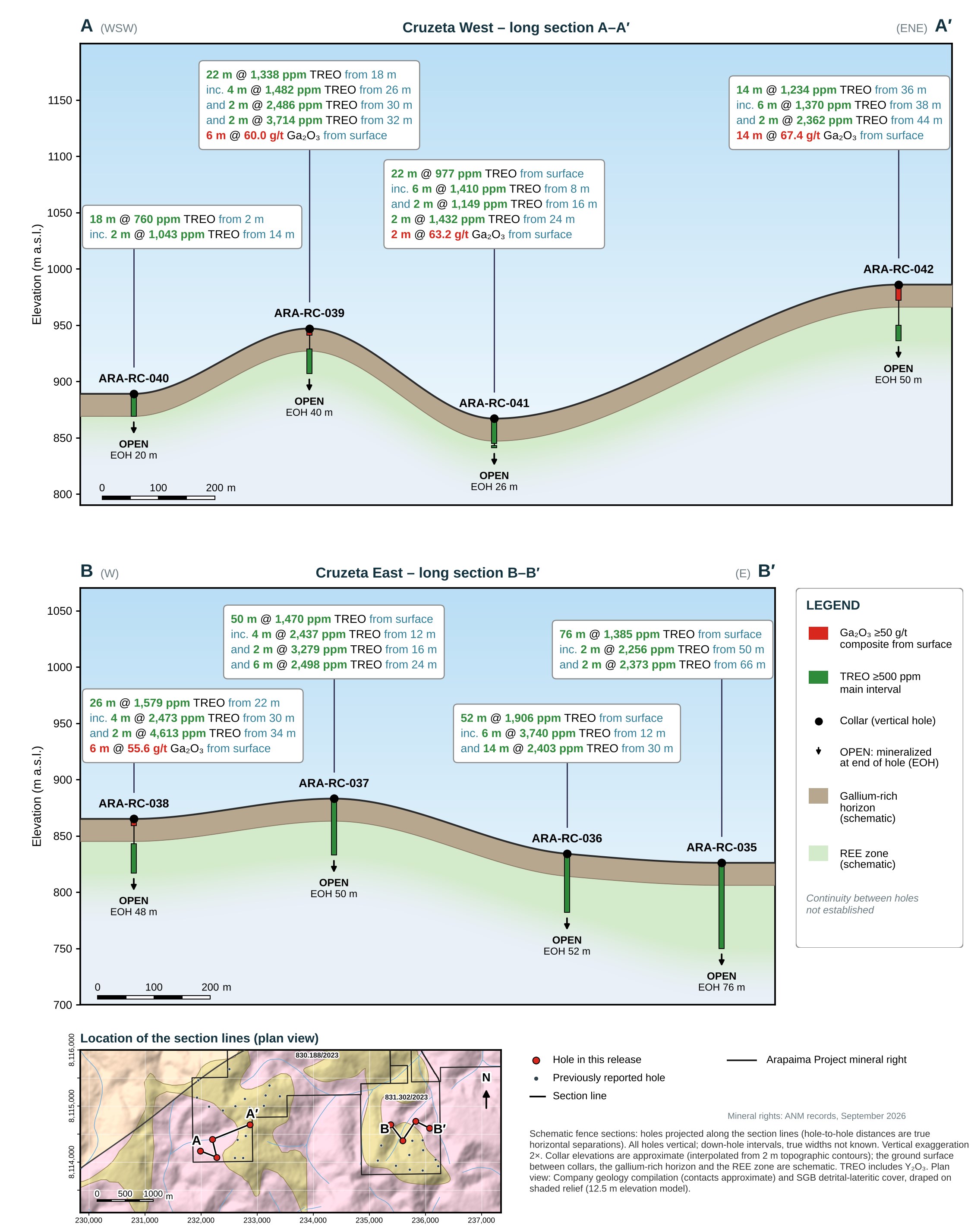
Cruzeta West. The four western holes are shallower (20 to 50 m) and returned main intervals of 14 to 22 m. ARA-RC-039 returned 22 m at 1,338 ppm TREO from 18 m, including 2 m at 2,486 ppm from 30 m and 2 m at 3,714 ppm from 32 m. ARA-RC-042 returned 14 m at 1,234 ppm TREO from 36 m to the end of the hole at 50 m, including 2 m at 2,362 ppm from 44 m. ARA-RC-041 returned 22 m at 977 ppm TREO from surface, including 6 m at 1,410 ppm from 8 m, and a separate 2 m at 1,432 ppm TREO from 24 m at the end of the hole. ARA-RC-040 returned 18 m at 760 ppm TREO from 2 m to the end of the hole at 20 m. Long sections through both areas are shown in Figure 2.
Highest grades. Six 2 m samples in four holes grade 3,000 ppm TREO or more, and 25 of the 208 samples grade 2,000 ppm or more. The highest, ARA-RC-038 at 34 to 36 m, returned 4,613 ppm TREO, with 1,349 ppm MREO (29.2% of TREO), 1,298 ppm NdPr oxides, 41.3 ppm dysprosium oxide (“Dy2O3“) and 9.1 ppm terbium oxide (“Tb4O7“). Three consecutive samples in ARA-RC-036 between 12 and 18 m grade 3,370, 3,903 and 3,946 ppm TREO, ARA-RC-039 returned 3,714 ppm at 32 to 34 m and ARA-RC-037 returned 3,279 ppm at 16 to 18 m.
Magnet rare earths rise with grade. In the nine holes, MREO makes up 14.1% of TREO in the 49 samples below 500 ppm TREO, 20.3% in the 62 samples between 500 and 1,000 ppm, 22.2% in the 19 samples between 2,000 and 3,000 ppm and 24.5% in the six samples of 3,000 ppm or more (Table A7; ratios of summed grades). The main intervals contain 20.3% to 23.3% MREO and 19.2% to 22.4% NdPr oxides. This is a statistical relationship in the samples analyzed and does not establish the form in which the elements occur or how they would be recovered.
Gallium, Yttrium and Scandium Sit in the Same Profile
Gallium, yttrium and scandium were analyzed in every sample, and each sits in the same profile as the rare earths (Tables A4 to A6 and A8).
Gallium. Gallium oxide is highest in the upper part of the profile, above the main rare earth zone (Figure 2). Composites of 50 g/t Ga2O3 or more from surface were returned in four of the nine holes: 14 m at 67 g/t in ARA-RC-042 (peak 78 g/t at 2 to 4 m), 6 m at 60 g/t in ARA-RC-039, 6 m at 56 g/t in ARA-RC-038 and 12 m at 60 g/t in ARA-RC-032; the first 2 m sample of ARA-RC-041 returned 63 g/t. ARA-RC-042 also returned 20 m at 56 g/t from 22 m, and 20 of its 25 samples grade 50 g/t or more. Of the 208 samples, 38 grade 50 g/t Ga2O3 or more, and the upper 20 m is richer in the west than in the east (17 of 40 samples at 50 g/t or more, with a mean of 50 g/t, against 4 of 40, with a mean of 42 g/t). Gallium declines with depth, from a mean of 51 g/t in the first 10 m to 34 g/t below 40 m, while the share of samples at 500 ppm TREO or more rises from 60% in the first 10 m to 91% between 30 and 40 m.
Yttrium. Yttrium follows the rare earth zone. ARA-RC-036 returned 40 m at 102 ppm Y2O3 from 6 m (2,223 ppm TREO), including 4 m at 122 ppm from 30 m and 4 m at 276 ppm from 40 m, with a maximum single-sample value of 315 ppm Y2O3 at 40 to 42 m. ARA-RC-037 returned 22 m at 83 ppm Y2O3 from 14 m, including 4 m at 109 ppm from 28 m. Composites of 50 ppm Y2O3 or more occur in seven of the nine holes (Table A5).
Scandium. Scandium was detected at or above the 5 ppm Sc detection limit in 98 of the 208 samples and reached 12 ppm Sc (18.4 g/t Sc2O3) in ARA-RC-036 (32 to 34 m) and ARA-RC-042 (40 to 42 m). Composites of 15 g/t Sc2O3 or more over at least 4 m occur in ARA-RC-036 (8 m at 16.1 g/t from 10 m and 4 m at 16.9 g/t from 32 m) and ARA-RC-042 (4 m at 15.3 g/t from 2 m and 6 m at 16.9 g/t from 36 m). These are low values close to the detection limit. Scandium is reported as an analytical observation: its host is not known, it is not interpreted as ionically adsorbed, no recovery of scandium has been demonstrated and no scandium potential is implied.
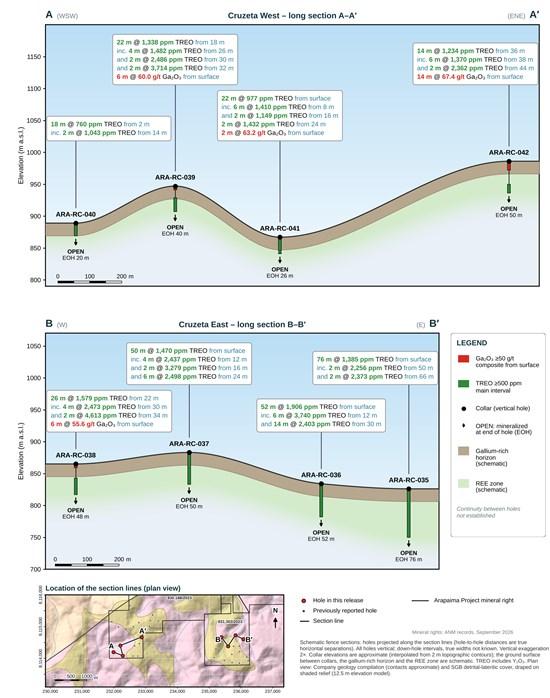
Figure 2. Long sections of Cruzeta West (A-A′, upper) and Cruzeta East (B-B′, lower), with the section lines in plan view (lower left; geology, detrital-lateritic cover and mineral rights as in Figure 1). On each hole log, green shows the main intervals of 500 ppm TREO or more and red the gallium composite of 50 g/t Ga2O3 or more from surface; “OPEN” marks holes that ended in mineralization. Collar elevations are approximate (interpolated from 2 m topographic contours); the ground surface, the gallium-rich horizon and the REE zone are schematic. Vertical exaggeration is 2×, all holes are vertical, true widths are not known and continuity between holes has not been established.
To view an enhanced version of this graphic, please visit:
https://images.newsfilecorp.com/files/10093/321338_8a258b3df48868d7_003full.jpg
First Hole at Domingos Gonçalves
ARA-RC-032 is a single vertical hole drilled to 54 m at the Domingos Gonçalves target, about 5 km east-southeast of the Boa Vista holes and about 11 km from the nearest Cruzeta hole. It returned 34 m at 776 ppm TREO from 4 m (22.0% MREO; 20.7% NdPr oxides), including 2 m at 1,054 ppm TREO (26.0% MREO) from 16 m, and 12 m at 60 g/t Ga2O3 from surface (peak 65 g/t at 4 to 6 m). The last two samples, at 50 to 54 m, grade 494 and 384 ppm TREO, below the 500 ppm threshold, so unlike the Cruzeta holes this hole did not end in mineralization at that threshold. One hole does not establish the extent or continuity of mineralization at Domingos Gonçalves; the result shows gallium near surface above a rare earth zone, consistent with the profile at Cruzeta and Boa Vista, and the target requires further drilling.
Scale and Continuity
The eight Cruzeta holes were drilled inside the footprint reported on July 22, 2026, so they add data within the target rather than extending it. With them, 36 holes at Cruzeta have returned results: all 36 intersected a main interval of 500 ppm TREO or more and 30 ended in mineralization. Five of the 42 holes drilled at Arapaima returned main intervals of 50 m or more, and three of them, ARA-RC-035, ARA-RC-036 and ARA-RC-037, are reported here and begin at surface. The three drilled targets lie within a land package of approximately 91,900 hectares, most of which has not been drilled.
The eight holes show the same vertical zoning as the earlier holes: gallium is highest near surface and TREO is highest below it, in both the eastern and western areas (Table A8). That zoning is the Company’s interpretation of a weathering profile over the Caladão Granite. It does not establish geological or grade continuity: the new holes lie 146 to 312 m from their nearest neighbors, they are vertical RC holes sampled at 2 m, and no metallurgical recovery data have been reported.
A mineral resource estimate requires, among other things, drilling at a spacing that supports geological and grade continuity, a verified and quality-controlled database and metallurgical information. The Company has not begun a mineral resource estimate, has not estimated any tonnage or grade range and cannot say whether the drilling to date will support one; the hole spacing, the use of vertical RC drilling and the absence of reported metallurgical recovery data are among the factors that will determine that.
Why Supply Security Has Become a Strategic Question
Governments and manufacturers are re-examining how exposed they are to a single source of supply. China produced about 99% of the world’s primary low-purity gallium in 2025 (U.S. Geological Survey, Mineral Commodity Summaries 2026). In 2024 it mined about 60% of the world’s magnet rare earths, refined 91% of the world’s rare earths and produced 94% of its sintered permanent magnets (International Energy Agency, April 2026). At the G7 summit in Evian on June 17, 2026, the leaders set the aim of reducing their dependence on a single supplier outside the G7 and its partners for rare earths and permanent magnets to under 60% by 2030.
Gallium, yttrium, scandium and the dysprosium and terbium of the MREO fraction are all subject to Chinese export licensing. China has required licenses for gallium exports since August 1, 2023. Since April 4, 2025 it has required licenses for seven medium and heavy rare earths (samarium, gadolinium, terbium, dysprosium, lutetium, scandium and yttrium), and that requirement remains in force. A wider package of rare earth measures announced in October 2025, and China’s ban on exports of gallium and other dual-use items to the United States, were suspended in November 2025 for about one year under the October 2025 trade understanding between Washington and Beijing. The suspensions are temporary, and whether they are extended, modified or ended is a decision for the Chinese authorities (announcements of China’s Ministry of Commerce, as reported by Xinhua and Pillsbury).
Supply cannot be created quickly. S&P Global Market Intelligence found that the mines that began producing between 2020 and 2023 took almost 18 years on average to go from discovery to first production (April 2024). The IEA reports that demand for magnet rare earths (neodymium, praseodymium, dysprosium and terbium, the four oxides that make up MREO in this release) has doubled since 2015 and is set to expand by a further third by 2030 under current policy settings, and that, even with planned expansions, expected production from existing capacity outside China would cover only about 50% of the mining demand projected for 2035, 25% of the refining demand and well below 20% of the magnet demand (April 2026).
Arapaima combines gallium, rare earths including the magnet rare earths, yttrium and scandium in one weathering profile on a land package of approximately 91,900 hectares that is 100% owned by Spark and is not subject to any offtake or partnership agreement. That is an exploration observation, not a statement about supply: no mineral resource has been estimated, no recovery of any element from Arapaima material has been demonstrated, and the market and policy information above is third-party information that is not an indication of the value of any Arapaima mineralization.
Drilling at Arapaima
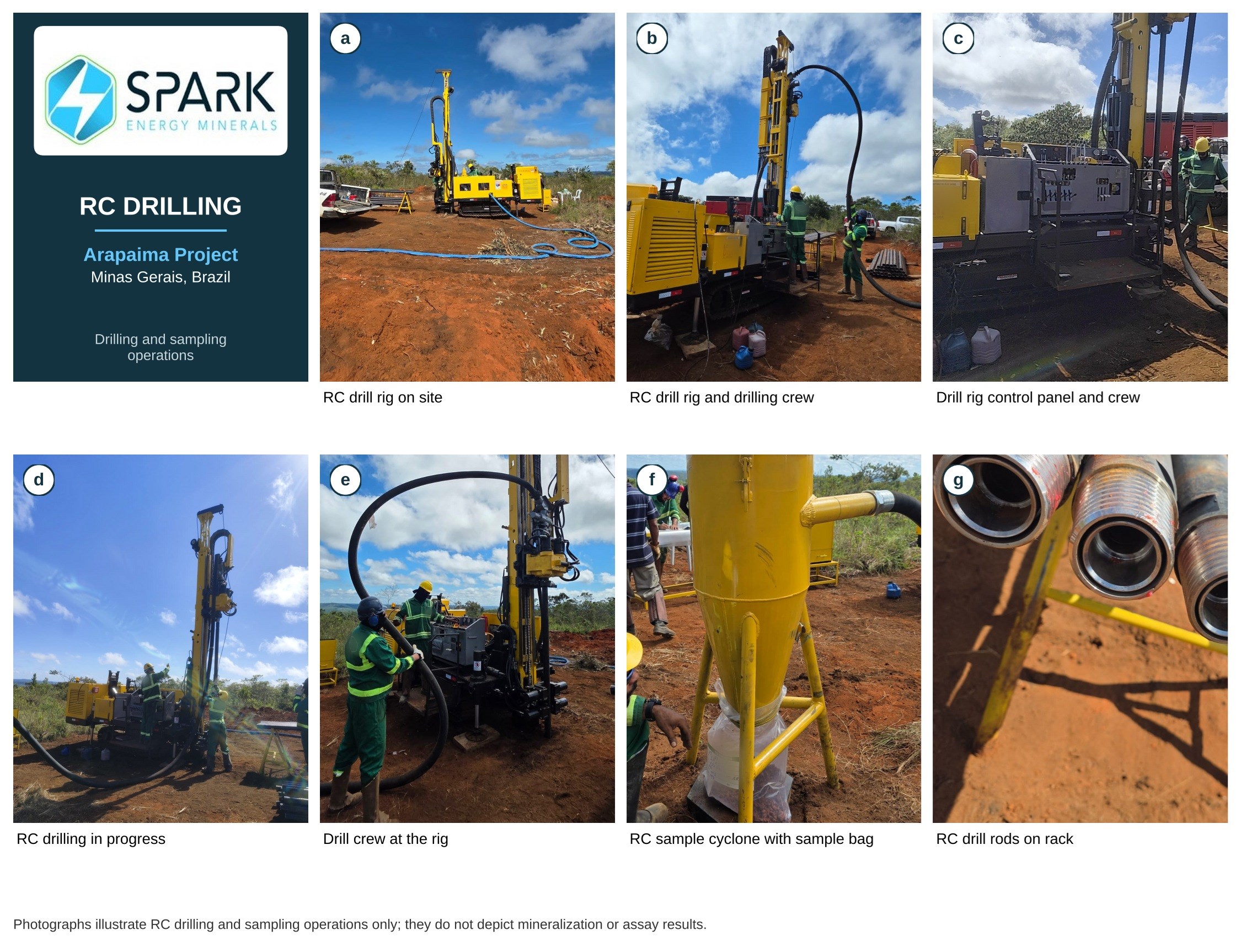
The nine holes reported here are part of the 2,320 m of RC drilling completed in 42 holes at Cruzeta, Boa Vista and Domingos Gonçalves. Figure 3 shows the drilling and sampling operations.
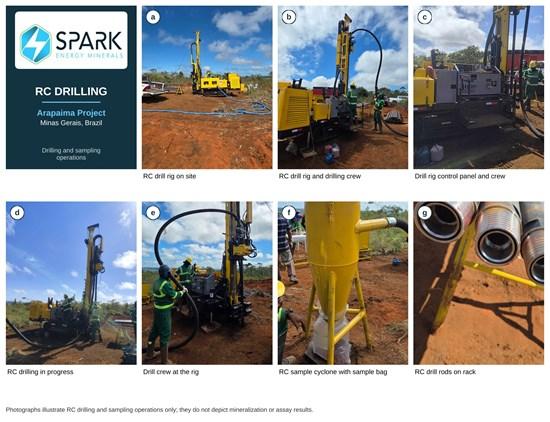
Figure 3. RC drilling and sampling operations at Arapaima: (a) RC drill rig on site; (b) rig and drilling crew; (c) rig control panel and crew; (d) drilling in progress; (e) drill crew at the rig; (f) sample cyclone with sample bag; (g) drill rods on rack. The photographs illustrate drilling and sampling operations only; they do not depict mineralization or assay results.
To view an enhanced version of this graphic, please visit:
https://images.newsfilecorp.com/files/10093/321338_8a258b3df48868d7_004full.jpg
Next Steps
The Company plans to collar a drill hole at the top of the Cruzeta road cut, where access allows, to test the granite below the sampled face, as announced on October 8, 2026. This work is subject to financing, and the scope and timing of any further drilling at Arapaima have not been determined.
Mineralogical and metallurgical test work on the clay mineralization, including the deportment and recoverability of gallium, rare earths, yttrium and scandium, is planned; no results of that work have been reported to date.
Gallium, yttrium and scandium will be reported with every future drill result at Arapaima; no resource estimation has begun.
The Company’s applications for government support, disclosed on September 23, 2026, remain under evaluation; no decision has been made and no funding has been awarded.
Selected assay results for all 208 samples from the nine drill holes, together with drill-hole information, reported intervals, composites and technical notes, are available in the Supporting Assay Schedule (PDF).
The schedules of August 13, August 27 and October 8, 2026 remain available through the links in those releases.
Drill Hole Information
The nine holes are vertical RC holes (dip −90°). Collar coordinates (SIRGAS 2000, UTM zone 24S), elevations and end-of-hole depths are listed in Table A1. Reported intervals are down-hole lengths; because the holes are vertical and the orientation of the mineralization is not known, true widths are not known and may differ materially from the down-hole lengths. The holes are assumed to be vertical; no down-hole survey data have been recorded.
Technical Notes and Reporting Basis
Calculations. TREO is the sum of 15 oxides: La2O3, CeO2, Pr6O11, Nd2O3, Sm2O3, Eu2O3, Gd2O3, Tb4O7, Dy2O3, Ho2O3, Er2O3, Tm2O3, Yb2O3, Lu2O3 and Y2O3; scandium is not included. MREO is Nd2O3 + Pr6O11 + Dy2O3 + Tb4O7, samarium is not included, and NdPr is Nd2O3 + Pr6O11. MREO and NdPr percentages are the ratio of the summed oxide grades to the summed TREO. Oxide grades are calculated from the elemental assays, for example Y2O3 = Y × 1.2699, Ga2O3 = Ga × 1.3442 and Sc2O3 = Sc × 1.5338. Where a lanthanide was reported below its detection limit, the detection limit is included in TREO, an upper bound; this applies to 3 of the 208 samples, by 0.06 to 0.11 ppm TREO, none in an MREO component, and has no effect on any reported interval. Scandium was reported below the 5 ppm detection limit (7.7 g/t Sc2O3) in 110 samples.
Intervals. Main intervals are consecutive 2 m samples grading 500 ppm TREO or more, with no internal dilution, reported as length-weighted averages; where a hole has two separate intervals, both are shown as main intervals (ARA-RC-041). One isolated 2 m sample grading 516 ppm TREO (32 to 34 m in ARA-RC-042) lies outside the reported main interval and is not reported as a separate interval. Sub-interval are higher-grade portions of a main interval selected by the Qualified Persons from consecutive 2 m samples; they are part of, not additional to, the main interval. Gallium composites are consecutive samples from surface grading 50 g/t Ga2O3 or more over at least 4 m, with no internal dilution. Yttrium composites are consecutive samples grading 50 ppm or 100 ppm Y2O3 or more over at least 4 m, and scandium composites are consecutive samples grading 15 g/t Sc2O3 or more over at least 4 m, in each case with no internal dilution. These thresholds are reporting criteria used to describe the data; they are not economic cut-off grades, and no economic significance should be attached to them.
Basis of the results. All results are in-situ analytical results of RC samples; they do not represent recoverable grades or the recovery of any element. Intervals are down-hole lengths and true widths are not known. The description of the profile as a gallium-rich horizon above a REE zone, its interpretation as ionic adsorption clay-style mineralization and the observation that MREO rises with grade are interpretations of the Qualified Persons that may change with further work. Statistics are computed on primary samples; quality-control samples are excluded. Values are rounded, and totals and percentages may not sum exactly. Comparisons with earlier holes refer to Spark’s own drilling only.
Collar elevations. The elevation (RL) of each collar in Table A1 is approximate: it is interpolated from 2 m topographic contours and was not surveyed. These elevations replace the field-GPS elevations published in the drill-hole tables of the Company’s earlier releases. For the 33 holes reported earlier, the revised elevations differ from the published values by between 117 m lower and 148 m higher (24 of the 33 holes by more than 15 m), and the horizontal coordinates differ by no more than 1 m. Elevations do not affect the down-hole depths, intervals or grades reported; they affect only the vertical position of the holes in sections.
Previously disclosed information. The news release of October 20, 2026 referred to nine further holes at Cruzeta and Boa Vista awaiting reporting. Of the nine holes reported here, eight are at Cruzeta (ARA-RC-035 to ARA-RC-042) and one, ARA-RC-032, is at the Domingos Gonçalves target, about 5 km east-southeast of the Boa Vista holes.
Sampling, Analytical Procedures and QA/QC
RC drill samples were collected at 2 m down-hole intervals from vertical holes and split with a Jones riffle splitter to approximately 2 kg for analysis, with approximately 1 kg retained for archiving. The Company’s quality-control program comprises a blank (crushed quartz) as the first sample of each batch, each drill hole constituting a batch, a field duplicate every 20 samples and two certified reference materials every 25 samples; control results are used to monitor laboratory accuracy and precision and are excluded from the reported tables. In all nine holes the gaps in the primary sample numbering correspond to the control samples that this program requires. All samples were analyzed by SGS Geosol Laboratórios (Vespasiano, Minas Gerais, Brazil), an independent laboratory certified to ISO 9001:2015 and ISO 14001:2015. Sample preparation comprised crushing (75% passing 3 mm), pulverizing (250 g, 95% passing 150 mesh) and Jones splitting (code PRP70J_A2), and analysis was by sodium peroxide fusion followed by inductively coupled plasma optical emission spectrometry (ICP-OES) and mass spectrometry (ICP-MS) (code ICM90A), as recorded on the laboratory certificates of analysis.
Data Verification
The data disclosed in this release were verified as follows. The results of the 27 primary samples of ARA-RC-032 were compared, element by element, with SGS Geosol certificate of analysis GQ2608068 and with the Company’s assay database, and no differences were found. The oxide conversions, intervals, composites, highest values and statistics were recalculated independently from the primary samples and reproduce the values in this release. The results of the 181 primary samples of ARA-RC-035 to ARA-RC-042 were compared, element by element, with the SGS Geosol certificates of analysis that report them and with the Company’s assay database, and no differences were found; the quality-control results and the collar information were reviewed. No independent re-sampling or re-assaying was undertaken. The results are not a mineral resource estimate, and the limitations described in this release apply to them.
Exploration-Stage Property; No Mineral Resource or Economic Analysis
Arapaima is an exploration-stage property. No mineral resource or mineral reserve has been estimated at Arapaima, and no preliminary economic assessment, pre-feasibility study or feasibility study has been completed or disclosed. The results reported here are not in any resource or reserve category, and there is no certainty that further exploration will result in the delineation of a mineral resource or that any mineralization will prove to be economically or technically viable to extract. No recovery of gallium, rare earths, yttrium or scandium from Arapaima material has been demonstrated, and no metallurgical test results have been reported.
Cautionary Statement Regarding Exploration Results
The exploration results in this release are preliminary. Drill intercepts are based on assays of individual vertical RC holes and are not necessarily indicative of mineralization elsewhere on the property or at depth. Intervals, composites and statistics describe the geochemical distribution of the elements in the samples analyzed; they are not evidence of continuity, of grade over any volume or of economic potential. Reported lengths are down-hole lengths; true widths are not known and may differ materially. References to a “system”, “footprint”, “continuity”, “zoning”, “profile” or deposit “style”, including any ionic adsorption clay-style interpretation, reflect the Company’s current geological interpretation only and have not been verified by a mineral resource estimate. Individual high-grade samples are not necessarily representative of the mineralization sampled. RC sampling may be subject to contamination, sample loss and down-hole dilution that can affect reported grades. The scandium results are low values close to the detection limit; scandium is reported as an analytical observation, its host is not known, it has not been interpreted as ionically adsorbed, no scandium recovery has been demonstrated and no scandium potential is implied. The relationship between MREO and grade is a statistical relationship in the samples analyzed and does not establish how the elements occur or how they would be recovered. Market and policy information in this release is third-party information and is not an indication of the value of any Arapaima mineralization.
Qualified Persons
The scientific and technical information in this news release has been reviewed and approved by Jonathan Victor Hill, BSc (Hons), FAusIMM, Vice President Exploration, Country Manager and Director of the Company, and by Dr. Fernando Tallarico, P.Geo., FSEG, Chief Executive Officer and Chairman of the Company, each of whom is a Qualified Person as defined in National Instrument 43-101 Standards of Disclosure for Mineral Projects. Neither is independent of the Company.
About Spark Energy Minerals Inc.
Spark Energy Minerals Inc. is a Canadian critical minerals exploration company whose principal asset, the Arapaima Project, comprises approximately 91,900 hectares across several municipalities in the Lithium Valley region of Minas Gerais, Brazil. The Company has made gallium and rare earth element discoveries at Cruzeta and, more recently, at Boa Vista, in a weathering profile over the Caladão Granite, which it interprets as ionic adsorption clay-style mineralization. Lithium-bearing pegmatites are a secondary target on the property. The Company also holds the Seridó tungsten project in Rio Grande do Norte and the Solonópole tantalum and lithium project in Ceará, Brazil.
For Additional Information, Please Contact
Spark Energy Minerals Inc.
Attention: Dr. Fernando Tallarico, P.Geo., FSEG, Chief Executive Officer and Chairman
Telephone: +1-877-272-9226
Email: connect@sparkminerals.co
Website: www.sparkminerals.co
On behalf of the Board of Directors of Spark Energy Minerals Inc.
Dr. Fernando Tallarico, Chief Executive Officer and Chairman
Neither the Canadian Securities Exchange nor its Regulation Services Provider, the Canadian Investment Regulatory Organization, accepts responsibility for the adequacy or accuracy of this release.
Appendix A. Supporting Tables
All values are calculated from the sample-level assay results of the nine holes (208 primary samples, all 2 m; SGS Geosol, method ICM90A). In-situ analytical results; not recoverable grades. Down-hole lengths; true widths are not known. TREO includes Y2O3. Thresholds are reporting criteria, not cut-off grades. Quality-control samples are excluded.
Table A1. Drill hole collar information
| Hole | Easting (m) | Northing (m) | RL (m) | EOH (m) | Dip | Final 2 m sample, TREO (ppm) |
| Cruzeta East | ||||||
| ARA-RC-035 | 236070 | 8114608 | 826 | 76 | −90° | 862 |
| ARA-RC-036 | 235825 | 8114732 | 834 | 52 | −90° | 750 |
| ARA-RC-037 | 235596 | 8114387 | 883 | 50 | −90° | 843 |
| ARA-RC-038 | 235382 | 8114671 | 865 | 48 | −90° | 963 |
| Cruzeta West | ||||||
| ARA-RC-039 | 232283 | 8114086 | 947 | 40 | −90° | 879 |
| ARA-RC-040 | 231992 | 8114199 | 889 | 20 | −90° | 580 |
| ARA-RC-041 | 232204 | 8114405 | 867 | 26 | −90° | 1,432 |
| ARA-RC-042 | 232870 | 8114671 | 986 | 50 | −90° | 707 |
| Domingos Gonçalves | ||||||
| ARA-RC-032 | 242260 | 8105133 | 846 | 54 | −90° | 384 |
Coordinates: SIRGAS 2000 / UTM zone 24S (EPSG:31984). All holes are vertical (nominal dip −90°); no down-hole survey data have been recorded. RL is the approximate collar elevation, interpolated from 2 m topographic contours; it was not surveyed. EOH is the end-of-hole depth.
Table A2. Main intervals and sub-intervals (500 ppm TREO reporting threshold)
| Hole | Interval | From (m) |
To (m) |
Length (m) |
TREO (ppm) |
MREO (% of TREO) |
NdPr (% of TREO) |
NdPr (ppm) |
Highest 2 m sample, TREO ppm (depth) |
| Cruzeta East | |||||||||
| ARA-RC-035 | Main | surface | 76 | 76 | 1,385 | 20.8 | 20.2 | 280 | 2,373 (66-68 m) |
| ARA-RC-035 | incl. | 50 | 52 | 2 | 2,256 | 19.5 | 18.9 | 426 | |
| ARA-RC-035 | and | 66 | 68 | 2 | 2,373 | 20.3 | 19.3 | 459 | |
| ARA-RC-036 | Main | surface | 52 | 52 | 1,906 | 20.4 | 19.2 | 366 | 3,946 (16-18 m) |
| ARA-RC-036 | incl. | 12 | 18 | 6 | 3,740 | 22.0 | 21.0 | 786 | |
| ARA-RC-036 | and | 30 | 44 | 14 | 2,403 | 20.6 | 19.2 | 461 | |
| ARA-RC-037 | Main | surface | 50 | 50 | 1,470 | 22.2 | 21.2 | 312 | 3,279 (16-18 m) |
| ARA-RC-037 | incl. | 12 | 16 | 4 | 2,437 | 18.4 | 17.5 | 426 | |
| ARA-RC-037 | and | 16 | 18 | 2 | 3,279 | 29.6 | 28.2 | 926 | |
| ARA-RC-037 | and | 24 | 30 | 6 | 2,498 | 27.2 | 26.0 | 650 | |
| ARA-RC-038 | Main | 22 | 48 | 26 | 1,579 | 23.3 | 22.4 | 354 | 4,613 (34-36 m) |
| ARA-RC-038 | incl. | 30 | 34 | 4 | 2,473 | 25.6 | 24.5 | 607 | |
| ARA-RC-038 | and | 34 | 36 | 2 | 4,613 | 29.2 | 28.1 | 1,298 | |
| Cruzeta West | |||||||||
| ARA-RC-039 | Main | 18 | 40 | 22 | 1,338 | 21.6 | 20.8 | 278 | 3,714 (32-34 m) |
| ARA-RC-039 | incl. | 26 | 30 | 4 | 1,482 | 22.2 | 21.5 | 318 | |
| ARA-RC-039 | and | 30 | 32 | 2 | 2,486 | 22.4 | 21.7 | 540 | |
| ARA-RC-039 | and | 32 | 34 | 2 | 3,714 | 21.8 | 21.2 | 787 | |
| ARA-RC-040 | Main | 2 | 20 | 18 | 760 | 21.4 | 20.6 | 157 | 1,043 (14-16 m) |
| ARA-RC-040 | incl. | 14 | 16 | 2 | 1,043 | 22.7 | 22.0 | 230 | |
| ARA-RC-041 | Main | surface | 22 | 22 | 977 | 21.6 | 20.8 | 203 | 1,702 (12-14 m) |
| ARA-RC-041 | incl. | 8 | 14 | 6 | 1,410 | 23.6 | 22.7 | 320 | |
| ARA-RC-041 | and | 16 | 18 | 2 | 1,149 | 20.2 | 19.5 | 224 | |
| ARA-RC-041 | Main | 24 | 26 | 2 | 1,432 | 20.3 | 19.6 | 280 | 1,432 (24-26 m) |
| ARA-RC-042 | Main | 36 | 50 | 14 | 1,234 | 20.4 | 19.4 | 240 | 2,362 (44-46 m) |
| ARA-RC-042 | incl. | 38 | 44 | 6 | 1,370 | 19.9 | 19.1 | 262 | |
| ARA-RC-042 | and | 44 | 46 | 2 | 2,362 | 21.3 | 20.2 | 476 | |
| Domingos Gonçalves | |||||||||
| ARA-RC-032 | Main | 4 | 38 | 34 | 776 | 22.0 | 20.7 | 160 | 1,054 (16-18 m) |
| ARA-RC-032 | incl. | 16 | 18 | 2 | 1,054 | 26.0 | 25.2 | 265 | |
Main = consecutive 2 m samples at 500 ppm TREO or more, no internal dilution, length-weighted. “incl.” and “and” are higher-grade sub-intervals within a main interval, not additional to it. Surface = 0 m. ARA-RC-041 has two separate main intervals.
Table A3. Magnet rare earth oxides in the main intervals
| Hole | Interval (m) |
Length (m) |
TREO (ppm) |
Nd2O3 (ppm) |
Pr6O11 (ppm) |
Dy2O3 (ppm) |
Tb4O7 (ppm) |
MREO (ppm) |
MREO (% of TREO) |
| Cruzeta East | |||||||||
| ARA-RC-035 | 0-76 | 76 | 1,385 | 216 | 64 | 6.6 | 1.6 | 288 | 20.8 |
| ARA-RC-036 | 0-52 | 52 | 1,906 | 282 | 84 | 19.3 | 3.7 | 389 | 20.4 |
| ARA-RC-037 | 0-50 | 50 | 1,470 | 241 | 71 | 12.3 | 2.5 | 327 | 22.2 |
| ARA-RC-038 | 22-48 | 26 | 1,579 | 272 | 81 | 12.2 | 2.6 | 369 | 23.3 |
| Cruzeta West | |||||||||
| ARA-RC-039 | 18-40 | 22 | 1,338 | 212 | 66 | 9.4 | 2.0 | 290 | 21.6 |
| ARA-RC-040 | 2-20 | 18 | 760 | 120 | 36 | 4.8 | 1.1 | 163 | 21.4 |
| ARA-RC-041 | 0-22 | 22 | 977 | 154 | 49 | 6.6 | 1.4 | 211 | 21.6 |
| ARA-RC-041 | 24-26 | 2 | 1,432 | 211 | 69 | 8.1 | 1.9 | 290 | 20.3 |
| ARA-RC-042 | 36-50 | 14 | 1,234 | 180 | 59 | 10.3 | 2.1 | 252 | 20.4 |
| Domingos Gonçalves | |||||||||
| ARA-RC-032 | 4-38 | 34 | 776 | 121 | 39 | 8.2 | 1.9 | 171 | 22.0 |
Length-weighted averages of the 2 m samples in each main interval. MREO = Nd2O3 + Pr6O11 + Dy2O3 + Tb4O7; samarium is not included.
Table A4. Gallium
| Hole | Composite at 50 g/t Ga2O3 or more from surface |
Highest 2 m sample, g/t (depth) |
Mean Ga2O3 in top 20 m (g/t) |
Samples at 50 g/t or more |
| Cruzeta East | ||||
| ARA-RC-035 | none | 55 (2-4 m) | 47 | 1 of 38 |
| ARA-RC-036 | none | 48 (6-8 m) | 41 | 0 of 26 |
| ARA-RC-037 | none | 43 (0-2 m) | 33 | 0 of 25 |
| ARA-RC-038 | 6 m at 56 g/t | 60 (0-2 m) | 48 | 3 of 24 |
| Cruzeta West | ||||
| ARA-RC-039 | 6 m at 60 g/t | 66 (18-20 m) | 55 | 7 of 20 |
| ARA-RC-040 | none | 46 (6-8 m) | 39 | 0 of 10 |
| ARA-RC-041 | none (one 2 m sample of 63 g/t at 0 to 2 m) |
63 (0-2 m) | 42 | 1 of 13 |
| ARA-RC-042 | 14 m at 67 g/t | 78 (2-4 m) | 62 | 20 of 25 |
| Domingos Gonçalves | ||||
| ARA-RC-032 | 12 m at 60 g/t | 65 (4-6 m) | 54 | 6 of 27 |
Gallium oxide (Ga2O3) in g/t = Ga × 1.3442. Composites are consecutive 2 m samples from surface, at least 4 m, no internal dilution. ARA-RC-042 also returned 20 m at 56 g/t from 22 m, not from surface.
Table A5. Yttrium composites
| Hole | From (m) | To (m) | Length (m) | Y2O3 (ppm) | TREO (ppm) | Maximum Y2O3 in composite (ppm) |
| Composites at ≥50 ppm Y2O3 (minimum 4 m, no internal dilution) | ||||||
| ARA-RC-035 | 58 | 72 | 14 | 72 | 1,666 | 108 |
| ARA-RC-036 | 6 | 46 | 40 | 102 | 2,223 | 315 |
| ARA-RC-037 | 14 | 36 | 22 | 83 | 2,054 | 114 |
| ARA-RC-038 | 30 | 36 | 6 | 107 | 3,186 | 146 |
| ARA-RC-039 | 30 | 34 | 4 | 63 | 3,100 | 71 |
| ARA-RC-042 | 44 | 48 | 4 | 79 | 1,653 | 107 |
| ARA-RC-032 | 34 | 42 | 8 | 91 | 526 | 174 |
| Composites at ≥100 ppm Y2O3 (minimum 4 m, no internal dilution) | ||||||
| ARA-RC-036 | 30 | 34 | 4 | 122 | 2,305 | 143 |
| ARA-RC-036 | 40 | 44 | 4 | 276 | 2,318 | 315 |
| ARA-RC-037 | 28 | 32 | 4 | 109 | 2,212 | 114 |
Length-weighted averages of consecutive 2 m samples, at least 4 m, no internal dilution. Y2O3 = Y × 1.2699. The 100 ppm composites lie within the 50 ppm composites of the same hole. Composites at 50 ppm or more occur in seven of the nine holes; none were returned in ARA-RC-040 and ARA-RC-041.
Table A6. Scandium
| Hole | Samples with Sc at or above 5 ppm |
Maximum Sc (ppm) |
Maximum Sc2O3 (g/t) |
Composites at 15 g/t Sc2O3 or more (minimum 4 m) |
| Cruzeta East | ||||
| ARA-RC-035 | 0 of 38 | <5 | <7.7 | none |
| ARA-RC-036 | 20 of 26 | 12 | 18.4 | 8 m @ 16.1 (10-18 m); 4 m @ 16.9 (32-36 m) |
| ARA-RC-037 | 15 of 25 | 10 | 15.3 | none |
| ARA-RC-038 | 10 of 24 | 10 | 15.3 | none |
| Cruzeta West | ||||
| ARA-RC-039 | 17 of 20 | 10 | 15.3 | none |
| ARA-RC-040 | 5 of 10 | 8 | 12.3 | none |
| ARA-RC-041 | 5 of 13 | 7 | 10.7 | none |
| ARA-RC-042 | 23 of 25 | 12 | 18.4 | 4 m @ 15.3 (2-6 m); 6 m @ 16.9 (36-42 m) |
| Domingos Gonçalves | ||||
| ARA-RC-032 | 3 of 27 | 7 | 10.7 | none |
Sc2O3 = Sc × 1.5338. The detection limit for scandium is 5 ppm (7.7 g/t Sc2O3); 110 of the 208 samples were below it. Analytical observation only: the host of scandium is not known and no recovery has been demonstrated.
Table A7. TREO grade classes and magnet rare earth share (nine holes)
| TREO class (ppm) | Samples | Mean TREO (ppm) | MREO (% of TREO) | NdPr (% of TREO) |
| Below 500 | 49 | 258 | 14.1 | 13.0 |
| 500 to 1,000 | 62 | 765 | 20.3 | 19.3 |
| 1,000 to 1,500 | 52 | 1,256 | 20.7 | 20.0 |
| 1,500 to 2,000 | 20 | 1,695 | 20.7 | 19.7 |
| 2,000 to 3,000 | 19 | 2,427 | 22.2 | 21.0 |
| 3,000 or more | 6 | 3,804 | 24.5 | 23.5 |
| All samples | 208 | 1,097 | 20.9 | 20.0 |
MREO and NdPr percentages are ratios of summed grades within each class. Classes include the lower bound and exclude the upper bound.
Table A8. Gallium and TREO by depth (nine holes; 2 m samples by mid-point)
| Depth interval | Samples | Holes | Mean Ga2O3 (g/t) |
Median Ga2O3 (g/t) |
Mean TREO (ppm) |
Median TREO (ppm) |
Samples at 500 ppm TREO or more |
| 0 to 10 m | 45 | 9 | 51 | 46 | 633 | 605 | 27 (60%) |
| 10 to 20 m | 45 | 9 | 43 | 43 | 1,126 | 954 | 31 (69%) |
| 20 to 30 m | 38 | 8 | 40 | 40 | 1,152 | 1,192 | 31 (82%) |
| 30 to 40 m | 35 | 7 | 35 | 34 | 1,474 | 1,213 | 32 (91%) |
| 40 to 50 m | 29 | 6 | 34 | 31 | 1,090 | 963 | 24 (83%) |
| 50 to 80 m | 16 | 3 | 34 | 35 | 1,377 | 1,461 | 14 (88%) |
Deeper intervals are represented by fewer holes (Holes column): the 50 to 80 m interval comprises ARA-RC-035 (13 of the 16 samples), ARA-RC-036 and ARA-RC-032. Statistics describe the samples analyzed, not the size or continuity of mineralization.
Dynasty Gold Corp. (TSX-V: DYG) (FSE: D5G1) (OTC Oink: DGDCF) is pleased to report that it has recei... READ MORE
Atico Mining Corporation (TSX-V: ATY) (OTCID: ATCMF) is pleased to announce positive results ... READ MORE
Scottie Resources Corp. (TSX-V: SCOT) (OTCQB: SCTSF) (FSE: SR80) is pleased to report additional hi... READ MORE
Pacifica Silver Corp. (CSE: PSIL) (OTCQB: PAGFF) is pleased to announce assay results for an additio... READ MORE