








Sonoro Gold Corp. (TSX-V: SGO) (OTCQB: SMOFF) (FRA: 23SP) is pleased to announce assay results from the initial 10,000 meters completed as part of an ongoing 50,000-meter drilling campaign at the Company’s flagship Cerro Caliche gold project in Sonora, Mexico. The objective of the program is to potentially increase the size, grade and classification of the project’s mineral resource as well as confirm structural continuity of the northwest-trending mineralized corridors.
A total of 46 reverse circulation drill holes were completed at the central-western region of the property where the Company proposes to develop an open-pit, heap leach mining operation as outlined in the technical report titled “Updated Mineral Resource Estimate and Preliminary Economic Assessment on the Cerro Caliche Gold Project,” dated December 4, 2025.
Highlights:
Infill drilling confirms geological continuity and expansion of known mineralized zones while step-out drilling confirms both lateral and depth extensions of the mineralized corridors. Infill drilling at the already significant mineralized vein zone of Buena Suerte also confirmed mineralization in areas previously designated as waste. Targeted drilling at El Quince, the intermediate area between the central and western mineralized corridors, identified the area as a new and potentially significant mineralized zone with several higher-grade intervals.
“We have made significant progress to date with the new drilling campaign,” commented Kenneth MacLeod, President and CEO of Sonoro Gold. “Newly constructed and upgraded access roads along with extensive geological mapping and surface sampling have optimized drilling targets and the results have identified a new potentially significant mineralized zone and confirmed extensions of the mineralized corridors both laterally and at depth. Confirming geological continuity of gold mineralization between mineralized zones is also significant as it may support connecting the current pit shells as described in the PEA. This new drilling data will help optimize our geological model and redefine new drilling targets as we continue with the campaign.”
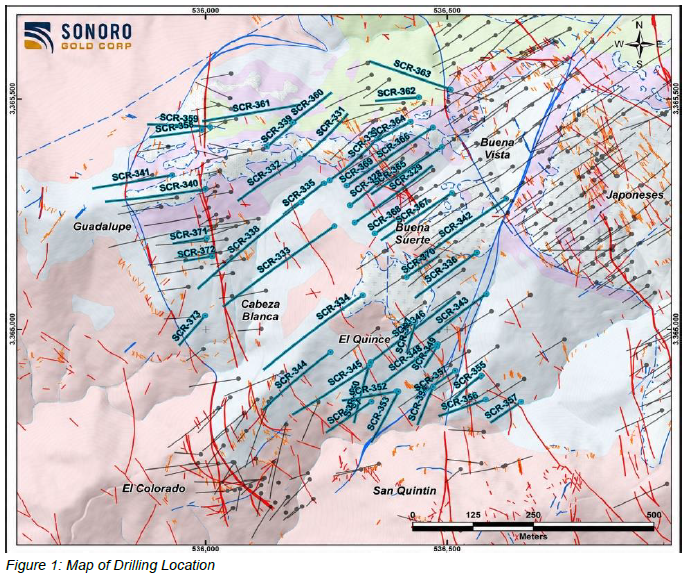
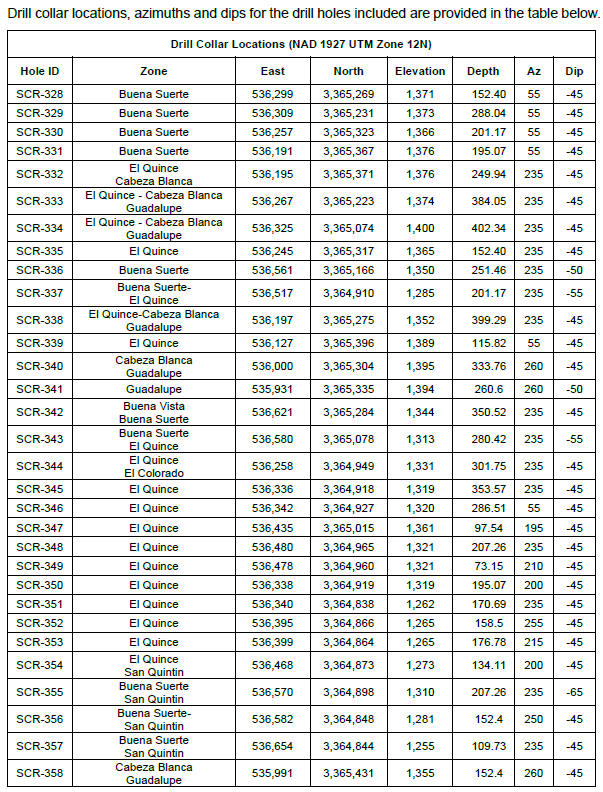
The map below illustrates the location of the drill holes.
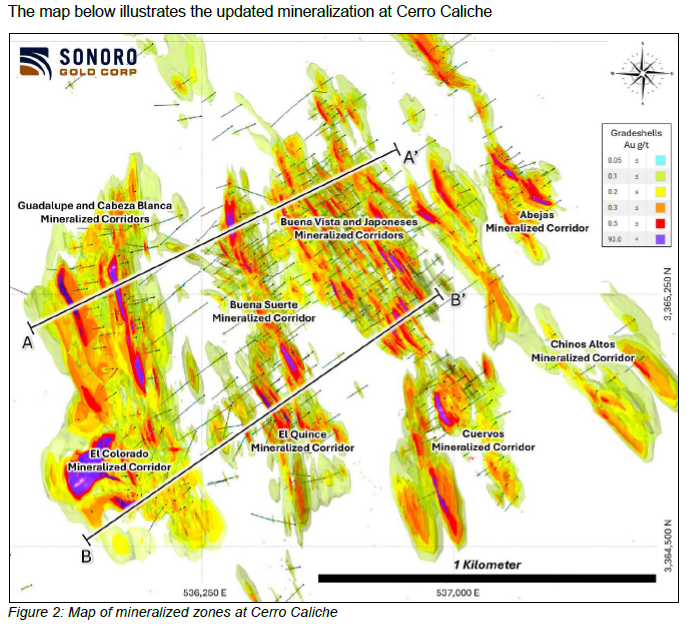
El Quince Zone
Target drilling at El Quince returned multiple intercepts of high-grade mineralization confirming this previously undrilled area as a potentially significant zone within the Cerro Caliche mineralized system. Due to steep topography, access to the area had been limited in prior exploration programs.
Extensive geological mapping, surface rock sampling and review of historical mine workings identified similar geological, structural and mineralized characteristics to those already identified at Cerro Caliche. With the construction of access roads by the Company, previously defined geological targets were drilled and assayed, confirming mineralization at El Quince to be associated with the project’s northwest-trending structures and corridors.
Drill holes SCR-348 and SCR-349 both intersected higher grades of gold with high silver content, implying the zone was possibly downfaulted from a higher elevation. SCR-348 returned 9.14m @ 3.076 g/t Au and 26.10 g/t Ag, including 6.09m @ 4.531 g/t Au and 37.5 g/t Ag and SCR-349 returned 18.29m @ 1.674 g/t Au and 30.40 g/t Ag, including 6.10m @ 4.568 g/t Au and 84.60 g/t Ag.
A total of 15 drill holes were completed at El Quince with intercepts confirming significant mineralization that may increase both the size and grade of the project’s overall resource.
Drill holes SCR-333, SCR-334 and SCR-338 appear to have all intersected the Cabeza Blanca vein at depth as assay results demonstrated similar widespread lower grade gold mineralization. SCR-333 intercepted 6.10m @ 0.892 g/t Au, SCR-334 intercepted 6.09m @ 0.578 g/t Au and SCR-338 intercepted 10.66m @ 0.488 g/t Au.
Drill holes SCR-337 and SCR-354 intersected mineralized intervals of 9.15m @ 0.633 g/t Au and 24.38m @ 0.368 g/t Au in the footwall of the northeasterly trending post mineral fault at San Quintin, representing lateral extensions of the mineralization.
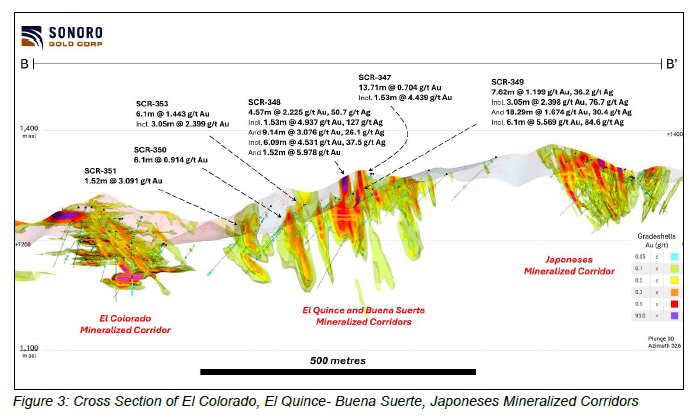
Buena Suerte Mineralized Zone
Buena Suerte is a significant mineralized vein zone on the property and targeted drilling at El Quince confirms the newly identified mineralized zone continues northward and merges into Buena Suerte.
Step-out drilling in the footwall of the northeasterly trending post-mineral fault noted above at San Quintin also confirmed lateral extensions of Buena Suerte with drill holes SCR-355, SCR-356 and SCR-357 intercepting 3.05m @ 1.163 g/t Au, 15.24m @ 0.648 g/t Au and 9.14m @ 0.521 g/t Au respectively.
Detailed geological mapping and surface sampling of areas at Buena Suerte previously designated for waste rock storage facilities as outlined in the PEA, demonstrated evidence of mineralization, including stockworks, parallel quartz veinlets and hydrothermal breccias.
These zones will no longer be considered for waste rock storage as an alternative site has been identified.
Nine targeted infill drill holes were completed within this area previously modelled as waste confirming mineralization and the expansion of the Buena Suerte defined mineralized zone. Notable returns including drill holes:
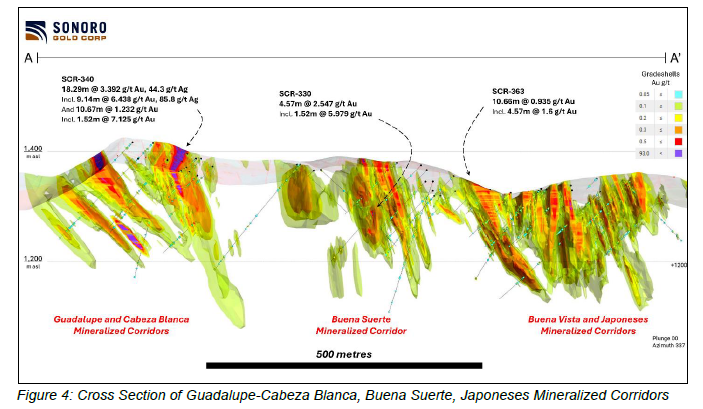
Cabeza Blanca, Guadalupe and El Colorado Mineralized Zones
Targeted drilling within and surrounding the mineral resource at Cabeza Blanca, Guadalupe and El Colorado investigated the potential continuity between the zones. Results confirm continuous gold mineralization between the zones, expanding known mineralization and potentially connecting the proposed pit shells within the mine plan as outlined in the PEA.
Several drill holes returned higher grade intercepts including SCR-340 which intercepted 18.29m @ 3.39 g/t Au including 9.14m @ 6.43 g/t Au and 10.67m @ 1.23 g/t Au including 1.52m @ 7.12 g/t Au as well as drill hole SCR-358 which intercepted 7.62m @ 0.63 g/t Au including 1.52m @ 2.11 g/t Au.
Results also confirm mineralization extending laterally and at depth with several zones remaining open with the potential to expand the mineralized corridors.
The following table provides selected drill results with interval grading of 1.0 g/t Au or greater.
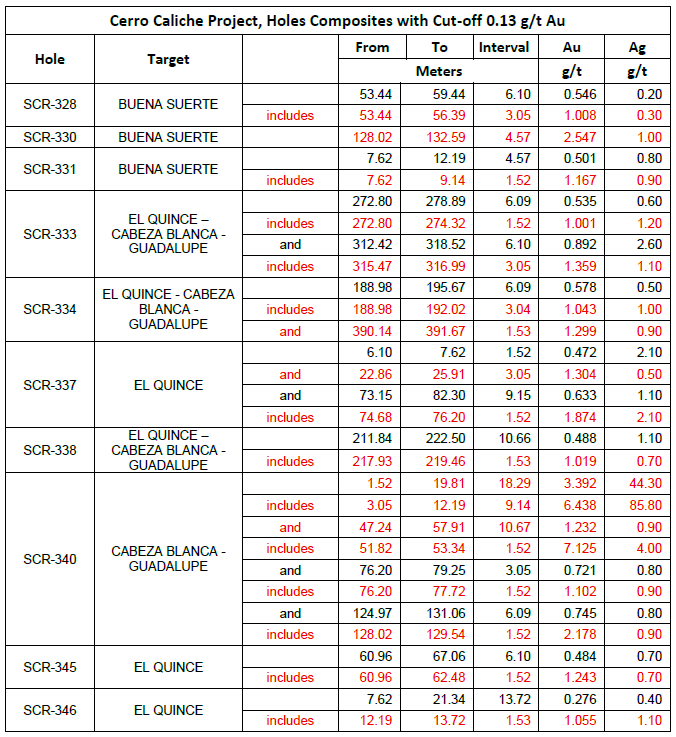
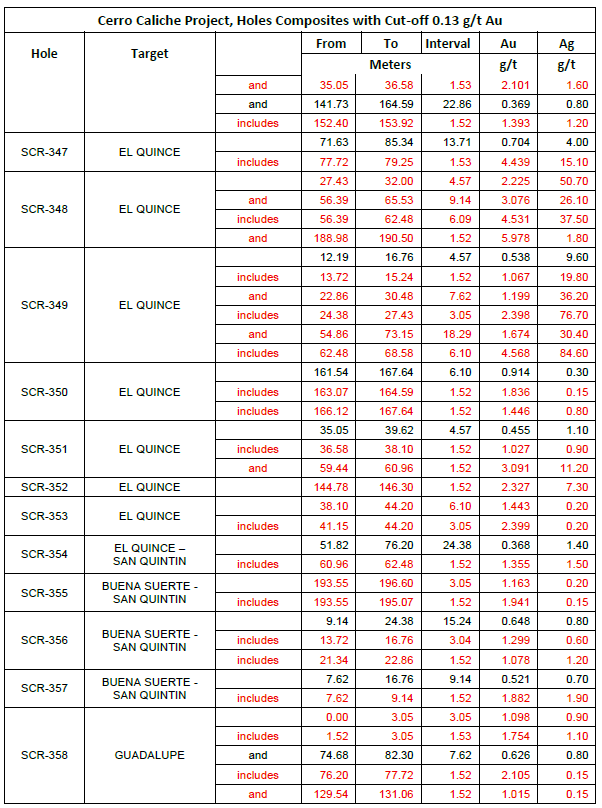
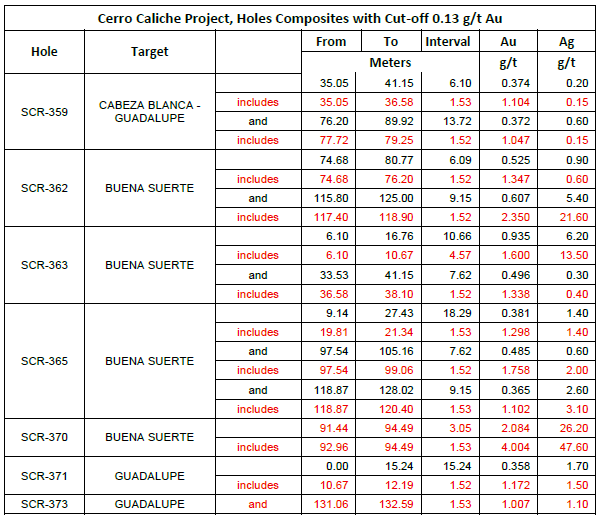
The reported gold and silver grades are analytical results taken directly from assay certificates issued by Bureau Veritas and are reported uncut. The drill results presented herein are exploration results and do not constitute an updated mineral resource estimate. The results will be incorporated into the geological model and evaluated as part of a future mineral resource estimate update prepared in accordance with NI 43-101.
Mineralized intervals were composited using a nominal reporting cut-off grade of 0.13 g/t Au. This reporting criterion is used solely to present the continuity of the intercepted mineralization and does not represent a new mineral resource estimate or an assessment of economic viability.
True widths are estimated to represent approximately 60% to 90% of the reported drilled interval lengths. Drill holes were completed at inclinations ranging from –45° to –70° and were oriented to intersect the mineralized structures as close to perpendicular as practicable. With the exception of the Guadalupe and El Colorado zones, the mineralized structures generally have steep dips approaching vertical.
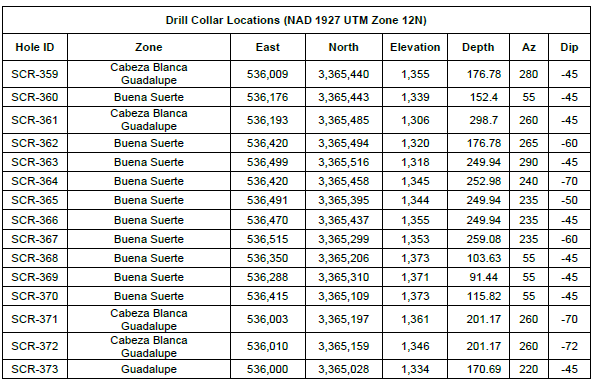
Quality Assurance/Quality Control Measures and Analytical Procedures
Drill samples are collected through an airstream cyclone and passed through a sample splitter three consecutive times to improve sample homogeneity. A representative split comprising approximately 40% of each sample is then placed in a bag, identified, sealed, and sent to the laboratory. As part of the quality assurance and quality control (QA/QC) program, blanks, certified reference materials (standards), and duplicate samples are systematically inserted into the sample stream.
Personnel from either Sonoro Gold Corp. or Bureau Veritas (BV) collect the samples directly from the drill site and transport them to BV’s sample preparation laboratory in Hermosillo, Sonora. At the laboratory, the entire sample received is crushed, and an approximate 250-gram split is obtained and pulverized.
Approximately 90 grams of each pulverized sample are separated and sent to BV’s laboratories in Hermosillo, Sonora, or Reno, Nevada. A 30-gram aliquot of this material is analyzed for gold using fire assay with an atomic absorption finish. Additionally, an approximate 10-gram aliquot of each pulverized sample is sent to BV’s laboratory in Vancouver, Canada, where it undergoes aqua regia digestion followed by multi-element ICP analysis, including silver.
A review of the inserted control-sample results identified no significant QA/QC issues with the analytical results received from the laboratories involved.
Qualified Person Statement
Stephen Kenwood, P.Geo., an Independent Director of Sonoro, is a Qualified Person within the context of National Instrument 43-101 (NI 43-101) and has read and approved this news release.
About Sonoro Gold Corp.
Sonoro Gold Corp. is a publicly listed exploration and development Company holding the near-development-stage Cerro Caliche project and the exploration-stage San Marcial project in Sonora State, Mexico. The Company has highly experienced operational and management teams with proven track records for the discovery and development of natural resource deposits.
Brutus Mining Inc. (CSE: BRU) (FSE: ZI3) is pleased to announce that it has closed its non-brokered ... READ MORE
Jaguar Uranium Corp. (NYSE American: JAGU) is pleased to announce an independent Mineral Resource E... READ MORE
Auro Metals Inc. (TSX-V: AURO) (OTCQB: AURFF), is pleased to announce the assay results of the fina... READ MORE
Endeavour Silver Corp. (NYSE: EXK) (TSX: EDR) is pleased to announce that repairs to the primary bal... READ MORE
Scorpio Gold Corp. (NASDAQ: SGLD) (TSX-V: SGLD) (OTCQB: SRCRF) (FSE: RY9) is pleased to announce re... READ MORE