







Roxmore Resources Inc. (TSX: RM) (OTCQX: GARLF) is pleased to report gold and silver assay results from the ongoing drill campaign at its flagship Converse Gold Project.
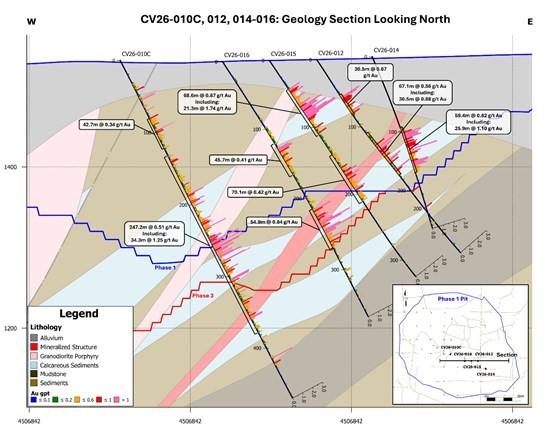
Highlights include hole CV26-010C, which returned a significant intercept of 247.2m grading 0.51 g/t Au and 3.79 g/t Ag from 131.7m including 34.3m grading 1.25 g/t Au from 246.3m. The hole was drilled through sparsely drilled area currently classified as inferred mineralization with the potential to upgrade confidence to indicated. Importantly, the hole intersected higher grades than the modelled inferred blocks it drilled through.
Key Highlights
Resource Classification, True Widths of Intercepts and Grade Improvements Targeted with Current Drilling
The primary objective of the current drilling campaign is to upgrade portions of the existing Mineral Resource Estimate from the inferred category to indicated and/or measured. The recently released MRE[1] employed a more rigorous classification methodology of measured, indicated and inferred material with drill spacing having an enhanced influence over what had previously been employed for previous estimates. Roxmore is utilizing angle holes to intersect steeply-dipping, mineralized faults and stratigraphy, so true thickness of reported intercepts is generally 75% to 100% of drilled thickness. Historic drilling was mostly vertical and not considered optimal.
John Dorward, Executive Chairman of Roxmore commented: “These initial results are very encouraging and provide further confidence in our updated geological model and resource development strategy. The drilling program is performing as intended, targeting the conversion of a significant component of inferred material to indicated or better, along with targeted improvements in grade. The result from hole CV26-010C demonstrates this approach as it drove a significant intercept through a broad area of inferred material at better than modelled grades and extended mineralization beyond the current extent of the pit shell.”
Geology and Mineralization
The Company believes the gold system at Converse has similarities to the giant Phoenix deposit currently being mined by Nevada Gold Mines, located a short distance to the east. The holes intersected in this release were supportive of Roxmore’s updated geological model, including lithologies, faulting and alteration styles. This predictable three-dimensional model supported the recently updated gold mineral resource estimate which was completed by SLR Consulting as part of the PEA.
CV26-010C was the first drill hole completed as part of the indicated resource conversion infill drill program at Converse. The infill program is designed to test the continuity of mineralization within the current geological model and support the conversion of inferred mineral resources to the indicated category. The program will also provide additional geological information to locally refine the interpretation and model.
CV26-010C further supports the Company’s updated geological model for North Redline. The drill hole intersected a sequence of Havallah Formation sedimentary rocks, including calcareous siltstone, calcareous sandstone and lesser limestone interbedded with non-calcareous clastic sedimentary rocks. These rocks are cut by multiple intrusive dikes and structurally disrupted intervals. Gold mineralization is predominantly associated with skarn alteration developed within the more reactive calcareous sedimentary horizons, particularly where these horizons occur near interpreted high-angle fluid-feeding structures and intrusive dikes.
Prograde alteration is characterized by pyroxene-dominant skarn with locally increased garnet development. This prograde assemblage is variably overprinted by retrograde chlorite-carbonate alteration with lesser epidote, actinolite and tremolite. The drill hole also intersected locally endoskarn-altered intrusive rocks.
CV26-012, CV26-014, CV26-015 and CV26-016 were drilled approximately 125 m – 300 m east of CV26-010C and intersected a shallower eastern expression of the interpreted mineralized system encountered by CV26-010C at depth. Although structural relationships are interpreted from RC chips, alteration and geochemical results indicate a broadly consistent mineralization style between the holes, characterized by moderate to strong prograde skarn with variable retrograde overprinting and associated sulphide mineralization. In addition to the previously recognized main feeder system, drilling east of CV26-010C has highlighted a consistent zone of contact-controlled mineralization developed along a favourable sedimentary horizon.
Drill holes outlined above exhibit variable oxidation states within mineralized domains, ranging from oxidized through transitional to primary sulphide zones. Oxidized intervals are commonly characterized by limonite and locally developed nontronite, whereas sulphide-bearing intervals include pyrrhotite, pyrite, and chalcopyrite, with locally occurring molybdenite.
Upcoming Catalysts
About Roxmore Resources Inc.
Roxmore is focused on developing its flagship, Converse Gold Project, one of the largest undeveloped gold deposits not owned by a major mining company in Nevada, USA. The Converse Gold Project is located within the prolific Battle Mountain trend containing Indicated MRE of 103 million tonnes (Mt) at an average gold grade of 0.65 g/t, containing 2.16 million ounces (Moz) Au and an Inferred Mineral Resource estimate of 218 Mt at an average gold grade of 0.43 g/t containing 3.04 Moz Au. The company completed a PEA for the project outlining attractive economics with an After-Tax NPV5% of US$2.7 Billion, IRR of 43%, and payback achieved in 2.2 years at long term consensus gold price of US$3,600/oz. The Simple Heap leach operation features significant production from a single pit with highlights including 3.5 million payable ounces LOM at 267,000 oz per year on average in the first full 8 years of production and 246,000 oz on average over the 14-year Life of Mine. The PEA is preliminary in nature, it includes Inferred Mineral Resources that are considered too speculative geologically to have the economic considerations applied to them that would enable them to be categorized as Mineral Reserves, and there is no certainty that the preliminary economic assessment will be realized. Mineral Resources that are not Mineral Reserves do not have demonstrated economic viability. With decades of expertise in Nevada and globally, our Board and management are focused on unlocking the potential of this project.
Qualified Person
The scientific and technical information contained in this news release has been reviewed along with the rigorous Quality Control program results, and approved by Vance Spalding, Certified Professional Geologist, Executive VP Exploration for Roxmore, who is a “qualified person” within the meaning of National Instrument 43-101 – Standards of Disclosure for Mineral Projects.
Quality Control & Assurance
Drill core is generally extracted from the core tube and split tubes by the drill contractor and placed in core boxes with appropriate depth markers noting recovery. Full core boxes are then sealed before being transported by Roxmore’s personnel to Roxmore’s facility in Winnemucca, Nevada where it is geologically and geotechnically logged by Roxmore geologists: checked for recovery, photographed, and marked for assays. The core is cut in half and placed in plastic bags, zip-tied and grouped in burlap sacks and sealed for transport to the ALS Global preparation facility in Elko, Nevada. The retained half-core is stored at Roxmore’s facility in Winnemucca, Nevada.
RC chips are collected into 5-gallon woven polyethylene bags in 5-foot intervals and sealed by the drill contractor. The target weight of samples is 3 to 5 kilograms. Bags are pre-labeled with sample numbers and depth intervals and validated against a sampling sheet. Every 30th sample is a field-split-duplicate. RC chips are geologically logged in the field by Roxmore geologists. Chip trays are transported to Roxmore’s processing facility by Roxmore’s personnel to Roxmore’s facility in Winnemucca, Nevada where they are photographed and stored. RC samples are grouped in burlap sacks and sealed for transport in the field. Samples are transported to the ALS Global preparation facility in Elko, Nevada.
Sample preparation is done according to ALS code PREP-31BY [1 kg-split pulverization]. The primary assay methods used are ALS codes Au-AA24 and ME-ICP61. The gold overlimit methods are Au-GRA22 and Au_SCR21 (overlimit triggers are 3 ppm and 10 ppm Au respectively). ALS Global is an independent, ISO-accredited laboratory with no affiliation to Roxmore Resources beyond its role as a third-party analytical service provider.
QA/QC is performed as each certificate is imported into Roxmore’s GeoSequel database. Performance charts are prepared for coarse blanks, certified reference materials and duplicates used. Roxmore uses OREAS standards for the Converse project. The insertion frequencies of blanks is 3.33%, of CRMs is 3.33%, and of half-core duplicates and RC-chip field-split-duplicates is 3.33%. They are split at the RC rig using an even-numbered-chute riffle splitter. Coarse blank above 10x over the lower detection limit (LDL) of the Au-AA24 method are re-run. For certified reference materials, the certified mean is considered the target. The certified standard deviation is used to calculate the acceptable range. The acceptable range is defined as within 3 standard deviations from the certified mean.
Brutus Mining Inc. (CSE: BRU) (FSE: ZI3) is pleased to announce that it has closed its non-brokered ... READ MORE
Jaguar Uranium Corp. (NYSE American: JAGU) is pleased to announce an independent Mineral Resource E... READ MORE
Auro Metals Inc. (TSX-V: AURO) (OTCQB: AURFF), is pleased to announce the assay results of the fina... READ MORE
Endeavour Silver Corp. (NYSE: EXK) (TSX: EDR) is pleased to announce that repairs to the primary bal... READ MORE
Scorpio Gold Corp. (NASDAQ: SGLD) (TSX-V: SGLD) (OTCQB: SRCRF) (FSE: RY9) is pleased to announce re... READ MORE