








Radisson Mining Resources Inc. (TSX-V: RDS) (OTCQX: RMRDF) is pleased to announce the results of six new drill holes recently completed at its 100%-owned O’Brien Gold Project located in the Abitibi region of Québec. The six holes represent new wedge branches targeting the “Trend 1-Trend 2 Gap“, an area of little previous drilling extending over an approximate 800-metre vertical extent in the central portion of the Project. All have returned significant intercepts of high-grade gold mineralization. This follows a pattern developed in recently published results in the same area (see news releases dated June 1, 2026, June 22, 2026, and July 7, 2026), with important implications for future mineral resources. These results are the latest from the Company’s ongoing 140,000-metre step-out drill program and continue to extend the scope of gold mineralization beyond the Company’s March 2026 Mineral Resource Estimate. Highlights (Figure 1 and Table 1) include:
Matt Manson, President and CEO: “We have now released results from two pilot holes and thirteen directional wedge branches in the “Trend 1-Trend 2 Gap”, previously a large hole in our drill coverage extending over 800 metres vertically in the centre of the deposit. Thirteen of these fifteen holes have intersected mineralization with grades and thicknesses consistent with the Project’s mineral resources. In many cases, as with today’s news, we have intersected multiple, parallel zones of mineralization with very high grades. Previous drilling at O’Brien has defined steeply plunging mineralization “Trends” separated by “Gaps”, a pattern that defines the character of our mineral resource block model and influences our exploration targeting and conceptual mine design. We now know that the gap between Trend #1 and Trend #2, at least, is a function of insufficient drilling. Gold mineralization appears laterally continuous across this area. This has important implications for mineral resource growth and may positively influence future development scenarios such as stope continuity in a potential mine and the location of future mining infrastructure such as drifts and ramps. All of this gap drilling has been achieved from just two drill rigs successfully completing multiple wedge branches over a broad area from two pilot holes (OB-26-386 and 387). A total of eight drill rigs are currently active at the Project as part of the ongoing 140,000-metre step-out drill program focused exclusively on mineral resource growth. This drilling will run concurrently with the recently announced advanced underground exploration program (see news release dated August 24, 2026). These parallel, fully-funded programs offer substantial progress on both the exploration of the Project and its development path.”
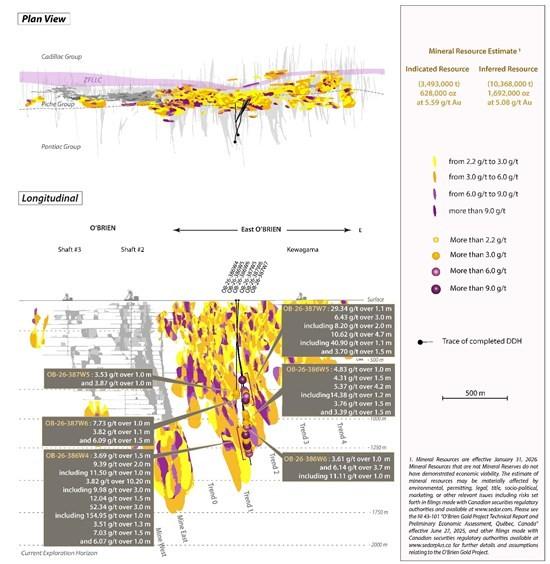
Figure 1: Longitudinal Vertical Section and Plan View of Gold Vein Mineralization and Mineral Resources at the O’Brien Gold Project, with Today’s Drill Holes Illustrated
Gold Mineralization at O’Brien
Gold mineralizing quartz-sulphide veins at O’Brien occur within a thin band of interlayered mafic volcanic rocks, conglomerates, and porphyritic andesitic sills of the Piché Group occurring in contact with the east-west oriented Larder Lake-Cadillac Break (“LLCB”). Gold, along with pyrite and arsenopyrite, is typically associated with shearing and a pervasive biotite alteration, and developed within multiple Piché Group lithologies and, occasionally, the hanging-wall Pontiac and footwall Cadillac meta-sedimentary rocks.
Table 1: Assay Results Calculated at a 3 g/t Au Bottom Cut-Off from Drill Holes Published Today
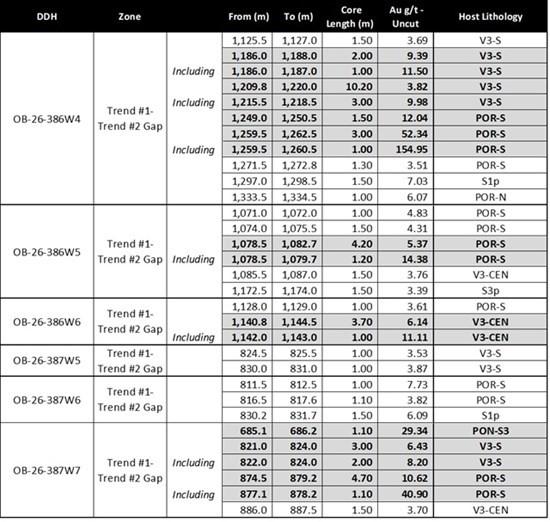
Notes on Calculation of Drill Intercepts:
The O’Brien Gold Project Mineral Resource Estimate effective January 31, 2026 utilizes a 2.20 g/t Au bottom cut-off, a US$2,500 gold price, a minimum mining width of 1.2 metres, and a 60 g/t Au upper cap on individual assays. Intercepts presented in Table 1 are calculated with a 3.00 g/t Au bottom cut-off. Sample grades are uncapped. True widths, based on depth of intercept and drill hole inclination, are estimated to be 30-80% of core length. Table 3 presents additional drill intercepts calculated with a 1.00 g/t Au bottom cut-off over a minimum 1.0 metre core length so as to illustrate the frequency and continuity of mineralized intervals within which high-grade gold veins at O’Brien are developed. Lithology Codes: PON-S3: Pontiac Sediments; V3-S, V3-N, V3-CEN: Basalt-South, North, Central; S1P, S3P: Conglomerate and Greywackes; POR-S, POR-N: Porphyry South, North; TX: Crystal Tuff; ZFLLC: Larder Lake-Cadillac Fault Zone
As mapped at the historic O’Brien mine, and now replicated in the modern drilling, individual veins are generally narrow, ranging from several centimetres up to several metres in thickness and areassociated with broader, mineralized alteration envelopes. Multiple veins occur sub-parallel to each other, as well as sub-parallel to the Piché lithologies and the LLCB. Individual veins have well-established lateral continuity, with steeply plunging grade shoots developed over significant lengths.
The historic O’Brien mine produced over half a million ounces of gold from such veins and shoots at an average grade exceeding 15 g/t Au and over a vertical extent of at least 1,000 metres. Modern exploration has focussed on delineating well-developed vein mineralization below and to the east of the historic mine. Based on the historic data available, it is clear that the former mine was “high-graded”, with mining focussed on a main central stope and parallel veins identified but left undeveloped.
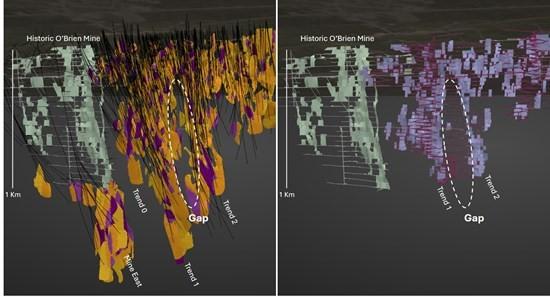
Figure 2: The “Trend 1-Trend 2 Gap” Illustrated on the Basis of the March 2026 MRE (left) and the July 2025 PEA Mine Design (Right). This Graphic Also Illustrates the Growth in the Project’s MRE since the July 2025 PEA was Completed.
Step-Out Drilling at O’Brien
Since the end of 2024, Radisson has been pursuing a program of broad step-outs beneath the historic O’Brien Gold mine and the existing mineral resources designed to test the extent of gold mineralization at the Project. This drilling is accomplished with pilot holes followed by wedges and directional drilling to maximize drill efficiency and minimize costs. In October 2025, Radisson announced the expansion of the step-out drill program to 140,000 metres employing eight drill rigs (see Radisson news release dated October 16, 2025).
The origin of the step-out drill program was the deep pilot hole OB-24-337, which was the first exploration drill hole located below the former mine workings since mining ended in 1957. This hole intersected 31.24 g/t Au over 8.0 metres, including 242.0 g/t Au over 1.0 m at approximately 1,500 metres vertical depth (see Radisson news release dated December 16, 2024). Fifteen wedge branches were completed from OB-24-337 delineating up to eight gold-bearing veins over a 250-metre by 700-metre area in what is referred to as “O’Brien Mine East” (see Radisson news release dated February 12, 2026). In March 2026, Radisson published an interim update in the Project’s mineral resources, showing meaningful growth based on the on-going drilling (see Radisson news release dated March 2, 2026).
The focus of the step-out drill program has been the extension of mineralization at depth, with an exploration floor of 2 kilometres depth, and recently announced plans to extend this drilling to 2.5 kilometres depth (see Radisson news release dated May 28, 2026). Given the character of neighbouring gold deposits and the wealth of mining infrastructure within or close to the O’Brien Gold Project, Radisson believes that significant exploration potential exists to these depths, and such mineralization might reasonably be expected to be developed.
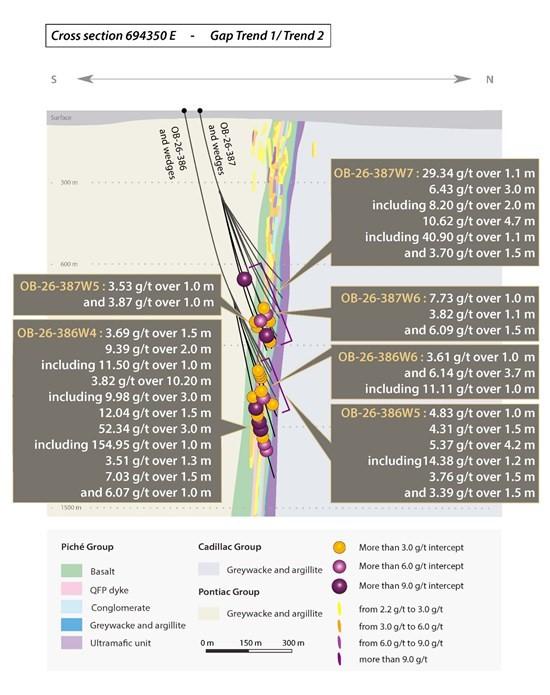
Figure 3: Vertical Section Through “Trend 1 – Trend 2 Gap” with Today’s New Drill Results
In addition to the progressively deeper drilling, the 140,000-metre program includes targeting of areas within the O’Brien geological model that have not previously been tested and offer the potential for additional mineral resources at shallower depths. As exploration drilling at O’Brien has progressed over the last several years, high-grade intercepts and vein delineations have typically been followed up with additional drilling on steep east plunging trends. This is consistent with the observation of steeply plunging high-grade shoots in the historical O’Brien mine, from surface trenching, and from the orientation of grade trends in the MRE. This exploration strategy has resulted in a number of large-scale mineralization “Trends 0 to 5” being delineated, with intervening “gaps”. These gaps are typically defined by a lack of drilling rather than a lack of mineralization. Significant gaps include between the former mine and “Trend 0”, and a gap of 800 metres vertical extent between “Trends 1 and 2” (Figure 1 and Figure 2).
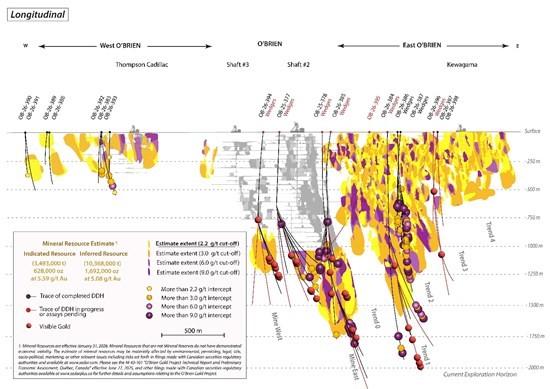
Figure 4: Deep Step-Out Drill Holes Completed and/or Published by the Company Since March 2026
Pilot holes OB-26-386 and OB-26-387 were established to target the Trend 1-Trend 2 Gap at approximately 500 and 1,000 metres vertical depth. Thirteen directional wedge branches have now been completed from the two pilot holes for a total of fifteen cuts through the Piché Group. All of these drill holes have returned intercepts of gold mineralization in the characteristic quartz-sulphide-gold veins and alteration envelops developed within the conglomerate, porphyry and volcanic units of the Piché Group (Figure 3). Thirteen of the fifteen have returned intercepts with grades and thicknesses consistent with the Project’s mineral resources. Selected highlights of these fifteen holes now include:
These results demonstrate that continuity of mineralization at O’Brien can be established laterally between what were previously thought to be discrete mineralization trends. In addition, the presence of a gap in the mineral resource block model between Trends 1 and 2 drives a gap between mining areas and mine infrastructure planning, as was demonstrated in the mine design contained within Radisson’s July 2025 Preliminary Economic Assessment for the Project (Figure 2). Additional mineral resources in these under-drilled gaps will also benefit the density of mineralization at the Project, which is a common measure of economic viability and capital efficiency in underground mine design.
The six new drill holes at the Project continue to demonstrate the very high incidence of intercepts with grades and thicknesses consistent with the Project’s mineral resources (“hits”, per Table 2). This now stands at 82% of all drill holes completed to date, an impressive result for a step-out drill program specifically targeting non-resource areas (Figure 4). Mineralization remains open in every direction, with clear opportunities to expand the quantity of new mineral resources, in particular by drilling at depth.
Table 2: Drill Results Published for the O’Brien Gold Project Since December 2024
| Date of Publication | Total Number of Drill Holes |
Drill Holes with Intercepts >+3g/t |
Success Rate (%) |
| September 2, 2026 | 6 | 6 | 100% |
| July 7, 2026 | 3 | 3 | 100% |
| June 22, 2026-O’Brien | 5 | 5 | 100% |
| June 22, 2026-Thompson-Cadillac | 2 | 1 | 50% |
| June 1, 2026 | 7 | 6 | 86% |
| April 30, 2026-O’Brien | 7 | 7 | 100% |
| April 30, 2026-Thompson-Cadillac | 9 | 2 | 22% |
| January 27, 2026 | 7 | 7 | 100% |
| January 6, 2026 | 6 | 5 | 83% |
| October 28, 2025 | 15 | 13 | 87% |
| September 8, 2025 | 15 | 13 | 87% |
| July 16, 2025 | 14 | 11 | 79% |
| April 2, 2025 | 3 | 3 | 100% |
| February 26, 2025 | 20 | 15 | 75% |
| December 16, 2024 | 1 | 1 | 100% |
| Total | 120 | 98 | 82% |
Table 3: Detailed Assay Results (see “Notes on Calculation of Drill Intercepts”)
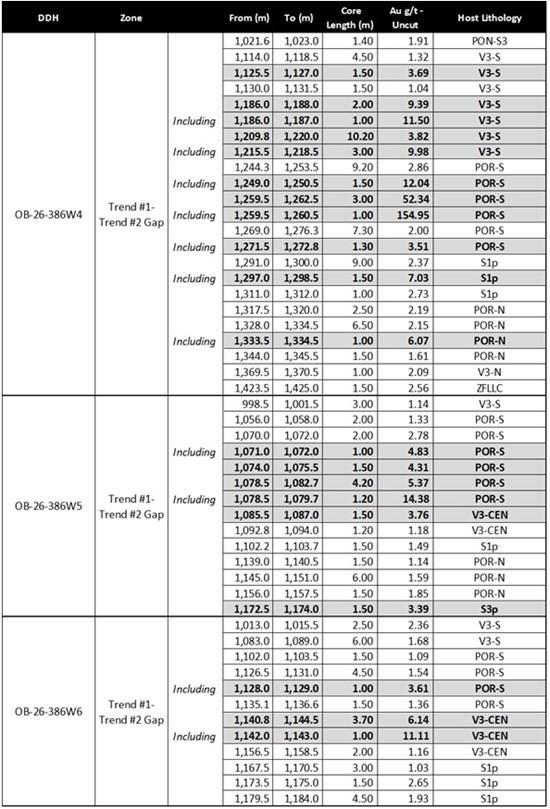
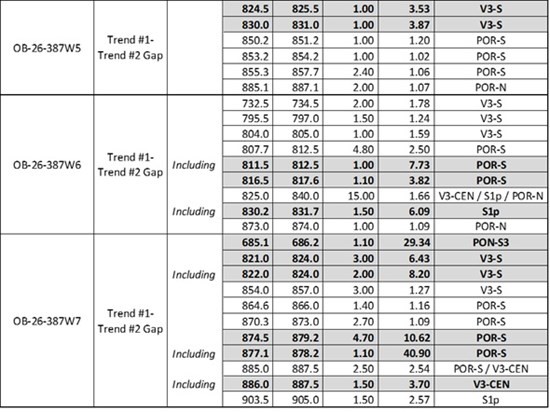
Table 4: Drill Hole Collar Information for Holes contained in this News Release
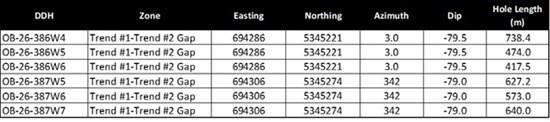
Notes: Hole lengths for wedges represent meterage from point of wedge. Collar position is reported for pilot hole.
QA/QC
All drill core in this campaign is NQ in size. Assays were completed on sawn half-core, with the second half retained in the core box for future reference. Geologists mark cut lines on the core perpendicular to the foliation. The half on the right side of the saw blade is bagged for the laboratory and the left half is retained as reference. Sample bags are sealed, placed in rice sacks, plastic-wrapped on pallets, and held in a secure facility until pick-up by the laboratory’s dedicated truck.
Samples are delivered to MSALABS’ analytical laboratory in Val-d’Or, Québec, for preparation and gold analysis. The entire sample is dried and crushed (70% passing a 2-millimetre sieve) and split to 500 g. Gold analysis is performed on an approximately 500 g aliquot (a single jar) using Chrysos PhotonAssay technology. Mineralized zones containing visible gold, plus additional intervals selected at the discretion of the logging geologist, are analyzed to extinction, whereby the entire sample is split into multiple ~500 g jars, each jar is analyzed by PhotonAssay, and the weighted average of the results is used for reporting. A one-metre sample typically requires five jars.
Certified reference materials (CRMs), blank samples, and reject duplicates are inserted for quality assurance and quality control. Either a CRM, a blank, or a duplicate is inserted during regular sampling at a rate of 1 per 25 samples, with the insertion rate increased for intervals selected for assay to extinction. Four different CRMs are in use with an appropriate range of certified grades suited for O’Brien mineralization. Jars of CRM material are stored at the laboratory and inserted into the sample stream as directed by Radisson. The CRMs were selected by Radisson in accordance with Chrysos Corporation’s best-practice guidelines for PhotonAssay. Blanks consist of commercially obtained crushed quartzite known to be barren of gold. Samples returning results greater than 1 g/t Au are also fire assayed.
MSALABS operates under ISO/IEC 17025 accreditation, utilizing industry-standard QA/QC frameworks for gold analysis. Through the integration of blanks, duplicates, and CRMs into its workflow, the laboratory adheres to established benchmarks that ensure precise, reliable, and verifiable results.
QP Disclosure
Disclosure of a scientific or technical nature in this news release was prepared under the supervision of Mr. Richard Nieminen, P.Geo, (QC), a geological consultant for Radisson and a Qualified Person for purposes of NI 43-101. Mr. Luke Evans, M.Sc., P.Eng., ing, of SLR Consulting (Canada) Ltd., is the Qualified Person responsible for the preparation of the MRE at O’Brien. Each of Mr. Nieminen and Mr. Evans is independent of Radisson and the O’Brien Gold Project.
About Radisson Mining
Radisson is a gold exploration company focused on its 100% owned O’Brien Gold Project, located in the Bousquet-Cadillac mining camp along the world-renowned Larder-Lake-Cadillac Break in Abitibi, Québec. A July 2025 PEA described a low cost and high value project with an 11-year mine life and significant upside potential based on the use of existing regional infrastructure. Indicated Mineral Resources are estimated at 0.63 Moz (3.49 Mt at 5.59 g/t Au), with additional Inferred Mineral Resources estimated at 1.69 Moz (10.37 Mt at 5.08 g/t Au). Please see the NI 43-101 “O’Brien Gold Project Technical Report and Preliminary Economic Assessment, Québec, Canada” effective June 27, 2025, Radisson’s news release dated March 2, 2026 “With Step-Out Drilling Continuing, Radisson Demonstrates Meaningful Resource Growth at O’Brien with an Updated Mineral Resource Estimate” and other filings made with Canadian securities regulatory authorities available at www.sedarplus.ca for further details and assumptions relating to the O’Brien Gold Project.
Brutus Mining Inc. (CSE: BRU) (FSE: ZI3) is pleased to announce that it has closed its non-brokered ... READ MORE
Jaguar Uranium Corp. (NYSE American: JAGU) is pleased to announce an independent Mineral Resource E... READ MORE
Auro Metals Inc. (TSX-V: AURO) (OTCQB: AURFF), is pleased to announce the assay results of the fina... READ MORE
Endeavour Silver Corp. (NYSE: EXK) (TSX: EDR) is pleased to announce that repairs to the primary bal... READ MORE
Scorpio Gold Corp. (NASDAQ: SGLD) (TSX-V: SGLD) (OTCQB: SRCRF) (FSE: RY9) is pleased to announce re... READ MORE