







Pecoy Copper Corp. (TSX-V: PCU) (FSE: D5E) (OTCQB: PCUUF) is pleased to report initial assay results from its ongoing Phase 1 drill program at its 100% owned Pecoy Project in southern Peru. The Company’s first diamond drill hole, PEC-25-065, intersected approximately 1,186 metres of continuous copper-gold-molybdenum-silver mineralization, beginning near surface. This hole confirms the scale and vertical continuity of the South Breccia system and significantly extends the mineralization below the current resource pit shell.
Highlights:
Hole PEC-25-065 provides the first continuous deep section through the South Breccia system, demonstrating vertically persistent hydrothermal brecciation and stockwork-style veining from surface to approximately 1,186 metres depth. The hole did not exit the mineralized system and transitions at depth into intrusive-dominated altered host rocks, supporting the interpreted porphyry architecture. The hole ended in a transitional brecciation zone.
Vincent Metcalfe, Chief Executive Officer of Pecoy Copper, commented: “Our current 865 million tonne inferred resource at 0.34% copper, with gold, molybdenum and silver credits, was constrained by a conceptual pit shell. This first hole at the South Breccia intersected continuous mineralization approximately 407 metres below that constraint, and at grades exceeding the current resource average. These results support the interpreted scale and vertical continuity of the system and reinforce the exploration potential of the project as we advance our fully funded drill program.”
Table 1: Significant Intersections
| Hole | From (m) | To (m) | Length (m) | Cu % | Au g/t | Mo % | Ag g/t |
| PEC-25-065 | 17.00 | 1186.25 | 1169.25 | 0.33 | 0.11 | 0.013 | 1.20 |
| incl. | 17.00 | 1030.75 | 1013.75 | 0.37 | 0.13 | 0.016 | 1.33 |
| incl. | 246.00 | 946.00 | 700.00 | 0.43 | 0.14 | 0.019 | 1.49 |
| incl. | 450.00 | 751.10 | 301.10 | 0.53 | 0.15 | 0.018 | 1.81 |
| incl. | 400.00 | 566.00 | 166.00 | 0.42 | 0.29 | 0.005 | 1.15 |
| Below current pit shell | |||||||
| incl. | 624.00 | 1030.75 | 406.75 | 0.44 | 0.06 | 0.027 | 1.64 |
| incl. | 624.00 | 921.25 | 297.25 | 0.52 | 0.07 | 0.033 | 1.94 |
| incl. | 668.00 | 751.10 | 83.10 | 0.72 | 0.08 | 0.016 | 2.57 |
Note: True thickness and widths of the mineralization are currently unknown
Hole PEC-25-065 targeted the South Breccia Zone, where mineralization is hosted within brecciated and altered intrusive and is characterized by chalcopyrite, gold, silver and molybdenite, consistent with a large porphyry-related system. Magnetite abundance appears, at times, spatially associated with higher gold values.
The hole was drilled at a steep northeast orientation to test the system at depth and toward the east, with the objective of testing:
Mineralization persists to the end of hole at 1,186 metres, where chalcopyrite-bearing veins and disseminations remain present within altered intrusive rocks. No transition to distal propylitic alteration or barren intrusive was observed. This suggests the porphyry center may lie at depth beneath the South Breccia Zone.
The upper portion of the hole is characterized by hydrothermal breccia and crackle-style stockwork veining, while deeper portions transition into more massive intrusive rocks with pervasive alteration and disseminated sulphides, reflecting vertical evolution within the hydrothermal system.
Copper, gold, molybdenum, and silver values occur throughout the interval, with molybdenum values locally increasing at depth, consistent with metal zoning typical of porphyry systems.
South Breccia
The South Breccia represents one of the most advanced and best-defined mineralized breccia bodies at Pecoy and hosts the higher-grade mineralization encountered to date. Drilling has outlined a coherent geometry with strong continuity, and the breccia remains open laterally and at depth, including toward the west beneath alluvial cover. The 2026 program will focus, among other targets, on testing and expanding this higher-grade ore body through step-out drilling under cover, continued evaluation of depth potential, and further refinement of breccia geometry and internal controls on mineralization.
Phase 1 Progress
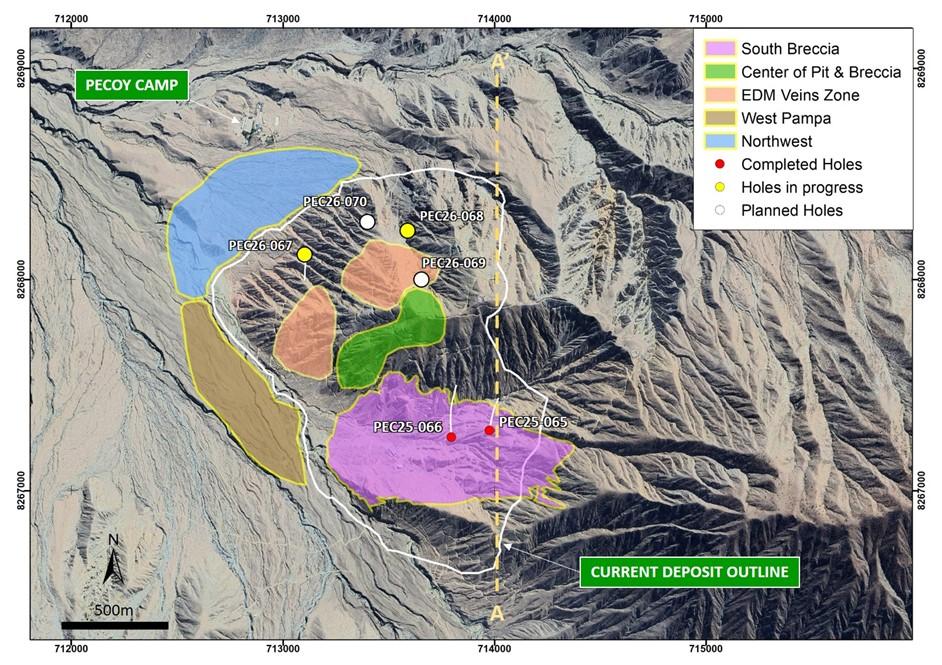
To date, approximately 3,000 metres have been drilled during the Phase 1 program, with two holes completed in the South Breccia Zone and two additional holes currently in progress. Drilling has now shifted toward testing the Center of the Pit target and Central Breccia areas.
Table 2: Drillhole information
| Hole | UTM East | UTM North | Elev (masl) | Azimuth | Dip | Length Drilled (m) | Drill Status |
| PEC-25-065 | 713977 | 8267284 | 1899 | N0 | -80 | 1186.25 | Complete |
| PEC-25-066 | 713796 | 8267252 | 1832 | N0 | -75 | 1068.50 | Complete |
| PEC-25-067 | 713104 | 8268120 | 1715 | N175 | -75 | n/a | In Progress |
| PEC-25-068 | 713587 | 8268230 | 1863 | N180 | -80 | n/a | In Progress |
| PEC-25-069 | 713630 | 8268000 | 2007 | N180 | -75 | n/a | Ready |
Additional assay results will be released once assays are received, analyzed, and confirmed by the Company.
Pecoy Project Highlights
For more information about Pecoy Copper, please visit our website at www.pecoycopper.com or view the Company’s VRIFY presentation in connection with this release at https://vrify.com/decks/21492.
Figure 1: Looking west – Cross-section through the South Breccia Zone illustrating drill hole PEC-25-065 (1,186 m total depth) and interpreted alteration and mineralization domains. Mineralization remains open at depth.
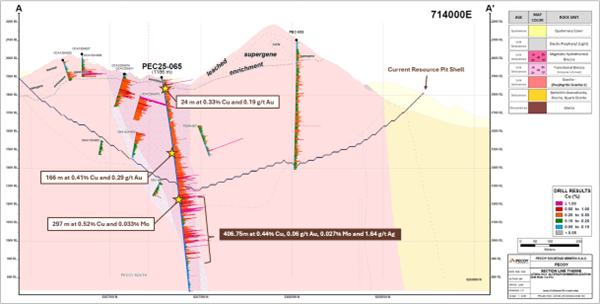
Figure 2: Plan view of the Pecoy Project showing the current deposit outline, principal mineralized zones, and current Phase 1 drill hole locations
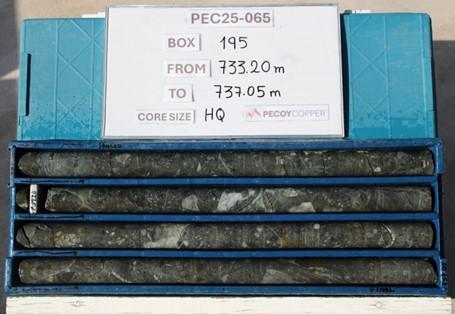
Picture 1: Box 195 – From: 733.20m To 737.05m, includes sample DS250610, 2 metres at 1.45% Cu, 0.053% Mo, 0.18g/t Au, 4.50g/t Ag. Coarse breccia with sulfides in matrix. Very low magnetite.
Qualified Persons and Technical Notes
The scientific and technical information in this news release has been reviewed and approved by Vincent Cardin-Tremblay, P.Geo., current Chief Geological Officer of Pecoy Copper, a Qualified Person as defined by National Instrument 43-101 – Standards of Disclosure for Mineral Projects.
Diamond drill core from the Pecoy Project was logged and sampled at the Company’s secure core facility at site by Company personnel. Drill core was sawn in half, with one half retained for reference and the other half sampled at nominal intervals of up to 2 metres, with sample boundaries adjusted to respect geological contacts. Core diameter varied between HQ, and NQ, depending on depth.
Samples were bagged, sealed, and transported by commercial carrier to the Bureau Veritas preparation laboratory in Arequipa, Peru, where samples were crushed and a 250 g split was pulverized to 85% passing 75 µm (200 mesh). Prepared pulps were then sent and analyzed at the assay laboratory in Lima, Peru. Bureau Veritas is an ISO-accredited laboratory and is independent of the Company.
Gold analyses were performed using fire assay fusion with ICP-OES finish on a 30 g sample (FA330). Samples returning gold values greater than 10 g/t Au were re-analyzed using fire assay with gravimetric finish (FA530). Copper and silver were analyzed by ICP-OES/MS following a four-acid digestion as part of a 45-element multi-element suite (4A200). Samples returning values over the upper detection limit (Au, Ag, Cu, Zn, Mo, Pb) were re-analyzed using four-acid digestion with AAS finish (MA402).
A comprehensive Quality Assurance and Quality Control program was implemented as part of the sampling and analysis procedures. Certified reference materials, blanks, and duplicate samples (field, preparation, and analytical duplicates) were inserted into the sample stream at regular intervals, representing approximately 15% of the total samples submitted. No significant QA/QC issues were identified during the analysis, and the results are considered reliable for reporting purposes.
An NI 43-101 technical report in respect of the Pecoy Project with an effective date of April 30, 2025 and dated July 23, 2025 was prepared by Mining Plus and is available on SEDAR+ under the Company’s profile. Mineral resources are not mineral reserves and do not have demonstrated economic viability.
About Pecoy Copper
Pecoy Copper is advancing the 9,975-hectare Pecoy Copper-Gold-Molybdenum-Silver Project, a large, undeveloped porphyry system located in southern Peru’s Arequipa region, within one of the world’s most prolific copper belts. The Pecoy deposit hosts a current copper inferred resource of 865 million tonnes at 0.34% Cu, with significant associated gold, molybdenum, and silver credits.
To date, less than 49,000 metres of historical drilling have been completed at Pecoy, defining a broad and continuous mineralized system with potential for expansion along strike and at depth. The project benefits from its favourable elevation of approximately 1,650 metres above sea level, providing year-round access and reduced operating complexity compared to many high-altitude Andean deposits.
Strategically located near the Pacific coast, Pecoy enjoys excellent infrastructure, with close proximity to highways, power lines, and water sources, and good access to the deep-water ports of Matarani (approximately 240 km southwest) and Ilo. This infrastructure advantage positions Pecoy Copper to advance the project efficiently from exploration toward future development within one of the world’s most established and mining-friendly jurisdictions.
Hudbay Minerals Inc. (TSX:HBM) (NYSE: HBM) today released its ann... READ MORE
Strategic acquisition of an established operating gold mine, loca... READ MORE
Cerro de Pasco Resources Inc. (TSX-V: CDPR) (OTCQB: GPPRF) (FRA: ... READ MORE
The Garneau Titanium Project Features Ilmenite-Rich Boulder with ... READ MORE
ValOre Metals Corp. (TSX‐V: VO) (OTCQB: KVLQF) (Frankfurt: KEQ0... READ MORE