






Highlights
Blair Way, Company Director, President, and CEO, comments: “The Corvette Property continues to deliver, with our widest intercept to date. Returned core sample assays indicating wide and high-grade pegmatite intercepts continue to be returned at CV5. The initial core assay results for the drill holes over the recently announced western extension at CV5 continue to demonstrate that high grades over material widths are present over a more than 4 km strike length. We would also like to thank our shareholders for their patience with reporting of analytical results this summer-fall. The wildfires prevented shipping of samples to the laboratory for much of the summer, and also impacted the restart of laboratories after the wildfires. The situation is improving, and assays are flowing more regularly from the laboratory. We will continue to announce results in batches to ensure clarity of locations to readers.”
Patriot Battery Metals Inc. (TSX-V: PMET) (ASX: PMT) (OTCQX: PMETF) (FSE: R9GA) is pleased to announce core assays for the first series of drill holes completed at the CV5 Spodumene Pegmatite as part of the ongoing 2023 summer-fall drill program being completed at its wholly owned Corvette Property, located in the Eeyou Istchee James Bay region of Quebec. The CV5 Spodumene Pegmatite, with a maiden mineral resource estimate of 109.2 Mt at 1.42% Li2O inferred1, is situated approximately 13.5 km south of the regional and all–weather Trans-Taiga Road and powerline infrastructure.
Core assay results from the first series of drill holes completed this year at the CV5 Spodumene Pegmatite (13 holes in total) are reported herein. These include drill holes completed for resource infill (i.e., to improve resource confidence from the inferred category to the indicated category), hydrogeological model support, as well as those completed over the recently announced western extension (see news release dated September 24, 2023). Analytical results for all holes reported herein for pegmatite intervals >2 m are presented in Table 1 and drill attributes in Table 2.
Recently Announced 650 m Western Extension at CV5
Core assay results are announced herein for seven drill holes completed over the recently announced western extension at CV5 (see news release dated September 24, 2023). This series of holes represent approximately 500 m of the 650 m of new strike length (which remains open) and are not included in the June 2023 mineral resource estimate for CV5 (see news release dated July 30, 2023). These drill holes tested various depths from surface and confirm high grades of lithium continue in this direction (Figure 1 and Figure 2). A core photo of a well-mineralized interval from CV23–209 is presented in Figure 5. Results include:
This initial batch of core assays returned from drill holes over the western extension supports that the interpreted bifurcation of the CV5 Pegmatite’s principal dyke, into two (2) distinct dykes moving westerly, remains well-mineralized along each. For example, drill hole CV23-208 returned 7.6 m at 2.64% Li2O, including 5.1 m at 3.50% Li2O in one dyke, and 28.8 m at 1.63% Li2O, including 13.0 m at 2.19% Li2O in the other.
Infill Drilling at CV5
Drill hole CV23-199, primarily planned and completed as a hydrogeological hole, also doubled as a mineral resource infill hole for CV5 and returned the widest mineralized drill intersection to date on the Property at the CV5 Spodumene Pegmatite – 172.4 m at 0.93% Li2O, including 34.5 m at 1.85% Li2O and 26.1 m at 1.81% Li2O (Figure 1, Figure 2, and Figure 3). The 172.4 m intersection is comprised of a near-continuous pegmatite interval with only 1.8 m of non-pegmatite dilution. A core photo of a well-mineralized interval from CV23-199 is presented in Figure 4.
Since CV23-199 was designed as a vertical hole, it is more oblique to the dip of CV5 Pegmatite’s principal dyke than is typical. True width of the pegmatite in the area of drill hole CV23-199 is estimated to approximate 125 m at a depth of 125 m.
Hydrogeological results to date at CV5 have not shown anything of concern. The initial field test program is now complete, which included multiple drill holes and observation wells in and around the deposit, permeability tests, and water level measurements. The hydrogeological numerical model and a preliminary report are now being prepared.
Although multiple land-based drill holes targeting resource infill have been completed over the summer-fall program, the majority of the infill drilling to date has focused on barge-based drilling over the shallow glacial lake, which covers a portion of the deposit. These holes targeted locations where ice formation in winter may not be sufficient to support ice-based drilling. Core sample assays results are pending for these holes.
Significant Drilling and Assays Results to Come
Drilling at the Property is anticipated to be paused shortly due to the onset of winter conditions. Work continues on the completion of the Company’s exploration camp and all-season exploration access road to the CV5 Pegmatite. Core processing will continue into December, with a planned ramp up to ten (10) drill rigs beginning in early January 2024. The Company’s exploration camp and all-season exploration access road to CV5 are anticipated to be completed this fall, ahead of the commencement of the 2024 drill program.
As announced September 24, 2023, the CV5 Spodumene Pegmatite has been traced continuously by drilling over a lateral distance of at least 4.35 km and remains open. Summary drill program updates for all holes completed over the 2023 summer-fall program at the CV5, CV13, and CV9 spodumene pegmatites will be announced over the coming weeks and will include hole locations and attributes, as well as listings of all core-length pegmatite intervals greater than 2 m. Through November 9, 2023, over the summer-fall program, approximately 42,900 m (166 holes) have been completed. This includes 25,200 m (78 holes) at CV5, 13,700 m (70 holes) at CV13, and 4,000 m (18 holes) at CV9.
Core assays for thirteen drill holes from CV5 are reported herein. Core sample assays remain to be announced for more than 140 drill holes completed over the 2023 summer-fall program. The forest fires and road closures in western parts of the Eeyou Istchee James Bay significantly impacted the summer drill season with access prevented for almost 10 weeks. The
Company was able to re-commence drill operations at the Property in August; however, sample shipments to the lab were not able to be resumed until several weeks later due to the continued road closures at the time. Core samples from a large number of drill holes have now arrived at the laboratory with processing underway, and shipments are now back to their regular weekly schedule. Results are anticipated to be reported in batches per pegmatite (CV5, CV13, and CV9) as received.
| 1 The CV5 mineral resource estimate (109.2 Mt at 1.42% Li2O and 160 ppm Ta2O5 inferred) is reported at a cut-off grade of 0.40% Li2O with effective date of June 25, 2023 (through drill hole CV23-190). Mineral resources are not mineral reserves as they do not have demonstrated economic viability. |
Quality Assurance / Quality Control
A Quality Assurance / Quality Control protocol following industry best practices was incorporated into the program and included systematic insertion of quartz blanks and certified reference materials into sample batches at a rate of approximately 5%. Additionally, analysis of pulp-split and coarse-split sample duplicates were completed to assess analytical precision at different stages of the laboratory preparation process, and external (secondary) laboratory pulp-split duplicates were prepared at the primary lab for subsequent check analysis and validation.
All core samples collected were shipped to SGS Canada’s laboratory in Val-d’Or, QC, for sample preparation (code PRP89 special) which includes drying at 105°C, crush to 90% passing 2 mm, riffle split 250 g, and pulverize 85% passing 75 microns. The pulps were shipped by air to SGS Canada’s laboratory in Burnaby, BC, where the samples were homogenized and subsequently analyzed for multi-element (including Li and Ta) using sodium peroxide fusion with ICP-AES/MS finish (codes GE_ICP91A50 and GE_IMS91A50).
About the CV Lithium Trend
The CV Lithium Trend is an emerging spodumene pegmatite district discovered by the Company in 2017 and is interpreted to span more than 50 kilometres across the Property. The core area includes the approximate 4.35 km long CV5 Spodumene Pegmatite, which hosts a maiden mineral resource estimate of 109.2 Mt at 1.42% Li2O inferred1.
To date, seven distinct clusters of lithium pegmatite have been discovered across the Property – CV4, CV5, CV8, CV9, CV10, CV12, and CV13. Given the proximity of some pegmatite outcrops to each other, as well as the shallow till cover in the area, it is probable that some of the outcrops may reflect a discontinuous surface exposure of a single, larger pegmatite “outcrop” subsurface. Further, the high number of well-mineralized pegmatites along the trend indicate a strong potential for a series of relatively closely spaced/stacked, sub-parallel, and sizable spodumene-bearing pegmatite bodies, with significant lateral and depth extent, to be present.
Qualified/Competent Person
The information in this news release that relates to exploration results for the Corvette Property is based on, and fairly represents, information compiled by Mr. Darren L. Smith, M.Sc., P.Geo., who is a Qualified Person as defined by National Instrument 43-101 – Standards of Disclosure for Mineral Projects, and member in good standing with the Ordre des Géologues du Québec (Geologist Permit number 01968), and with the Association of Professional Engineers and Geoscientists of Alberta (member number 87868). Mr. Smith has reviewed and approved the technical information in this news release.
Mr. Smith is Vice President of Exploration for Patriot Battery Metals Inc. and holds common shares and options in the Company.
Mr. Smith has sufficient experience, which is relevant to the style of mineralization, type of deposit under consideration, and to the activities being undertaken to qualify as a Competent Person as described by the Australasian Code for Reporting of Exploration Results, Mineral Resources and Ore Reserves (the JORC Code). Mr. Smith consents to the inclusion in this news release of the matters based on his information in the form and context in which it appears.
About Patriot Battery Metals Inc.
Patriot Battery Metals Inc. is a hard-rock lithium exploration company focused on advancing its district-scale 100% owned Corvette Property located in the Eeyou Istchee James Bay region of Quebec, Canada, and proximal to regional road and powerline infrastructure. The Corvette Property hosts the CV5 Spodumene Pegmatite with a maiden mineral resource estimate of 109.2 Mt at 1.42% Li2O inferred1 and ranks as the largest lithium pegmatite resource in the Americas based on contained lithium carbonate equivalent (LCE), and one of the top 10 largest lithium pegmatite resources in the world. Additionally, the Corvette Property hosts multiple other spodumene pegmatite clusters that remain to be drill tested, as well as more than 20 km of prospective trend that remain to be assessed.
| 1 The CV5 mineral resource estimate (109.2 Mt at 1.42% Li2O and 160 ppm Ta2O5 inferred) is reported at a cut-off grade of 0.40% Li2O with effective date of June 25, 2023 (through drill hole CV23-190). Mineral resources are not mineral reserves as they do not have demonstrated economic viability. |
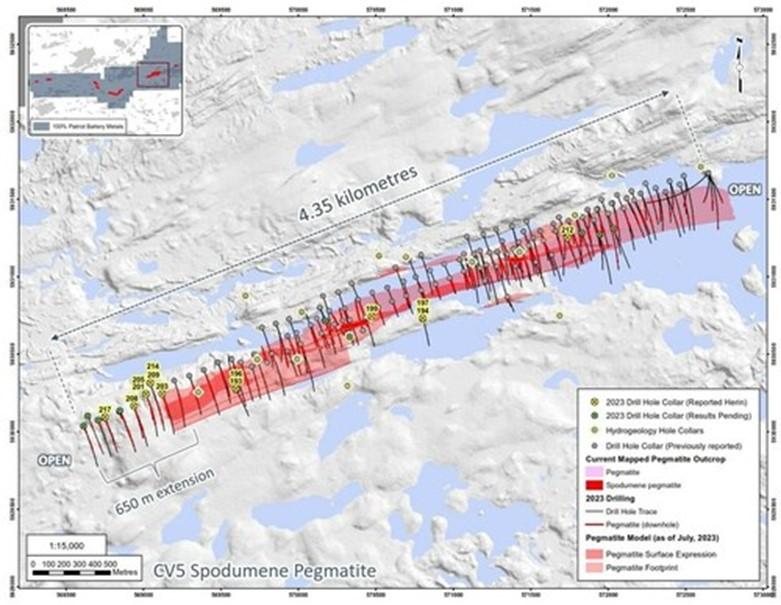
Figure 1: Drill holes completed at the CV5 Spodumene Pegmatite as announced September 24, 2023. (CNW Group/Patriot Battery Metals Inc)

Figure 2: Drill holes completed at the CV5 Spodumene Pegmatite as announced September 24, 2023. – western area. (CNW Group/Patriot Battery Metals Inc)

Table 1: Core assay summary for drill holes reported herein at the CV5 Spodumene Pegmatite (CNW Group/Patriot Battery Metals Inc)
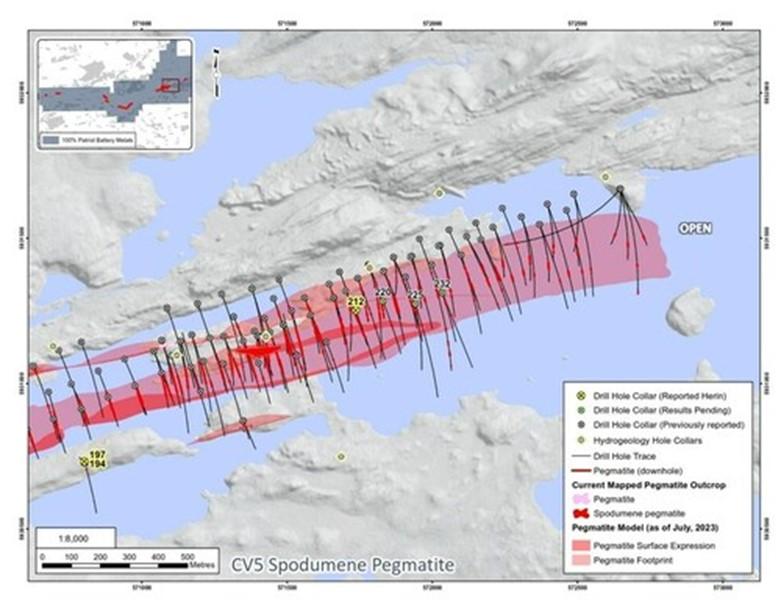
Figure 3: Drill holes completed at the CV5 Spodumene Pegmatite as announced September 24, 2023 – east-central, and eastern areas. (CNW Group/Patriot Battery Metals Inc)

Figure 4: Well mineralized spodumene pegmatite drill core grading ~2.6% Li2O from hole CV23-199 (CNW Group/Patriot Battery Metals Inc)
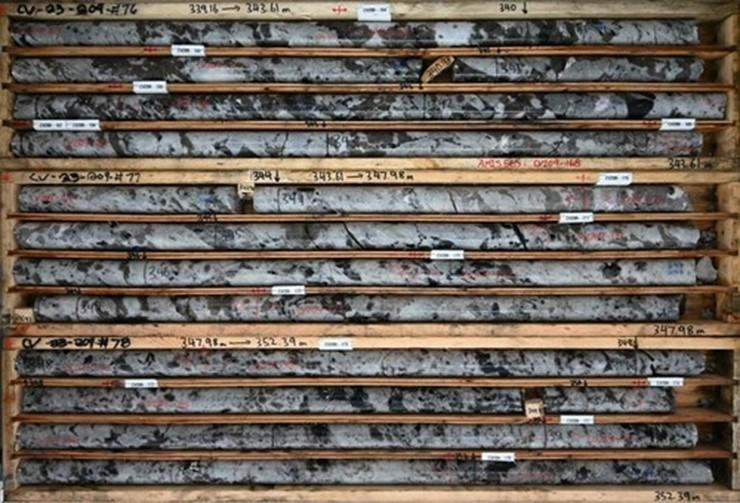
Figure 5: Well mineralized spodumene pegmatite drill core grading ~2.0% Li2O from hole CV23-209 (western extension) (CNW Group/Patriot Battery Metals Inc)

Table 2: Attributes for drill holes reported herein at the CV5 Spodumene Pegmatite (CNW Group/Patriot Battery Metals Inc)
Critical Metals Corp. (Nasdaq: CRML) a leading critical minerals ... READ MORE
Holes SH26-22 and SH26-23 return up to 930 g/t AgEq within broade... READ MORE
Pasinex Resources Limited (CSE: PSE) (FSE: PNX) a growing zinc-fo... READ MORE
Aya Gold & Silver Inc. (TSX: AYA; NASDAQ: AYA) is pleased to... READ MORE
New Break Resources Ltd. (CSE: NBRK) (OTCQB: NBRKF) (FSE: O91) ha... READ MORE