








Indicated Resources Contain 29.9 Moz AgEq1 at 519 g/t AgEq and Inferred Resources Contain 27.9 Moz AgEq at 369 g/t AgEq
Outcrop Silver & Gold Corporation (TSX: OCG) (OTCQX: OCGSF) (DE: MRG) is pleased to report the results of an updated mineral resource estimate for its 100%-owned Santa Ana primary silver project in Colombia.
HIGHLIGHTS
“Since the Maiden MRE three years ago, Outcrop Silver’s exploration team has done an outstanding job of growing contained silver and gold ounces, as well as understanding the geology at the Santa Ana project,” commented Rob Bruggeman, President and CEO. “Mineralization at Santa Ana continues to impress with its high grades, continuity and scale. New vein systems like Guadual and Aguilar have added substantial resources to the Updated MRE, with another dozen veins still to be adequately drill tested and more veins likely to be discovered as exploration continues.”
The Updated MRE was prepared by APEX Geoscience Ltd. in accordance with Canadian Institute of Mining, Metallurgy and Petroleum Definition Standards – For Mineral Resources and Mineral Reserves adopted May 19, 2014, and in accordance with National Instrument 43-101 – Standards of Disclosure for Mineral Projects. The effective date of the Updated MRE is September 10, 2026.
Table 1. Summary of the Indicated and Inferred Underground Mineral Resources on the Santa Ana Property
| Vein Area | Classification | Tonnes (kt) |
Contained Metal (Moz) | Average Grades (g/t) | ||||||||||||||||||||||||||||||||||||||||||||||||||||||||
| AgEq | Ag | Au | AgEq | Ag | Au | |||||||||||||||||||||||||||||||||||||||||||||||||||||||
| Aguilar | Indicated | 373 | 4.2 | 2.7 | 0.019 | 348.5 | 221.1 | 1.61 | ||||||||||||||||||||||||||||||||||||||||||||||||||||
| Aguilar | Inferred | 582 | 5.2 | 3.3 | 0.024 | 275.3 | 175.5 | 1.26 | ||||||||||||||||||||||||||||||||||||||||||||||||||||
| El Dorado | Indicated | 77 | 1.7 | 1.2 | 0.006 | 686.7 | 502.3 | 2.33 | ||||||||||||||||||||||||||||||||||||||||||||||||||||
| El Dorado | Inferred | 97 | 0. | . | .005 | 301.3 | 169.0 | 1.67 | ||||||||||||||||||||||||||||||||||||||||||||||||||||
| Esp Santo | Indicated | 4 | 0.0 | 0.0 | 0.000 | 197.4 | 117.5 | 1.01 | ||||||||||||||||||||||||||||||||||||||||||||||||||||
| Esp Santo | Inferred | 18 | 0.1 | 0.1 | 0.001 | 183.5 | 89.2 | 1.19 | ||||||||||||||||||||||||||||||||||||||||||||||||||||
| Guadual | Indicated | 255 | 4.9 | 4.0 | 0.011 | 592.9 | 486.4 | 1.35 | ||||||||||||||||||||||||||||||||||||||||||||||||||||
| Guadual | Inferred | 326 | 4. | .0 | 0.011 | 459.1 | 379.0 | 1.01 | ||||||||||||||||||||||||||||||||||||||||||||||||||||
| La Porfia | Indicated | 124 | 2.0 | 0.9 | 0.014 | 513.4 | 233.8 | 3.54 | ||||||||||||||||||||||||||||||||||||||||||||||||||||
| La Porfia | Inferred | 84 | 1.4 | 0.5 | 0.011 | 511.5 | 194.8 | 4.01 | ||||||||||||||||||||||||||||||||||||||||||||||||||||
| La Ye | Indicated | 60 | 0.5 | 0.3 | 0.002 | 254.2 | 165.2 | 1.13 | ||||||||||||||||||||||||||||||||||||||||||||||||||||
| La Ye | Inferred | 82 | 0.7 | 0.5 | 0.003 | 272.4 | 174.8 | 1.23 | ||||||||||||||||||||||||||||||||||||||||||||||||||||
| Las Maras | Indicated | 194 | 5.3 | 4. | .009 | 854.8 | 735.1 | 1.51 | ||||||||||||||||||||||||||||||||||||||||||||||||||||
| Las Maras | Inferred | 158 | 3.8 | 3.0 | 0.010 | 750.6 | 596.9 | 1.94 | ||||||||||||||||||||||||||||||||||||||||||||||||||||
| La Isabela | Indicated | 9 | 0.1 | 0.1 | 0.000 | 293.9 | 205.6 | 1.12 | ||||||||||||||||||||||||||||||||||||||||||||||||||||
| La Isabela | Inferred | 73 | 0.6 | 0.4 | 0.002 | 249.2 | 170.7 | 0.99 | ||||||||||||||||||||||||||||||||||||||||||||||||||||
| Los Mangos | Indicated | 170 | 2.9 | 2.2 | 0.009 | 525.1 | 397.0 | 1.62 | ||||||||||||||||||||||||||||||||||||||||||||||||||||
| Los Mangos | Inferred | 78 | 1.4 | 1.2 | 0.002 | 547.4 | 487.6 | 0.76 | ||||||||||||||||||||||||||||||||||||||||||||||||||||
| Los Naranjos | Indicated | 177 | 2.4 | 2.0 | 0.006 | 429.5 | 345.2 | 1.07 | ||||||||||||||||||||||||||||||||||||||||||||||||||||
| Los Naranjos | Inferred | 90 | 0.8 | 0.6 | 0.002 | 264.0 | 215.4 | 0.62 | ||||||||||||||||||||||||||||||||||||||||||||||||||||
| Morena | Indicated | 19 | 0.2 | 0.2 | 0.000 | 325.0 | 268.6 | 0.71 | ||||||||||||||||||||||||||||||||||||||||||||||||||||
| Morena | Inferred | 136 | 1.7 | 1.2 | 0.005 | 382.2 | 285.2 | 1.23 | ||||||||||||||||||||||||||||||||||||||||||||||||||||
| Paraíso | Indicated | 155 | 3.2 | 1.6 | 0.020 | 634.4 | 319. | .98 | ||||||||||||||||||||||||||||||||||||||||||||||||||||
| Paraíso | Inferred | 201 | 2.2 | 1.2 | 0.012 | 333.4 | 183.5 | 1.90 | ||||||||||||||||||||||||||||||||||||||||||||||||||||
| Santa Ana | Indicated | 176 | 2.5 | 2.0 | 0.006 | 446.4 | 357.9 | 1.12 | ||||||||||||||||||||||||||||||||||||||||||||||||||||
| Santa Ana | Inferred | 426 | 4.4 | 3.6 | 0.010 | 319.9 | 263.2 | 0.72 | ||||||||||||||||||||||||||||||||||||||||||||||||||||
| Total | Indicated | 1,793 | 29.9 | 21.7 | 0.104 | 518.7 | 376.4 | 1.80 | ||||||||||||||||||||||||||||||||||||||||||||||||||||
| Total | Inferred | 2,352 | 27.9 | 20.1 | 0.098 | 368.5 | 266.4 | 1.29 | ||||||||||||||||||||||||||||||||||||||||||||||||||||
| Notes: | |
| 1. | Warren Black, M.Sc., P.Geo., Senior Consultant: Mineral Resources and Geostatistics of APEX Geoscience Ltd., who is deemed a Qualified Person as defined by NI 43-101, is responsible for the completion of the mineral resource estimation, with an effective date of September 10, 2026. |
| 2. | Mineral Resources that are not Mineral Reserves do not have demonstrated economic viability. |
| 3. | The estimate of Mineral Resources may be materially affected by environmental, permitting, legal, title, taxation, socio-political, marketing, or other relevant issues. |
| 4. | The Inferred Mineral Resource in this estimate has a lower level of confidence than that applied to an Indicated Mineral Resource and must not be converted to a Mineral Reserve. It is reasonably expected that the majority of the Inferred Mineral Resource could potentially be upgraded to an Indicated Mineral Resource with continued exploration. |
| 5. | The Mineral Resources were estimated in accordance with the Canadian Institute of Mining, Metallurgy and Petroleum (CIM), CIM Standards on Mineral Resources and Reserves, Definitions (2014) and Best Practices Guidelines (2019) prepared by the CIM Standing Committee on Reserve Definitions and adopted by the CIM Council. |
| 6. | Historically mined areas were removed from the block-modelled Mineral Resources. |
| 7. | Economic assumptions used include US$40/oz Ag, US$3,100/oz Au, process recoveries of 96.3% for Ag and 98.5% for Au, a US$35/t processing cost, and G&A of US$15/t. The resulting Ag equivalency ratio is rounded to 79:1. |
| 8. | Underground Mineral Resources are reported within optimized mining shapes generated using mining shape optimization and reported on a “take-all” basis (i.e., including internal dilution within the shapes). |
| 9. | For the Santa Ana and Los Naranjos vein areas, evaluated using long-hole open stoping (LHOS), a mining cost of US$65/t, together with the economic assumptions above, results in an underground AgEq cutoff grade of 95 g/t. Minimum shape dimensions are 1.5 m (W) × 10 m (H) × 10 m (L). |
| 10. | All other vein areas are evaluated using cut-and-fill mining. A mining cost of US$110/t, together with the economic assumptions above, results in an underground AgEq cutoff grade of 130 g/t. Minimum mining-shape dimensions are 1.0 m (W) × 5 m (H) × 5 m (L). |
The information in Table 2 illustrates the grade distribution of material comprising the stated Underground Mineral Resource. It does not represent alternative Mineral Resource estimates or alternative reporting cut-off scenarios. The Underground Mineral Resource is reported on a take-all basis within the RPEEE-constrained underground reporting shapes shown in Table 1.
Table 2 – Distribution of AgEq Grades Within the Stated Underground Mineral Resource Reporting Shapes
| AgEq Cutoff (g/t) |
Tonnes (kt) |
Contained Metal (Moz) | Average Grades (g/t) | ||||
| AgEq | Ag | Au | AgEq | Ag | Au | ||
| Indicated | |||||||
| MRE Statement | 1,793 | 29.9 | 21.7 | 0.104 | 518.7 | 376.4 | 1.80 |
| 50 | 1,728 | 29.9 | 21.7 | 0.104 | 537.8 | 390.3 | 1.87 |
| 75 | 1,703 | 29.8 | 21.6 | 0.103 | 544.8 | 395.4 | 1.89 |
| 95 | 1,678 | 29.8 | 21.6 | 0.103 | 551.5 | 400.4 | 1.91 |
| 130 | 1,617 | 29.5 | 21.5 | 0.102 | 568.2 | 412.7 | 1.97 |
| 175 | 1,479 | 28.8 | 21.0 | 0.100 | 606.7 | 441.3 | 2.09 |
| 250 | 1,209 | 27.0 | 19.7 | 0.092 | 694.9 | 507.3 | 2.38 |
| 500 | 629 | 20.3 | 15.0 | 0.067 | 1,005.9 | 743.3 | 3.32 |
| Inferred | |||||||
| MRE Statement | 2,352 | 27.9 | 20.1 | 0.098 | 368.5 | 266.4 | 1.29 |
| 50 | 2,275 | 27.8 | 20.1 | 0.098 | 380.3 | 275.0 | 1.33 |
| 75 | 2,247 | 27.8 | 20.1 | 0.097 | 384.4 | 278.0 | 1.35 |
| 95 | 2,213 | 27.7 | 20.0 | 0.097 | 389.0 | 281.4 | 1.36 |
| 130 | 2,111 | 27.3 | 19.8 | 0.095 | 402.3 | 291.1 | 1.41 |
| 175 | 1,788 | 25.7 | 18.7 | 0.088 | 447.0 | 325.7 | 1.53 |
| 250 | 1,290 | 22.3 | 16.4 | 0.075 | 538.2 | 395.3 | 1.81 |
| 500 | 468 | 13.1 | 10.0 | 0.040 | 869.0 | 661.4 | 2.63 |
| Notes: | |
| 1. | The bolded figures represent the reported Underground MRE, reported on a take-all basis within the optimized underground reporting shapes |
| 2. | All tonnage, grade, and contained metal values comprise classified model blocks within the fixed optimized underground reporting shapes used to constrain the Underground MRE reported in Table 1. No additional external mining dilution or mining recovery factors have been applied to the values presented. |
| 3. | The non-bolded rows illustrate the distribution of grades within the fixed Underground MRE reporting shapes by applying the indicated AgEq thresholds to the contained model blocks. These rows do not represent separately reported Mineral Resource estimates. |
Updated MRE Discussion
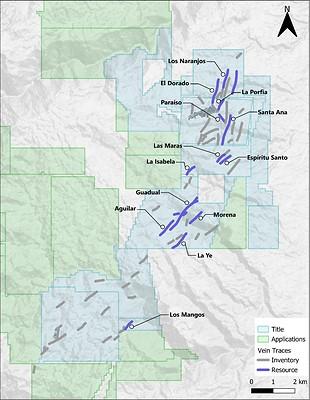
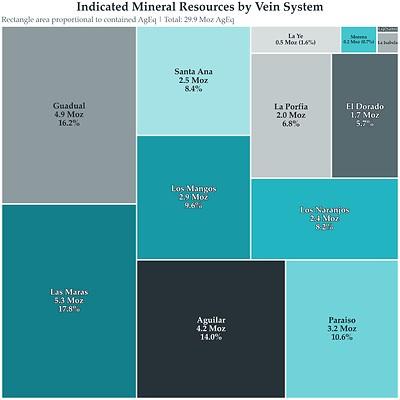
The Updated MRE is based on a total of 130,006 m of drilling in 646 drill holes, representing an increase of 71,094 m of drilling from the Maiden MRE. Silver and gold mineralization in the Updated MRE is represented by 46 mineralized domains across 13 vein systems (Figure 1). Indicated mineralization varies in AgEq grade from 197.4 to 854.8 g/t, averaging 518.7 g/t AgEq. Some of the veins – such as El Dorado, Guadual, Paraiso, and Las Maras – demonstrate exceptionally high average AgEq grades.
Resource Classification Discussion
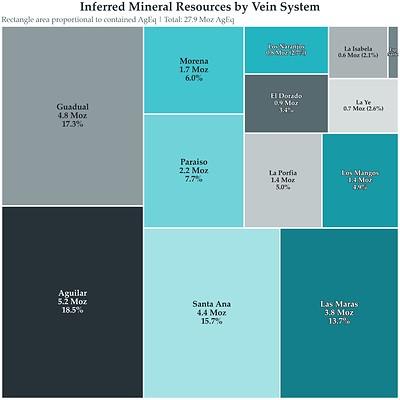
Mineral Resource classification in the Updated MRE applied a more rigorous standard than the Maiden MRE. Whereas the 2023 classification relied on a single distance-based criterion (Indicated within 40 m of drillhole samples), the 2026 classification requires both a defined search distance and a minimum number of supporting drillholes (three for Indicated, two for Inferred). As a result, despite a substantial increase in drilling since 2023, the growth in Indicated resources was modest (23.5%), reflecting the additional rigor of the updated classification approach rather than a limitation in the underlying data. Inferred resources increased substantially (106.3%) as a result of the additional drilling.
Classification was completed separately from grade estimation using search ellipsoids and minimum drillhole support. Indicated Resources require three drillholes within a 60 × 60 × 30 m ellipsoid, while Inferred Resources require two drillholes within a 120 × 80 × 30 m ellipsoid; trench and underground samples were not used to support Indicated classification.
Underground Mineral Resources are constrained within potentially mineable shapes generated using mining shape optimization (MSO) based on the selected mining method, geometry, and economic assumptions. Once a qualifying shape is defined, all material within the shape is reported on a “take-all” basis, including internal material below the stated cutoff grade, to reflect practical mining selectivity and internal dilution. Figures 2 and 3 illustrate the AgEq contained in each vein system for Indicated and Inferred mineral resource estimates.
Santa Ana Project Mineralization and Exploration Potential
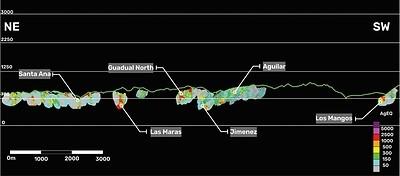
Silver and gold mineralization at Santa Ana is hosted in a series of major vein systems that include multiple parallel veins and mineralized shoots spanning a strike length of 17 km (Figure 4). Mineralization is open along strike, especially at the southwestern end of the Santa Ana project. There are at least twelve known vein systems not included in the Updated MRE due to insufficient or no drill testing. Future drilling will evaluate the potential of these vein systems to further grow the mineral resource estimates. Furthermore, the Company maintains a pipeline of untested geophysical and geochemical anomalies that could translate into additional drill targets, further supporting the growth potential of the Santa Ana project.
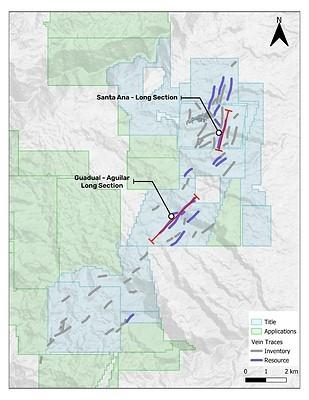
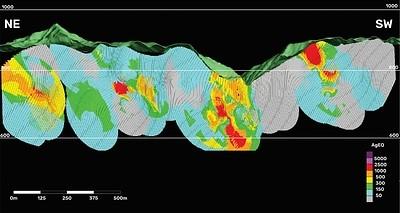
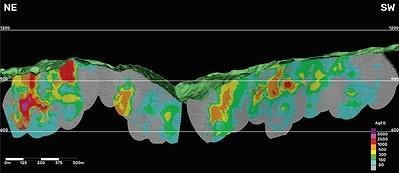
The vein systems on the Santa Ana project vary from steeply dipping to shallow dipping. The majority of the mineralization occurs within 300 m from surface (Figure 5, 6 and 7), with resource growth potential at depth from ore shoots and feeders.
Vein Descriptions
The mineralized trends at the Santa Ana Project are strongly structurally controlled and are characterized by narrow veins hosted primarily within two principal structural orientations. The dominant vein system strikes NNE and is associated with steeply dipping shear structures, typically dipping approximately 80° to the west, whereas a secondary vein set strikes NE and exhibits more moderate westerly dips, generally ranging from 35° to 60°.
Mineralization is hosted predominantly within quartz-sericite and chlorite-actinolite schists, locally crosscut by intermediate-composition dikes. Hydrothermal alteration adjacent to the mineralized structures is generally restricted, with sericitic and argillic alteration forming narrow halos that typically extend less than 1 m into the wall rock. Mineralization is characterized by an assemblage of pyrite (Py), sphalerite (Sph), galena (Gn), with variable chalcopyrite (Cpy), argentite (Arg), pyrargyrite (Pyr), native silver, and electrum. The relative abundance of these minerals varies systematically along both the strike and dip of the mineralized veins.
| Vein | Width (m) | Trend | Length Azimuth (m) |
Length Dip (m) |
Mineral Assemblage |
| Guadual | 1.04 | ~220°/69° | 1300 | 400 | Py + Gn + Sph ± Prg ± Arg |
| Maras | 1.2 | ~220°/79° | 370 | 430 | Py + Gn + Sph ± Prg ± Arg ± Ag ± Elec |
| Aguilar | 0.75 | ~230°/55° | 1600 | 520 | Py + Gn + Sph ± Arg ± Prg |
| Santa Ana | 1.98 | ~190°/82° | 1700 | 350 | Py + Gn + Sph ± Prg ± Arg ± Ag ± Elec |
| Paraíso | 0.77 | ~140°/30° | 520 | 580 | Py + Gn + Sph ± Prg ± Arg ± V.G |
| Los Mangos | 1.11 | ~40°/86° | 750 | 320 | Py + Gn + Sph ± Arg |
| Porfia | 0.45 | ~225°/40° | 270 | 500 | Py + Gn + Sph ± Prg ± Arg ± V.G |
Py: Pyrite, Gn: Galena, Sph: Sphalerite, Prg: Pyrargyrite, Arg: Argentite, Ag: Native Silver, Elec: Electrum, V.G: Visible Gold.
Resource Modeling
The Updated MRE is based on 646 diamond drillholes. APEX was supplied with wireframes generated by Outcrop Silver in Leapfrog and APEX refined the interpretation by incorporating unmodelled high-grade intercepts and adding data-supported domains while preserving the overall geological framework. Mineralized vein thicknesses in the indicated and inferred resources ranged from 0.06 to 9.96 m and averaged 0.91 m.
Mineral Resource modelling was conducted in the UTM coordinate system relative to the North American Datum 1983 / UTM Zone 15N (EPSG:26915). The MRE utilized a block model with a parent block size of 2 m (X) by 2 m (Y) by 2 m (Z) to honour the mineralization wireframes for estimation. Silver (Ag) and gold (Au) grades were estimated using inverse distance squared (ID2) with locally varying anisotropy (LVA) to reproduce grade continuity along the variable orientations of the mineralized veins. For the Santa Ana vein set, a High Yield (HY) estimation approach was incorporated with the ID2-LVA estimation to restrict the spatial influence of high-grade samples. The model is sub-blocked for shape optimization and resource reporting. Underground Mineral Resources are reported within optimized mining shapes generated using mining-shape optimization and reported on a “take-all” basis (i.e., including internal dilution within the shapes). Drillhole samples were composited to a target length of 1.0 m using a balanced compositing method that adjusts composite lengths within each contiguous domain interval to maintain consistent support and minimize short residual composites.
Composite silver and gold grades were reviewed for outliers using log-probability plots and 3D spatial analysis. Grade capping thresholds were applied on a vein-area basis where warranted to limit the influence of isolated high-grade values on the resource estimate.
Specific gravity test work was completed for 1,541 core samples. Density values were assigned by vein domain based on statistical analysis of available specific gravity measurements. A density of 2.77 t/m³ was assigned to the Los Mangos and Las Maras vein areas, 2.46 t/m³ to La Isabela, and 2.65 t/m³ to all other mineralized vein areas. A density of 2.63 t/m³ was assigned to country rock.
A technical report prepared by APEX in accordance with NI 43-101 will be filed on the Company’s website and SEDAR+ within 45 days of this press release.
Progress to Date and Resource Growth Potential
The Updated MRE demonstrates the effectiveness of Outcrop Silver’s systematic exploration strategy across the Santa Ana Project. Since the 2023 Maiden MRE, exploration has expanded the scale of known mineralized systems, converted previously untested and blind targets into mineral resources, and validated predictive exploration concepts developed through the team’s geological analysis and interpretation, leading to the identification of additional mineralization within previously known systems. With mineral resources now defined across a substantially broader portion of the project, from Los Naranjos in the north to Los Mangos in the south, the Updated MRE demonstrates the progress achieved through systematic exploration since 2023. With several known vein systems remaining insufficiently tested or untested, the Outcrop Silver technical team has a substantial pipeline of exploration work to continue applying the same disciplined approach that has driven resource growth since the Maiden MRE.
Qualified Persons
The Updated MRE was prepared under the supervision of Warren Black, M.Sc., P.Geo., a Senior Consultant: Mineral Resources and Geostatistics of APEX who is independent of the Company and a Qualified Person as defined under NI 43-101. Mr. Black is not aware of any environmental, permitting, legal, title, taxation, socio-political, marketing, or other relevant factors that could materially affect the Updated MRE and has reviewed and approved the technical contents relating to the Updated MRE in this news release.
The technical information presented in this news release has been reviewed and approved by Carlos Torres, P.Geo., Vice President of Exploration for Outcrop Silver and the Qualified Person for exploration at the Santa Ana Project, as defined by NI 43-101.
1Silver Equivalent
Metal prices used for equivalent calculations were US$3,100/oz for gold, and US$40/oz for silver, based on three-year trailing average prices. Metallurgical recoveries based on Outcrop Silver’s metallurgical test work are 98.5% for gold and 96.3% for silver (see news release dated June 25, 2024). The equivalency formula is as follows:

The resulting silver-to-gold equivalency ratio has been rounded to 79:1, meaning that 79 g/t Ag is equivalent to 1 g/t Au for the purposes of calculating silver-equivalent grades.
QA/QC
Outcrop Silver applied its standard protocols for sampling and assay for exploration activities. Core diameter is a mix of HTW and NTW, depending on the drill hole depth. Diamond drill core boxes were photographed, sawed, sampled, and tagged. Samples were bagged, tagged, and packaged for shipment by truck from Santa Ana’s core logging facilities in Falan, Colombia to the Actlabs certified sample preparation facility in Medellin, Colombia. Actlabs is an accredited laboratory independent of the Company. HTW/NTW core is sawn with one-half shipped. Samples delivered to Actlabs were AA assayed on Au, Ag, Pb, and Zn at Medellin using 1A2Au, 1A3Au, Multi-elements AR (Ag Cu Pb Zn), and Code 8 methods. Then, samples were sent to Actlabs Canada in Ancaster, Ontario, for ICP multi-elemental analysis under code 1E3. In line with QA/QC best practices, blanks, duplicates, and certified reference materials are inserted into the sample stream at approximately 3 control samples every 20 samples to monitor laboratory performance. A comparison of control samples and their standard deviations indicates acceptable assay accuracy and no detectable contamination. No material QA/QC issues have been identified with respect to sample collection, security, and assaying. The samples are analyzed for gold and silver using a standard fire assay on a 30-gram sample with a gravimetric finish for over-limits. Multi-element geochemistry was determined by ICP-MS using either aqua regia or four acid digestions. Crush rejects, pulps, and the remaining core are stored in a secured facility at Santa Ana for future assay verification.
About Santa Ana
The 100%-owned Santa Ana project spans over 28,000 hectares within the Mariquita District, encompassing both titles and applications, and is recognized as the largest and highest-grade primary silver district in Colombia, with mining records dating back to 1585.
The ongoing 35,000 metre drill campaign has extended known mineralization and tested additional target areas within the 17-kilometre-long fully titled mineralized corridor at the Santa Ana Project. Additional drilling will focus on growing mineral resources within the known vein systems while also drill testing new vein systems. Since initial drilling in 2019, the Company has a track record of discovering new high-grade vein systems on a regular basis.
About Outcrop Silver
Outcrop Silver is rapidly advancing its flagship Santa Ana high-grade silver project in Colombia. Leveraging a disciplined and seasoned team of professionals with decades of experience in the region, Outcrop Silver is dedicated to expanding high grade silver and gold mineral resources while advancing the Santa Ana project towards production.
At the core of our operations is a commitment to responsible mining practices and community engagement, underscoring our approach to sustainable development. With a deep understanding of the Colombian mining landscape and a proven track record of successful exploration, Outcrop Silver is well-positioned to transform the Santa Ana project into a significant silver producer, making a positive contribution to the local economy and setting new standards in the mining industry.
Brutus Mining Inc. (CSE: BRU) (FSE: ZI3) is pleased to announce that it has closed its non-brokered ... READ MORE
Jaguar Uranium Corp. (NYSE American: JAGU) is pleased to announce an independent Mineral Resource E... READ MORE
Auro Metals Inc. (TSX-V: AURO) (OTCQB: AURFF), is pleased to announce the assay results of the fina... READ MORE
Endeavour Silver Corp. (NYSE: EXK) (TSX: EDR) is pleased to announce that repairs to the primary bal... READ MORE
Scorpio Gold Corp. (NASDAQ: SGLD) (TSX-V: SGLD) (OTCQB: SRCRF) (FSE: RY9) is pleased to announce re... READ MORE