







Oreterra Metals Corp. (TSX-V: OTMC) (OTCQB: OTMCF) (FSE: D4R0) (WKN: A421RQ) is pleased to announce that drilling is underway with a first drill at the Trek South porphyry copper-gold prospect, located adjacent to Teck-Newmont’s Galore Creek porphyry deposits in BC’s Golden Triangle. The Trek South prospect is a significant new exploration target, revealed by a dramatic recent pull-back in glacial ice cover, and has never been drilled. A second drill will join the program in approximately one week. Crews are operating from an on-site camp, photo below, located only 1.2 km directly upslope from the partially constructed portion of the Galore Creek – Highway 37 road.
“We are excited to be underway on the most important stage of the exploration program for the Company and our investors, which is drill testing this compelling combination of geological, geophysical and geochemical targets,” said Kevin Keough, Chief Executive Officer. “Trek South is a terrific prospect, our team has done a great deal of good work to get to this point, and we’re keenly watching the drilling progress. We will be reporting further as the drill results come in.”
Exploration at Trek South has been following the UBC MDRU model for BC-style porphyry Cu-Au-Ag deposits, where a porphyry intrusion at depth fractures overlying rocks, allowing hydrothermal fluids to enter and alter them and introduce metals. At Trek South, abundant porphyry-style alteration includes widespread intense epidote alteration, overprinting Cu-Au-Ag quartz-pyrite stockworks, Cu-Au-W enriched epidote-garnet-chalcopyrite-pyrite skarnification, and local actinolite, carbonate, biotite-magnetite and hematite alteration. The recently confirmed presence of mineralized feldspar-biotite porphyritic dykes also links surface alteration to an underlying intrusion.
Drilling Plan
As shown on Figure 1 below, the Phase 1 Trek South drill program will encompass approximately 5,000 metres of drilling in 8 angled core holes spaced 150 metres apart along two fences oriented southwest to northeast outboard to the Trek South glacier toe. As information is gathered from ongoing drilling, some adjustment to the number of holes, locations, lengths, dips and azimuths may occur. Drilling will generally advance from southwest to northeast across the target area, testing a roughly one kilometre long induced polarization chargeability high and resistivity low that is for the most part also coincident with a bullseye magnetic high.
Drill Target: IP Anomaly: The strong IP chargeability anomaly, which ranges up to 40 mV/v, is believed to reflect the presence of sulphide minerals in the rocks below the porphyry-style alteration visible on surface. Sulphide minerals typically host the metals in a porphyry system. Of note, IP survey results for line 2N (Figure 2), one of three lines of IP surveyed in 2022, demonstrate that the chargeability high and corresponding resistivity low comes to surface along a relatively narrow ‘neck’ where strongly developed copper-tungsten skarns have been mapped and sampled in outcrop. The chargeability envelope has therefore been shown to encompass metal-bearing sulphides. The same section view shows a significant broadening of the IP chargeability and resistivity anomalies below approximately 100 metres vertical depth. A similar phenomenon is also observed on the other two lines of IP from the 2022 survey, where chargeability appears to ‘leak’ to surface above a much larger volume of chargeability below.
Drill Target: Magnetic Anomaly: The strongly positive magnetic anomaly associated with much of the length of the main IP chargeability anomaly is also considered an important drill target as it is believed to potentially reflect the higher-grade, potassically altered, magnetically positive core areas of the Trek South porphyry system, as predicted by the MDRU model. Minor amounts of potassic-magnetic alteration have been found at surface.
Drill hole TS26-01: TS26-01, now drilling, is collared in outcropping porphyry-style alteration (very strong red garnet and epidote vein networks and overprinting Cu-Au-Ag quartz-pyrite stockworks) and among bornite and chalcopyrite-bearing mafic volcanic boulders pushed out by ice flow from a source area under the Trek South glacier. It is being drilled to a southeast azimuth at a dip of minus 60 degrees to a targeted depth of 600 metres. Located at the west end of the most southerly of two planned fences of holes, TS26-01 is designed to test underlying, coincident, IP chargeability, positive magnetic, and magnetotelluric anomalies, which geophysical surveys indicate increase in both intensity and scale at depth. The hole will also test out to the south below what remains of the Trek South glacier, and below Cu-Au-Ag mineralized boulder trains coming off the glacier, which have been traced up-ice more than 600 metres. A composite grab sample (D771897) of the boulders referred to above taken by the Company in 2022 assayed 2.86% Cu, 8.85 g/t Au and 46.5 g/t Ag. Readers are cautioned that grab samples are by their nature selective, and not necessarily representative of overall grades. Nonetheless, the sampling does indicate the likely presence of high-grade mineralization still hidden beneath the nearby glacier which has receded some 200 metres in the past 15 years.
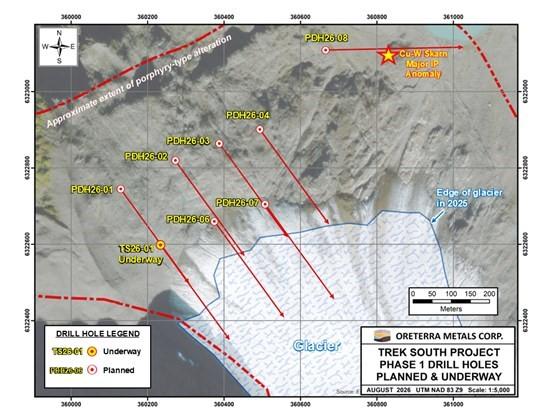
Figure 1: Trek South drill holes, planned and in progress
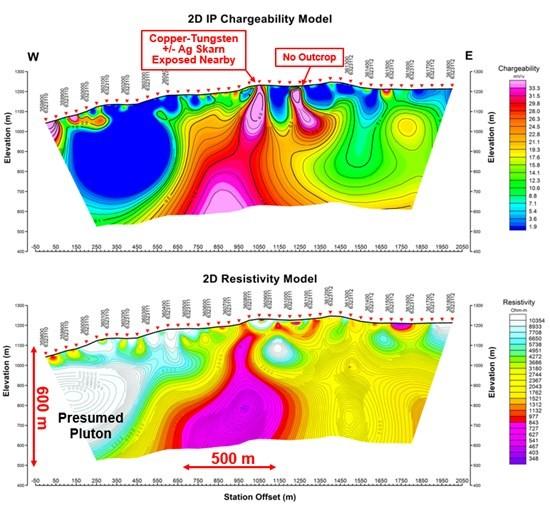
Figure 2: IP chargeability high and resistivity low beneath mineralized outcrops
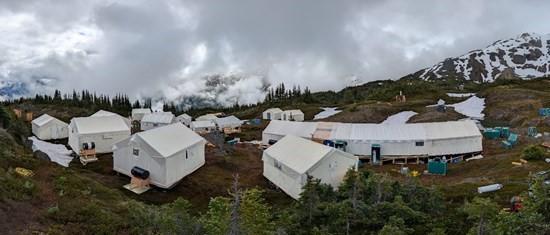
Photo 1: Trek South Camp, July 30, 2026
Field Programs on Targets Adjacent to Trek South:
Field programs including geological mapping, sampling and potentially IP surveying, are underway or planned on several promising targets located 0.6 to 1 km west of the Trek South prospect, the most significant of which are the porphyry-style Tundra Zone and the Eskay-Creek style Toe Zone. Neither zone has ever been drilled.
Tundra Zone: The Tundra Zone groups together multiple historical copper-gold-silver showings within an area measuring at least 600 metres N-S by 300 metres E-W exhibiting highly anomalous levels of pyrite, often 10-15%, as both disseminated grains and veinlets in multiple rock types. Numerous sites within the zone contain visible copper mineralization, and past sampling by the Company returned high values of copper to 1.7%, gold to 3.16 g/t Au and silver to 53.7 g/t Ag. The same area has a high temperature white mica and potassic white mica hyperspectral signature. This important combination of high levels of variably mineralized pyritic rocks with a white mica signature is highly suggestive of a “pyrite shell” like those commonly found surrounding porphyry copper deposits. In addition, this alteration assemblage overlies the northern half of a circular aeromagnetic high approximately 800 metres across, thought to reflect a magnetic pluton and/or potassic alteration zone at depth. An IP survey is planned for this area this month to further evaluate this high-potential target and, potentially, advance it to drill-ready status.
Toe Zone: The Toe Zone hosts several horizons of high-grade massive sulphide Cu-Au-Ag-Zn-Sb mineralization, ranging from one to four metres in width, spread across a 130 metre wide series of exposures, and open in three directions. High levels of pyrite mineralization are found in both argillites and felsic volcanics through this sequence, some of which are known to contain appreciable levels of Cu, Au and Ag. Assay results from recent detailed sampling of some of these extensive pyritic zones are pending. An Eskay Creek model is favoured for the Toe Zone, due to the similarity in stratigraphy and metal contents. A first ever IP survey will take place this month over the most promising part of this zone to better define it for possible future drill testing.
Oreterra Moves up to the OTCQB Exchange
The Company is pleased to announce that it has commenced trading on the OTCQB Venture Market. The trading symbol remains OTMCF. The move is expected to provide the Company with enhanced investor visibility and increased liquidity.
Qualified Person
The technical information in this news release has been reviewed and approved by John Biczok, P.Geo., Vice President, Exploration for Oreterra Metals Corp. and a Qualified Person as defined by National Instrument 43-101.
About Oreterra Metals Corp.
Oreterra Metals Corp. is a TSXV-listed mineral exploration company focused primarily on copper and gold. The Company holds several wholly-owned porphyry copper-gold prospects in British Columbia’s Golden Triangle, the most significant of which is the large-scale Trek South prospect, only recently revealed by glacial ice melt, located adjacent to the southeast of Teck-Newmont’s Galore Creek project, currently undergoing pre-feasibility studies. Drilling will test below the approximately 1 X 1.6 km wide zone of porphyry-style alteration, mineralization and Cu-Au-Ag +/- Te, W metal values exposed and sampled in bare bedrock at surface, and into the underlying intense induced polarization, magnetic and magneto-telluric anomalies present at Trek South. In addition, the first significant exploration work since 2007 is now planned for Oreterra’s JW porphyry prospect, located 6 km northwest of Galore Creek.
Additional wholly-owned Oreterra interests include two former producers in Nevada: the Kinkaid claims in the Walker Lane trend covering numerous shallow Au-Cu-Ag workings over what is believed to be one or more porphyry centres, and the Scossa mine property in the Sleeper trend which is a former high-grade gold producer. The Company also holds a 100% interest in the large-scale Lundmark-Akow Lake Au-Cu property adjacent to the northwest of the Musselwhite Mine, where drilling by the Company has produced highly encouraging, broad VMS-style Au-Cu intersections. Oreterra also retains an ongoing interest in several properties including a 2% NSR on McEwen Mining’s Hislop gold property in Ontario and a 2% NSR on Enduro Metals’ Newmont Lake Au-Cu-Ag property in BC. Technical presentations on each of the Kinkaid, Scossa and Lundmark-Akow Lake properties, authored by J. Biczok, P.Geo, are available at https://www.oreterra.com/investors.
Brutus Mining Inc. (CSE: BRU) (FSE: ZI3) is pleased to announce that it has closed its non-brokered ... READ MORE
Jaguar Uranium Corp. (NYSE American: JAGU) is pleased to announce an independent Mineral Resource E... READ MORE
Auro Metals Inc. (TSX-V: AURO) (OTCQB: AURFF), is pleased to announce the assay results of the fina... READ MORE
Endeavour Silver Corp. (NYSE: EXK) (TSX: EDR) is pleased to announce that repairs to the primary bal... READ MORE
Scorpio Gold Corp. (NASDAQ: SGLD) (TSX-V: SGLD) (OTCQB: SRCRF) (FSE: RY9) is pleased to announce re... READ MORE