







NorthWest Copper Corp. (TSX-V: NWST) is pleased to report drill results from hole K-25-287 completed as part of its 2025 program at the Company’s 100% owned Kwanika project in British Columbia. The hole returned higher-grade1 results in both the Pit and Central Zones, highlighted by a significant near-surface intercept of 25.9 metres grading 0.91% Cu and 1.29g/t Au (2.09% copper equivalent2).
Paul Olmsted, CEO of NorthWest, stated: “This drill hole is the 15th reported from our 2025 exploration program at Kwanika, a program which we believe has been highly successful in achieving its goals and will be value accretive. The program exceeded expectations by demonstrating the continuity of higher-grade zones over significant widths in both the Central Zone and the Pit Zone, materially improving our understanding of the mineralization. Results from the Pit Zone, in particular, are expected to support higher-grade open pit mineral resources. When combined with increased confidence in the higher-grade Central Zone to support alternative underground mining methods, and targeted recovery improvements from ongoing metallurgical test work, we expect to deliver an exciting mineral resource update in the first quarter of the year. Together, these developments are expected to support the potential for a more capital-efficient and economically compelling combined open pit and underground development plan, to be reflected in an updated preliminary economic assessment (“PEA”) delivered in mid 2026 that will aim to improve upon the 2023 PEA3.”
Hole K-25-287 intersected multiple higher-grade intercepts across a number of mineralized zones in both the Pit and Central Zones over significant widths. The hole returned unexpectedly wide intercepts within Pit Zone 10 and 12 at shallow depths, expanding the size of these higher-grade zones and providing better definition of the zones relative to Pit Zone 5.
The hole also intersected the Central Zone over a significant combined true width of 32.0 metres. This result continues to demonstrate the east-west zonation of the mineralization from copper-dominant to gold-dominant towards the west and clarifies an area poorly tested by a historical low-angle drill hole.
|
Drill Hole Highlights: |
|
| K-25-287 | |
| Pit Zone 11: | 47.5 metres of 1.22% Cu, 0.82g/t Au (1.99% CuEq) from 96.5 metres |
| Pit Zone 10: | 35.9 metres of 0.81% Cu, 1.03g/t Au (1.75% CuEq) from 144 metres including 25.9 metres of 0.91% Cu, 1.29g/t Au (2.09% CuEq) from 179.9 metres |
| Central Zone: | 32.0 metres of 0.32% Cu, 1.13g/t Au (1.34% CuEq) from 285 metres |
Geoff Chinn, VP Business Development and Exploration, added: “With the final drill hole reported in the Kwanika Central Deposit, we have confirmed that potassic alteration crosscut by mineralized quartz stockwork, later deformed by faults and fractures and overprinted by silica, sericite and pyrite, forms discrete continuous zones of higher-grade mineralization. Mineralization at Kwanika is strongly structurally controlled, which we believe has been emplaced along active fault zones. These zones have a distinctive geometry relative to the north-south trending Central Zone, where the Western Zones strike east-west, dip north and abut the western margin of the Central Zone, while the Pit Zones also strike east-west but dip south and abut the eastern margin of the Central Zone. These orientations are consistent with pull-apart faults, where the Central Zone is interpreted to be related to a crossing strike-slip zone, while the Pit Zones and Western Zones are associated with extensional normal faults. Pull-apart extensional faulting is known to be favourable structural settings for porphyry deposits, and while the full extent of structures at Kwanika remains unknown, hidden by younger sedimentary rocks and glacial cover, it represents a highly prospective geological environment warranting further exploration. With drill results at the Kwanika deposit complete we look forward to results from nearby exploration targets drilled as part of the 2025 program.”
Kwanika Exploration Program
On April 10, 2025, NorthWest announced a refined model for its flagship Kwanika project (“Target Model”), highlighting three key higher-grade zones: the Pit, Central and Western Zones. These zones target grades of 1.5% to 2.5% CuEq over combined true thicknesses of 30 to 45 metres, to be assessed against a more selective top-down bulk underground mining method.
The 2025 exploration program was designed to confirm, define and expand on the Company’s understanding of higher-grade copper-gold mineralization within the near surface and underground portions of the current mineral resources. Results of the 15 holes drilled at Kwanika, including holes K-25-287 demonstrate the merits of the program and indicate meaningful progress toward these objectives has been achieved.
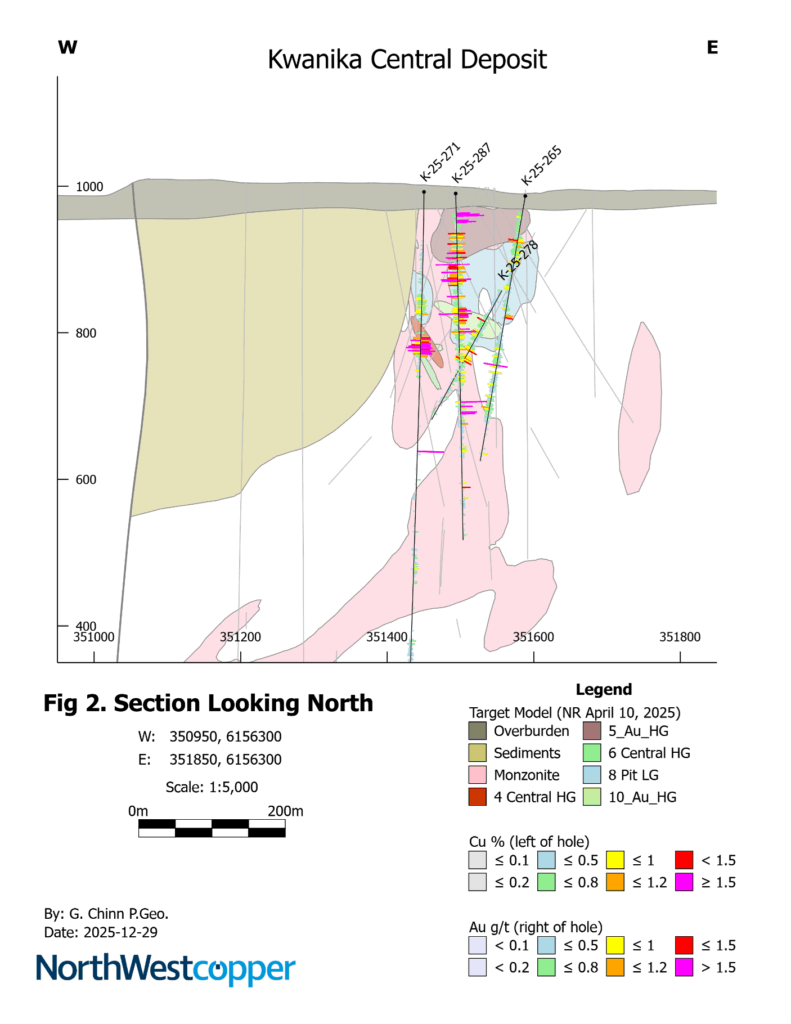
The hole location for K-25-287 relative to the entire drill program is presented in Figure 1 below. Figure 2 illustrates the cross section of the position and context of hole K-25-287 relative to the Target Model. Continuous mineralized intercepts and collar locations are summarized in Table 1 and Table 2.
Figure 1: Plan View of 2025 Program Drill Hole Location
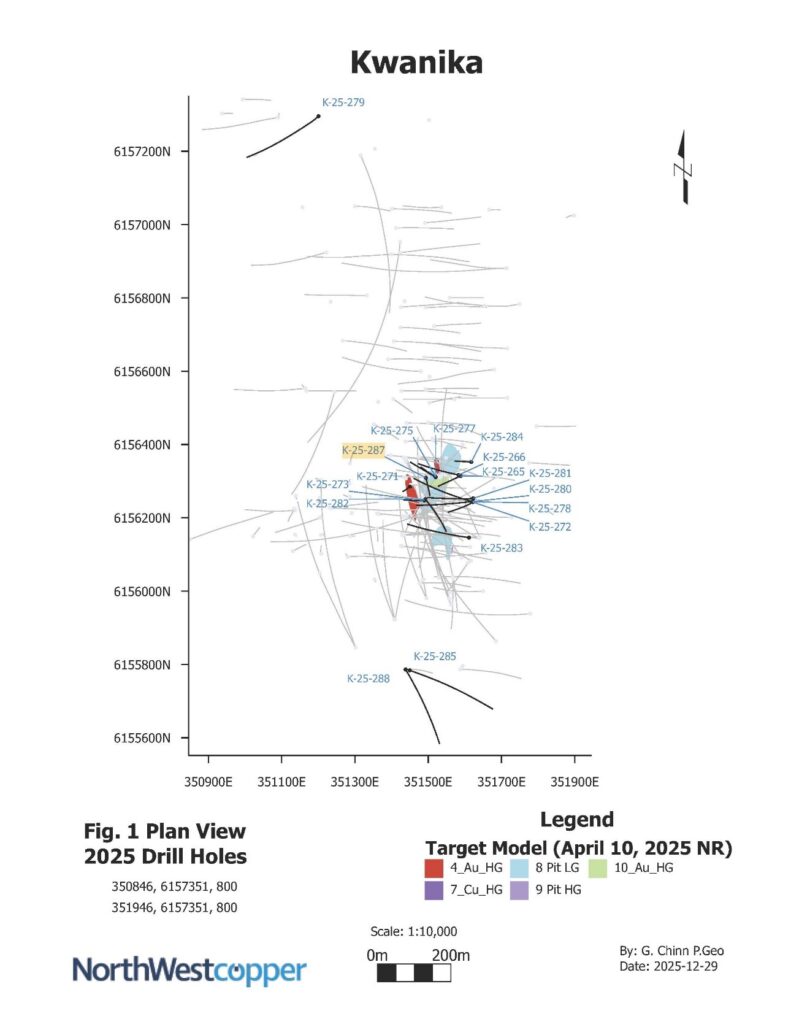
Figure 2: Cross Section of Target Model at K-25-287 Drill Location
A summary of the geological aspects of hole K-25-287 is presented below.
The hole was drilled using HQ core at an azimuth of 160° azimuth and a dip of -85° to a depth of 551 metres. Core was half sawn and sampled on 2-metre intervals. The purpose of the hole was to test the eastern extension of the Western Zones and to infill the Pit and Central Zones along the way.
At 26 metres, the hole intersected Pit Zone 5 at a low angle. This intersection confirms and infills the zone, returning a near-surface, gold-dominate mineralized interval over 65 metres (17 metre true width). Mineralization is hosted within strong potassic alteration crosscut by a dismembered early quartz stockwork containing pyrite and chalcopyrite. The interval also returned an elevated 0.11 g/t palladium over its length, indicative of very hot, chloride rich fluids.
At 96.5 metres, the hole intersected Pit Zone 11, confirming and infilling this zone. A near-surface, copper-dominant interval was returned over 48 metres (31 metre true width), hosted within potassic alteration (monzonite) crosscut by a dismembered early quartz stockwork. At 126.7 metres the interval transitions to a propylitic altered diorite with weak overprinting potassic and sericite alteration crosscut by quartz veins and veinlets containing pyrite and chalcopyrite mineralization and anhydrite veins and veinlets.
At 144 metres, the hole intersected Pit Zone 10, confirming and infilling this zone. The hole returned a near-surface interval over 36 metres (23 metre true width), hosted in moderately strong potassic alteration (monzonite) crosscut by quartz veins and veinlets containing pyrite and chalcopyrite mineralization. At 148 metres, the monzonite is strongly tectonized and overprinted by sericite alteration that includes breccias and rubble zones healed by silica, containing well mineralized veins and veinlets containing pyrite and chalcopyrite mineralization.
At 185 metres, the hole intersected Pit Zone 12, confirming and infilling this zone. The hole returned a near-surface interval over 46 metres (29 metre true width), hosted in a propylitic altered diorite overprinted by selective hematite and potassic alteration containing finely disseminated pyrite and vein hosted chalcopyrite and locally bornite mineralization.
At 245 metres, the hole intersected the northern edge of Central Zone 4. The hole returned an interval over 14 metres (9 metre true width), hosted in strong potassic alteration, logged as monzonite, crosscut by a quartz stockwork containing pyrite and chalcopyrite mineralization. The interval also reported an elevated 0.19 g/t palladium over its length indicative of very hot, chloride rich fluids.
At 285 metres, the hole intersected Central Zone 6. The hole returned an interval over 32 metres (21 metre true width), hosted in strong potassic alteration, logged as monzonite, crosscut by a quartz stockwork containing pyrite and chalcopyrite mineralization. Below 299 metres, the rocks transition to a tectonized monzonite overprinted by sericite alteration containing a dismembered quartz stockwork.
The hole did not intersect significant Western Zone mineralization.
Overall, hole K-25-287 demonstrated that the mineralized intersection between the Western and Central Zones does not extend further to the north. However, the hole did return unexpectedly wide intersections of Pit Zone 10 and 12 at shallow depths, defining these moderately southeast dipping zones and illustrating how the steeper dipping Pit Zone 5 branches off these zones.
Table 1: Drill Results in this News Release4 5
| Hole | From | To | Length | Zone | Cu | Au | Ag | CuEq | True Width | Description |
| (m) | (m) | (m) | (%) | (g/t) | (g/t) | (%) | Est. (m) | Target Model Zone Reference | ||
| K-25-287 | 26.0 | 91.0 | 65.0 | Pit | 0.65 | 1.12 | 3.10 | 1.67 | 16.8 | Higher-Grade Pit Zone 5 |
| K-25-287 | 96.5 | 144.0 | 47.5 | Pit | 1.22 | 0.82 | 3.00 | 1.99 | 30.6 | Higher-Grade Pit Cu Zone 11 |
| K-25-287 | 144.0 | 179.9 | 35.9 | Pit | 0.81 | 1.03 | 2.88 | 1.75 | 23.0 | Higher-Grade Pit Zone 10 |
| Including | 154.0 | 179.9 | 25.9 | Pit | 0.91 | 1.29 | 3.18 | 2.09 | 16.6 | Higher-Grade Pit Zone 10 |
| K-25-287 | 185.3 | 231.0 | 45.7 | Pit | 0.52 | 0.81 | 2.42 | 1.27 | 29.4 | Higher-Grade Pit Zone 12 |
| K-25-287 | 245.0 | 259.0 | 14.0 | Central | 0.55 | 0.75 | 2.44 | 1.24 | 9.0 | Higher-Grade Au Zone 4 |
| K-25-287 | 285.0 | 317.0 | 32.0 | Central | 0.32 | 1.13 | 1.74 | 1.34 | 20.6 | Higher-Grade Au Zone 6 |
Table 2: Drill Collar Information6
| Hole | Collar X | Collar Y | Collar Z | Collar Azimuth | Collar Dip | Final Length |
| K-25-287 | 351493 | 6156310 | 990 | 160 | -85 | 551 |
Quality Assurance / Quality Control
Drilling at Kwanika in 2025 was designed and supervised by NorthWest, implemented by InData Geoscience with assay QA/QC checks by Explore Geosolutions. Samples were collected, tracked and an external QA/QC program was implemented using blanks and standards to monitor analytical accuracy and precision. The samples were sealed on site and shipped to Activation Laboratories Ltd. in Kamloops, BC. The laboratory’s internal quality control system complies with global certifications for quality ISO 17025. Drill core samples were analyzed using a combination of Actlabs multi-element 1F2 analysis for low level concentrations (4-Acid Digestion, ICP-OES) and the 8-4 Acid ICP-OES analysis for higher level concentrations (4-Acid Digestion, ICP-OES with automatic over limits for base metals and silver). Gold, platinum and palladium assaying was completed with 1C-OES method, using a 30-gram fire assay with ICP finish analysis. In addition, about 5% of the sample pulps are re-assayed at a secondary laboratory to confirm reproducibility and check for bias.
Amalgamation of Subsidiaries
The Company has completed a vertical short-form amalgamation with Tsayta Resources Corporation, and 0790202 B.C. Ltd. two wholly-owned subsidiaries of the Company, effective January 1, 2026, pursuant to the Business Corporations Act (British Columbia).
The Amalgamation was completed to streamline the financial and regulatory reporting process and reduce administrative costs.
No securities of the Company were issued in connection with the Amalgamation and the Company’s share capital remains unchanged. Pursuant to the Amalgamation, all of the issued and outstanding shares of the Subsidiaries were cancelled, and the assets, liabilities and obligations of the Subsidiaries were assumed by the Company. The resulting amalgamated company has retained the name “NorthWest Copper Corp.”, maintained the same Articles and management as the Company, and the common shares of the Company remain listed on the TSX Venture Exchange under the symbol “NWST”.
The Company has filed the Certificate of Amalgamation and Notice of Articles on SEDAR+, which are publicly available at www.sedarplus.ca.
Technical aspects of this news release have been reviewed, verified, and approved by Geoff Chinn, P.Geo., VP Business Development and Exploration for NorthWest, who is a qualified person as defined by National Instrument 43-101 – Standards of Disclosure for Minerals Projects.
About NorthWest:
NorthWest is a copper-gold exploration and development company with a pipeline of advanced and early-stage projects in British Columbia, including Kwanika-Stardust, Lorraine-Top Cat and East Niv. With a robust portfolio in an established mining jurisdiction, NorthWest is well positioned to participate fully in strengthening global copper and gold markets. The Company is committed to responsible mineral exploration, working collaboratively with First Nations to help ensure future development incorporates stewardship best practices and respects traditional land use.
Hudbay Minerals Inc. (TSX:HBM) (NYSE: HBM) today released its ann... READ MORE
Strategic acquisition of an established operating gold mine, loca... READ MORE
Cerro de Pasco Resources Inc. (TSX-V: CDPR) (OTCQB: GPPRF) (FRA: ... READ MORE
The Garneau Titanium Project Features Ilmenite-Rich Boulder with ... READ MORE
ValOre Metals Corp. (TSX‐V: VO) (OTCQB: KVLQF) (Frankfurt: KEQ0... READ MORE