








NorthWest Copper Corp. (TSX-V: NWST) is pleased to announce additional drilling results from the North Pit Extension Zone at the Company’s 100% owned Kwanika project in British Columbia.
The latest results continue to demonstrate the potential to expand near-surface copper-gold mineralization within the North Pit Extension Zone, highlighted by two broad mineralized intervals in hole K-26-311, and drilling that extended known mineralized zones both up-dip and at depth. Importantly, the combination of broad mineralized intervals, higher-grade intersections and improved continuity between drill holes supports the Company’s objective of growing the open-pit mineral resource at Kwanika while increasing confidence in the existing resource.
North Pit Extension Zone Drill Hole Highlights:
| K-26-311:
K-26-338: K-26-338: |
24.7 metres of 0.28% Cu and 0.55 g/t Au (0.89% CuEq) from 54.0 metres, and 81.0 metres of 0.28% Cu and 0.28 g/t Au (0.59% CuEq) from 92.0 metres 42.8 metres of 0.35% Cu and 0.37 g/t Au (0.76% CuEq) from 191.0 metres, including 29.4 metres of 0.40% Cu and 0.45 g/t Au (0.90% CuEq) from 200.6 metres 6.0 metres of 3.29% Cu and 1.73 g/t Au (5.32% CuEq) from 246.0 metres,including 0.7 metres of 13.1% Cu and 7.62 g/t Au (21.98% CuEq) from 247.7 metres |
Paul Olmsted, CEO of NorthWest stated: “These latest results continue to build our confidence in the North Pit Extension and its potential to contribute to a larger, more robust open-pit mineral resource at Kwanika. We are particularly encouraged by the broad intervals of copper-gold mineralization of lower-grade below the current open pit mineral resource. As we continue evaluating our 2026 drilling results, we see opportunities to extend known mineralization and potentially support resource growth within the North Pit Extension, enhancing the value of the open-pit component of Kwanika.”
2026 Kwanika Exploration Program
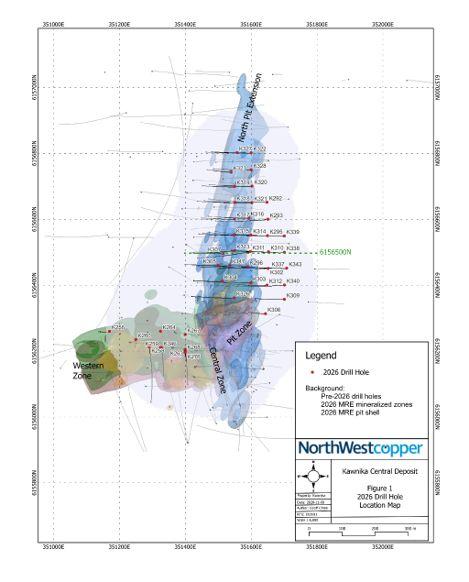
With the five holes reported in this release, the Company has now reported results from 29 of the 43 holes completed during the 2026 Kwanika drill program, which totaled 12,291 metres. The 2026 program was designed to improve confidence in existing mineral resources, extend known mineralization and identify further opportunities for expansion, particularly in the North Pit Extension. Planned collar locations for the holes of the 2026 drill program are presented in Figure 1, along with the location of the cross section 6156500 N (Figure 2) containing the reported holes in this release.
Figure 1: Kwanika Central 2026 drill hole location map
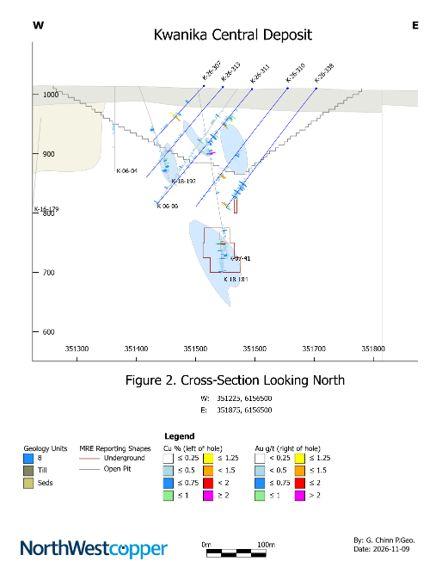
Geoff Chinn, VP Business Development and Exploration added: “The five holes completed on Section 6156500 N continue to define and extend mineralization within the North Pit Extension Zone on this section. Importantly, the deeper intersection in hole K-26-338 highlights the potential to extend open pit mineral resources at depth, while holes K-26-311, K-26-313, and K-26-307 successfully extended mineralization up-dip to the overburden contact. It is encouraging to continue identifying extensions of mineralization as we progress with our reported drill results to the north, while refining our understanding of the geology and building greater confidence in grade continuity across the North Pit Extension.”
Kwanika Exploration Drill Hole Summaries
Results for five drill holes are presented on cross-section 6156500 N (Figure 2) with composited mineralized intersections listed in Table 1 and collar locations provided in Table 2. The cross-section is in the North Pit Extension Zone with holes designed to extend mineralization up and down dip and improve geological and grade continuity by reducing drill hole spacing to approximately 50 metres. A summary of the geological aspects of holes is presented below.
Figure 2: Cross-Section 6156500 N showing 2026 drill results
North Pit Extension Zone
Hole K-26-307 was drilled with NQ2 core, sampled on about 2-metre intervals from half sawn core and drilled on 270° azimuth at a -45° dip to a depth of 126 metres.
After 36 metres of overburden the hole intersected dark green propylitic altered porphyritic monzodiorite to 108 metres containing up to 10% finely disseminated sulphides and sporadic early quartz and gypsum veins with mineralization correlated to Unit 8 and 14 (Comp. 1, 2, and 3) then crosscut by a medium orange porphyritic dyke to 115 metres followed by additional dark green propylitic altered porphyritic monzodiorite to the end of hole at 126 metres.
Hole K-26-310 was drilled with NQ2 core, sampled on about 2-metre intervals from half sawn core and drilled on 270° azimuth at a -50° dip to a depth of 252 metres.
After 43 metres of overburden the hole intersected a medium green-grey propylitic altered monzonite to 63 metres then grey-green tectonic breccia to 67 metres followed by light to medium grey-green propylitic altered monzonite to 85 metres with banded potassic alteration increasing in intensity to 102 metres. A light grey-green to light orange fractured monzodiorite continues to 107 metres, followed by dark grey-green to medium orange propylitic altered monzonite to 116 metres containing finely disseminated sulphides and anhydrite-calcite veins. A mineralized fractured light grey-green to orange propylitic and sericite altered monzonite continues to 127 metres containing quartz veinlets and anhydrite veins, followed by a medium grey tectonic breccia including dismembered quartz-sulphide stockwork with potassic alteration overprinted by structurally controlled chlorite-sericite alteration that ended in quartz stockwork vein system at 132 metres. A mineralized orange to dark grey-green fractured potassic altered monzonite continued to 135 transitioning to medium orange to light tan potassic altered monzonite with quartz-sulphide veins to 149 (Comp. 4) correlated to Unit 10 that ends in a metre wide mineralized quartz vein, followed by orange to light tan potassic altered monzonite to 161 metres, and crosscut by an orange potassic-hematite altered fractured porphyritic dyke to 164 metres. A light tan potassic altered tectonic breccia containing disseminated pyrite and quartz-tourmaline veins continues to 176 metres, crosscut by a light grey to medium orange porphyritic dyke to 181 metres, followed by mineralized grey-green to light tan sericite-chlorite altered brecciated quartz vein system to 187 metres, then a mineralized fractured medium orange to light tan potassic altered monzonite with dismembered quartz-sulphide stockwork to 196 metres (Comp. 5 and 6) correlated to Unit 14 and a mineralized orange to light tan potassic altered monzonite with trace disseminated pyrite and quartz-calcite veins to 206 metres. A dark grey-green potassic-propylitic altered andesite with anhydrite-calcite veins continues to 220 metres, followed by light grey to grey-green and orange potassic and propylitic altered monzonite with sporadic early quartz veins consistent with primary porphyry mineralization to 239 metres (Comp. 7) and an orange to black & white monzodiorite to the end of hole at 252 metres.
Hole K-26-311 was drilled with NQ2 core, sampled on about 2-metre intervals from half sawn core and drilled on 260° azimuth at a -50° dip to a depth of 252 metres.
After 42 metres of overburden the hole intersected a dark tan mineralized weathered fractured potassic altered porphyritic monzonite with dismembered quartz-sulphide stockwork to 46 metres, then dark tan-grey fractured potassic altered porphyritic monzodiorite with frequent early quartz veins to 58 metres, followed by a mineralized fault zone with early quartz vein and monzodiorite fragments to 65 metre and mineralized medium tan potassic altered porphyritic monzodiorite containing early quartz-sulphide veins and sulphide stringers to 79 metres (Comp. 8) correlated to Unit 10. Mineralization is crosscut by a dark orange porphyritic dyke to 88 metres, followed by mineralized dark grey to orange potassic altered porphyritic monzodiorite with early quartz-sulphide veins and sulphide stringers to 108 metres (Comp. 10) correlated to Unit 14. Mineralization is again crosscut by a dark brown porphyritic dyke to 109 metres, followed by a mineralized medium to dark grey propylitic over potassic altered fractured monzodiorite with discontinuous early-stage quartz-sulphide veins and anhydrite veins to 153 metres (Comp. 11) correlated to Unit 8, transitioning to a dark green to steel-blue propylitic altered monzodiorite with finely disseminated sulphides and quartz-anhydrite veins to 180 metres and crosscut by brown porphyritic dyke with calcite veins to 181 metres. A dark grey to green fractured propylitic altered monzodiorite continues with trace amount of fracture-controlled pyrite and early quartz veins to 214 metres, crosscut by medium orange potassic altered dyke to 217 metres, followed by alternating dark grey to dark orange potassic and propylitic altered monzodiorite with local early quartz veins and disseminated pyrite to 250 metres, ending in medium grey strongly fractured monzodiorite that was crosscut by early quartz tourmaline veins to end of hole at 252 metres.
Hole K-26-313 was drilled with NQ2 core, sampled on about 2-metre intervals from half sawn core and drilled on 265° azimuth at a -50° dip to a depth of 201 metres.
After 69 metres of overburden the hole intersected a mineralized dark green propylitic altered porphyritic diorite containing finely disseminated sulphides and calcite-anhydrite to 168 metres, which is mineralized after 76 metres (Comp. 12 and 13) correlated to Unit 8. Mineralization is crosscut by a maroon porphyritic dyke to 173 metres. A sequence of unmineralized diorite continued to 201 metres, crosscut by late dykes between 179 and 186 metres and between 192 to 194 metres.
Hole K-26-338 was drilled with NQ2 core, sampled on about 2-metre intervals from half sawn core and drilled on 270° azimuth at a -50° dip to a depth of 252 metres.
After 42 metres of overburden the hole intersected a dark grey to black epidote and propylitic altered diorite to 99 metres, then medium grey propylitic altered monzodiorite to 102 metres, followed by dark grey propylitic altered diorite to 148 metres and medium grey-orange potassic altered monzodiorite to 186 metres containing planar anhydrite veins. A mineralized medium grey-orange potassic altered porphyritic monzodiorite continues to 197 metres, then a mineralized light grey fault and shear zone to 201, followed by a mineralized dark grey fractured propylitic and potassic altered monzonite with some early quartz veins associated and blebby pyrite crosscut by anhydrite veins to 237 metres (Comp. 14 and 15) correlating to Unit 10. A mineralized fractured orange to light tan potassic altered porphyritic monzonite with irregular and stockwork quartz-sulphide veins crosscut by sinuous anhydrite veins to 252 metres (Comp. 16) and including a short interval of high-grade pyrite-chalcopyrite breccia (Comp. 17) correlating to Unit 14 with the hole ending in mineralization.
Hole Summary: The 2026 drilling on Section 6156500 N demonstrated, defined, and expanded both low-grade and higher-grade mineralization at depth and up-dip to the overburden contact and have the potential to expand open pit mineral resources in this area.
K-26-307 successfully extended mineralization about 50 metres up-dip to the overburden contact. K-26-310 intersected a typical interval through the Kwanika Central deposit where an upper fracture-healed potassic altered monzonite with quartz-sulphide veins is crosscut by one or more unmineralized late dykes, followed by another potassic altered fracture-healed monzonite zone, then transitioned to primary porphyry mineralization. Hole K-26-311 provided a 50 metre up-dip intersection of mineralization in K-26-310. While the hole starts in mineralized monzonite it is dominantly propylitic altered monzodiorite except were crosscut by late dykes. The hole includes higher-grade intersections thought to represent extension of Units 10 and 14. Hole K-26-313 provided a 50 metre up-dip intersection of mineralization in K-26-311 with dominantly finely disseminated sulphides correlated to Unit 8. Hole K-26-338 intersected continuous mineralization from about 180 metres to the end of hole at 252 metres hosted in potassic and propylitic altered monzonite. Higher-grade intervals may correlate to Unit 10 and thereby extending this unit 50 metres north, whereas higher-grade at the end of the hole appears to correlate to Unit 14.
Table 1: Drill Results in this News Release1 2
| Comp | Hole | From | To | Length | Area | Cu | Au | Ag | Pd | CuEq | True Width |
Mineralized Unit |
| # | (m) | (m) | (m) | (%) | (g/t) | (g/t) | (g/t) | (%) | Est. (m) | |||
| 1 | K-26-307 | 36.0 | 42.0 | 6.0 | Pit N. Ext. | 0.39 | 0.18 | 0.40 | 0.01 | 0.58 | 5.6 | Unit Cu 8 |
| 2 | K-26-307 | 62.0 | 74.0 | 12.0 | Pit N. Ext. | 0.42 | 0.48 | 1.03 | 0.02 | 0.95 | 11.3 | Unit Au 14? |
| 3 | K-26-307 | 88.9 | 103.0 | 14.1 | Pit N. Ext. | 0.29 | 0.11 | 0.29 | 0.01 | 0.42 | 13.3 | Unit Cu 8 |
| 4 | K-26-310 | 138.0 | 149.0 | 11.0 | Pit N. Ext. | 0.05 | 0.43 | 0.37 | 0.02 | 0.51 | 9.9 | Unit Au 10 |
| 5 | K-26-310 | 180.6 | 202.7 | 22.1 | Pit N. Ext. | 0.17 | 0.47 | 0.60 | 0.02 | 0.68 | 20.0 | Unit Au 14 |
| 6 | Including | 180.6 | 195.0 | 14.4 | Pit N. Ext. | 0.16 | 0.61 | 0.61 | 0.02 | 0.82 | 13.1 | Unit Au 14 |
| 7 | K-26-310 | 233.2 | 237.9 | 4.7 | Pit N. Ext. | 0.24 | 0.27 | 0.39 | 0.02 | 0.53 | 4.2 | Porphyry Au Cu |
| 8 | K-26-311 | 54.0 | 78.7 | 24.7 | Pit N. Ext. | 0.28 | 0.55 | 1.08 | 0.03 | 0.89 | 22.3 | Unit Au 10 |
| 9 | K-26-311 | 92.0 | 173.0 | 81.0 | Pit N. Ext. | 0.28 | 0.28 | 1.14 | 0.00 | 0.59 | 73.4 | |
| 10 | Including | 94.0 | 120.6 | 26.6 | Pit N. Ext. | 0.32 | 0.41 | 1.07 | 0.00 | 0.77 | 24.1 | Unit Au 14 |
| 11 | And | 134.3 | 139.0 | 4.7 | Pit N. Ext. | 0.51 | 0.44 | 2.81 | 0.00 | 1.02 | 4.2 | Unit Cu 8 |
| 12 | K-26-313 | 97.0 | 125.0 | 28.0 | Pit N. Ext. | 0.25 | 0.13 | 0.71 | 0.01 | 0.40 | 25.4 | Unit Cu 8 |
| 13 | K-26-313 | 145.0 | 157.0 | 12.0 | Pit N. Ext. | 0.23 | 0.20 | 0.76 | 0.01 | 0.45 | 10.9 | Unit Cu 8 |
| 14 | K-26-338 | 191.0 | 233.8 | 42.8 | Pit N. Ext. | 0.35 | 0.37 | 0.77 | 0.01 | 0.76 | 38.8 | |
| 15 | Including | 200.6 | 230.0 | 29.4 | Pit N. Ext. | 0.40 | 0.45 | 0.99 | 0.01 | 0.90 | 26.6 | Unit Au 10 |
| 16 | K-26-338 | 246.0 | 252.0 | 6.0 | Pit N. Ext. | 3.29 | 1.73 | 14.19 | 0.01 | 5.32 | 5.4 | Unit Au 14 |
| 17 | Including | 247.7 | 248.4 | 0.7 | Pit N. Ext. | 13.10 | 7.62 | 57.10 | 0.03 | 21.98 | 0.7 | Unit Au 14 |
Table 2: Drill Collar Information3
| Hole | Collar X | Collar Y | Collar Z | Collar Azimuth |
Collar Dip | Final Length | Core Size |
| K-26-307 | 351514 | 6156498 | 1014 | 270 | -45 | 126 | NQ2 |
| K-26-310 | 351665 | 6156501 | 1012 | 270 | -50 | 252 | NQ2 |
| K-26-311 | 351595 | 6156508 | 1012 | 260 | -50 | 252 | NQ2 |
| K-26-313 | 351546 | 6156503 | 1013 | 265 | -50 | 201 | NQ2 |
| K-26-338 | 351703 | 6156500 | 1013 | 270 | -50 | 252 | NQ2 |
Quality Assurance / Quality Control
Drilling at Kwanika in 2026 was designed and supervised by NorthWest and implemented by InData Geoscience with assay QA/QC checks by Explore Geosolutions. Samples were collected, tracked and an external QA/QC program was implemented using coarse blanks and certified prepared blanks and standards to monitor analytical accuracy and precision. The samples were sealed on site and shipped to Activation Laboratories Ltd. in Kamloops, BC. The laboratory’s internal quality control system complies with global certifications for quality ISO 17025. Drill core samples were analyzed using a combination of Actlabs multi-element 1F2 analysis for low level concentrations (4-Acid Digestion, ICP-OES) and the 8-4 Acid ICP-OES analysis for higher level concentrations (4-Acid Digestion, ICP-OES with automatic over limits for base metals and silver). Gold, platinum and palladium assaying was completed with 1C-OES method, using a 30-gram fire assay with ICP finish analysis. In addition, about 5% of the sample pulps are re-assayed at a secondary laboratory to confirm reproducibility and check for bias.
Technical and scientific aspects of this news release have been reviewed, verified, and approved by Geoff Chinn, P.Geo., VP Business Development and Exploration for NorthWest, who is a qualified person as defined by National Instrument 43-101 – Standards of Disclosure for Mineral Projects.
About NorthWest:
NorthWest is a copper-gold exploration and development company with a pipeline of advanced and early-stage projects in British Columbia, including Kwanika-Stardust, Lorraine-Top Cat and East Niv. With a robust portfolio in an established mining jurisdiction, NorthWest is well positioned to participate fully in strengthening global copper and gold markets. The Company is committed to responsible mineral exploration, working collaboratively with First Nations to help ensure future development incorporates stewardship best practices and respects traditional land use. Additional information can be found on the Company’s website at www.northwestcopper.ca.
On Behalf of NorthWest
“Paul Olmsted”
CEO, NorthWest Copper
For further information, please contact:
416-457-3333
info@northwestcopper.ca
Neither the TSXV nor its Regulation Services Provider (as that term is defined in the policies of the TSX Venture Exchange) accepts responsibility for the adequacy or accuracy of this release.
55 North Gold Inc. (CSE: FFF) (OTCQB: FFFNF) (FSE: 6YF) is pleased to announce that it has entered i... READ MORE
Sitka Gold Corp. (TSX-V: SIG) (FSE: 1RF) (OTCQX: SITKF) is pleased to announce a strategic partnersh... READ MORE
Brunswick Exploration Inc. (TSX-V: BRW) (OTCQB: BRWXF) (FRANKFURT:1XQ) is pleased to announce the cl... READ MORE
Kuya Silver Corporation (CSE: KUYA) (OTCQB: KUYAF) (FSE: 6MR1) is pleased to announce financial and... READ MORE
Cadillac Mines Corporation (TSX: CADY), is pleased to announce additional assay results from diamon... READ MORE