








NorthWest Copper Corp. (TSX-V: NWST) is pleased to announce additional drilling results from the North Pit Extension Zone at the Company’s 100% owned Kwanika project in British Columbia, highlighted by 61.9 metres grading 1.01% copper equivalent.
The results extend interpreted higher-grade mineralization approximately 50 metres north, confirm additional mineralized intervals near surface and at depth, and highlight opportunities for potential expansion of the open-pit mineral resource within the North Pit Extension.
|
North Pit Extension Zone Drill Hole Highlights: |
|
| K-26-296: | 61.9 metres of 0.37% Cu and 0.58 g/t Au (1.01% CuEq) from 39.0 metres, |
| including 34.5 metres of 0.49% Cu and 0.88 g/t Au (1.46% CuEq) from 42.0 metres. | |
| K-26-302: | 20.0 metres of 0.29% Cu and 1.18 g/t Au (1.57% CuEq) from 211.0 metres. |
| K-26-343: | 102.0 metres of 0.31% Cu and 0.27 g/t Au (0.60% CuEq) from 209.0 metres, Including 5.9 metres of 0.62% Cu and 0.56 g/t Au (1.22% CuEq) from 222.1 metres, and 20.5 metres of 0.37% Cu and 0.36 g/t Au (0.76% CuEq) from 274.5 metres, and 7.5 metres of 0.30% Cu and 0.52 g/t Au (0.86% CuEq) from 303.5 metres. |
Paul Olmsted, CEO of NorthWest stated: “These results continue to demonstrate the opportunity we see at Kwanika to extend mineralization beyond the areas defined by previous drilling. We believe upgrading and expanding the North Pit Extension Zone could strengthen the open pit component of Kwanika and provide greater flexibility for the potential coordinated development of the Kwanika and Stardust underground mineral resources. Together with encouraging results reported from the Western Zone and Pit Zones, the 2026 program is building a stronger foundation for future resource growth and project optimization.”
2026 Kwanika Exploration Program
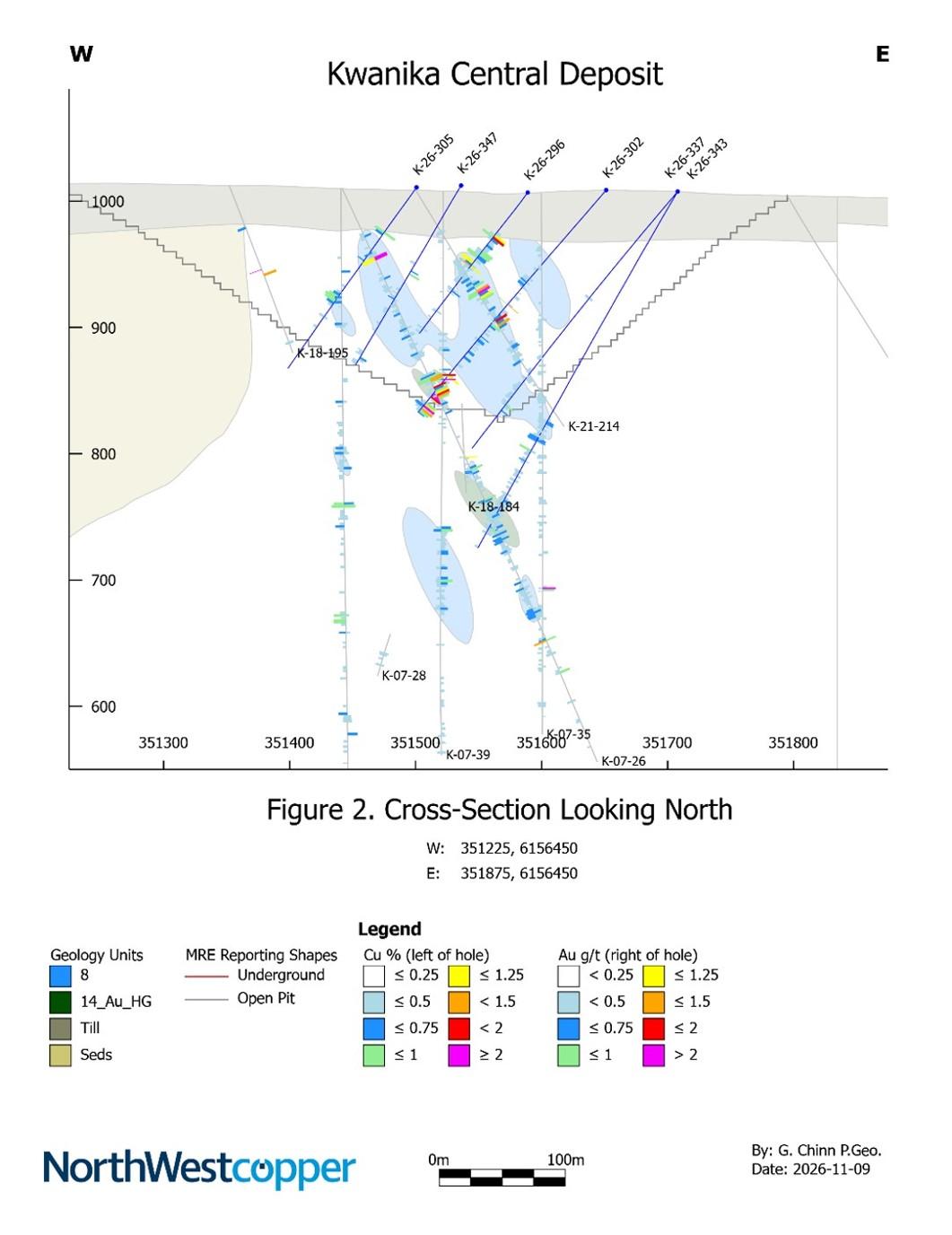
With the seven holes reported in this release, the Company has reported results from 24 of the 43 holes completed in the 2026 Kwanika drill program, which totaled 12,291 metres. Planned drill collar locations for the 2026 program are presented in Figure 1, along with the location of cross section 6156450 N (Figure 2), which illustrates the drill results reported in this release.
Figure 1: Kwanika Central 2026 drill hole location map
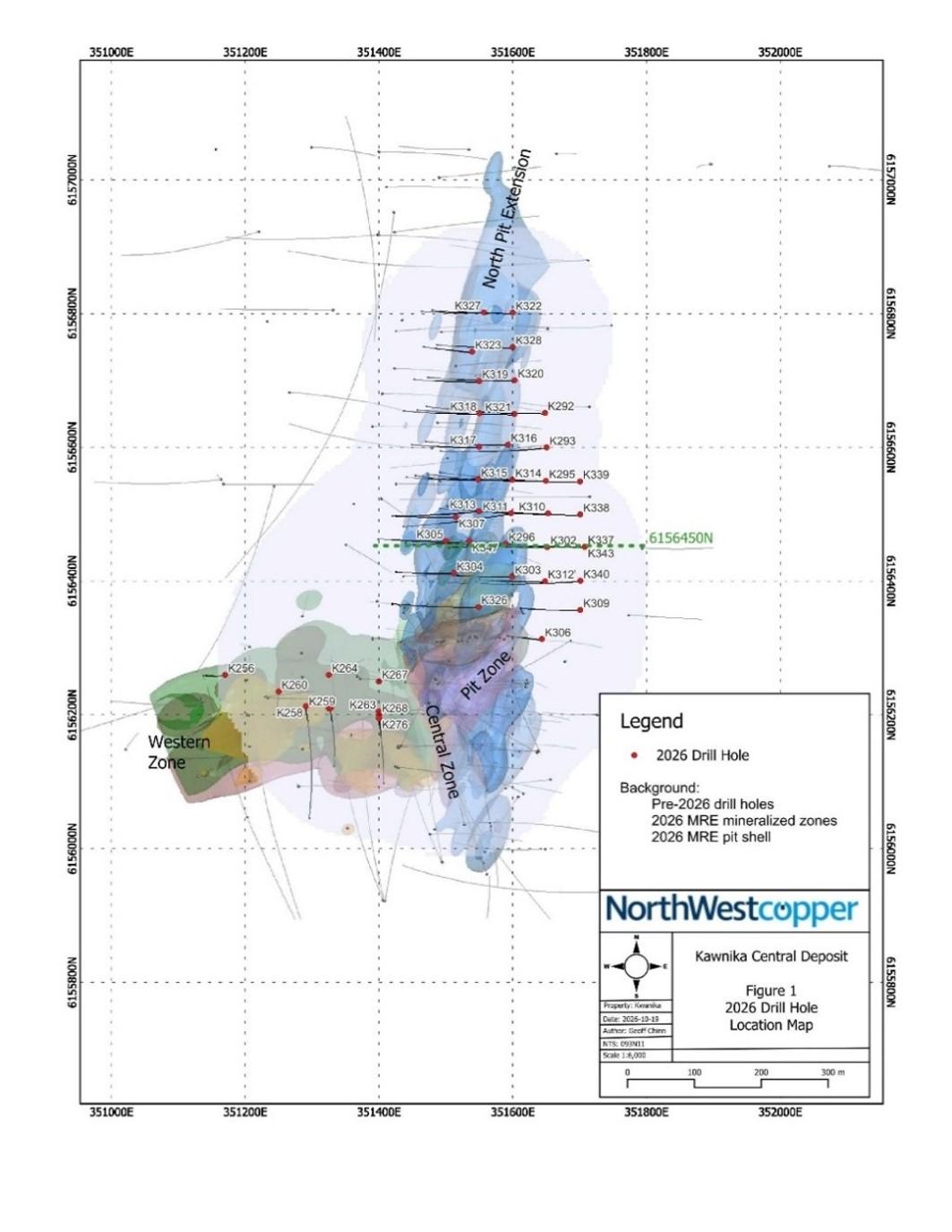
Geoff Chinn, VP Business Development and Exploration added: “The six holes completed on Section 6156450N intersected multiple parallel intervals of mineralization with significant cumulative widths that further define and expand mineralization while reducing drill hole spacing to approximately 50 metres. Importantly, the results extend higher-grade Unit 10 mineralization an additional 50 metres north and demonstrate wide low-grade mineralization at depth, highlighting the potential to expand open pit mineral resources. Based on our current geological model, we believe the North Pit Extension to be limited by drill information not geology, and it is encouraging to encounter extensions of mineralization to the north.”
Kwanika Exploration Drill Hole Summaries
Results for seven drill holes are presented on cross-section 6156450 N (Figure 2) with composited mineralized intersections (Comps.) listed in Table 1 and collar locations provided in Table 2. The cross-section is in the North Pit Extension Zone with holes designed to extend mineralization up and down dip and improve geological and grade continuity by reducing drill hole spacing to approximately 50 metres. A summary of the geological aspects of holes is presented below.
Figure 2: Cross-Section 6156450 N showing 2026 drill results
North Pit Extension Zone
Hole K-26-296 was drilled with NQ core, sampled on about 2-metre intervals from half sawn core and drilled on 265° azimuth at a -53° dip to a depth of 141 metres.
After 39 metres of overburden the hole intersected a 65 metres wide mineralized interval (Comp. 1) consisting of a light orange to buff potassic altered monzonite with planar to irregular quartz stockwork to 75 metres (Comp. 2) potentially correlated to Unit 10 then propylitic altered dark grey-green and patchy orange potassic altered monzonite crosscut by planar to irregular anhydrite veinlets to 93 metres followed by late dyke to 96 metres and a healed tectonic breccia to 102 metres. A sequence of orange to dark green-grey monzodiorite and dark grey green to faint orange monzonite continued to the end of the hole hosting short intervals of mineralization (Comp. 3) correlated to Unit 8. The persistence of higher-grade interval Composite 2 on this section supports extending Unit 10 from the south by 50 metres.
Hole K-26-302 was drilled with NQ, sampled on about 2-metre intervals from half sawn core and drilled on 270° azimuth at a -50° dip to a depth of 231 metres.
After 52 metres of overburden the hole intersected a dark grey-green diorite to 83 metres followed by mineralized dark grey-green and dark orange monzodiorite to 114 metres (Comp. 4) correlated to Unit 8 then dark grey-green and dark orange monzonite porphyry to 132 metres where the hole encountered a fault zone. Mineralization starts in the fault zone and continues to 143 metres (Comp. 5) correlated to Unit 10 in a potassic altered light grey to orange porphyritic monzonite with irregular quartz veins to 152 metres. A wide low-grade mineralization continued in a silicified and potassic altered tan-grey porphyritic monzonite to 182 metres (Comp. 6) correlated to Unit 8 including an intense quartz stockwork sub-interval between 167 and 169 metres. Another mineralized interval occurs between 190 and 199 (Comp. 7) correlated to Unit 14 due to its elevated palladium values. Mineralization is interrupted by a late dyke between 201 and 208 metres with mineralization on the other side to 231 metres (Comp. 8) confirming Unit 14 and continuing to the end of the hole, ending in mineralization. The persistence of higher-grade interval Composite 8 supports extending Unit 10 from the south by 50 metres as well as confirming higher-grade Unit 14.
Hole K-26-305 was drilled with NQ core, sampled on about 2-metre intervals from half sawn core and drilled on 270° azimuth at a -55° dip to a depth of 176 metres.
After 39 metres of overburden the hole intersected a sequence of mostly dark green propylitic altered monzodiorite crosscut by medium orange potassic altered porphyritic dykes. Monzondiorite intervals include 39 to 119 metres (Comps. 9 and 10), 125 to 156 metres, 158 to163 metres and 174 to 176 metres. Mineralization occurs as abundant finely disseminated sulphides and associated with sporadic distributed irregular early quartz veins crosscut by planar gypsum veins. The hole represents the propylitic altered up-dip extension of deeper mineralization and notable by the presence of sporadic early quartz veins, abundant finely disseminated sulphides crosscut by late gypsum veins.
Hole K-26-337 was drilled with NQ core, sampled on about 2-metre intervals from half sawn core and drilled on 270° azimuth at a -50° dip to a depth of 261 metres.
After 42 metres of overburden the hole intersected an unmineralized carbonate vein to 50 metres then dark green propylitic altered porphyritic diorite to 154 metres followed by a fractured and mineralized medium orange to mottled green porphyritic monzonite to 261 metres (Comp 11) correlated with Unit 8, including a short higher-grade interval between 210 and 218 metres of potassic alteration (Comp 12). Mineralization is associated with dismembered and displaced early quartz veins crosscut by regular gypsum veins.
Hole K-26-343 was drilled with NQ core, sampled on about 2-metre intervals from half sawn core and drilled on 270° azimuth at a -60° dip to a depth of 324 metres.
After 51 metres of overburden the hole intersected propylitic altered dark grey-green diorite to 122 metres followed by porphyritic diorite to 200 metres. A fractured potassic altered light tan dyke was encountered between 200 and 205 metres followed by wide mineralized tan-grey potassic altered porphyritic diorite with fracture filling quartz veins crosscut by gypsum and calcite veins to 324 metres (Comp. 13, including higher-grade intervals defined by Comps 14, 15, 16) interrupted by later potassic altered dykes between 128 and 222 metres and between 299 and 304 metres. Higher-grade Composite intervals 15, and 17 may correlate to Units 10 and 14 demonstrating the persistence of higher-grade mineralization north and to depth on to this section with the potential to expand open pit mineral resources. Note the slightly elevated palladium at depth in Composite 16 potentially the system is getting stronger.
Hole K-26-347 was drilled with NQ2 core, sampled on about 2-metre intervals from half sawn core and drilled on 265° azimuth at a -58° dip to a depth of 165 metres.
After 56 metres of overburden the hole intersected a rubbly dark grey porphyritic dyke to 66 metres then propylitic altered dark grey-orange diorite crosscut by calcite-quartz veinlets. A potassic altered dark orange dyke was encountered between 76 and 78 metres followed by a propylitic altered dark grey-green diorite hosting disseminated mineralization and thin anhydrite veins to 81 metres crosscut by dark grey porphyritic dyke hosting mineralization associated with relic quartz stockwork and later thin anhydrite veins to 82 metres (Comp. 17) correlated to Unit 8. A sequence of diorite and dykes continues to 99 metres where dark green-orange to light tan monzodiorite with patchy potassic alteration over propylitic alteration was encountered to 161 metres that hosted intermittent mineralized intervals associate with irregular early quartz veining and planar anhydrite veinlets (Comps 18, and 19) correlated to Unit 8. Mineralization continues through a light brown porphyritic andesite dyke containing irregular early quartz and gypsum-anhydrite veins to 162 metres followed by mineralized monzodiorite to the end of the hole that possibly represented the up-dip continuation of Unit 14 (Comp. 20).
Hole K-26-347A was drilled with HWT casing, unsampled and drilled on 265° azimuth at a -58° dip to a depth of 45 metres. The hole was abandoned due to poor drilling performance by a drill contractor who needed to leave site. The hole was re-drilled by another drill contractor as K-26-347.
Hole Summary: The 2026 drilling on Section 6156450 N demonstrated and defined low-grade mineralization and importantly extended potentially higher-grade Unit 10 a further 50 metres to the north. Hole K-26-296 projected higher-grade mineralization to the overburden contact. Hole K-26-343 confirmed wide low-grade extensions of mineralization at depth. Hole K-26-302 confirmed higher-grade mineralization widths of Unit 14 however broader geological interpretation of the intersection remains unclear. The infill and expansion drilling is making important improvements to the geological understanding of mineralization as the drill program progresses to the north.
Table 1: Drill Results in this News Release1 2
| Comp | Hole | From | To | Length | Area | Cu | Au | Ag | Pd | CuEq | True Width | Mineralized |
| # | (m) | (m) | (m) | (%) | (g/t) | (g/t) | (g/t) | (%) | Est. (m) | Unit | ||
| 1 | K-26-296 | 39.0 | 100.9 | 61.9 | Pit N. Ext. | 0.37 | 0.58 | 1.55 | 0.03 | 1.01 | 54.7 | |
| 2 | Including | 42.0 | 76.5 | 34.5 | Pit N. Ext. | 0.49 | 0.88 | 1.85 | 0.04 | 1.46 | 30.5 | Unit Au 10 |
| 3 | K-26-296 | 135.5 | 141.0 | 5.5 | Pit N. Ext. | 0.34 | 0.23 | 1.56 | 0.00 | 0.60 | 4.9 | Unit Cu 8 |
| 4 | K-26-302 | 92.0 | 102.3 | 10.3 | Pit N. Ext. | 0.46 | 0.27 | 1.61 | 0.00 | 0.77 | 9.3 | Unit Cu 8 |
| 5 | K-26-302 | 133.8 | 142.5 | 8.8 | Pit N. Ext. | 0.21 | 0.65 | 0.86 | 0.02 | 0.92 | 7.9 | Unit Au 10 |
| 6 | K-26-302 | 152.1 | 182.4 | 30.3 | Pit N. Ext. | 0.11 | 0.49 | 0.49 | 0.02 | 0.64 | 27.5 | Unit Cu 8 |
| 7 | K-26-302 | 190.4 | 198.7 | 8.3 | Pit N. Ext. | 0.21 | 0.45 | 0.76 | 0.06 | 0.69 | 7.5 | Unit Au 14 |
| 8 | K-26-302 | 211.0 | 231.0 | 20.0 | Pit N. Ext. | 0.29 | 1.18 | 1.15 | 0.02 | 1.57 | 18.1 | Unit Au 14 |
| 9 | K-26-305 | 43.0 | 47.0 | 4.0 | Pit N. Ext. | 0.70 | 0.57 | 1.50 | 0.01 | 1.33 | 3.5 | Unit Au 14 |
| 10 | K-26-305 | 102.0 | 116.0 | 14.0 | Pit N. Ext. | 0.63 | 0.15 | 0.81 | 0.01 | 0.81 | 12.1 | Unit Cu 8 |
| 11 | K-26-337 | 184.0 | 220.0 | 36.0 | Pit N. Ext. | 0.30 | 0.24 | 0.31 | 0.01 | 0.56 | 32.6 | Unit Cu 8 |
| 12 | Including | 210.0 | 218.3 | 8.3 | Pit N. Ext. | 0.35 | 0.31 | 0.30 | 0.01 | 0.69 | 7.5 | Unit Cu 8 |
| 13 | K-26-343 | 209.0 | 311.0 | 102.0 | Pit N. Ext. | 0.31 | 0.27 | 0.29 | 0.01 | 0.60 | 83.5 | |
| 14 | Including | 222.1 | 228.0 | 5.9 | Pit N. Ext. | 0.62 | 0.56 | 0.33 | 0.01 | 1.22 | 4.8 | Unit Au 10? |
| 15 | And | 274.5 | 295.0 | 20.5 | Pit N. Ext. | 0.37 | 0.36 | 0.34 | 0.01 | 0.76 | 16.8 | Unit Cu 8 |
| 16 | And | 303.5 | 311.0 | 7.5 | Pit N. Ext. | 0.30 | 0.52 | 0.36 | 0.03 | 0.86 | 6.1 | Unit Au 14? |
| 17 | K-26-347 | 78.0 | 82.1 | 4.1 | Pit N. Ext. | 0.10 | 0.54 | 0.49 | 0.00 | 0.68 | 3.4 | Unit Cu 8 |
| 18 | K-26-347 | 99.0 | 105.0 | 6.0 | Pit N. Ext. | 0.33 | 0.13 | 1.32 | 0.00 | 0.48 | 5.0 | Unit Cu 8 |
| 19 | K-26-347 | 111.0 | 116.0 | 5.0 | Pit N. Ext. | 0.27 | 0.16 | 1.45 | 0.01 | 0.45 | 4.2 | Unit Cu 8 |
| 20 | K-26-347 | 152.0 | 164.0 | 12.0 | Pit N. Ext. | 0.33 | 0.20 | 1.71 | 0.01 | 0.56 | 10.1 | Unit Au 14? |
| 21 | K-26-347A | – | – | Pit N. Ext. | – | – | – | – | – | – | Abandoned | |
Table 2: Drill Collar Information3
| Hole | Collar X | Collar Y | Collar Z | Collar Azimuth |
Collar Dip | Final Length | Core Size |
| K-26-296 | 351589 | 6156455 | 1012 | 265 | -53 | 141 | NQ |
| K-26-302 | 351651 | 6156453 | 1014 | 270 | -50 | 231 | NQ |
| K-26-305 | 351501 | 6156460 | 1011 | 270 | -55 | 176 | NQ2 |
| K-26-337 | 351708 | 6156451 | 1013 | 270 | -50 | 261 | NQ |
| K-26-343 | 351708 | 6156451 | 1012 | 270 | -60 | 324 | NQ |
| K-26-347A | 351537 | 6156462 | 1013 | 265 | -58 | 45 | NQ |
| K-26-347 | 351536 | 6156462 | 1012 | 265 | -58 | 165 | NQ2 |
Quality Assurance / Quality Control
Drilling at Kwanika in 2026 was designed and supervised by NorthWest and implemented by InData Geoscience with assay QA/QC checks by Explore Geosolutions. Samples were collected, tracked and an external QA/QC program was implemented using coarse blanks and certified prepared blanks and standards to monitor analytical accuracy and precision. The samples were sealed on site and shipped to Activation Laboratories Ltd. (“Actlabs”) in Kamloops, BC. The laboratory’s internal quality control system complies with global certifications for quality ISO 17025. Drill core samples were analyzed using a combination of Actlabs multi-element 1F2 analysis for low level concentrations (4-Acid Digestion, ICP-OES) and the 8-4 Acid ICP-OES analysis for higher level concentrations (4-Acid Digestion, ICP-OES with automatic over limits for base metals and silver). Gold, platinum and palladium assaying was completed with 1C-OES method, using a 30-gram fire assay with ICP finish analysis. In addition, about 5% of the sample pulps are re-assayed at a secondary laboratory to confirm reproducibility and check for bias.
Technical and scientific aspects of this news release have been reviewed, verified, and approved by Geoff Chinn, P.Geo., VP Business Development and Exploration for NorthWest, who is a qualified person as defined by National Instrument 43-101 – Standards of Disclosure for Mineral Projects.
About NorthWest:
NorthWest is a copper-gold exploration and development company with a pipeline of advanced and early-stage projects in British Columbia, including Kwanika-Stardust, Lorraine-Top Cat and East Niv. With a robust portfolio in an established mining jurisdiction, NorthWest is well positioned to participate fully in strengthening global copper and gold markets. The Company is committed to responsible mineral exploration, working collaboratively with First Nations to help ensure future development incorporates stewardship best practices and respects traditional land use.
Excellon shareholders to receive shares of a standalone, European... READ MORE
*1.33 g/t AuEq (1.29 g/t Au, 0.45 g/t Ag, 0.03 % Cu) over 34 m, 3... READ MORE
Highlights 10.6 g/t gold over 57m from 148m downhole, including 7... READ MORE
Tudor Gold Corp. (TSX-V: TUD) (FSE: H56) reports results from fou... READ MORE