







Another hole of winter drill program returns 53.05 cumulative metres of syenitic pegmatite typically associated with rare earth minerals (assays pending)
North American Niobium and Critical Minerals Corp. (CSE: NIOB) (FSE: KS82.F) (OTCQB: NIOMF) has completed a successful drill program at its Seigneurie project in Québec, delineating a pegmatite-syenite system that currently extends at least 1.5 kilometres east-west and 800 metres north-south. In addition to hits at previously disclosed SGN-2026-07 and SGN-2026-08—which intersected 211.25 and 108.60 cumulative metres of pegmatite associated with niobium and rare earth indicators—SGN-2026-003, SGN-2025-04, and SGN-2026-06 returned 11.73, 18, and 53.05 cumulative metres of pegmatite. Nine holes totaling just under 2,000 metres were drilled overall at Seigneurie.
“We are seeing the same indicators across multiple holes: pegmatite, sustained radiometric responses, and the same quartz and magnetite associations logged in our central holes,” said Murray Nye, NIOB’s Chief Executive Officer. “With the upper contact of the syenite in SGN-2026-006 concealed beneath 120 metres overburden, the syste m could be larger than what we have drilled. In addition, step-out drilling has confirmed that the Seigneurie pegmatite-syenite system extends well beyond the central main hill. We are now waiting on assays.”
Highlights
All assays are pending; thin sections have been collected on representative pegmatite and syenite intervals to characterize the niobium and rare-earth elements bearing phases.
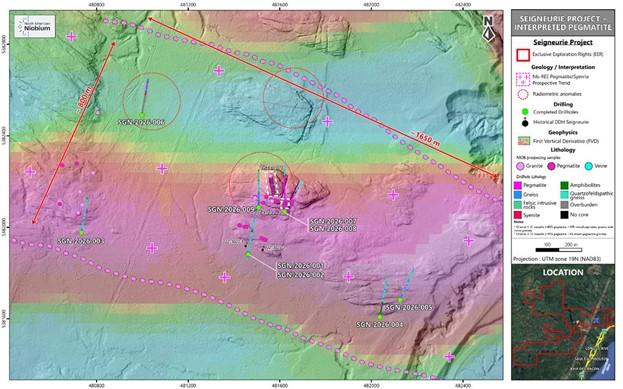
Figure 1: Plan view of the Seigneurie 2026 drill program (SGN-2026-001 through 009), 1,963 metres total
Program Summary
The 2026 winter drill program at Seigneurie was designed to test the central target on the main hill, then step-outs to test the north, east, south, and west lateral extents of the system. SGN-2026-007 and SGN-2026-008 tested the central target, which the balance of the holes tested the extents. Nine holes totaling 1,963 metres were drilled, and pegmatite was intersected in seven of the nine holes. Cumulative pegmatite intercepts and key observations for each step-out and infill hole are summarized in Table 1, below. Assays are pending.
SGN-2026-001, the longest hole in the program at 299 metres, intersected approximately 15.5 metres of cumulative pegmatite. The most notable interval is a 2.05-metre pegmatite from 290.45 to 292.50 metres, which returned a strong sustained radiometric response.
SGN-2026-002 was abandoned at 32 metres in overburden and gneiss.
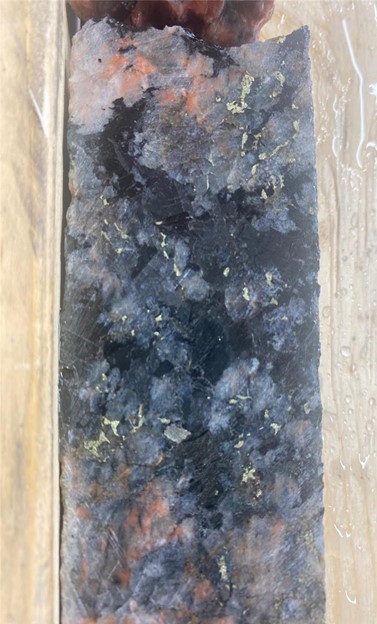
SGN-2026-003, approximately 750 metres west of the central main-hill target, returned 11.73 of pegmatite in total. This included a 7.70-metre interval from 71.15 to 78.85 metres with sustained high scintillometer response associated with disseminated chalcopyrite logged in association with magnetite and pyrite—the first sulphide assemblage of this kind logged at Seigneurie. The Company has expanded the analytical suite for this hole to include copper and gold in addition to its standard niobium and rare earth element suite.
Figure 2: Pegmatite interval associated with chalcopyrite, pyrite as well as elevated radiometric responses in hole SGN-2026-003.
SGN-2026-004, approximately 1.5 kilometres east of SGN-2026-003, returned over 18 metres of pegmatite.
SGN-2026-006 was collared on a radiometric anomaly originally identified by a 1970s airborne survey. After approximately 121.5 metres of overburden, the first 23.80 metres of cored interval (121.50 to 145.30 metres) returned a pink, coarse-grained to pegmatitic quartz-rich syenite that is encouraging for niobium mineralization. The hole returned an additional 29.25 metres of pegmatite below the syenite, including 11.55 metres (163.10 to 174.65 metres) with a sustained gamma-ray spectrometer response in the smoky-quartz-rich core, and 5.00 metres (196.20 to 201.20 metres) with magnetite clusters that returned indicative niobium responses on portable XRF screening (indicative only; see pXRF disclosure).
SGN-2026-009 — collared west of SGN-2026-007 — intersected ~62 metres of folidated K-feldspar-dominant rock logged as a syenitic-to-monzonitic intrusive. The hole cut a fractured fault zone that may obscure the syenite-pegmatite system here; lithogeochemistry is pending to resolve the unit’s true nature.
Table 1: Hole-by-hole summary of step out holes (SGN-2026-001 to SGN-2026-06 and SGN-2026-009)
| Hole | Metres drilled |
Total pegmatite and syenite (metres) | Notable single intercept (metres) |
Other observations |
| SGN-2026-001 | 299 | 15.46 | 2.05 from 290.45 to 292.50 | Strongest sustained radiometric response logged in any of the step-out holes; black metallic mineral on core under investigation as potential niobium-bearing phase, mineralogy planned |
| SGN-2026-002 | 32 | – | Abandoned at 32 m in overburden and gneiss | – |
| SGN-2026-003 | 227 | 11.73 | 7.70 from 71.15 to 78.85 pegmatite with high scintillometer response and disseminated chalcopyrite (with magnetite and pyrite) | Located ~750 m west of central main-hill target and ~1.5 km west of SGN-2026-004; core assayed for gold and copper in addition to standard niobium and rare earth analytical suite |
| SGN-2026-004 | 242 | 18.80 | 11.00 from 63.80 to 74.80 pink granitic pegmatite; over 18 metres of total pegmatite | Located approximately 1.5 km east of SGN-2026-003; pegmatite system extends across more than 1.5 km of strike |
| SGN-2026-005 | 200 | 23.55 | 8.20 from 71.75 to 79.95
3.10 from 132.60 to 135.70 |
Trace chalcopyrite and r are arsenopyrite logged in pegmatite at 113-129 m within zones of weak chloritization |
| SGN-2026-006 | 224 | 53.05 (29.25 m pegmatite + 23.80 m pegmatitic syenite) | 23.80 from 121.50 to 145.30 coarse-grained to pegmatitic quartz-rich syenite, intersected immediately at top of cored interval beneath ~121.5 m of overburden; upper contact concealed
11.55 from 163.10 to 174.65 pegmatite with sustained gam ma-ray spectrometer response in |
Disseminated magnetite grains (1-10mm wide) within an adjacent pegmatite (196.20-201.20 m) returned indicative responses for niobium on portable XRF screening (indicative only; see pXRF disclosure) |
Qualified Person
The scientific and technical information contained in this news release has been prepared in accordance with National Instrument 43-101 — Standards of Disclosure for Mineral Projects. Clyde McMillan, P.Geo., a consultant to the Company and a Qualified Person as defined under NI 43-101, has reviewed and approved the technical information contained herein. Mr. McMillan is non-independent of the Company as an Officer and Shareholder. The Qualified Person has reviewed the drill logs, core photog raphs, gamma-ray spectrometer data, portable XRF screening data and field records for SGN-2026-001 through SGN-2026-009 and has verified the intervals reported herein. Laboratory assays for the program are pending as of the date of this release. Sample preparation, security and analytical procedures follow industry-standard QA/QC practice including the insertion of certified reference materials, blanks and field duplicates; results will be reported once received and QA/QC review is complete. Portable XRF results are indicative only, are subject to matrix and calibration limitations, and are not a substitute for laboratory analysis. Radiometric readings on core were collected with a hand-held gamma-ray spectrometer as a qualitative logging aid and are not a substitute for laboratory assay.
Portable XRF (pXRF) analyses referenced in this release were collected using an Evident Vanta MAX/CORE handheld analyzer in GeoChem 3-Beam mode on spot measurements taken on representative drill core during logging. The instrument was rented from Geospectra Mining Technologies and was supplied with a calibration certificate confirming factory calibration prior to deployment. All measurements were performed by a certified pXRF operator. On-site quality control included periodic measurements of certified reference materials (CRMs) and instrument blanks throughout the program to monitor analytical performance and detect any drift. No pXRF values are reported in this release. Because pXRF measurements are semi-quantitative, the analyzer was used solely to confirm the presence of target elements and associated mineralization during core logging.
Gamma-ray spectrometer responses logged on SGN-2026-008 using a Radiation Solutions Inc. RS-125/225 Super-SPEC handheld gamma-ray spectrometer equipped with a 2.0″ × 2.0″ NaI crystal are spatially consistent with historical radiometric measurements collected by SOQUEM in 1977 over the same prospect (Quebec MERN open-file report GM 34527, ‘Campagne de Forage, Anomalie C11R10, Projet 22-3023’).
The 1977 work identified the Seigneurie radiometric anomaly that was subsequently targeted by the Company’s 2026 drill program. The fact that the present-day hand-held gamma-ray spectrometer readings reproduce the location and intensity of the 1977 historical response provides an independent cross-validation of the radiometric anomaly that SGN-2026-007 was designed to test.
ABOUT NORTH AMERICAN NIOBIUM AND CRITICAL MINERALS CORP.
North American Niobium and Critical Minerals Corp. is a North American mineral exploration company focused on the acquisition and development of precious, base, and critical mineral assets. Its portfolio includes the Silver Lake property in British Columbia’s Omineca Mining Division and a district-scale land package covering 29,936 hectares in Quebec’s Grenville Province. The Quebec properties host rare earth element, niobium, and nickel-copper occurrences, expanding the Company’s footprint into critical minerals that are strategically important for energy and defense applications.
Brutus Mining Inc. (CSE: BRU) (FSE: ZI3) is pleased to announce that it has closed its non-brokered ... READ MORE
Jaguar Uranium Corp. (NYSE American: JAGU) is pleased to announce an independent Mineral Resource E... READ MORE
Auro Metals Inc. (TSX-V: AURO) (OTCQB: AURFF), is pleased to announce the assay results of the fina... READ MORE
Endeavour Silver Corp. (NYSE: EXK) (TSX: EDR) is pleased to announce that repairs to the primary bal... READ MORE
Scorpio Gold Corp. (NASDAQ: SGLD) (TSX-V: SGLD) (OTCQB: SRCRF) (FSE: RY9) is pleased to announce re... READ MORE