








Highlights:
Meridian Mining plc (LSE: MNO) (TSX: MNO) (FSE: N2E0) (Tradegate: N2E0) (OTCQX: MRRDF) is pleased to report that it has drilled multiple stacked layers of Au-Cu-Ag & Zn-Pb VMS mineralisation below Santa Helena, further extending the limits of mineralisation1. Santa Helena is located 10km south-east of the advanced Cabaçal gold-copper-silver project located in Mato Grosso, Brazil2. CD-878 returned 11.3m @ 0.8g/t Au, 0.2% Cu, 17.6g/t Ag, 3.4% Zn & 0.6% Pb from 199.8m, including an interval containing visible gold. CD-878 then intercepted a lower layer of copper-dominant VMS mineralisation returning 1.7m @ 0.9% Cu, 0.1g/t Au and 8.3g/t Ag. CD-878’s upper zone is interpreted as a 90m down-dip “widening extension” to the previously reported CD-869 intersection of 7.2m @ 1.4g/t Au, 0.1% Cu, 24.3g/t Ag, 2.3% Zn & 0.9% Pb. Drilling across the greater Santa Helena system continues. In addition, the first reconnaissance programmes across the Jauru and Araputanga portfolio of highly prospective exploration licences have commenced.
Mr. Gilbert Clark, CEO, comments: “The quickest way to build further resource tonnes at Santa Helena is by drilling thick layers of mineralisation. CD-878, drilled below Santa Helena’s existing resource, intercepted multiple stacked layers of Au-Cu-Ag & Zn-Pb VMS mineralisation that remain open in all directions. CD-878’s upper layer hosts robust grades of gold and silver including a zone with visible gold. It shows a thickening to the up-dip mineralisation of CD-869, that also returned strong grades of gold and silver, and zones of visible gold, in a thinner 7.2m intercept. Excitingly, CD-878’s second lower layer is copper-rich, grading up to 1.6% Cu.
“As Meridian continues its well-funded Cabaçal exploration programmes, we have now opened a second and a third frontier for exploration. We have recently initiated the first reconnaissance programmes across the Jauru and Araputanga portfolio of highly prospective exploration licences. With Cabaçal’s DFS publication approaching, we look forward to reporting future results from our expanding exploration programmes. Meridian’s combination of being a near-term mine builder while exploring South America’s most underexplored VMS provinces presents an attractive investment opportunity.”
Santa Helena Near-Mine Exploration
Drill hole CD-878 has returned multiple stacked layers of gold-copper-silver and lead-zinc mineralisation together totalling 13.0m, below and separate from the Santa Helena Central resource area (“Figure 1”). CD-878 was drilled to test the down-dip projection of this VMS mineralisation first intercepted by CD-869. This new zone of mineralisation remains open in all directions and a borehole electromagnetic programme is being planned. Ongoing exploratory drilling (“Figure 2”) continues to enhance the potential for defining further stacked VMS horizons within the larger Santa Helena system.
CD-878 intersected an upper broad interval with a higher abundance of banded sulphides, and a number of more discrete higher-grade sub-intervals, returning:
CD-878 then intercepted a second lower layer of copper-dominant VMS stringer mineralisation:
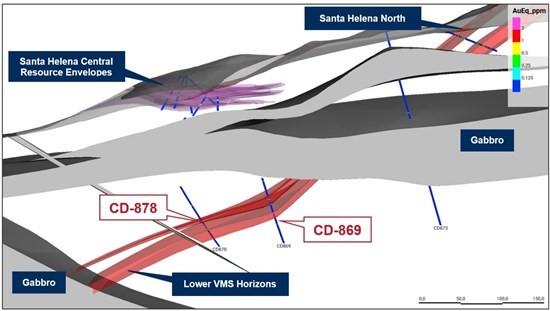
Figure 1: Cross section showing CD-878 – CD-869 mineralisation layers (in red), below Santa Helena Central mineralisation envelopes (in purple), with post-mineralisation intrusions in green.
The upper layer’s peak gold result was 7.3g/t Au over 0.7m from 203.5m, coincident with peak silver of 71.7g/t Ag (Sample CBDS132288). The peak zinc grade was 7.1% Zn over 0.4m from 200.8m (Sample CBDS132282), and peak lead grade was 3.4% Pb over 0.7m from 203.5m (Sample CBDS132288). Similar to the up-dip intersection, the intersection was not copper-rich (peak of 0.64% Cu; Sample CBDS132293). The lower copper-rich stringer zone in the footwall to this intersection includes a sample of 1.6% Cu over 0.6m from 225.0m (Sample CBDS132325). Also like the other zones, the intersection corresponds with a zone of sodium depletion, with magnesium enrichment (consistent with chloritic alteration), and with a suite of VHMS pathfinder elements.
The main composite of CD-878 is located ~90 m down-dip from CD-869, with the envelope of mineralisation widening from 7.2m to 11.3m and remaining open. For reference, the up-dip CD-869 intersections returned intervals of:
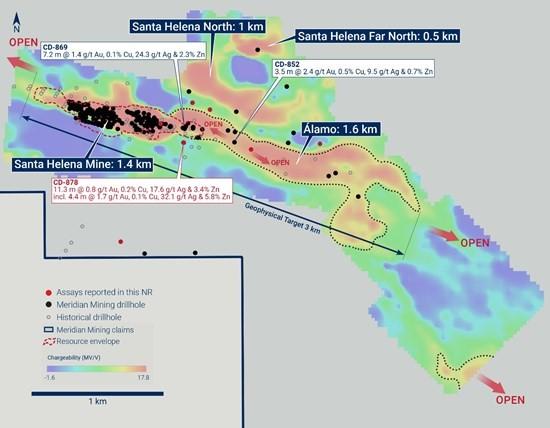
Figure 2: Location of CD-878, collared in eastern margin of Santa Helena Central resource area and drilled below the resource envelope.
The metal distribution continues to suggest that this sulphide system may represent a more distal, cooler domain of a broader VMS system, with ongoing drilling along strike designed to test for variations in Cu:Zn ratios. The pulse of more copper-rich stringer mineralisation in CD-878 may be a signal of a phase of hotter fluids in a footwall fracture.
The CD-869 / CD-878 position is interpreted to be a down-dip projection of the Santa Helena North chargeability and surface geochemical anomalies. These were interpreted as the uppermost surficial expression of a VMS exhalative horizon. Initial confirmation of mineralisation within this anomaly came from CD-607, which intersected VMS pathfinders and trace mineralisation3. The horizon was considered prospective for thickened down-dip or down-plunge extensions. Broad-spaced drilling commenced this year to improve geological understanding and assess the potential for resource extensions. Additional potential also exists for structurally controlled gold with overprinting mineralisation associated with later deformational events in the Cabaçal Belt.
Additional drilling is in progress. The succession is interrupted to a degree by post-mineralisation gabbroic sills, with modelling in progress to understand their geometry and how they potentially displace this second VMS horizon. CD-874 intersected a marginal section of the Santa Helena mineralisation but terminated early at 48.7m before reaching the second horizon position. Up-dip hole CD-873 intersected a broad but lower-grade interval, on the upper side of a mafic intrusive body. They possibly represent the same plane, or the extension of one of the hanging wall mineralised positions with the gabbroic body cutting the main mineral position. Up-dip hole CD-865 was terminated in the gabbroic unit. Some broad step-out holes at the far eastern sector of the Álamo trend included CD-872 and CD-876. CD-872 intersected a broad but lower-grade gold-zinc anomaly in the transition zone, and a zinc anomaly in the shallow basement, which may be an up-dip expression of the same system. CD-876 intersected multiple narrow low-grade bands. Both holes have associated pathfinder signals. The shallow-dipping stratigraphy provides access to a broad extent of prospective greenstone contact at explorable depths, and CD-878 was collared approximately 450m to the south of the leading edge of the Santa Helena North’s chargeability anomaly.
Regional Exploration Programmes
The Company is also commencing initial field reconnaissance programmes in the Jauru – Araputanga Greenstone Belts to the west of Cabaçal, for initial verification / extension of BP Minerals’ soil grids, whilst continuing reconnaissance in the broader Cabaçal Belt (“Figure 3”). The Company holds 66,552 ha in the Jauru and Araputanga Belts, and 51,826 ha in the Cabaçal Belt. Currently, industrial mining for gold is underway within the southern sector of the Jauru Belt, at a new open pit operated by a private company along strike from the Company’s licences, highlighting the geology’s prospectivity.
The geological units of the Jauru and Araputanga Belts are considered to be coeval with that of the Cabaçal Belt, with all containing formations assigned to the Alto Jauru Group. These include:
The aerial INPUT survey of BP Minerals over the Jauru and Araputanga Belts defined at least 54 geophysical anomalies, and their surface geochemical reconnaissance defined multiple gold and base metal stream anomalies. The abundance of mafic volcanics increases to the west, and both belts have banded iron formations.
The Company remains active with landholder engagement across the broad licence package with 147 written agreements now in place, growing month by month. We expect the programmes to accelerate during the later part of 2026 and into 2027.
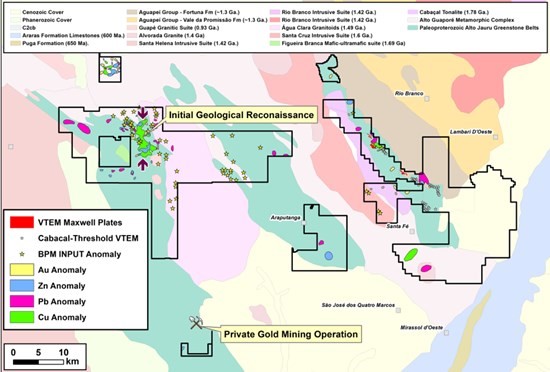
Figure 3: Jauru – Araputanga Greenstone Belts: Geology, geophysical and geochemical anomalies, and initial reconnaissance area.
Technical Notes
Drill core samples have been analysed at the ALS laboratory in Lima, Peru. Samples are dried, crushed with 70% passing <2mm, split to give a mass of approximately 250g, and pulverised with 85% passing 200µm. Routine gold analyses have been conducted by Au‐AA24 (fire assay of a 50g charge with AAS finish). High‐grade samples (>10g/t Au) are repeated with a gravimetric finish (Au‐GRA22). Base metal analysis is conducted by methods ME-ICP61 and OG62 (four-acid digest with ICP-AES finish). Visible gold intervals are sampled by metallic screen fire assay method Au‐SCR21. Samples are held in the Company’s secure facilities until dispatched and delivered by staff and commercial couriers to the laboratory. Pulps and coarse rejects are retained and returned to the Company for storage. The Company submits a range of quality control samples, including blanks and gold and polymetallic standards supplied by Rocklabs, ITAK and OREAS, supplementing laboratory quality control procedures. Approximately 5% of archived samples are sent for umpire laboratory analysis, including any lots exhibiting QA/QC outliers after discussion with the laboratory. In BP Minerals’ sampling, gold was analysed historically by fire assay and base metals by three-acid digest and ICP finish at the Nomos laboratory in Rio de Janeiro. Silver was analysed by aqua regia digest with an atomic absorption finish. True width is considered to be 85-95% of intersection width. Assay figures and intervals are rounded to 1 decimal place.
Induced polarisation surveys have been conducted by the Company’s in-house team utilising its GDD GRx8-16c receiver and 5000W-2400-15A transmitter. Results are sent daily for processing and quality control to the Company’s consultancy, Core Geophysics. Geophysical and geochemical exploration targets are preliminary in nature and not conclusive evidence of the likelihood of a mineral deposit.
Adjacent Properties: The mineralisation identified on the adjacent property is not necessarily indicative of the mineralisation on the Company’s licences.
Qualified Person Statement
Mr. Erich Marques, B.Sc., FAIG, Chief Geologist of Meridian Mining and a Qualified Person as defined by National Instrument 43-101, has reviewed, verified, and approved the technical information in this news release.
About Meridian
Meridian Mining is focused on:
The Pre-feasibility Study technical report (the “PFS Technical Report”) dated March 31, 2025, entitled: “Cabaçal Gold-Copper Project NI 43-101 Technical Report and Pre-feasibility Study” outlines a base case after-tax NPV5 of USD 984 million and 61.2% IRR from a pre-production capital cost of USD 248 million, leading to capital repayment in 17 months (assuming a metals price scenario of USD 2,119 per ounce of gold, USD 4.16 per pound of copper, and USD 26.89 per ounce of silver). Cabaçal has a low All-in-Sustaining-Cost of USD 742 per ounce gold equivalent & production profile of 141,000 ounces of gold equivalent life of mine, driven by high metallurgical recovery, a low life-of-mine strip ratio of 2.3:1, and the low operating cost environment of Brazil.
The Cabaçal Mineral Reserve estimate in the PFS consists of Proven and Probable reserves of 41.7 million tonnes at 0.63g/t gold, 0.44% copper and 1.64g/t silver (at a 0.25 g/t gold equivalent cut-off grade).
Readers are encouraged to read the PFS Technical Report in its entirety. The PFS Technical Report may be found under the Company’s profile on SEDAR+ at www.sedarplus.ca and on the Company’s website at www.meridianmining.co.
The PFS Technical Report was prepared for the Company by Tommaso Roberto Raponi (P. Eng), Principal Metallurgist with Ausenco Engineering Canada ULC; Scott Elfen (P. E.), Global Lead Geotechnical and Civil Services with Ausenco Engineering Canada ULC; John Anthony McCartney, C.Geol., Ausenco Chile Ltda.; Porfirio Cabaleiro Rodriguez (Engineer Geologist FAIG), of GE21 Consultoria Mineral; Leonardo Soares (BSc Geo, MAIG), Senior Geological Consultant of GE21 Consultoria Mineral; Norman Lotter (Mineral Processing Engineer; P.Eng.), of Flowsheets Metallurgical Consulting Inc.; and, Juliano Felix de Lima (Engineer Geologist MAIG), of GE21 Consultoria Mineral.
Brutus Mining Inc. (CSE: BRU) (FSE: ZI3) is pleased to announce that it has closed its non-brokered ... READ MORE
Jaguar Uranium Corp. (NYSE American: JAGU) is pleased to announce an independent Mineral Resource E... READ MORE
Auro Metals Inc. (TSX-V: AURO) (OTCQB: AURFF), is pleased to announce the assay results of the fina... READ MORE
Endeavour Silver Corp. (NYSE: EXK) (TSX: EDR) is pleased to announce that repairs to the primary bal... READ MORE
Scorpio Gold Corp. (NASDAQ: SGLD) (TSX-V: SGLD) (OTCQB: SRCRF) (FSE: RY9) is pleased to announce re... READ MORE