






Li-FT Power Ltd. (TSX-V: LIFT) (OTCQX: LIFFF) (Frankfurt: WS0) is pleased to report results from the 2026 winter program completed at the Yellowknife Lithium Project, located outside the city of Yellowknife, Northwest Territories (Figure 1). This program comprised a total of 17 drill holes for 4,778 m, with results for eight holes (2,110 m) summarized in this news release and including the following highlights:
All 17 holes were drilled in the BIG area of the YLP (Figure 2), with 16 drilled on the BIG East pegmatite complex and one hole drilled on its fault offset northern extension, referred to as BIG North (Figure 3). This program marks the first drill campaign in BIG area since publication of the mineral resource in October 2024.
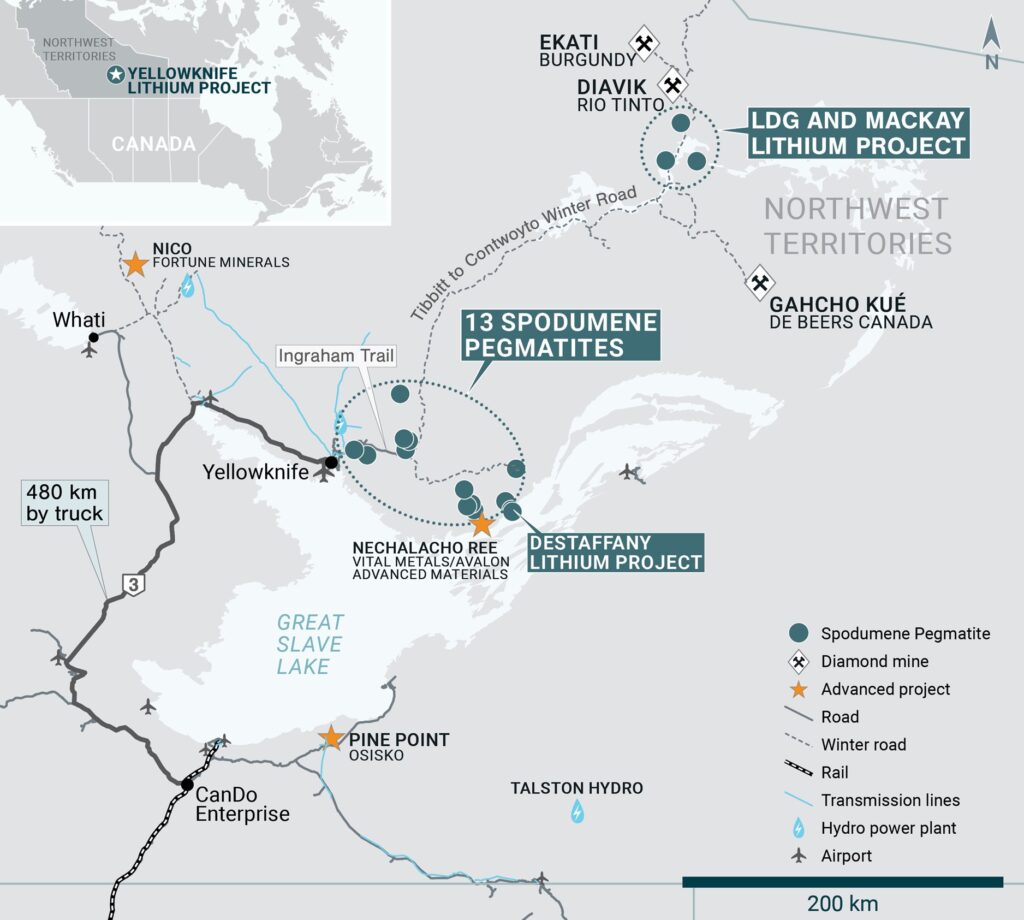
Figure 1 – Location of LIFT’s Yellowknife Lithium Project (YLP) in the NWT.
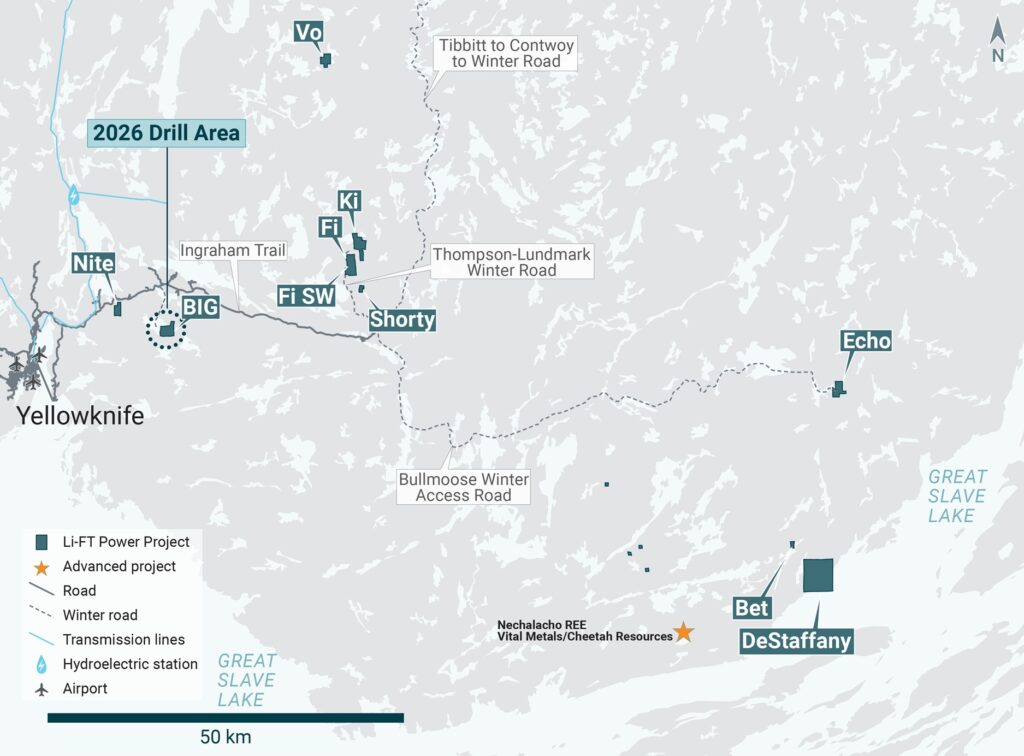
Figure 2 – Location of LIFT’s BIG pegmatites within the YLP.
Discussion of Results
The BIG East pegmatite complex comprises a north-northeast trending corridor of parallel-trending dykes that is exposed for at least 1.8 km of strike length, ranges from 10-100 m wide, and dips approximately 55°-75° degrees to the west. Spodumene-bearing pegmatite occurs as either a single dyke 20-35 m wide, or as two to four dykes of similar cumulative thickness within corridors up to 65 m wide.
The 2026 winter program extended along 1,000 m of strike length of the BIG East complex and reached depths of 50 to 300 m vertically below surface. A table of composite calculations, general comments related to this discussion, and a table of collar headers are provided towards the end of this section whereas hole-by-hole descriptions are provided below.
YLP-0312 was drilled to test the northern part of the BIG East pegmatite approximately 150 m below surface and 100 m down-dip of previously released YLP-0058 (1.10% Li2O over 28 m in three dykes over 68 m). New drilling intersected a 26-m-wide pegmatite dyke that returned a wall-to-wall composite of 1.29% Li2O over 26 m, including 17 m averaging 1.65% Li2O (Table 1, Figure 4).
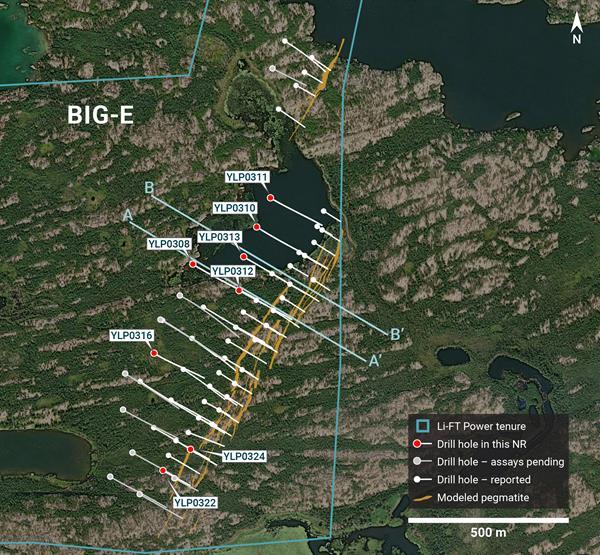
Figure 3 – Plan map showing BIG tenure boundary, pegmatite dykes, 2023-2024 drill traces, and the 2026 resource delineation holes.
YLP-0308 was drilled an additional 100 m downdip of YLP-0312 to test mineralization at 250 m below surface, intersecting four pegmatite dykes totalling 45 m within a drilled width of 57 m, with negligible spodumene.
YLP-0313 was collared 100 m north of YLP-0312, to test the BIG East complex at 150-200 m below surface and 100 m downdip of YLP-0251 (1.06% Li2O over 28 m). New drilling intersected 12- , and 10-m-wide dykes spaced 22 m apart, with the upper one returning 1.12% Li2O over 10 m and the lower one 0.68% Li2O over 10 m, including 6 m of 1.03% Li2O (Figure 5, Table 1). Mineralization on this section remains open at depth.
YLP-0322 was collared 50 m south of YLP-0063, previously the most southerly hole drilled on BIG East. New drilling aimed to test pegmatite at 100 m below surface and intersected seven dykes, between 1 and 11 m wide, that sum to 33 m of pegmatite in a drilled with of 75 m. Four of these dykes are spodumene-bearing, returning intersections of 1.15% Li2O over 9 m, 0.97% Li2O over 10 m, 0.57% Li2O over 5 m, and 0.53% Li2O over 2 m (Table 1). Mineralization in this section is open along strike to the south and at depth.
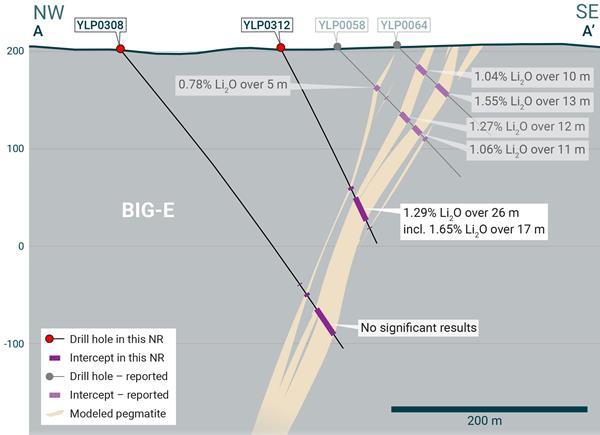
Figure 4 – Section A-A’ looking northeast and showing the BIG East pegmatite as well as results from 2023-2024 and 2026 drilling.
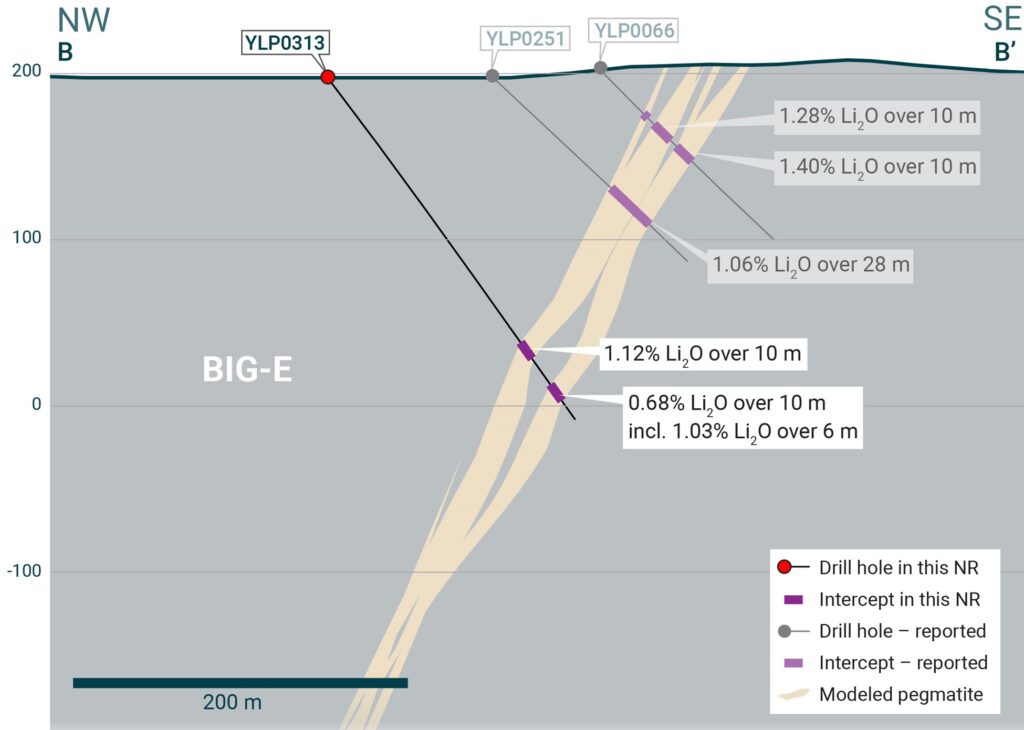
Figure 5 – Section B-B’ looking northeast and showing the BIG East pegmatite as well as results from 2023-2024 and 2 026 drilling.
YLP-0324 was also drilled near the southern end of the BIG East complex, collared approximately 100 m northeast of YLP-0322 to test the corridor at 50 m below surface and 50 m up-dip of YLP-0068 (1.02% Li2O over 26 m). Drilling intersected 16 m of pegmatite in three dykes over 49 m of drill core, with the widest dyke returning 1.04% Li2O over 11 m.
YLP-0310 and 0311 were drilled at the north end of the BIG East pegmatite to, respectively, test 100 m downdip of previously drilled holes YLP-0271 (1.34% Li2O over 35 m) and YLP-0267 (0.47% Li2O over 12 m in three dykes over 44 m). Both new drill holes intersected 20- to 30-m-wide pegmatite at their expected depths, with negligible spodumene.
YLP-0316 was drilled to test the central part of the BIG East complex at approximately 250 m below surface and 100 m downdip of YLP-0117 (1.56% Li2O over 26 m). Drilling intersected a 22-m-wide pegmatite dyke at the expected depth, with negligible spodumene.
Table 1 – Notable results from the 2026 YLP winter drilling program.
| Hole No. | From (m) | To (m) | Interval (m) | Li2O% | Dyke |
| YLP0312 | 170 | 196 | 26 | 1.29 | BIG East |
| inc | 177 | 194 | 17 | 1.65 | |
| YLP0313 | 198 | 208 | 10 | 1.12 | BIG East |
| and | 230 | 240 | 10 | 0.68 | |
| inc | 233 | 239 | 6 | 1.03 | |
| YLP0322 | 70 | 80 | 10 | 0.97 | BIG East |
| and | 93 | 98 | 5 | 0.57 | |
| and | 101 | 110 | 9 | 1.15 | |
| and | 127 | 129 | 2 | 0.53 | |
| YLP0324 | 54 | 65 | 11 | 1.04 | BIG East |
| YLP0308 | No significant results | BIG East | |||
| YLP0310 | No significant results | BIG East | |||
| YLP0311 | No significant results | BIG East | |||
| YLP0316 | No significant results | BIG East | |||
Current Mineral Resource Estimate
The consolidated mineral resource estimate (MRE) for LIFT’s Yellowknife Lithium Project covers 8 of 13 spodumene-bearing pegmatite dykes (Figures 1, 2) and totals 50.4 million tonnes (Mt) at 1.00% Li2O for 506,000 tonnes of Li2O (1.25 million tonnes of LCE) in the inferred category, posit ioning the project as one of the largest spodumene projects in North America.
BIG East is the largest of the eight deposits included in the consolidated MRE, containing 16.5 Mt grading 1.06% Li2O using a cutoff grade of 0.4% Li2O. The 2026 results improve geological understanding of the deposit and supports localized expansion of the current MRE, including its southern extent where it remains open at depth and along strike.
Francis MacDonald, President & CEO of LIFT comments, “We’re pleased with the results from this winter’s drill program at BIG East. The intercepts confirm the continuity of mineralization at depth and provide a strong basis for our ongoing work in the area, including adding to the resource base at BIG East.”
General Statements
All holes described in this news release were drilled broadly perpendicular to the dyke o rientation so that the true thickness of reported intercepts will range somewhere between 65-100% of the drilled widths. A collar header table for all 2025 drill holes is provided below.
Visual core logging, mineralogical studies, and metallurgical work confirm that the predominant host mineral for lithium is spodumene.
Table 2 – Drill collar header data for the 2026 YLP winter drilling program.
| Drill Hole | NAD83 | Easting | Northing | Elevation (m) | Azimuth (°) | Dip (°) | Depth (m) | Dyke |
| YLP0308 | Zone 12N | 345,908 | 6,933,357 | 197 | 121 | 50 | 383 | BIG East |
| YLP0310 | Zone 12N | 346,107 | 6,933,472 | 197 | 121 | 50 | 285 | BIG East |
| YLP0311 | Zone 12N | 346,150 | 6,933,563 | 198 | 121 | 52 | 340 | BIG East |
| YLP0312 | Zone 12N | 346,052 | 6,933,275 | 201 | 121 | 62 | 222 | BIG East |
| YLP0313 | Zone 12N | 346,067 | 6,933,380 | 197 | 121 | 51 | 254 | BIG East |
| YLP0316 | Zone 12N | 345,788 | 6,933,080 | 198 | 120 | 55 | 338 | BIG East |
| YLP0322 | Zone 12N | 345,815 | 6,932,715 | 197 | 121 | 53 | 159 | BIG East |
| YLP0324 | Zone 12N | 345,901 | 6,932,781 | 195 | 121 | 45 | 129 | BIG East |
QAQC
All drill core samples were collected under the supervision of LIFT employees and contractors. Drill core was transported from the drill platform to the core processing facility where it was logged, photographed, and split by diamond saw prior to being sampled. Samples were then bagged, and blanks and certified reference materials were inserted at regular intervals. Field duplicates consisting of quarter-cut core samples were also included in the sample runs. Groups of samples were placed in large bags, sealed with numbered tags in order to maintain a chain-of-custody, and transported from LIFT’s core logging facility to ALS Labs (“ALS”) laboratory in Yellowknife, Northwest Territories.
Sample preparation and analytical work for this drill program were carried out by ALS. Samples were prepared for analysis according to ALS method CRU31: individual samples were crushed to 70% passing through 2 mm (10 mesh) screen; a 1,000-gram sub-sample was riffle split (SPL-21) and then pulverized (PUL-32) such that 85% passed through 75-micron (200 mesh) screen. A 0.2-gram sub-sample of the pulverized material was then dissolved in a sodium peroxide solution and analysed for lit hium according to ALS method ME-ICP82b. Another 0.2-gram sub-sample of the pulverized material was analysed for 53 elements according to ALS method ME-MS89L. All results passed the QA/QC screening at the lab, all inserted standards and blanks returned results that were within acceptable limits.
Qualified Person
The disclosure in this news release of scientific and technical information regarding LIFT’s mineral properties has been reviewed and approved by Ron Voordouw, Ph.D., P.Geo., Partner, Director Geoscience, Equity Exploration Consultants Ltd., and consultant to Li-FT Power Ltd. A Qualified Person as defined by National Instrument 43-101 Standards of Disclosure for Mineral Projects (NI 43-101) as well as a member in good standing with the Northwest Territories and Nunavut Association of Professional Engineers and Geoscientists (NAPEG) (Geologist Registration number: L5245).
About LIFT
LIFT is a mineral exploration company engaged in the acquisition, exploration, and development of lithium pegmatite projects located in Canada. The Company’s flagship project is the Yellowknife Lithium Project located in Northwest Territories, Canada. LIFT also holds three early-stage exploration properties in Quebec, Canada with excellent potential for the discovery of buried lithium pegmatites, as well as the Cali Project in Northwest Territories within the Little Nahanni Pegmatite Group.
Brutus Mining Inc. (CSE: BRU) (FSE: ZI3) is pleased to announce that it has closed its non-brokered ... READ MORE
Jaguar Uranium Corp. (NYSE American: JAGU) is pleased to announce an independent Mineral Resource E... READ MORE
Auro Metals Inc. (TSX-V: AURO) (OTCQB: AURFF), is pleased to announce the assay results of the fina... READ MORE
Endeavour Silver Corp. (NYSE: EXK) (TSX: EDR) is pleased to announce that repairs to the primary bal... READ MORE
Scorpio Gold Corp. (NASDAQ: SGLD) (TSX-V: SGLD) (OTCQB: SRCRF) (FSE: RY9) is pleased to announce re... READ MORE