






K2 Gold Corporation (TSX-V: KTO) (OTCQX: KTGDF) (FSE: 23K) today announced the results from four additional drill holes completed at the Dragonfly Zone at its 100% owned Mojave Project. Results from these four holes drilled off the third pad of the 2026 program confirm the presence of multiple stacked structures hosting high-grade oxide gold 75m to the south of K2’s 2020 discovery intercept, and 68m from K2’s previous results announced here.
The Dragonfly Zone is located 1.5km south of the undrilled Gold Valley target (rock samples to 375 g/t Au), 2km north of the Newmont target, and midway along the >6.5km long Eastside Gold Trend, a broad mineralized trend which has been identified by K2 sampling and limited historical drilling (see NI43-101 Technical Report).
29 holes have been completed to date for 5,389m of a fully permitted and fully funded 14,000m campaign, with drilling currently in progress at the Newmont Zone. Results from 18 additional K2 drill holes are pending.
Highlights
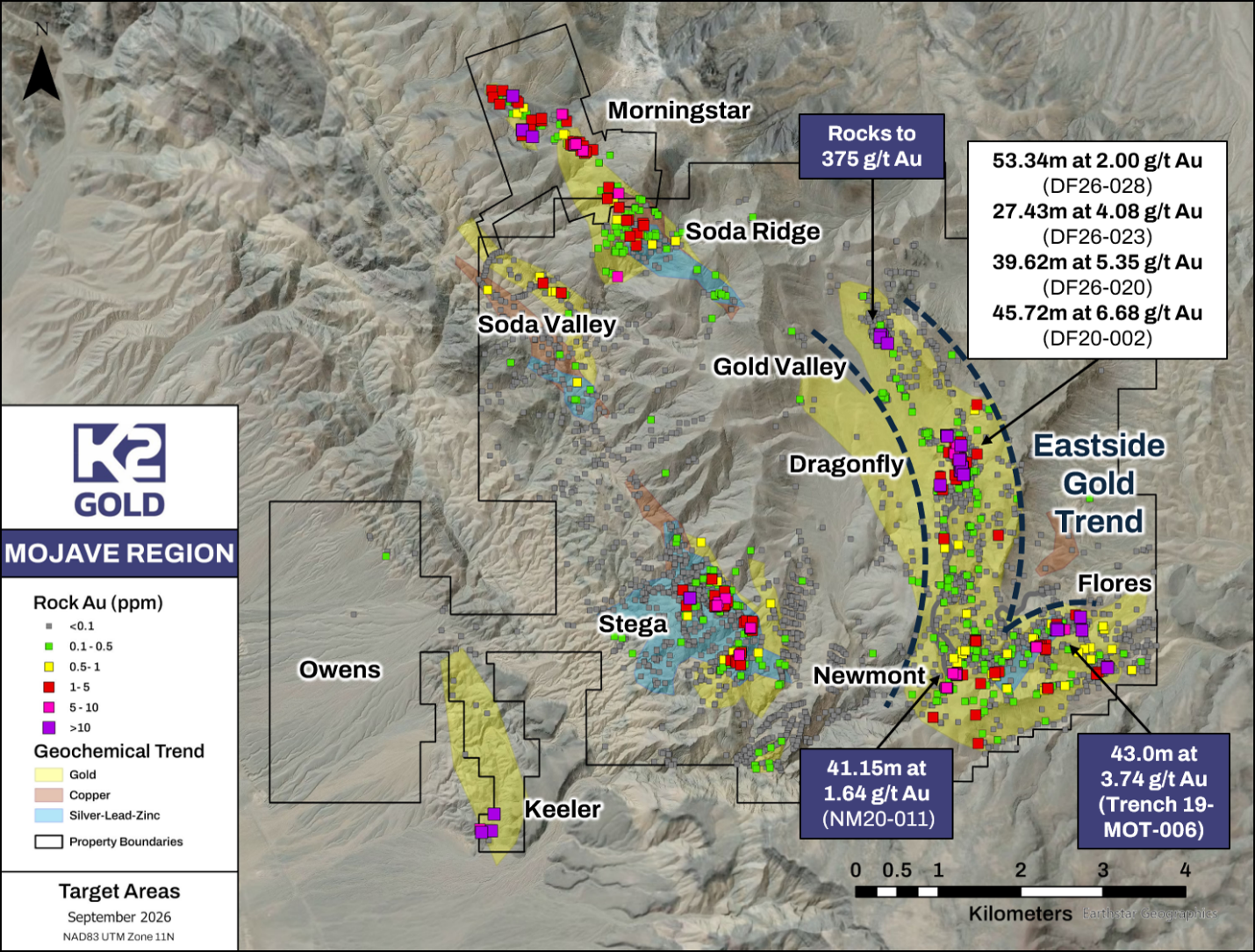
Figure 1: Map of target areas throughout the region – new Dragonfly results noted.
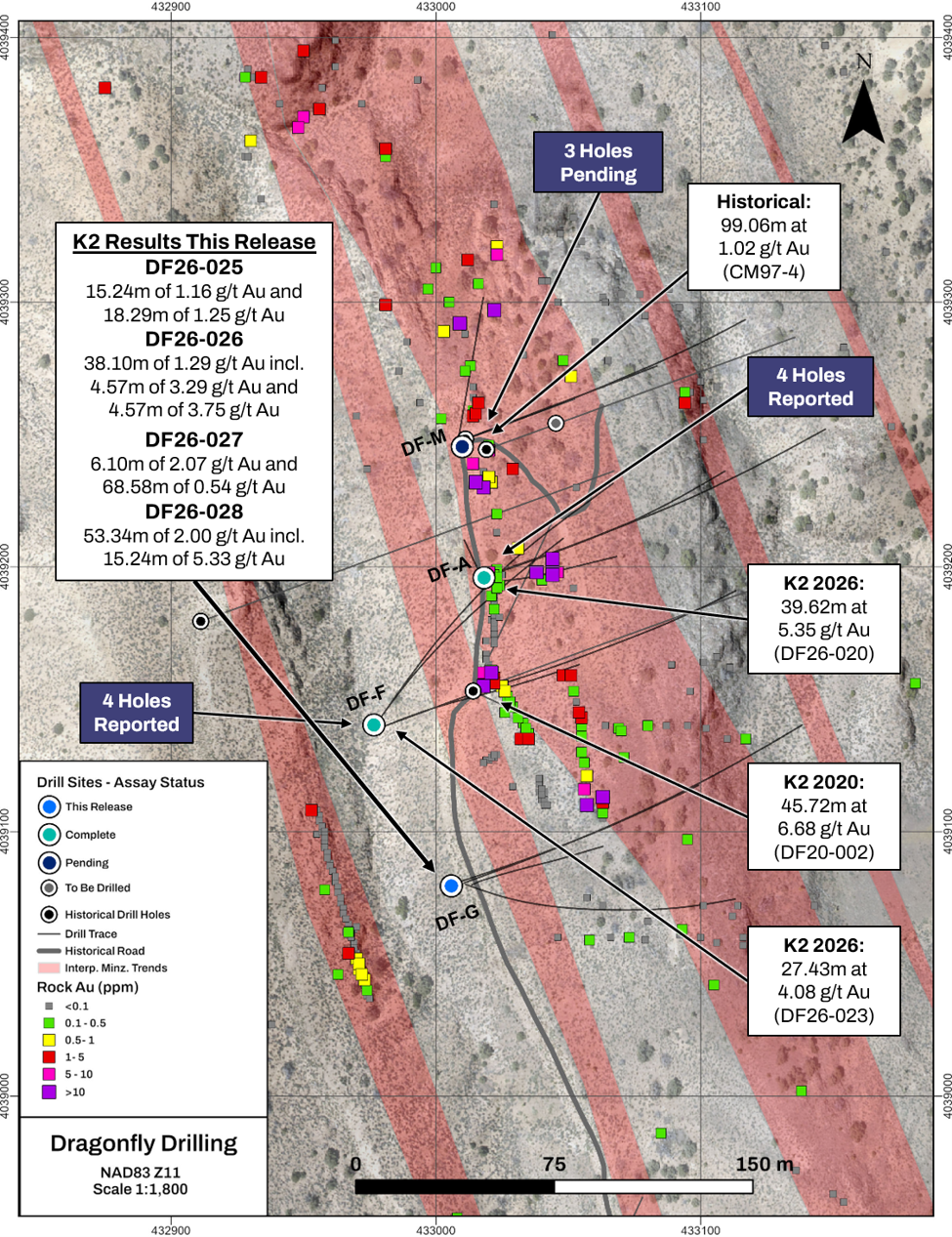
Figure 2: Plan map of 2026 RC drilling at the Dragonfly Zone, results from drilling on pad DF-G highlighted.
Dragonfly Zone – Site DF-G
Dragonfly is centrally located in the middle of the Eastside Gold Trend 1.5km south of Gold Valley and 2km north of Newmont and hosts high-grade oxide gold mineralization within a steeply west-dipping structural corridor. Ribs of silicified and strongly oxidized conglomerate and limestone, plus recessive but strongly gold mineralized siltstone, are exposed at surface in the core of the target area and carry gold values of up to 22.53 g/t Au in surface rock sampling. Surrounding the currently drilled portion of the target, stacked, subparallel, primarily steeply west dipping structures are observed over a 400m wide corridor, with the majority undrilled to date.
Drill holes reported in this release were collared from pad DF-G, a 75m step to the south-southwest from the high-grade gold drilled by K2 in 2020 (45.72m of 6.68 g/t Au in hole DF20-002). Three holes were drilled in an angled fan orientation at a 070° azimuth: DF26-025 (-68° dip), DF26-026 (-50° dip), and DF26-027 (-84° dip). The final hole from the pad was drilled at a 110° azimuth to test further south along the interpreted NNW-SSE trending mineralized structures, into untested ground with only minimal gold mineralization exposed at surface.
All four holes intersected a broad (up to 53m drilled width) main mineralized structure interpreted to be the main Dragonfly structural corridor. Within this structural zone, intersected gold grades in individual structures vary; with best individual gold values reaching up to 12.3 g/t Au (DF26-028). Crucially, the high-grade mineralization drilled from pad DF-G is found in the southernmost hole (interval of 15.24m of 5.33 g/t Au in DF26-028); extending K2’s 2026 high-grade intersections at Dragonfly as drilled to date to 160m of NNW-SSE oriented strike and confirming high grade gold at all pads drilled to date.
Table 1: Highlight results from drilling at site DF-G at the Dragonfly Zone. Full gold assay results for each hole are available here.
| Drill Hole | From (m) | To (m) | Width* (m) | Gold (g/t) | |
| DF26-025 | 7.62 | 22.86 | 15.24 | 0.23 | |
| 68.58 | 83.82 | 15.24 | 1.16 | ||
| 100.58 | 118.87 | 18.29 | 1.25 | ||
| DF26-026 | alteration envelope | 50.29 | 88.39 | 38.10 | 1.29 |
| including | 50.29 | 54.86 | 4.57 | 3.29 | |
| and including | 71.63 | 76.20 | 4.57 | 3.75 | |
| 140.21 | 144.78 | 4.57 | 0.71 | ||
| DF26-027 | 9.14 | 24.38 | 15.24 | 0.33 | |
| 60.96 | 67.06 | 6.10 | 2.07 | ||
| 83.82 | 91.44 | 7.62 | 0.54 | ||
| alteration envelope | 114.3 | 182.88 | 68.58 | 0.54 | |
| DF26-028 | 9.14 | 22.86 | 13.72 | 0.33 | |
| 44.20 | 48.77 | 4.57 | 2.11 | ||
| alteration envelope | 70.10 | 123.44 | 53.34 | 2.00 | |
| including | 82.30 | 97.54 | 15.24 | 5.33 |
*Reported widths are from angled drill holes and are drilled/apparent widths; true thickness of mineralization is currently unknown.
Table 2: Drill hole specifications for the initial holes in this release. Coordinates are in UTM NAD83 Z11.
| Drill Hole | Drill Site | UTM X | UTM Y | Elevation (m) | Azimuth (deg.) | Dip (deg.) | Length (m) |
| DF26-025 | DF-G | 433009 | 4039081 | 2201 | 70 | -68 | 192.02 |
| DF26-026 | DF-G | 433009 | 4039081 | 2201 | 70 | -50 | 192.02 |
| DF26-027 | DF-G | 433009 | 4039081 | 2201 | 70 | -84 | 192.02 |
| DF26-028 | DF-G | 433009 | 4039081 | 2201 | 110 | -50 | 192.02 |
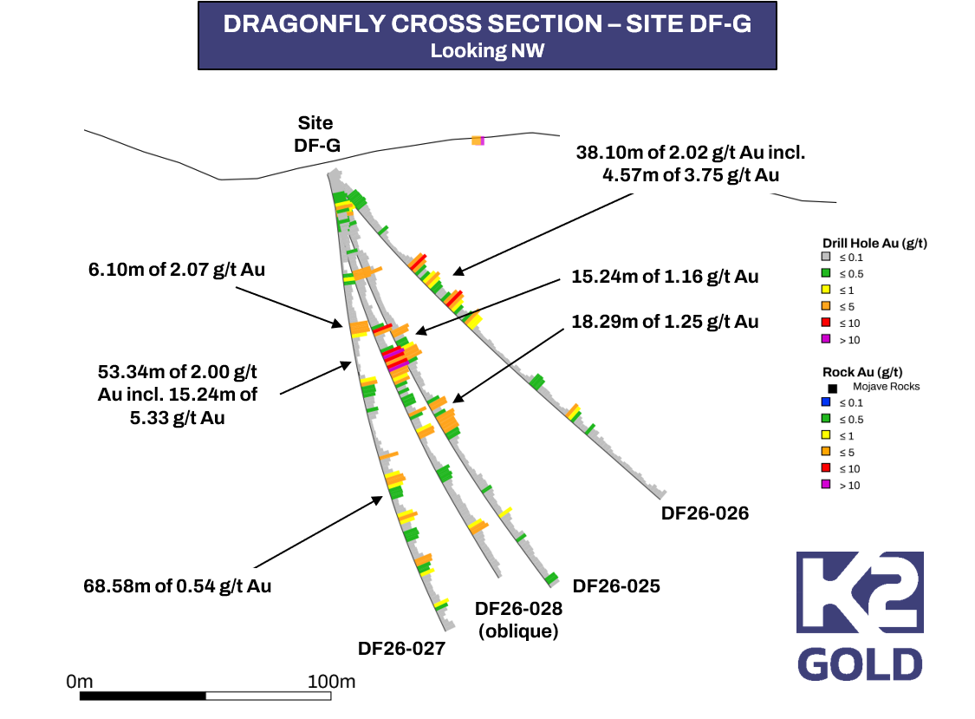
Figure 3: Cross section of drilling from pad DF-G in this release at the Dragonfly Zone, looking NW. Note that the section is drill-oriented 070-250 degrees, but view is to 315 degrees: DF26-028 was drilled to a 110 azimuth off-section, toward the viewer.
DF26-025 (192.02m, 070° Az., -68 Dip)
DF26-025 tested the Dragonfly structural corridor at an azimuth of 070° and dip of -68°. The hole intersected two principal gold-bearing intervals: 15.24m of 1.16 g/t Au from 68.58m and 18.29m of 1.25 g/t Au from 100.58m. Mineralization occurs within predominantly oxidized siltstone containing quartz-carbonate veining and increased iron oxides. Between the highlighted gold intervals, high pathfinder geochemistry is noted including elevated arsenic with scattered anomalous mercury and calcium depletion in quartz veined and silicified higher grade gold intervals with iron oxide saturation. Multiple intervals with the described alteration correspond to gold mineralized structures and support the interpretation of multiple mineralized structures within a broader corridor.
DF26-026 (192.02m, 070° Az., -50 Dip)
DF26-026 tested a shallower trajectory through the corridor from site DF-G, returning 38.10m of 1.29 g/t Au from 50.29m, including 4.57m of 3.75 g/t Au. The principal interval occurs within predominantly siltstone-hosted alteration containing quartz-carbonate veinlets and iron oxides. Discrete and pervasive quartz—iron oxide +/- illite/muscovite alteration pockets within broader envelopes of moderate alteration define the gold mineralized intervals, which include multiple high-grade pockets defined by individual samples running 6.10, 6.06, and 4.44 g/t Au. Together with the steeper DF26-025, the hole demonstrates gold mineralization across different elevations within the drill fan and helps constrain the geometry of the interpreted main Dragonfly structural corridor.
DF26-027 (192.02m, 070° Az., -84 Dip)
DF26-027 was drilled at a steep dip of -84° to test beneath the alteration intersected in DF26-025. The hole returned 6.10m of 2.07 g/t Au from 60.96m, followed farther down hole by a broad interval of 68.58m of 0.54 g/t Au from 114.30m highlighted by individual samples with 3.78, 3.43, and 4.05 g/t Au within a very broad quartz, calcite, iron oxide (goethite, hematite) and illite/muscovite alteration envelope defining the gold zone. Mineralization accompanies repeated instances of this alteration suite hosted by siltstone and sandstone with minor limestone horizons. The results demonstrate that gold-bearing alteration of significant width persists at depth, despite variable grades.
DF26-028 (192.02m, 110° Az., -50 Dip)
DF26-028 tested southeastward along the interpreted mineralized structures into previously untested ground with limited surface gold expression. The hole returned 53.34m of 2.00 g/t Au from 70.10m, including 15.24m of 5.33 g/t Au from 82.30m, within strongly oxidized sandstone and siltstone cut by quartz-carbonate veins. This high-grade interval in the southernmost hole drilled at Dragonfly to date extends the known mineralization southward and highlights the potential for additional gold mineralization beneath weakly mineralized surface exposures.
The upper part of this hole also cut 9.15m of 0.45 g/t starting at 9.14m depth in a goethite rich siltstone altered by quartz veining and silicification in what’s considered the first gold-mineralized structure. Following this intercept is a discrete 4.57m interval of 2.11 g/t Au which correlates with a mixed goethite-hematite rich altered siltstone with quartz and calcite veinlets with thin gossan-like veins or as bedding replacement. Once in the 53.34m interval, the alteration is notably high in silicification with calcite and hematite rich iron oxides and patches of manganese oxides. Also evident are RC chips with Liesegang banding, which is typical of siltstones and shales seen on the surface which host strong gold mineralization. The highest gold grade segment is decalcified, pervasively silicified, hematite-goethite rich siltstone with individual samples running 12.3, 8.59, and 10.4 g/t Au within an arsenic-antimony barium-rich interval that also contains silver up to 4.80 g/t. Notably, this high-grade core in DF26-028 occurs 25m south of the main drilled section, indicating that high grade gold is carried throughout the Dragonfly structures.
Permitting
In early 2026, the Company received a positive Record of Decision approving the Mojave Exploration Drilling Program from the U.S. Bureau of Land Management authorizing exploration drilling from up to 22 drill sites.
The Company’s drilling program is proceeding under a comprehensive Plan of Operations that aims to minimize environmental impact. Drill sites are limited in size, pads are constructed out of timber to avoid extensive excavation, and all sites have been pre-cleared by qualified biologists and archaeologists after years of baseline work, avoiding all known cultural and biological resources. In addition, Tribal Monitors from participating tribes are present at each drill site 24/7. The current program constitutes the largest drill program ever undertaken on the Mojave Project.
Next Steps
In total 15 holes have been drilled at Dragonfly with the results of 11 of those released to date including the four holes disclosed in this release. Four additional holes have been completed at Dragonfly from the DF-M and DF-A drill sites, with results from all four pending. All drill holes from all sites have intersected strong silicification, carbonate veining, and iron oxide enrichment due to the oxidation of sulphides plus clear zones of decalcification. An additional 16 holes are currently permitted at Dragonfly and are slated for drilling in the second phase of work at the target.
K2 has now drilled 14 holes at the Newmont target, located at the southern extent of the >6.5 km long Eastside Gold Trend, 2 km south of Dragonfly and 1.6 km west of the Flores target. At Newmont, K2 drilled oxide mineralization returning 1.64 g/t Au over 41.15m in hole NM20-011 (see K2 News Release Feb 20, 2021), and historical operators including BHP Minerals and Newmont Exploration completed limited drilling in 1997 and 1991, respectively.
The Company will continue to release results upon receipt and interpretation throughout the ongoing, fully permitted, drilling program.
Qualified Person and QA/QC
The technical information in this news release has been prepared in accordance with Canadian regulatory requirements set out in NI 43-101 and reviewed and approved by Eric Buitenhuis, M.Sc., P.Geo., K2’s QP and Vice President of Exploration.
The analytical work for the 2026 drilling program was performed by ALS Laboratories an internationally recognized and accredited analytical services provider. All samples were submitted to ALS’s Reno, Nevada facility, where they were prepared using procedure PREP-31Y (dry, crush entire sample to 2mm, rotary split and pulverize 250g to better than 85% passing 75 microns). Samples were then shipped to the ALS laboratory in North Vancouver, BC, Canada, where pulp samples were analysed for gold by method Au-ICP21, a 30-gram Fire Assay fusion with an ICP-AES finish. Samples returning >10 g/t Au by Fire Assay were subsequently analysed with method Au-GRA21, a 30-gram fire assay with a gravimetric finish. A 0.25g pulp was analysed by method ME-MS61, a 4-acid digestion and ICP-MS finish for 48 elements. Samples returning
Quality Assurance and Quality Control procedures include inserting coarse blanks and certified assay standards into the sample string at a rate of approximately 1/10 (10%). K2 personnel placed samples in sealed bags and shipped them to ALS.
About K2 Gold Corporation
K2 is a gold focused exploration company primarily operating in the SW USA and Yukon territory of Canada. The company is led by an experienced team with a track record of success including Great Bear, Great Bear Royalties, Kaminak and Northern Empire. The company is well financed with a treasury of over $27M.
K2 holds:
The Mojave Project is a +6000-hectare oxide gold project with base metal targets located in Inyo County, California. Multiple previously recognized surface gold targets have been successfully drilled in the past, most notably by Newmont and BHP. Since acquiring the property, K2 has completed geochemical and geophysical surveys, geologic mapping, LiDAR, a WorldView 3 alteration survey, and successfully completed a 17-hole RC drill program focused on the Dragonfly and Newmont Zones. Highlights from K2’s drilling program include 6.68 g/t Au over 45.72m from surface at the Dragonfly Zone, and 1.69 g/t Au over 41.15m from 44.20m depth at the Newmont Zone. A follow-up phase of drilling at Mojave is currently underway and will continue for the remainder of 2026. See Mojave 43-101 report here.
The Si2 Project is a low-sulphidation epithermal gold system located in Nevada within the Walker Lane Trend. Historical shallow drilling tested only the uppermost levels of the system and returned anomalous gold, silver, and pathfinder elements. Since acquiring the project, K2 has completed detailed geologic mapping, surface geochemistry, geophysics, alteration mineralogy studies, fluid inclusion analysis, and age dating. These integrated datasets confirm that prior drilling did not test the interpreted boiling zone, where gold grades are typically maximized in epithermal systems. In early 2026, K2 completed an 8-hole, 3,871m exploration drilling program targeting the depths of the system and successfully intersected broad intervals of gold mineralization and blind-to-surface quartz veining.
The Wels Project lies approximately 60km south of Fuerte Metals Coffee project discovered by Kaminak Gold Corporation (formerly a Discovery Group company prior to its acquisition by Goldcorp-Newmont). Both the Coffee project and the Wels project lie within the Tintina Gold Belt, share similar characteristics, and are host to structurally controlled gold mineralization within intrusive rocks exhibiting multiple trends of mineralization. K2’s drilling at the Wels Project has returned strong results including: 3.53g/t Au over 19.5m, and 10.38g/t Au over 6.0m.
The Wolf Project is a new district-scale gold exploration project in west-central Yukon Territory, Canada, located 80 km south of the 3.0 Moz Au Coffee Gold Project currently under development by Fuerte Metals. Wolf consists of the Wolf South block, a >10km long gold-in-soil anomaly previously held by multiple operators and consolidated by K2, and the Wolf North claim blocks which host greenfield intrusion-related and epithermal gold targets.
K2 Gold is committed to responsible exploration, safety, Indigenous and community engagement, and advancing high-quality projects through a collaborative and technically disciplined approach.
On behalf of the Board of Directors,
(signed) “Anthony Margarit”
Anthony Margarit,
President and Chief Executive Officer
Investor Inquiries
info@k2gold.com | +1 (604) 331-5090
For additional information about K2 Gold Corporation, please visit K2Gold.com
Follow Us On Social Media: LinkedIn | Instagram | X | YouTube
K2 Gold Corporation is a member of Discovery Group, based in Vancouver, Canada. For more information, please visit: discoverygroup.ca
Brutus Mining Inc. (CSE: BRU) (FSE: ZI3) is pleased to announce that it has closed its non-brokered ... READ MORE
Jaguar Uranium Corp. (NYSE American: JAGU) is pleased to announce an independent Mineral Resource E... READ MORE
Auro Metals Inc. (TSX-V: AURO) (OTCQB: AURFF), is pleased to announce the assay results of the fina... READ MORE
Endeavour Silver Corp. (NYSE: EXK) (TSX: EDR) is pleased to announce that repairs to the primary bal... READ MORE
Scorpio Gold Corp. (NASDAQ: SGLD) (TSX-V: SGLD) (OTCQB: SRCRF) (FSE: RY9) is pleased to announce re... READ MORE