







Honey Badger Silver Inc. (TSX-V: TUF) (OTCQB: HBEIF) is pleased to share that the company has newly recognized important critical minerals potential at its 100%-owned Plata project in the Yukon, including widespread high-grade antimony as well as copper and tungsten mineralization.
The Company’s Executive Chairman, Chad Williams, commented
“During the ongoing data review following the company’s recent fieldwork at Plata, we have recognized extensive high-grade antimony, copper, and tungsten mineralization within and around the Ajo Zone. The presence of these critical minerals, historically untested, compliments the known silver, gold, lead, and zinc mineralization, and underscores the outstanding mineral endowment at Plata, which continues to positively surprise us. I have said many times, and continue to believe, that because of its multiple types and locations of mineralization spread over vast distances, Plata is the property with the best exploration potential that I have seen in my 40-year career. We are excited to advance the Plata project this year as we prepare for Plata’s first drill program in nearly 15 years.”
Newly Recognized Critical Minerals at Plata
To date, the majority of known silver, gold, and base metal mineralization at Plata has been largely concentrated at the Ajo Zone, which represents a fairly consistent ~northwest-southeast trending tabular body (~1-6m wide) of high-grade silver-, gold-, lead-, and zinc-bearing quartz veining that is structurally hosted along the Plata Thrust Fault for approximately 1 km of currently known strike length. Other important silver mineralization near Ajo includes the Cebolla and Oliva Targets, historically referred to as the P2 and P6 targets, to the west and northwest, respectively. These target areas are understood to be controlled by late ~north-south trending structures and comprise wide (~5-20m) zones of massive sulfide mineralization containing high-grade silver, zinc, lead, and low-grade gold mineralization (Fig. 1). Although the focus at Plata will remain centered on expanding the silver and gold potential, recognizing the presence and added economic potential of antimony, copper, and tungsten is important given the increased demand for building domestic supply chains of these important critical minerals. This is the first time that Honey Badger Silver has documented the presence of high-grade antimony, tungsten, and copper mineralization at Plata, which were historically ignored by prior operators.
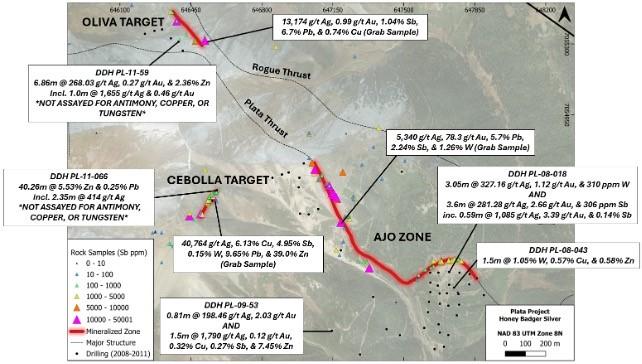
Figure 1. Map of the Plata Project showing antimony-in-rock values on surface across the Ajo Zone, Cebolla Target, and Oliva Target. Select grab samples and drill results are highlighted in text that show high-grade antimony, copper, and tungsten values in addition to high-grade silver, gold, lead, and zinc mineralization.
*Rock samples consist of material that has been classified as outcrop, subcrop, chip, and channel samples, as well as samples that are “undefined”. Samples classified as float have been excluded from the map.
*Drill intercepts from the Ajo Zone and Oliva Target are interpreted to represent close to true width, whereas drill holes from the Cebolla Target are understood to have intersected the mineralized lens at a steeper angle and a true width is potentially ~65% less than the apparent width
Critical Minerals Potential
Antimony (Sb)
Antimony mineralization is widespread at Plata and is present in the Ajo Zone, as well as both the Cebolla and Oliva targets. High-grade antimony importantly occurs throughout the entire length of the Ajo Zone, where 62 out of 144 rock samples collected along or adjacent to the structure returned over 0.1% Sb, 17 samples returned over 1.0% Sb, and five samples returned above the overlimit detection value of 5.0% Sb (Fig 1). Antimony mineralization at Ajo is also positively reflected in historical drill results and shows a strong positive correlation to silver. Antimony highlights from select drill results at Ajo include 1.5m @ 1,790 g/t Ag, 0.12 g/t Au, 0.32% Cu, 0.27% Sb, and 7.45% Zn (PL-09-53), 1.21m @ 1,255.36 g/t Ag, 1.11 g/t Au, & 0.14% Sb (PL-08-016), and 0.59m @ 1,085 g/t Ag, 3.39 g/t Au, & 0.14% Sb (PL-08-018). High-grade antimony is also present at both the Cebolla and Oliva targets with rock sample grades up to 4.95% Sb at Cebolla and 4.72% Sb at Oliva. Drill core from the Cebolla and Oliva targets was not assayed for antimony along with select drill core from Ajo, however the widespread presence of antimony with silver mineralization on surface in these areas indicates it may also be present at depth.
Copper (Cu)
Copper mineralization is broadly distributed throughout the Ajo Zone, as well as the Cebolla and Oliva targets. Collectively between these three areas, 77 out of 288 rock samples returned over 0.1% Cu, and 12 samples returned over 0.5% Cu. The highest reported copper grade of 6.13% Cu is from a rock sample collected at the Cebolla target that also returned 40,764 g/t Ag (4.07%), 4.95% Sb, 0.15% W, 9.65% Pb, and 39.0% Zn. Copper highlights from select drill results at Ajo include 1.52m @ 0.57% Cu (PL-08-043), 1.5m @ 0.32% Cu(PL-08-53), and 2.78m @ 0.10% Cu (PL-08-018). Grades over 0.1% Cu are consistently found with high-grade silver and gold mineralization in other drilling from Ajo. Drill core from the Cebolla and Oliva targets was not assayed for copper along with select drill core from Ajo, however the presence of local high-grade occurrences and broad low-grade mineralization on surface suggests that copper mineralization may also be present in the historical drilling at these target areas.
Tungsten (W)
Tungsten mineralization at Plata is variable but importantly present in both rock samples on surface and in historic drill results. The highest tungsten value at Plata is from a rock sample collected in the central Ajo Zone that returned 1.59% WO3 along with 5,340 g/t Ag, 78.3 g/t Au, 5.7% Pb, and 2.24% Sb (Fig. 1). Tungsten mineralization can also be found at Cebolla, where a rock sample returned up to 0.19% WO3. The best-known drill intercept for tungsten is from drillhole PL-08-043 located at the eastern end of the Ajo Zone and returned 1.5m @ 1.32% WO3. Drill core from the Cebolla and Oliva targets along with select drill core from Ajo was not assayed for tungsten. Additional elevated values of tungsten up to 680 ppm WO3 can be found in conjunction with high-grade silver and gold mineralization in other drill holes at Ajo.
Summary of Findings and Next Steps
Although Plata is well known for its high-grade silver, gold, lead, and zinc mineralization, we are extremely pleased to show the added critical minerals value that this project also boasts with the presence of extensive antimony, copper, and tungsten. We are particularly impressed with the scale of high-grade antimony that is prevalent across the Ajo Zone and surrounding targets. This renewed understanding will continue to inform future work at Plata and the design of our anticipated drill program this coming summer, in addition to adding another important layer of economic optionality to the project.
Antimony and Critical Mineral Significance
Antimony is classified as a critical mineral in Canada and has a wide range of applications including the production of flame retardants, batteries, electronics, and renewable energy technologies. China currently controls approximately 80% of global antimony production, resulting in a tightly constrained global supply chain(1). China’s recent export controls on antimony further complicates this situation, leading to price volatility and supply chain disruptions, which impacts global markets including Canada. However, this challenge presents Canada with an opportunity to play a key role in diversifying supply chains and enhancing domestic production of this critical mineral. This opportunity is recognized and exemplified by Canada’s Critical Minerals Strategy, which highlights the need for increased exploration, production, and recycling of antimony, amongst other critical minerals such as copper, tungsten, and zinc. Significant funding is being provided for these initiatives in order to establish Canada as a leading role in the global supply chain.
Qualified Person
Technical information in this news release has been reviewed and approved by Benjamin Kuzmich, P. Geo., a consultant, who is a Qualified Person (QP) for the purpose of National Instrument 43-101 “Standards of Disclosure for Mineral Projects”.
About Honey Badger Silver Inc.
Honey Badger Silver is a unique silver company. The company is led by a highly experienced leadership team with a track record of value-creation, backed by a skilled technical team. Our projects are located in areas with a long history of mining, including the Sunrise Lake project with a historic resource of 12.8 Moz of silver at a grade of 262 g/t silver (and 201.3 million pounds of zinc at a grade of 6% zinc) Indicated and 13.9 Moz of silver at a grade of 169 g/t silver (and 247.8 million pounds of zinc at a grade of 4.4% zinc) Inferred(2) located in the Northwest Territories and the Plata high grade silver project located 165 km east of Yukon’s prolific Keno Hill and adjacent to Snowline Gold’s Rogue discovery. The Company’s Clear Lake Project in the Yukon Territory has an unclassified historic resource of 5.5 Moz of silver at a grade of 22 g/t silver and 1.3 billion pounds of zinc at a grade of 7.6% zinc(3). The Company also has a significant land holding at the Nanisivik Mine Area located in Nunavut, Canada that produced over 20 Moz of silver between 1976 and 2002(4). We own 10,000 ozs of silver yielding 12% per annum. In each instance, the reliability of the historical resource estimates (the “Historical Estimates“) are considered reasonable, but a qualified person has not done sufficient work to classify the foregoing Historical Estimates as current mineral resources, and the Company is not treating the estimates as current mineral resources. There is no technical report associated with the Historical Estimates. The Historical Estimate contains categories that are not consistent with current CIM definitions. The Company considers the Historical Estimates to be relevant for the proper understanding of its mineral properties, however, significant data compilation, re-drilling, re-sampling and data verification may be required by a Qualified Person for the Historical Estimates to be in accordance with NI 43-101 standards and to verify the Historical Estimates as current mineral resources. No more recent estimates of the mineral resources or other data are available to the Company. There can be no certainty, following further evaluation and/or exploration work, that the historical estimates can be upgraded or verified as mineral resources or mineral reserves in accordance with NI 43-101.
Geological Survey of Canada, 2002-C22, “Structural and Stratigraphic Controls on Zn-Pb-Ag Mineralization at the Nanisivik Mississippi Valley type Deposit, Northern Baffin Island, Nunavut; by Patterson and Powis.”
Hudbay Minerals Inc. (TSX:HBM) (NYSE: HBM) today released its ann... READ MORE
Strategic acquisition of an established operating gold mine, loca... READ MORE
Cerro de Pasco Resources Inc. (TSX-V: CDPR) (OTCQB: GPPRF) (FRA: ... READ MORE
The Garneau Titanium Project Features Ilmenite-Rich Boulder with ... READ MORE
ValOre Metals Corp. (TSX‐V: VO) (OTCQB: KVLQF) (Frankfurt: KEQ0... READ MORE