








Gold X2 Mining Inc. (TSX-V: AUXX) (OTCQB: GSHRF) (FWB: DF8), is pleased to announce all assay results from its QES grade control drill program, with fifty-eight shallow holes targeting the marginal and core shears within the QES Zone at the Moss Gold Project in Northwest Ontario, Canada
Michael Henrichsen, CEO of Gold X2 commented, “The grade control drill program has been a success, confirming the presence of the modelled shears and grades that form the basis of our resource model. In addition, the drilling has consistently found additional mineralization that was unmodelled in the form of secondary shear zones. This effectively is demonstrating that we will be adding ounces and reducing our strip ratio, with the potential to add significant value to the project through the ongoing infill drill program.”
Highlights
Technical Overview
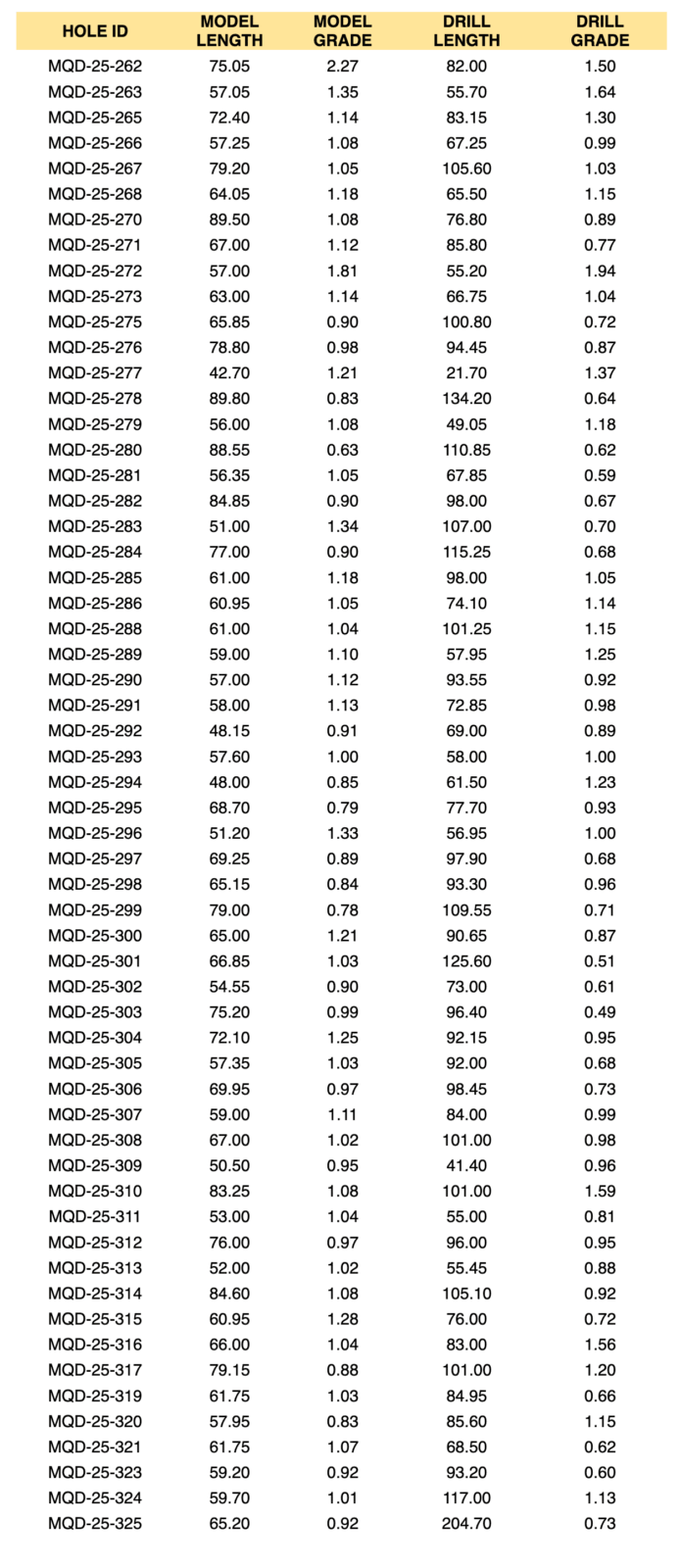
The results of the current grade control drill program are illustrated in the following figures and tables. Figure 1 shows the location map of the drill holes reported in this release. Figure 2 provides a cross-section through drill holes MQD-25-310, -312, -321, -324 and -325 representing the second easternmost section of the pattern. The results are summarized in Tables 1 to 3, which include significant intercepts (Table 1), drill hole locations (Table 2) and the reconciliation between actual drill intercepts and those predicted by the current resource model (Table 3).
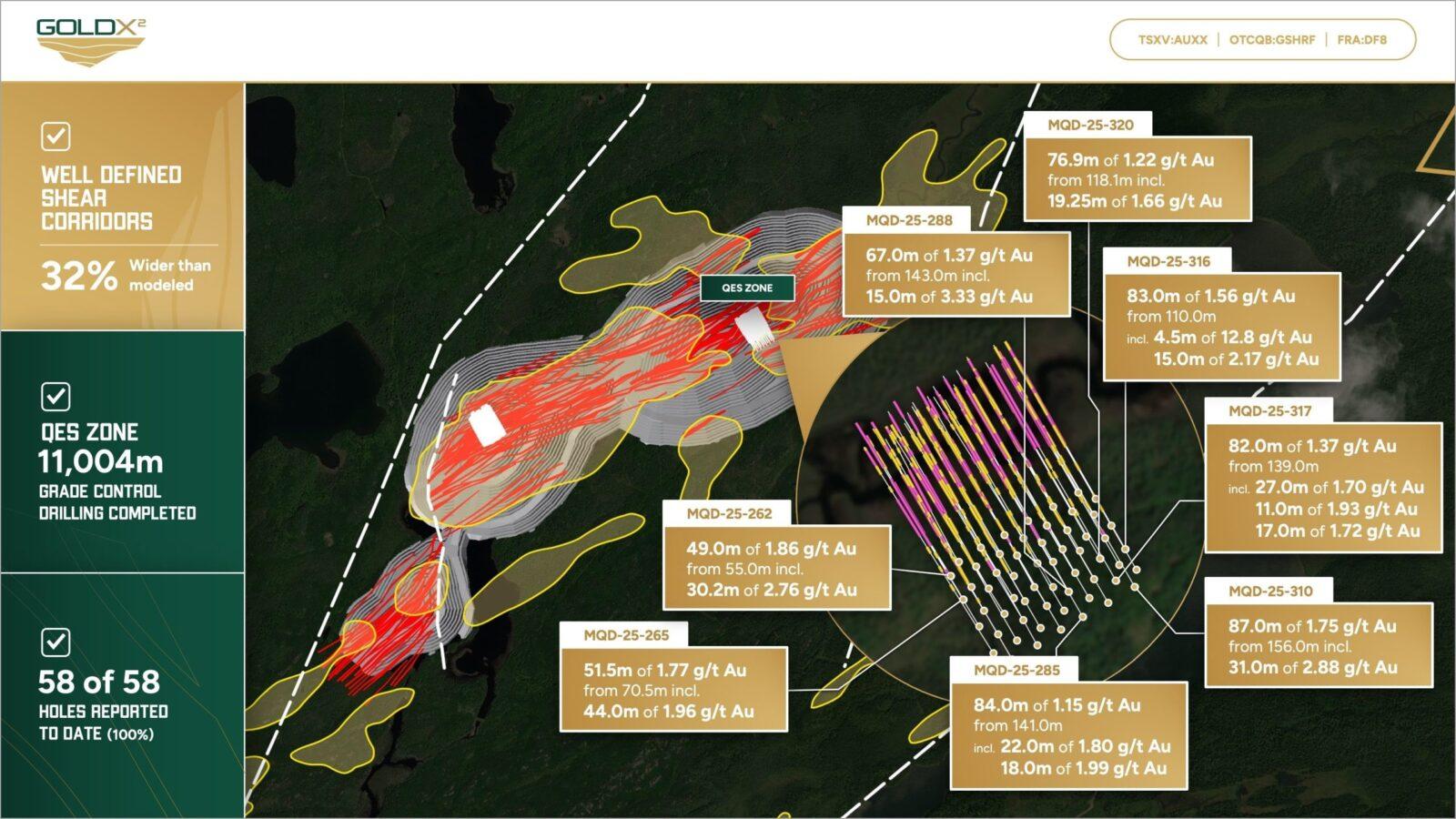
Figure 1: Illustrates the QES grade control drill program.
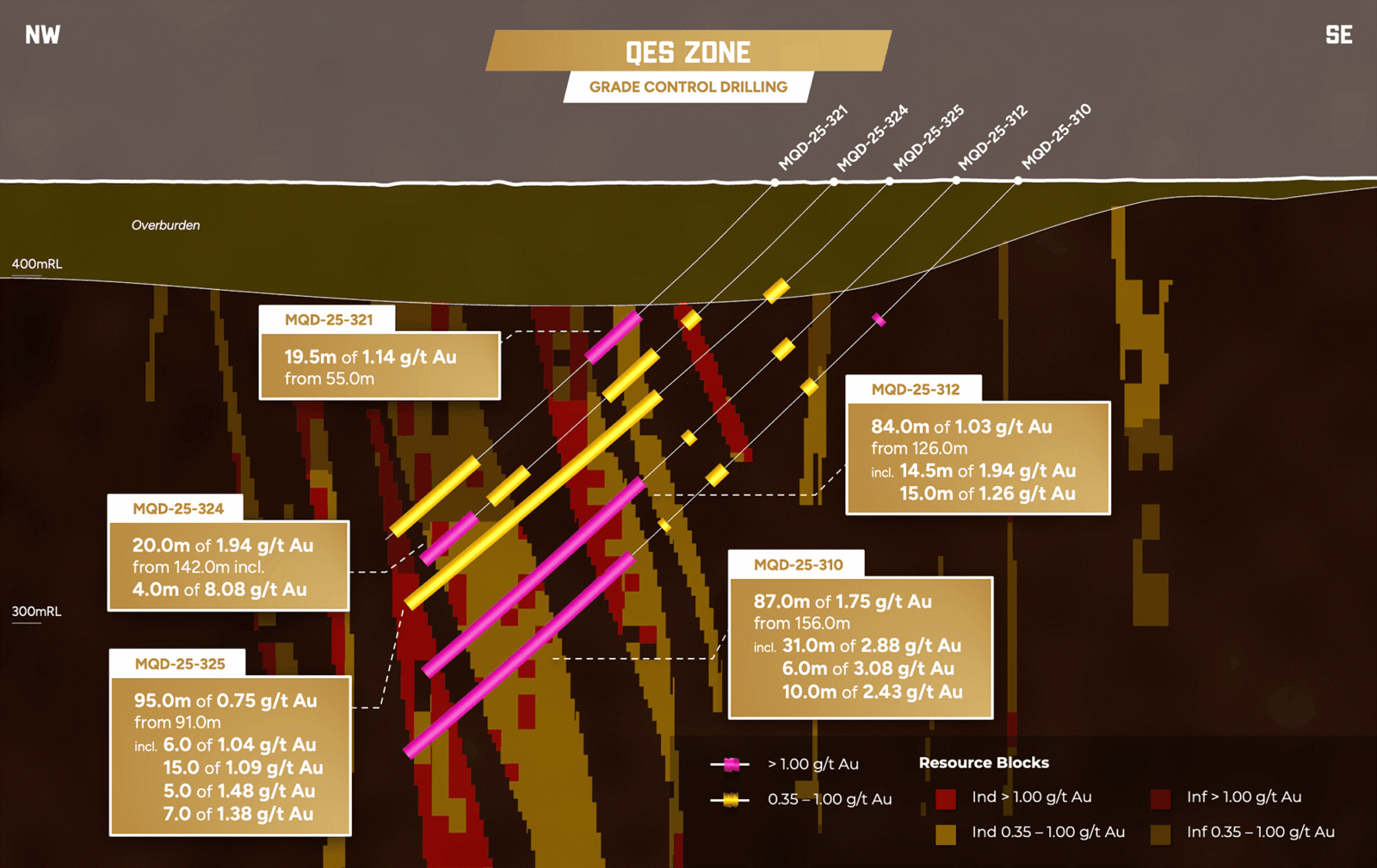
Figure 2: Shows a type section with reported intersections relative to the current resource block model
Gold X2 designed two grade control drilling programs that have been drilled on a 12.5-meter diamond-shaped pattern:
Both programs aim to investigate the short distance behaviour of gold mineralization, informing the determination of the optimal drill spacing to upgrade Inferred Mineral Resources to Indicated Mineral Resources in preparation for the upcoming Feasibility-level infill program. Additionally, the remaining half core will supply the required volume of sample for the upcoming Feasibility-level metallurgical studies. Finally, the tight spaced drilling provides mining-level precision that will derisk the Mineral Resource Estimate.
The results from the QES Zone pattern have outlined a more consistent shear system than currently modelled, similar to what was noted at the Main Zone pattern. The drilling identified two primary shear corridors with a ~10° variability in dip and strike resulting in the two corridors approaching each other towards the east and with depth. Better intercepts from the primary shears include 84.0m of 1.15 g/t Au from 141.0m in MQD-25-285, 87.0m of 1.75 g/t Au from 156.0m in MQD-25-310, 83.0m of 1.56 g/t Au from 110.0m in MQD-25-316, and 82.0m of 1.37 g/t Au from 139.0m in MQD-25-317.
Additional secondary shears, not modelled in the updated mineral resource, occur between the two primary corridors returning mineralized intervals including 13.0m of 0.66 g/t Au from 139.0m in MQD-25-268, 20.0m of 0.42 g/t Au from 125.0m in MQD-25-293, and 19.05m of 0.56 g/t Au from 123.95m in MQD-25-292.
The logging data aligns well with the existing understanding that the QES Zone is primarily hosted in a wide sheared quartz-eye granodiorite. All holes collared into 30-50m of overburden with some instances of shallower overburden than currently modelled. The southern holes first intersected the southern dacite volcanic package prior to intersecting the granodiorite complex. A 50-meter wide, weakly sheared and mineralized diorite is intersected between the volcanics and granodiorite.
The granodiorite is broadly sericite-hematite-silica altered with intensity increasing with stronger shearing and broad chlorite alteration seen in all units. In contrast to the Main Zone, which showed a negative correlation between epidote alteration and gold mineralization, the northern mineralized shear corridor has weak to moderate epidote alteration.
Assay results for the QES grade control pattern have been compared against expected intercepts from the current resource model (Table 3). The total combined intercept lengths from grade control drilling are 32% wider than is expected from the current resource model. The overall average grade is 13% lower, despite the results confirming the grades in the primary shears. This reflects discovery of additional lower-grade secondary shears that have not been well defined by drilling due to the exploration spacing of 50 meters and the reliance on historical assays in the area. This has an overall positive impact in that the additional low-grade secondary shears replace zones of poorly mineralized wall rock currently modelled as waste.
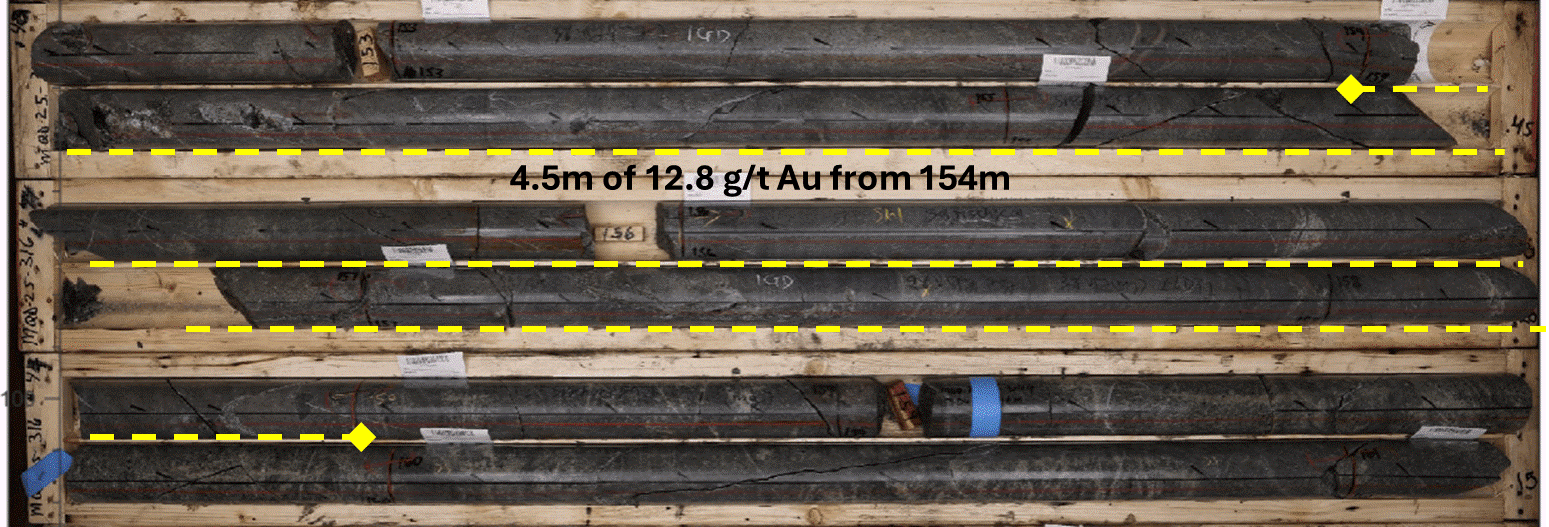
Figure 3: Hole MQD-25-316: Sheared, sericite-silica granodiorite yielding high grade intercepts of 4.5m of 12.8 g/t Au from 154.0m, as part of a greater intercept of 83.0m of 1.56 g/t Au from 110.0m.
Table 1: Significant intercepts

Table 2: Drill Collars
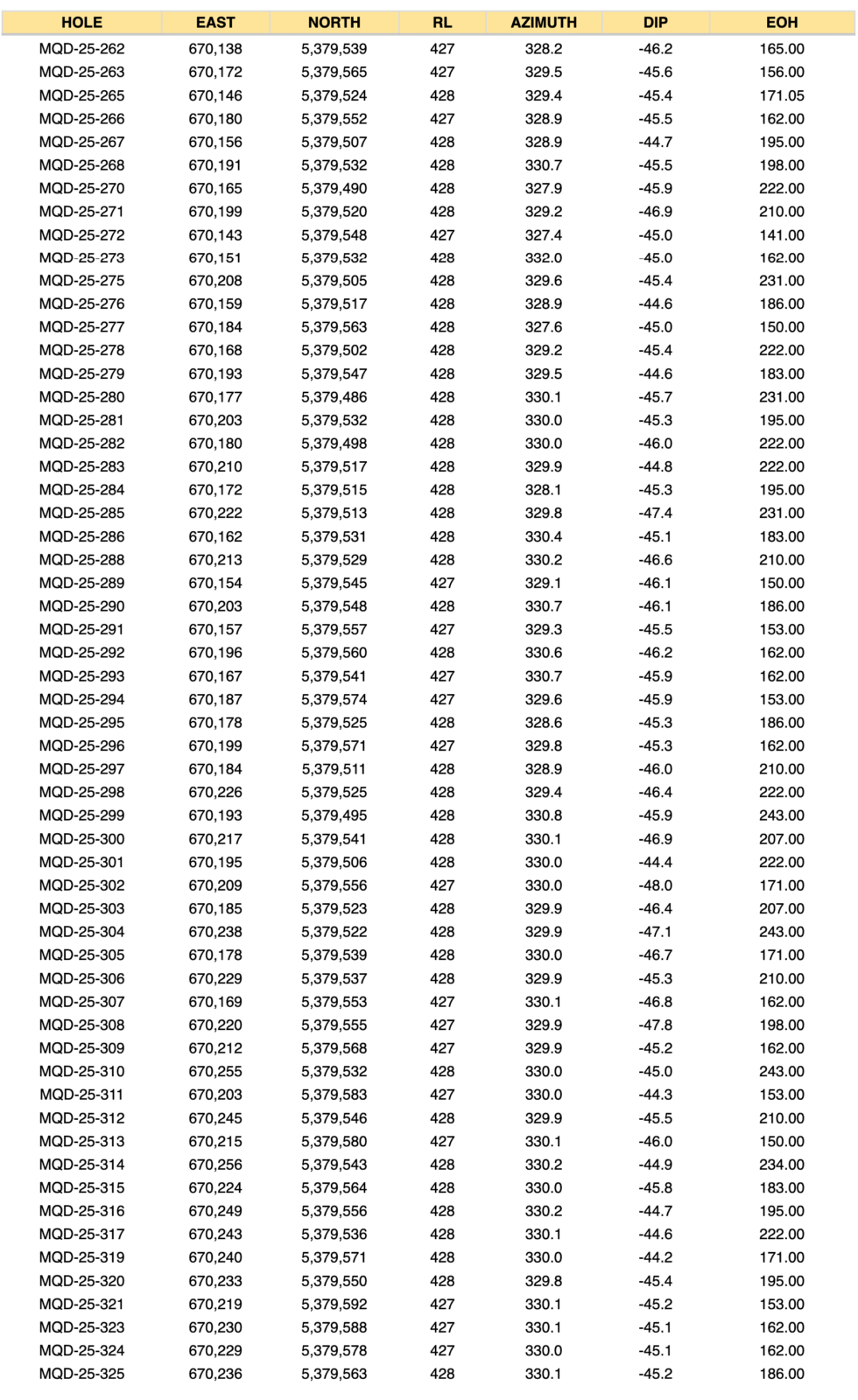
Table 3: Drill results versus expected results from the current resource model
The current Moss Gold Project Mineral Resource was announced on January 26, 2026. The details will be provided in a technical report, prepared in accordance with NI 43-101 standards, to be filed before March 12, 2026, under the Company’s SEDAR+ profile.
Analytical and QA/QC Procedures
The HQ diameter drill core has been oriented using ACTIII or equivalent tools and validated in the core shack. All core has been sawed in half cut just off the core orientation line (bottom of hole) with the right half (looking down hole) of the core bagged and sent a third-party analytical laboratory. The left half of the core was returned to core boxes and is stored at Gold X2’s Kashabowie core yard facility.
All samples were sent to ALS Geochemistry in Thunder Bay for preparation and analysis was performed in the ALS Vancouver analytical facility. ALS is accredited by the Standards Council of Canada (SCC) for the Accreditation of Mineral Analysis Testing Laboratories and CAN-P-4E ISO/IEC 17025. Samples were analysed for gold via fire assay with an AA finish (“Au-AA23”) and 48 pathfinder elements via ICP-MS after four-acid digestion (“ME-MS61”). Samples that assayed over 10 ppm Au were re-run via fire assay with a gravimetric finish (“Au-GRA21”).
In addition to ALS quality assurance / quality control protocols, Gold X2 has implemented a quality control program for all samples collected through the drilling program. The quality control program was designed by a qualified and independent third party, with a focus on the quality of analytical results for gold. Analytical results are received, imported to our secure on-line database and evaluated to meet our established guidelines to ensure that all sample batches pass industry best practice for analytical quality control. Certified reference materials are considered acceptable if values returned are within three standard deviations of the certified value reported by the manufacture of the material. In addition to the certified reference material, certified blank material is included in the sample stream to monitor contamination during sample preparation. Blank material results are assessed based on the returned gold result being less than ten times the quoted lower detection limit of the analytical method. The results of the on-going analytical quality control program are evaluated and reported to Gold X2 by Orix Geoscience Inc.
Qualified Person
Peter Flindell, PGeo, MAusIMM, MAIG, Vice-President, Exploration, of the Company, and a qualified person under National Instrument 43-101 – Standards of Disclosure for Mineral Projects, has approved the scientific and technical information contained in this news release.
Mr. Flindell has verified the data disclosed. To verify the information related to the winter drill program at the Moss Gold Project, Mr. Flindell has visited the property several times; discussed and reviewed logging, sampling, bulk density, core cutting and sample shipping processes with responsible site staff; discussed and reviewed assay and QA/QC results with responsible personnel; and reviewed supporting documentation, including drill hole location and orientation and significant assay interval calculations. He has also overseen the Company’s health and safety policies in the field to ensure full compliance, and consulted with the Project’s host indigenous communities on the planning and implementation of the drill program, particularly with respect to its impact on the environment and the Company’s remediation protocols.
About Gold X2 Mining
Gold X2 is a growth-oriented gold company focused on delivering long-term shareholder and stakeholder value through the acquisition and advancement of primary gold assets in tier-one jurisdictions. It is led by the ex-global head of structural geology for the world’s largest gold company and backed by one of Canada’s pre-eminent private equity firms. The Company’s current focus is the advanced stage 100% owned Moss Gold Project which is positioned in Ontario, Canada, with direct access from the Trans-Canada Highway, hydroelectric power near site, supportive local communities and skilled workforce. The Company has invested over $100 million of new capital and completed approximately 100,000 meters of drilling on the Moss Gold Project, which, in aggregate, has had over 300,000 meters of drilling. The 2026 updated NI 43-101 mineral resource estimate (“MRE”) for the Moss and East Coldstream Deposits has expanded to 2.458 million ounces of Indicated gold resources at 1.04 g/t Au, contained within 73.8 million tonnes and 4.209 million ounces of Inferred gold resources at 0.97 g/t Au contained within 134.7 million tonnes. The Moss Deposit also has a silver MRE of 3.160 million ounces of indicated silver resources at 1.53 g/t Ag contained within 64.3 Mt and 6.273 million ounces of inferred silver resources at 1.55 g/t Ag contained within 125.9 Mt. Results of a preliminary economic assessment of the Moss Gold Project suggest the potential for the deposit to support a long-life mining operation with a strong production profile and low production costs. The MRE and PEA are supported by a NI 43-101 technical report for the Moss Gold Project which will be filed on SEDAR+ (www.sedarplus.ca) and the Company’s website by March 12, 2026. For more information, please visit SEDAR+ (www.sedarplus.ca) and the Company’s website (www.goldx2.com).
Hudbay Minerals Inc. (TSX:HBM) (NYSE: HBM) today released its ann... READ MORE
Strategic acquisition of an established operating gold mine, loca... READ MORE
Cerro de Pasco Resources Inc. (TSX-V: CDPR) (OTCQB: GPPRF) (FRA: ... READ MORE
The Garneau Titanium Project Features Ilmenite-Rich Boulder with ... READ MORE
ValOre Metals Corp. (TSX‐V: VO) (OTCQB: KVLQF) (Frankfurt: KEQ0... READ MORE