








First Atlantic Nickel & Cobalt Corp. (TSX-V: FAN) (OTCQB: FANCF) (FSE: P210) is pleased to announce assay and Davis Tube Recovery metallurgical results from the first three drill holes at the Alloy Max North discovery at the Company’s wholly owned Pipestone XL Nickel-Cobalt (Ni-Fe-Co) Alloy Project in central Newfoundland. All three holes, XL-26-15, XL-26-16 and XL-26-17, returned magnetically recoverable awaruite (Ni-Fe-Co alloy) over drilled intervals of 405 to 504 meters, starting 9 to 21 meters from surface, and together confirm mineralization over approximately 1.3 kilometers of strike. The results establish Alloy Max North as the Company’s second large-scale zone of magnetically recoverable nickel, located up to approximately 7 kilometers north of the RPM Zone discovery, within the 30-kilometer Pipestone XL trend.
XL-26-17 returned the highest grades of the three holes: 0.11% DTR nickel over 306 meters, including 0.12% over 249 meters and 0.14% over 147 meters, within a 436.7-meter interval. The hole was drilled on the eastern side of Alloy Max North, toward the eastern contact of the ultramafic body. XL-26-16, the deepest hole drilled to date at Pipestone XL, returned 0.11% DTR nickel over its final 147 meters within a 504-meter interval, with grades strengthening toward the bottom of the hole. It also produced the highest magnetic concentrate grade reported over an interval at the Pipestone XL project to date: 2.18% nickel over 69 meters. XL-26-15, the first drill hole drilled in the Alloy Max North area, confirmed magnetically recoverable awaruite over its entire 405-meter interval. All three holes were drilled from west to east across the system, which the Company interprets to dip to the west at 60 to 70 degrees. DTR nickel grades strengthen to the east, toward the contact.
The Alloy Max South discovery hole, XL-26-18, intersected abundant, large-grain, visibly disseminated awaruite (see news release dated October 13, 2026). The hole was halted at approximately 40 meters, still in visible mineralization, when the drill was unable to advance through intensely faulted ground. Drill hole XL-26-19 has been designed to test below XL-26-18, collared to the west and drilled eastward, to pass beneath the fault zone and test the mineralization below where XL-26-18 stopped.
Drilling continues alongside development of the exploration access road, which has progressed past the Super Gulp Zone and is advancing into approximately 16 kilometers of undrilled ground between the Super Gulp Zone and the Atlantic Lake Zone. Trenching and bedrock sampling are being carried out along the route. The Company expects to provide further updates in the near future as it plans for larger-scale drill operations, supported by approximately $13.4 million raised since September 2026 without warrants.
KEY HIGHLIGHTS
FIRST THREE DISCOVERY HOLES AT ALLOY MAX NORTH ESTABLISH SECOND LARGE-SCALE ZONE OF MAGNETICALLY RECOVERABLE NICKEL OVER 1.3 KILOMETERS OF STRIKE
The Alloy Max target area extends approximately 4 kilometers in length and is up to 1.5 kilometers wide, and reaches up to approximately 7 kilometers north of the RPM Zone discovery. The results reported today confirm magnetically recoverable nickel over approximately 1.3 kilometers of strike at Alloy Max North, between XL-26-16 and XL-26-17. Including the Alloy Max South discovery hole, XL-26-18, drilling across the Alloy Max Zone now spans approximately 2.4 kilometers of strike and more than 1 kilometer of width. The three holes were drilled to the east at a dip of -60 degrees to cut across a system that the Company interprets to dip to the west at 60 to 70 degrees.
Across the three holes, the full reported intervals of 405 to 504 meters averaged 0.22% to 0.24% total nickel and 0.07% to 0.09% DTR nickel. Total nickel grades are consistent with those at the RPM Zone. Magnetic concentrate grades over the same intervals averaged 0.98% to 1.49% nickel, 1.81% to 2.09% chromium and 0.05% to 0.07% cobalt.
Together, the three holes indicate large-scale, consistent awaruite mineralization at Alloy Max North. Each hole returned magnetically recoverable nickel over significant intervals from the top of bedrock throughout the hole, with few dilutive rock units. DTR nickel grades strengthen to the east, toward the eastern contact of the ultramafic body: XL-26-17, the easternmost hole, returned the highest grades of the three holes, and the higher-grade intervals in XL-26-16 occur in the deeper, more easterly part of the hole.
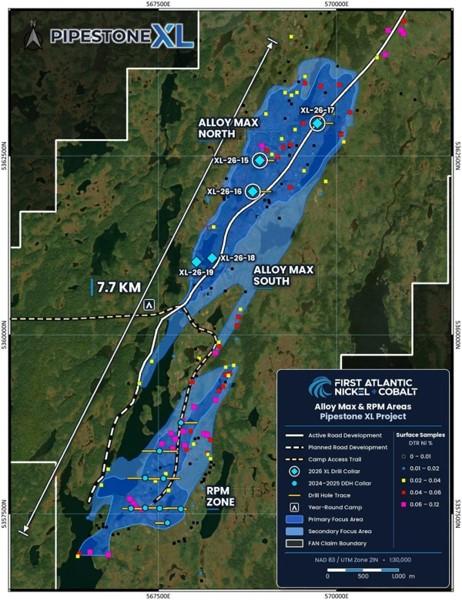
Figure 1: Map of the Alloy Max North, Alloy Max South and the RPM Zones, showing the 2026 drill collars (XL-26-15 to XL-26-19), the 2024–2025 RPM Zone drill holes, surface DTR nickel samples, active and planned exploration access road; and the year-round camp (NAD83, UTM Zone 21N).
XL-26-17, the northernmost and easternmost hole at Alloy Max North, returned 0.11% DTR nickel over 306 meters, from 126 to 432 meters. This includes 0.12% DTR Nickel over 249 meters from 147 to 396 meters, and 0.14% DTR Nickel over 147 meters, from 204 to 351 meters. Over the 147-meter interval, the magnetic concentrate graded 1.76% nickel, with total nickel recovery of 59.83%.
Over its full reported interval of 436.7-meters, from 13.3 to 450 meters, XL-26-17 averaged 0.09% DTR nickel, 0.24% total nickel and 1.12% nickel in magnetic concentrate. The hole defined the eastern edge of mineralization on its drill section.
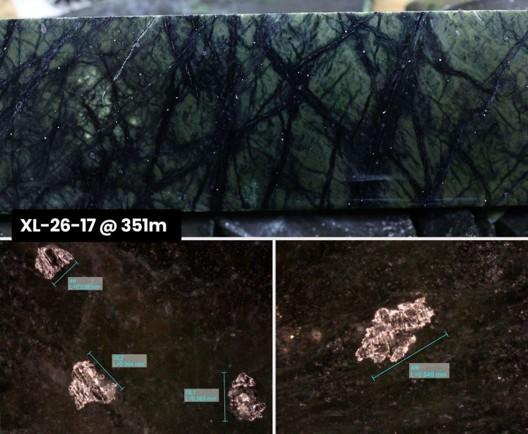
Figure 2: Visible awaruite grains in drill core from hole XL-26-17 at 351 meters downhole, measuring up to 549 microns, Alloy Max North, Pipestone XL Project.
Table 01: Pipestone XL Nickel-Cobalt Alloy Project – Summary of Assay Results and DTR Metallurgical Test Results for Drill Hole XL-26-17 (Alloy Max North Zone)
| Hole ID | From (m) | To (m) | Interval (m) | Total Ni (%) | Mag Con Ni (%) | Mass Pull (%) | Ni Recovery (%) | DTR Ni (%) | Mag Con Cr (%) | Total Cr (%) | DTR Cr (%) | Mag Con Co (%) | ||||||||||||||
| XL-26-17 | 13.3 | 450 | 436.7 | 0.24 | 1.12 | 7.65 | 35.34 | 0.09 | 1.98 | 0.32 | 0.15 | 0.05 | ||||||||||||||
| including | 126 | 432 | 306 | 0.24 | 1.36 | 7.99 | 44.53 | 0. | .95 | 0.33 | 0.15 | 0.05 | ||||||||||||||
| including | 147 | 396 | 249 | 0.23 | 1.50 | 7.85 | 49.13 | 0.12 | 1.93 | 0.32 | 0.15 | 0.05 | ||||||||||||||
| including | 204 | 351 | 147 | 0.23 | 1.76 | 7.84 | 59.83 | 0.14 | 1.95 | 0.32 | 0.15 | 0.05 | ||||||||||||||
| including | 249 | 336 | 87 | 0.22 | 1.87 | 7.89 | 65. | .15 | 1.79 | 0.29 | 0.14 | 0.05 | ||||||||||||||
| including “Up To” | 0.28 | 2.61 | 86.80 | 0.17 | 6.18 | 1.30 | 0.54 | 0.08 |
DTR nickel (%) is calculated by multiplying mass pull (%) by the nickel grade (%) of the magnetic concentrate. This value represents the proportion of nickel that may be recoverable through magnetic separation and is not equivalent to a standard assay result.
Column abbreviations: Mag Con = grade of the magnetic concentrate; Total = total grade by assay; DTR = Davis Tube Recovery (magnetically recovered) grade; Ni = nickel; Cr = chromium; Co = cobalt.
XL-26-16 was drilled to 525 meters, the deepest hole to date at Pipestone XL, and averaged 0.08% DTR nickel, 0.23% total nickel and 1.49% nickel in magnetic concentrate over 504 meters. Its final 147 meters, from 378 to 525 meters, returned 0.11% DTR nickel, including 0.12% DTR nickel and 2.10% nickel in magnetic concentrate over the final 87 meters, from 438 to 525 meters. A 69-meter interval from 180 to 249 meters returned 0.12% DTR nickel and 2.18% nickel in magnetic concentrate, the highest-grade concentrate reported over an interval to date at the Pipestone XL project. Mineralization remains open at depth.
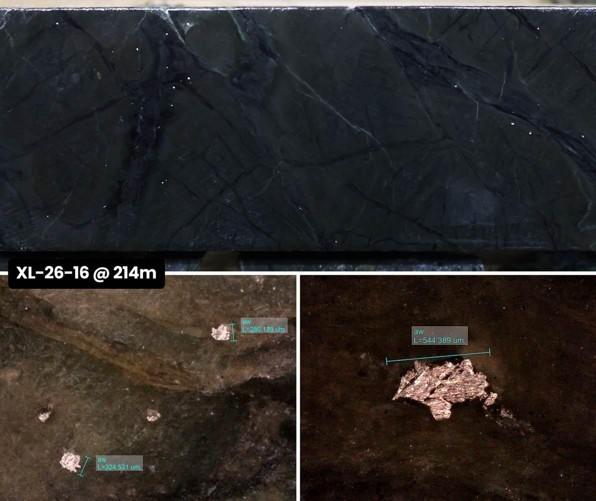
Figure 3: Visible awaruite grains in drill core from hole XL-26-16 at 214 meters downhole, measuring up to 544 microns, at the Alloy Max Zone, Alloy Max North, Pipestone XL Project.
Table 02: Pipestone XL Nickel-Cobalt Alloy Project – Summary of Assay Results and DTR Metallurgical Test Results for Drill Hole XL-26-16 (Alloy Max North Zone)
| Hole ID | From (m) | To (m) | Interval (m) | Total Ni (%) | Mag Con Ni (%) | Mass Pull (%) | Ni Recovery (%) | DTR Ni (%) | Mag Con Cr (%) | Total Cr (%) | DTR Cr (%) | Mag Con Co (%) | ||||||||||||||
| XL-26-16 | 21 | 525 | 504 | 0.23 | 1. | .71 | 35.37 | 0.08 | 2.09 | 0.31 | 0.11 | 0.07 | ||||||||||||||
| including | 180 | 249 | 69 | 0.23 | 2.18 | 5.66 | 50.78 | 0.12 | 1.82 | 0.29 | 0.10 | 0.09 | ||||||||||||||
| including | 378 | 525 | 147 | 0.23 | 1.93 | 5.53 | 45.82 | 0.11 | 2.03 | 0.29 | 0.11 | 0.08 | ||||||||||||||
| including | 438 | 525 | 87 | 0.23 | 2.10 | 5.59 | 49.94 | 0.12 | 1.86 | 0.29 | 0.10 | 0.09 | ||||||||||||||
| including | 468 | 525 | 57 | 0.23 | 2.09 | 6.07 | 54.17 | 0.13 | 1.73 | 0.28 | 0.11 | 0.08 | ||||||||||||||
| including “Up To” | 0. | .30 | 85.43 | 0.18 | 6.07 | 0.87 | 0.29 | 0.13 |
DTR nickel (%) is calculated by multiplying mass pull (%) by the nickel grade (%) of the magnetic concentrate. This value represents the proportion of nickel that may be recoverable through magnetic separation and is not equivalent to a standard assay result.
Column abbreviations: Mag Con = grade of the magnetic concentrate; Total = total grade by assay; DTR = Davis Tube Recovery (magnetically recovered) grade; Ni = nickel; Cr = chromium; Co = cobalt.
XL-26-15, the first drill hole in the Alloy Max North area, averaged 0.07% DTR nickel, 0.22% total nickel and 0.98% nickel in magnetic concentrate over 405 meters, from 9 to 414 meters, with consistent grades throughout the hole.
Table 03: Pipestone XL Nickel-Cobalt Alloy Project – Summary of Assay Results and DTR Metallurgical Test Results for Drill Hole XL-26-15 (Alloy Max North Zone)
| Hole ID | From (m) | To (m) | Interval (m) | Total Ni (%) | Mag Con Ni (%) | Mass Pull (%) | Ni Recovery (%) | DTR Ni (%) | Mag Con Cr (%) | Total Cr (%) | DTR Cr (%) | Mag Con Co (%) | ||||||||||||||
| XL-26-15 | 9 | 414 | 405 | 0.22 | 0.98 | 7.79 | 34.24 | 0.07 | 1.81 | 0.48 | 0.14 | 0.07 | ||||||||||||||
| including | 132 | 228 | 96 | 0.22 | 1.04 | 8.63 | 38.16 | 0.09 | 1.65 | 0.37 | 0.14 | 0.06 | ||||||||||||||
| including | 135 | 162 | 27 | 0.23 | 1.38 | 6.94 | 41.99 | 0.10 | 2.06 | 0.36 | 0.14 | 0.08 | ||||||||||||||
| including | 234 | 276 | 42 | 0.23 | 1.04 | 8.27 | 37.19 | 0.09 | 2.22 | 0.50 | 0.18 | 0.07 | ||||||||||||||
| including “Up To” | 0.26 | 1.56 | 52.50 | 0.11 | 7. | .08 | 0.73 | 0.10 |
DTR nickel (%) is calculated by multiplying mass pull (%) by the nickel grade (%) of the magnetic concentrate. This value represents the proportion of nickel that may be recoverable through magnetic separation and is not equivalent to a standard assay result.
Column abbreviations: Mag Con = grade of the magnetic concentrate; Total = total grade by assay; DTR = Davis Tube Recovery (magnetically recovered) grade; Ni = nickel; Cr = chromium; Co = cobalt.
Table 04: Drill Hole Collar Location Information for XL-26-15 through XL-26-17
| Hole ID | Easting (UTM) | Northing (UTM) | Elevation (m) | Azimuth (°) | Dip (°) |
| XL-26-15 | 568922 | 5362437 | 270 | 90 | -60 |
| XL-26-16 | 568825 | 5362003 | 262 | 90 | -60 |
| XL-26-17 | 569734 | 5362952 | 273 | 90 | -60 |
PIPESTONE XL DRILL RESULTS TABLES
Table 05: Pipestone XL Nickel-Cobalt Alloy Project – Complete Intervals for All Drill Holes Reported to Date
| Drill Hole | Zone | Section | From (m) | To (m) | Interval (m) | Total Ni (%) | Mag Con Ni (%) | Mass Pull (%) | Ni Recovery (%) | DTR Ni (%) | Comment | ||||||||||||||
| RPM Zone: | |||||||||||||||||||||||||
| AN-24-02 | RPM | S1 | 11.0 | 394.1 | 383.1 | 0.24 | 1.37 | 9.49 | 52.40 | 0.13 | NR – Mar 13, 2025 | ||||||||||||||
| including | 261.0 | 318.0 | 57.0 | 0.25 | 1.46 | 10.0 | 56.10 | 0.14 | |||||||||||||||||
| AN-24-03 | RPM | S1 | 18.0 | 234.0 | 216.0 | 0.25 | 1.32 | 9.12 | 44.44 | 0.11 | NR – Apr 15, 2025 | ||||||||||||||
| AN-24-04 | RPM | S1 | 12.0 | 378.0 | 366.0 | 0.23 | 1.46 | 9.53 | 59.09 | 0.14 | NR – Jun 24, 2025 | ||||||||||||||
| including | 183.0 | 255.0 | 72.0 | 0.24 | 1.50 | 9.92 | 62.83 | 0.15 | |||||||||||||||||
| AN-24-05 | RPM | S2 | 6.0 | 357.0 | 351.0 | 0.24 | 1.47 | 8.21 | 50.26 | 0.12 | NR – Jul 9, 2025 | ||||||||||||||
| including | 207.0 | 309.0 | 102.0 | 0.24 | 1.76 | 7.82 | 56.95 | 0.14 | |||||||||||||||||
| AN-25-06 | RPM | S2 | 5.65 | 453 | 447.35 | 0.22 | 1. | .02 | 51.84 | 0.11 | NR – Aug 13, 2025 | ||||||||||||||
| including | 138 | 249 | 111 | 0.22 | 1.42 | 9.17 | 57.59 | 0.13 | |||||||||||||||||
| AN-25-07 | RPM | S2 | 9 | 495 | 486.0 | 0.23 | 0.97 | 9.60 | 40.49 | 0.09 | NR – Oct 23, 2025 | ||||||||||||||
| including | 39 | 171 | 132 | 0.23 | 1.06 | 10.23 | 46.23 | 0.11 | |||||||||||||||||
| AN-25-08 | RPM | S3 | 11 | 491 | 480.0 | 0.22 | 1.35 | 8.79 | 51.94 | 0.12 | NR – Oct 23, 2025 | ||||||||||||||
| including | 158 | 362 | 204 | 0.22 | 1.57 | 8.08 | 58.60 | 0.13 | |||||||||||||||||
| AN-25-09 | RPM | S3 | 9 | 483 | 474.0 | 0.23 | 0.93 | 9.00 | 36.07 | 0.08 | NR – Dec 2, 2025 | ||||||||||||||
| including | 42 | 417 | 375 | 0.23 | 0.95 | 9.03 | 37.16 | 0.09 | |||||||||||||||||
| AN-25-10 | RPM | S1 | 8 | 236 | 228 | 0.22 | 1.44 | 10.48 | 68.62 | 0.15 | NR – Dec 2, 2025 | ||||||||||||||
| including | 8 | 59 | 51 | 0.21 | 1.76 | 9.47 | 79.80 | 0.17 | |||||||||||||||||
| AN-25-11 | RPM | S1 | 23 | 425 | 402 | 0.22 | 1.31 | 10.01 | 57.99 | 0.13 | NR – Jan 27, 2026 | ||||||||||||||
| AN-25-12 | RPM | S1 | 10.4 | 95 | 84.6 | 0.26 | 1.24 | 8.27 | 38.10 | 0.10 | NR – Jan 27, 2026 | ||||||||||||||
| AN-25-13 | RPM | S4 | 17 | 388 | 371 | 0.24 | 1.11 | 9.10 | 41.23 | 0.10 | NR – Jan 27, 2026 | ||||||||||||||
| including | 44 | 323 | 279 | 0.24 | 1.17 | 9.12 | 43.81 | 0.11 | |||||||||||||||||
| AN-25-14 | RPM | S0 | 8 | 335 | 327 | 0.23 | 0.54 | 8.71 | 19.27 | 0.05 | NR – Jan 27, 2026 | ||||||||||||||
| including | 29 | 116 | 87 | 0.24 | 0.73 | 9.04 | 27.07 | 0.07 | |||||||||||||||||
| Alloy Max North: | |||||||||||||||||||||||||
| XL-26-15 | Alloy Max North | 9 | 414 | 405 | 0.22 | 0.98 | 7.79 | 34.24 | 0.07 | This release | |||||||||||||||
| including | 132 | 228 | 96 | 0.22 | 1.04 | 8.63 | 38.16 | 0.09 | |||||||||||||||||
| XL-26-16 | Alloy Max North | 21 | 525 | 504 | 0.23 | 1.49 | 5.71 | 35.37 | 0.08 | This release | |||||||||||||||
| including | 468 | 525 | 57 | 0.23 | 2.09 | 6.07 | 54.17 | 0.13 | |||||||||||||||||
| XL-26-17 | Alloy Max North | 13.3 | 450 | 436.7 | 0.24 | 1.12 | 7.65 | 35.34 | 0.09 | This release | |||||||||||||||
| including | 204 | 351 | 147 | 0.23 | 1.76 | 7.84 | 59.83 | 0.14 | |||||||||||||||||
| Super Gulp Zone: | |||||||||||||||||||||||||
| AN-24-01 | Super Gulp | 3.23 | 297 | 293.8 | 0.25 | 0.89 | 6.9 | 24.6 | 0.06 | NR – Mar 13, 2025 | |||||||||||||||
| including | 51 | 120 | 69 | 0.26 | 0.99 | 6.7 | 25.4 | 0.07 | |||||||||||||||||
DTR nickel (%) is calculated by multiplying mass pull (%) by the nickel grade (%) of the magnetic concentrate. This value represents the proportion of nickel that may be recoverable through magnetic separation and is not equivalent to a standard assay result.
Column abbreviations: Mag Con = grade of the magnetic concentrate; DTR = Davis Tube Recovery (magnetically recovered) grade; Total Ni = whole-rock nickel grade; Ni Recovery = DTR Ni / Total Ni; Ni = nickel.
REFINING DRILL TARGETS WITH MAGNETIC INTENSITY AND DAVIS TUBE RESULTS
XL-26-17 targeted an area of lower magnetic intensity and returned the highest DTR nickel grades of the three holes. XL-26-15 tested the strongest magnetic response and returned the lowest. In XL-26-16, DTR nickel grades improved where the magnetic signature changed downhole.
The Company is comparing magnetic intensity, serpentinization and geological controls in drill core from Alloy Max and the RPM Zone with DTR results. The results point to areas of intermediate magnetic intensity as additional targets in both zones and will inform project-scale 3D modelling and drill targeting. Future systematic drilling within these zones is designed to identify higher grade areas within broad zones of consistent mineralization.
EXPLORATION ACCESS ROAD, 16 KILOMETERS OF UNDRILLED GROUND AND NEXT STEPS
Drilling continues alongside development of the exploration access road, which is advancing north of the Super Gulp Zone into approximately 16 kilometers of undrilled ground between the Super Gulp Zone and the Atlantic Lake Zone. Along the road route, thin overburden allows the Company to dig shallow trenches that expose bedrock. The bedrock is sampled directly and examined for visibly disseminated awaruite, and the results are used for geological mapping and to build an inventory of priority drill targets. At Alloy Max South, XL-26-19 has been designed to drill below the discovery hole, XL-26-18, and pass beneath the fault zone where XL-26-18 ended in mineralization.
The Company intends to use the proceeds of three flow-through financings completed since September 2026, which raised a total of approximately $13.4 with no warrants issued, to fund the remainder of its 2026 and 2027 exploration programs. The most recent financing was priced at $0.83 per flow-through share.2 The Company’s objective is to develop Pipestone XL as a multi-pit nickel-cobalt mining district, with the RPM Zone as its most advanced zone and Alloy Max Zone, and potentially the Super Gulp, as sources of additional tonnage.
PIPESTONE XL: FIVE AWARUITE ZONES ON A 30-KILOMETER TREND AND A SMELTER-FREE ROUTE TO DOWNSTREAM PROCESSING IN NORTH AMERICA
Pipestone XL is First Atlantic’s wholly owned project covering the entire 30-kilometer Pipestone Ophiolite Complex in central Newfoundland. Five zones of awaruite mineralization have been identified along the trend: RPM, Alloy Max, Super Gulp, Atlantic Lake and Chrome Pond. RPM is the most advanced, with drilling outlining magnetically recoverable awaruite over more than 1.2 kilometers of strike and more than 800 meters of width. The Alloy Max target area is approximately 4 kilometers long and up to 1.5 kilometers wide, and every hole assayed there has returned magnetically recoverable nickel.
Awaruite (Ni₃Fe) is a naturally occurring, magnetic nickel-iron-cobalt alloy that contains no sulphur. Electron microprobe analysis of awaruite from the RPM Zone averaged 77.62% nickel and 1.69% cobalt.3 Because the nickel is already in metallic form, it can be concentrated by magnetic separation and flotation without smelting, roasting or high-pressure acid leaching. In initial test work using the Company’s ONSHORE MAX™ (Magnetic Alloy eXtraction) process, magnetic separation produced a concentrate grading approximately 1.6% nickel, which flotation upgraded to an alloy concentrate averaging 67.4% nickel and grading up to 71.9% nickel and 1.76% cobalt.4 A typical nickel concentrate grades 10% to 15% nickel, according to the Nickel Institute.5
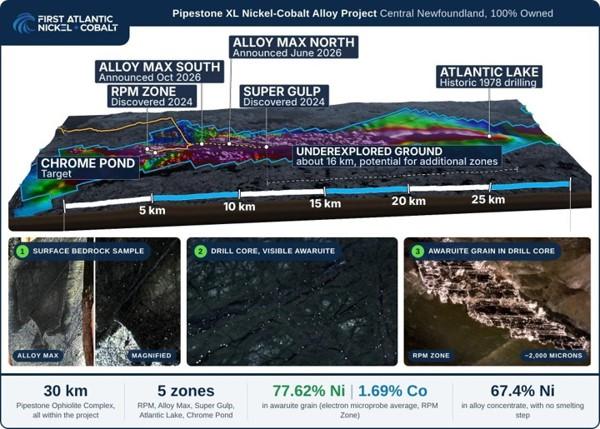
Figure 4: The Pipestone XL Nickel-Cobalt (Ni-Fe-Co) Alloy Project. Top: three-dimensional view of the 30-kilometer Pipestone XL trend with the Company’s magnetic survey draped on the terrain, showing the RPM, Alloy Max, Super Gulp, Atlantic Lake and Chrome Pond Zones. Bottom, left to right: bedrock sample collected beneath shallow overburden at an Alloy Max drill pad location and shown in two views, containing visible disseminated awaruite (news release dated April 8, 2026); drill core with visible awaruite from hole XL-26-18 at 32 meters downhole, Alloy Max South (news release dated October 13, 2026); and photomicrograph of an awaruite grain of up to approximately 2,000 microns in drill core from hole AN-25-08 at 370 meters, RPM Zone (news release dated September 25, 2025). The awaruite grades of 77.62% nickel and 1.69% cobalt is the electron microprobe average from the RPM Zone (news release dated May 21, 2026), and the 67.4% nickel alloy concentrate grade is the average of four flotation tests (news release dated June 24, 2026).
The United States has no operating nickel smelter after its last one, at Riddle, Oregon, closed in 1998.6 Canada has two remaining pyrometallurgical nickel smelters, both in Sudbury, Ontario.7 The last nickel smelter built in North America, at Thompson, Manitoba, opened 65 years ago in 19618 and was shut in 2018 after Vale said it would need to spend about $1 billion to meet new federal sulphur dioxide emission rules.9
A magnetic nickel-cobalt (Ni-Fe-Co) alloy concentrate from the Pipestone XL Project has the potential to be a large-scale source of nickel and cobalt for North America. Because the concentrate does not need a smelter, it can bypass the midstream smelting bottleneck and move directly from the mine to battery chemical refining or to stainless steel and specialty alloy production, keeping the supply chain onshore. Pipestone XL has year-round road access, nearby high-voltage transmission and hydroelectric power from the Bay d’Espoir generating station, and is approximately 200 kilometers from Vale’s Long Harbour nickel processing plant and Gander International Airport. The Company is also evaluating chromium as a potential co-product and low-carbon Engineered Mineral Hydrogen with VEMA Hydrogen.
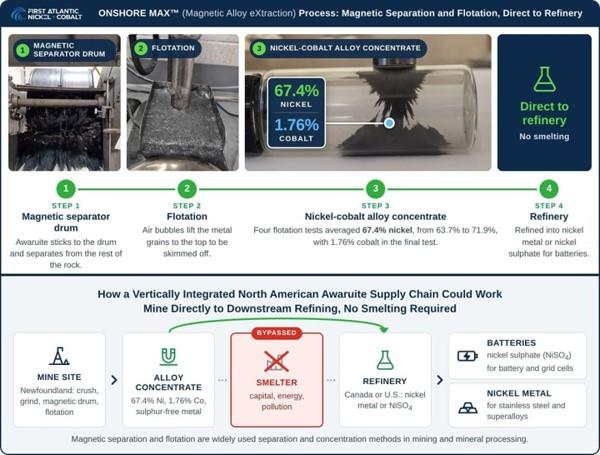
Figure 5: The ONSHORE MAX™ (Magnetic Alloy eXtraction) process. Top, left to right, from bench-scale test work at SGS Canada Inc. on RPM Zone material: laboratory drum separator collecting magnetic concentrate by low-intensity magnetic separation, which produced a magnetic concentrate grading approximately 1.6% nickel; bench-scale flotation cell at the rougher flotation stage; and a sample of the awaruite alloy concentrate under a magnet (news release dated June 24, 2026). Four flotation tests averaged 67.4% nickel, ranging from 63.7% to 71.9% nickel, with 1.76% cobalt in the final test (news release dated June 24, 2026). Bottom: conceptual diagram of a mine-to-refinery supply chain for awaruite alloy concentrate with no smelting step.
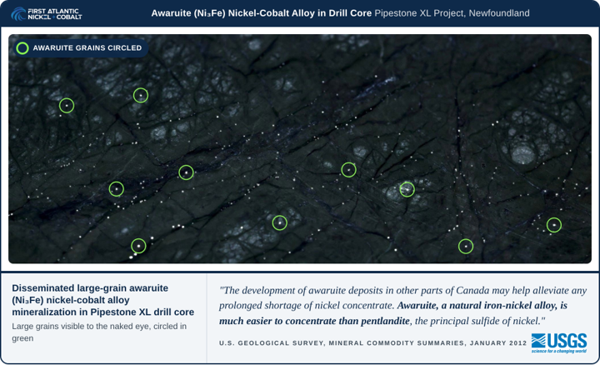
Figure 6: Drill core from hole XL-26-18 at 32 meters downhole, Alloy Max South, Pipestone XL Project, showing visibly disseminated awaruite (Ni₃Fe) nickel-cobalt alloy grains, circled in green (news release dated October 13, 2026), with a statement on awaruite from the U.S. Geological Survey’s Mineral Commodity Summaries, January 2012.10
NORTH ARM PROJECT
The Company also announces that it has closed the acquisition (the “Transaction”) of a 100% interest in three mineral licences. The licences comprise 209 mineral claims covering approximately 52.25 square kilometers in the Province of Newfoundland and Labrador. The Transaction was completed under an asset purchase agreement dated October 30, 2026 (the “Agreement”) with two arm’s-length parties.
Under the Agreement, the Company acquired the North Arm Project in exchange for the issuance of 1,000,000 common shares of the Company, issued at a deemed price of $0.55 per share. The Payment Shares are subject to a statutory hold period of four months and one day from the date of issuance, expiring March 11, 2027.
At closing, the Company also paid $51,250 to reimburse refundable security deposits that the Vendors had previously posted with the Government of Newfoundland and Labrador for the Property. From closing, the Vendors have assigned to the Company all rights to any future refund of those deposits.
The Property is not subject to any royalties or options. The Transaction closed after receiving final acceptance from the TSX Venture Exchange. No finder’s fees were paid in connection with the Transaction.
ABOUT FIRST ATLANTIC NICKEL & COBALT CORP.
First Atlantic Nickel & Cobalt Corp. (TSXV: FAN | OTCQB: FANCF | FSE: P210) is a critical mineral exploration company in Newfoundland and Labrador. Its wholly owned Pipestone XL Nickel-Cobalt Alloy Project covers the 30-kilometer Pipestone Ophiolite Complex, where the Company is drilling and testing awaruite, a magnetic, sulphur-free nickel-iron-cobalt alloy that can be concentrated without a smelter. Newfoundland and Labrador has ranked among the top 10 jurisdictions worldwide for investment attractiveness or mining policy in every Fraser Institute Annual Survey of Mining Companies since 2022.11 First Atlantic also holds the Ophiolite-X Project and the North Arm Project in western Newfoundland. The Company is a member of the U.S. Defense Industrial Base Consortium.
QUALIFIED PERSON
Adrian Smith, P.Geo., a director and the Chief Executive Officer of the Company, is a qualified person as defined by NI 43-101. The qualified person is a member in good standing of the Professional Engineers and Geoscientists Newfoundland and Labrador (PEGNL) and is a registered professional geoscientist (P.Geo.). Mr. Smith has reviewed and approved the technical information disclosed herein.
Magna Mining Inc. (TSX: NICU) is pleased to provide the results o... READ MORE
Omai Gold Mines Corp. (TSX-V: OMG) (OTCQB: OMGGF) is pleased to a... READ MORE
Hudbay Minerals Inc. (TSX:HBM) (NYSE: HBM) released its third qu... READ MORE
Titan Mining Corporation (NYSE-A:TII) (TSX:TI), a U.S.-focused cr... READ MORE