








DPM Metals Inc. (TSX: DPM) (ASX: DPM) is pleased to report results from delineation drilling at the Brevene Porphyry South high-grade, gold-copper discovery, located in the southeastern part of the Company’s Brevene exploration licence and contiguous with the Chelopech mine concession.
Highlights include:
EX_BRESPO_250_01: 98 metres grading 0.78 g/t AuEq, comprising of 0.37 g/t Au, 0.38% Cu and 38.49 g/t Mo from 1,310 metres downhole (hole ongoing)
See Table 1 and associated footnotes for full results from drilling and for details on the gold equivalent calculation. Refer to the news release issued June 3, 2026, available on our website, for more information regarding previously reported results for the Brevene Porphyry South prospect.
“Brevene Porphyry South continues to demonstrate exceptional scale and grade as our drilling program advances to unlock substantial value for our shareholders as we advance this significant discovery,” said David Rae, President and Chief Executive Officer of DPM Metals.
“In just three months, our exploration team has delivered exceptional drill intercepts in excess of 710 metres with high copper-gold grades considering the porphyry-style mineralization. These new results confirm that the high-grade porphyry system extends onto the Chelopech mine concession, with multiple holes currently advancing through visible mineralization, demonstrating the potential to further extend mineralization.
“With up to eight drill rigs dedicated to the Brevene Porphyry South target and an additional 15,000 metres of additional drilling planned through year-end, we are aggressively delineating a discovery that we believe will transform the Chelopech camp into a Tier One asset.”
Brevene Porphyry South drilling progress
The Company continues to systematically advance its exploration program at the Brevene Porphyry South target, with seven surface and two underground rigs currently focused on delineating the target (Figure 1).
The latest results confirm the vertical and lateral continuity of the porphyry-style mineralization and indicate a northwestward extension of the potassic alteration envelope onto the Chelopech mine concession (Figure 2). This expanded alteration footprint highlights the size and scale of the prospect, which continues to expand as drilling progresses.
Drillhole EX_BRES_555_02A extended the previously reported interval and returned 716.60 metres grading 3.30 g/t AuEq (1.63 g/t Au, 1.58% Cu and 17.09 g/t Mo; see Table 1) from 1,357 to 2073.60 metres downhole, including an exceptionally higher-grade interval of 138.60 metres grading 5.71 g/t AuEq (2.83 g/t Au, 2.72% Cu and 9.99 g/t Mo) from 1,935 metres to the end of hole. The results confirmed the lateral extent of the gold-copper mineralization across the porphyry system (Figure 3). The drillhole is characterized by magnetite-chlorite-sericite alteration overprinting earlier potassic alteration, with anhydrite veining and quartz-chalcopyrite-pyrite-magnetite sheeted veins and stockwork.
Drillhole EX_BRESPO_03 also extended the previously reported interval to 1,054 metres at an average grade of 2.49 g/t AuEq (1.20 g/t Au, 1.20% Cu and 43.46 g/t Mo) from 1,172 to 2,226 metres downhole (Figure 4). The results demonstrate the significant vertical extent (over 1,000 metres) of Au-Cu mineralization within the Brevene Porphyry South system. The mineralization is hosted by a strongly altered porphyritic intrusion, where magnetite-chlorite-sericite alteration overprints earlier potassic alteration, and characterized by quartz-dominated stockwork and sheeted veins, locally with silica flooding, hosting abundant chalcopyrite-pyrite mineralization. Notably, this hole showed an increase in molybdenum content at depth, with grades in the final 200 metres of core frequently returning assays above 100 g/t Mo.
Both drillholes EX_BRES_555_02A and EX_BRESPO_03 were stopped due to technical limitations and both terminated in mineralization, which remains open at depth (Figure 5). The deeper extent of the Brevene Porphyry South system will be further tested in the future.
Building on the results of the ongoing drilling program, drill hole EX_BRESPO_03A was designed to test the northeast extent of the Brevene Porphyry South target and is located between EX_BRESPO_03 and EX_BRES_01A. Assay results from this drillhole returned a wide interval grading 707 metres of 1.08 g/t AuEq (0.56 g/t Au, 0.48% Cu and 40.18 g/t Mo) from 1,175 metres downhole. Molybdenum concentration increases eastward with grades reaching up to 100 g/t Mo in the final 200 metres of the drillhole and continues beyond the gold-copper mineralization.
Drillhole EX_BRESPO_05 is currently in progress and has intersected strong magnetite-chlorite-sericite and potassic alteration, where the latter becomes more abundant as the hole advances. Current results returned 328 metres at 3.28 g/t AuEq (1.97 g/t Au, 1.24% Cu and 4.82 g/t Mo) from 1,176 metres downhole and the hole continues in significant visible mineralization.
An important revelation is the extension of the porphyry system northward onto the Chelopech mine concession which was confirmed by drillhole EX_BRESPO_06. The intersected porphyry mineralization is less intense compared to the nearby holes, and as of the date of this release, the drillhole returned 540 metres at 1.31 g/t AuEq (0.69 g/t Au, 0.57% Cu and 32.93 g/t Mo) from 1,143 metres downhole.
EX_BRESPO_07 is in progress from a drill position southwest of the interpreted mineralization. Widespread phyllic alteration was observed in the upper parts of the drillhole, transitioning to magnetite-chlorite-sericite alteration, which was observed within intrusive phases and metamorphic rocks. Drilling is currently advancing through potassic-altered diorite and has so far returned an interval of peripheral mineralization of 142 metres grading 1.42 g/t AuEq, comprising 0.72 g/t Au, 0.65% Cu and 29.60 g/t Mo from 1,455 metres downhole.
Drillhole EX_BRESPO_08 is currently being drilled along the southern flank of the Brevene Porphyry South target to test the potential extension of mineralization in this direction. After passing a section with weakly potassic altered gneiss, the hole entered a diorite with a high content of chalcopyrite hosted in a quartz-magnetite stockwork and disseminations.
Drillholes EX_BRESPO_09 and EX_BRESPO_10 were designed to test the extent of the mineralized system toward southwest and northeast, respectively. At the time of this news release, both drillholes were ongoing and had not yet reached their target depths.
Drillhole EX_BRESPO_250_01 is being drilled from an underground position to test the potential extension of porphyry mineralization onto the Chelopech mine concession and its linkages with shallow seated, high-sulphidation mineralization. Initially the hole intersected massive high-sulphidation type mineralization and then passed into widespread deep-seated phyllic alteration, followed by magnetite-chlorite-sericite alteration with chalcopyrite mineralization and quartz stockwork, with increasing intensity. At the time of this release, the drillhole returned 98 metres at 0.78 g/t AuEq (0.37 g/t Au, 0.38% Cu and 38.49 g/t Mo) from 1,310 metres downhole and remains in progress.
Elsewhere, the results from EX_BRESPO_04A, which targeted the eastern flank of the prospect did not return any significant intervals. The current geological interpretation suggests the Brevene Porphyry South system is bounded to the northeast and southwest by inferred northwest-trending faults, which controlled development of a sedimentary basin, as well as acting as conduits for emplacement of a porphyritic intrusion (see Figure 3). This structural orientation is consistent with one of the major regional trends within the Apuseni-Banat-Timok-Srednogorie metallogenic belt.
Ground magnetic surveying and updated three-dimensional magnetic models are being used to guide the drilling program. The resulting high-magnetic anomaly correlates with the high-grade Au-Cu potassic core of the porphyry system (Figure 6).
Table 1. Drill intercepts from exploration drilling at the Brevene Porphyry South target
| HOLEID | EAST | NORTH | RL | AZ | DIP | FROM | TO | LENGTH | AuEq | Au | Cu | Mo |
| (m) | (m) | (m) | (g/t) | (g/t) | (%) | g/t | ||||||
| EX_BRES_555_02A* | 6639 | 30079 | 558 | 170 | -60 | 1357 | 2073.6 | 716.6 | 3.30 | 1.63 | 1.58 | 17.09 |
| including | 1643 | 1929 | 286 | 3.54 | 1.80 | 1.64 | 12.41 | |||||
| including | 1935 | 2073.6 | 138.6 | 5.71 | 2.83 | 2.72 | 9.99 | |||||
| EX_BRES_555_02B | 6639 | 30079 | 558 | hole ongoing | ||||||||
| EX_BRESPO_03* | 7192 | 28742 | 682 | 310 | -72 | 1172 | 2226 | 1054 | 2.49 | 1.20 | 1.20 | 43.46 |
| including | 1487 | 1952 | 465 | 3.02 | 1.49 | 1.44 | 20.70 | |||||
| EX_BRESPO_04A | 8037 | 29951 | 704 | 250 | -58 | no significant intervals | ||||||
| EX_BRESPO_03A | 7192 | 28743 | 682 | 310 | -72 | 1175 | 1882 | 707 | 1.08 | 0.56 | 0.48 | 40.18 |
| including | 1191 | 1202 | 11 | 1.51 | 0.99 | 0.49 | 14.49 | |||||
| including | 1252 | 1270 | 18 | 2.04 | 1.22 | 0.78 | 9.05 | |||||
| including | 1284 | 1324 | 40 | 1.66 | 0.81 | 0.81 | 10.25 | |||||
| EX_BRESPO_03B | 7192 | 28743 | 682 | hole ongoing | ||||||||
| EX_BRESPO_05 | 6566 | 28819 | 689 | 54 | -80 | 1176 | 1504 | 328 | 3.28 | 1.97 | 1.24 | 4.82 |
| hole ongoing | ||||||||||||
| EX_BRESPO_06 | 6558 | 28823 | 689 | 350 | -77 | 1143 | 1683 | 540 | 1.31 | 0.69 | 0.57 | 32.93 |
| including | 1313 | 1325 | 12 | 2.14 | 1.38 | 0.70 | 25.33 | |||||
| including | 1355 | 1413 | 58 | 2.11 | 1.13 | 0.92 | 18.75 | |||||
| including | 1445 | 1481 | 36 | 2.14 | 1.49 | 0.61 | 17.53 | |||||
| including | 1657 | 1683 | 26 | 2.35 | 1.10 | 1.17 | 23.26 | |||||
| EX_BRESPO_06A | 6558 | 28823 | 689 | 20 | -73 | hole ongoing | ||||||
| EX_BRESPO_07 | 6356 | 28433 | 679 | 14 | -78 | 1455 | 1597 | 142 | 1.42 | 0.72 | 0.65 | 29.60 |
| including | 1553 | 1597 | 44 | 2.49 | 1.32 | 1.10 | 11.35 | |||||
| hole ongoing | ||||||||||||
| EX_BRESPO_08 | 7184 | 28741 | 682 | 300 | -75 | hole ongoing | ||||||
| EX_BRESPO_09 | 6313 | 27982 | 657 | 30 | -61 | hole ongoing | ||||||
| EX_BRESPO_10 | 7432 | 30285 | 730 | 233 | -75 | hole ongoing | ||||||
| EX_BRESPO_250_01 | 5756 | 29833 | 250 | 124 | -60 | 1310 | 1408 | 98 | 0.78 | 0.37 | 0.38 | 38.49 |
| hole ongoing | ||||||||||||
1) Coordinates are reported in the Chelopech mine-grid.
2) AuEq is calculated using the following formula: Au g/t + 1.056 x Cu% + Mo g/t * 0.00043, based on a gold price of US$2,500 per ounce, a copper price of US$3.85 per pound and a molybdenum price of US$15 per pound. The calculation assumes metallurgical recoveries of 90% for all metals and is based on testing of other porphyry mineralization styles at the Chelopech Camp.
3) Significant intercepts are reported using a minimum downhole width of 20 metres, a maximum internal dilution of 10 metres at a 0.7 g/t AuEq cut-off, whilst including intervals are reported using a minimum downhole width of 10 metres, a maximum internal dilution of 5 metres at a 1.5 g/t AuEq cut-off. No upper cuts were applied.
4) Daughter holes identified with “A” (e.g., EX_BRESPO_03A) are navigational holes with collar coordinates as of the parent hole.
5) Holes marked with (*) were partially reported in the Company`s news release from June 3, 2026, available on SEDAR+ at www.sedarplus.ca and the Company’s website.
6) For holes identified as “in progress,” reported intervals reflect assay results received as of September 20, 2026. Drilling and/or assay results for the remaining portions of these holes are pending.
7) Reported intercepts are downhole lengths. True widths have not been determined.
Preliminary metallurgical testwork results
Metallurgical testing of three Brevene Porphyry South composite samples is ongoing on three representative composite samples at the SLR Consulting laboratory in the United Kingdom. Table 2 presents the head-assay values for the three selected composite samples, that represent the different Cu-Au-Mo mineralization styles at the Brevene Porphyry South target.
Table 2. Geologic description and head assays
| Met composite sample ID |
Geological Description |
Cu (%) |
Au (g/t) |
Mo (g/t) |
| MET_BSP26_01 | Potassic alteration with chlorite-anhydrite overprint with hematite-magnetite, Pyrite>chalcopyrite | 0.77 | 0.92 | 19.70 |
| MET_BSP26_02 | Potassic alteration with strong silica flooding, dominant vein-hosted chalcopyrite-pyrite | 2.08 | 1.67 | 22.85 |
| MET_BSP26_03 | Potassic alteration with phyllic and strong anhydrite overprint; chalcopyrite-pyrite-molybdenite disseminations and veins | 1.34 | 0.76 | 195.50 |
Rougher grind-size optimization tests were carried out at P80 grind sizes of 75 µm, 106 µm and 125 µm. The rougher grade-recovery results indicated that the optimum grind size for copper, gold and molybdenum was P80 75 µm. Open-cycle cleaner tests were carried out on each of the metallurgical composites at the optimum primary grind size of P80 75 µm, using a promoter and 3-stage cleaning (FCT1). The conditions for FCT2 was completed at an elevated cleaner pH of 10.0–10.5, while FCT3 included regrinding of the combined rougher concentrate to P80 25 µm. A summary of the selected rougher stage and third-stage cleaner concentrate testwork results are presented in table 3 below.
Table 3. Preliminary results of selected rougher and open cycle cleaner tests
| Met composite sample ID | Test Stage | Mass Pull % |
Product / Concentrate Assay | Metal Distribution, % | ||||
| Cu % |
Mo % |
Au g/t |
Cu | Mo | Au | |||
| MET_BSP26_01 | Rougher – FT1 | 17.4 | 4.1 | – | 5.5 | 97.0 | – | 89.1 |
| Cleaner – FCT1 | 7.5 | 8.7 | – | 11.9 | 88.1 | – | 85.0 | |
| Cleaner – FCT2 | 7.7 | 8.3 | – | Pending | 90.0 | – | Pending | |
| Cleaner – FCT3 | 6.5 | 10.0 | – | Pending | 90.2 | – | Pending | |
| MET_BSP26_02 | Rougher – FT1 | 16.4 | 12.3 | – | 10.1 | 97.9 | – | 89.0 |
| Cleaner – FCT1 | 8.0 | 21.5 | – | 20.6 | 85.7 | – | 83.9 | |
| Cleaner – FCT2 | 8.7 | 20.2 | – | Pending | 87.0 | – | Pending | |
| MET_BSP26_03 | Rougher – FT1 | 12.1 | 10.3 | 0.14 | 5.6 | 98.2 | 88.7 | 86.0 |
| Cleaner – FCT1 | 4.6 | 25.0 | 0.4 | 15.3 | 90.5 | 84.1 | 80.6 | |
1) “-” indicates not assayed / not applicable.
2) “Pending” indicates assay results are pending.
Based on this early stage of testwork, the results indicate that Brevene Porphyry South mineralization is amenable to conventional rougher-cleaner flotation at relatively standard grind sizes. Preliminary cleaner testwork has produced Cu-Au concentrate grades ranging from 10.0% to 25.0% Cu and approximately 12 g/t to 20 g/t Au.
Detailed multi-element analyses of the cleaner-concentrate products are pending. However, exploration assay data indicate that deleterious elements, such as arsenic, occur at trace levels in all three composites and are not currently expected to reach penalty thresholds in the final concentrates.
The remainder of the current testwork program will focus on reagent optimization and improving the flotation selectivity of chalcopyrite over pyrite, particularly for MET_BSP26_01. The preliminary molybdenum response from MET_BSP26_03 is encouraging, and future testwork will evaluate the potential to produce a separate molybdenum concentrate.
Next Steps
The Company remains highly encouraged by these results, which further support the presence of a significant porphyry system southeast of the Chelopech mine, with drilling to date indicating elevated gold and copper grades relative to those typically associated with porphyry-style mineralization.
The latest drilling extends mineralization onto the Chelopech mine concession, further enhancing its potential to support future mine-life extension given the target’s proximity to existing infrastructure. Based on current data and geological interpretation, the mineralized system remains open to the north, south and west and is open at depth, where it is interpreted to plunge slightly to the southwest.
Drilling activities within the Brevene exploration licence are planned to continue until the end of September, at which point the exploration licence period concludes. The Company will shift drilling to the existing Chelopech mine concession, where the latest results have confirmed the Brevene Porphyry South target extends north onto the concession. Up to eight high-capacity drill rigs will be dedicated to the Brevene Porphyry South target, with approximately 15,000 additional metres of drilling is planned through the end of 2026. This expanded program is focused on delineating the northern and western extensions of the porphyry system, as well as testing the depth potential, where mineralization remains open. Further delineation drilling will continue in 2027, to support the Company’s internal Mineral Resource estimates and technical evaluations.
In addition, scout drilling is also continuing on the Chelopech mine concession, with two underground drill rigs targeting additional telescoped high-sulphidation mineralization similar to the Wedge Zone, which remains a high-priority for the Company given the Wedge Zone’s life of mine and near-term production potential within the Chelopech mining camp. Refer to the Company’s news release dated May 20, 2026, for additional information regarding the Wedge Zone Deep discovery.
In parallel with the drilling program, the Company continues to advance activities in support of converting the Brevene exploration licence to a mining concession. In late August, the final geology report, which includes technical and economic assessment, was submitted to the Ministry of Energy, with regulatory review ongoing.
The key milestones in this regulatory process include recognition of a Commercial Discovery; submission of a mining concession application; environmental and other permitting requirements; and ultimately, granting of a concession contract, all of which is subject to regulatory review and approval. As the Company advances through this regulatory process, DPM’s near-term exploration updates regarding the Chelopech camp will be focused on results from within the mine concession area, with further Brevene exploration results to resume once the regulatory milestones are achieved.
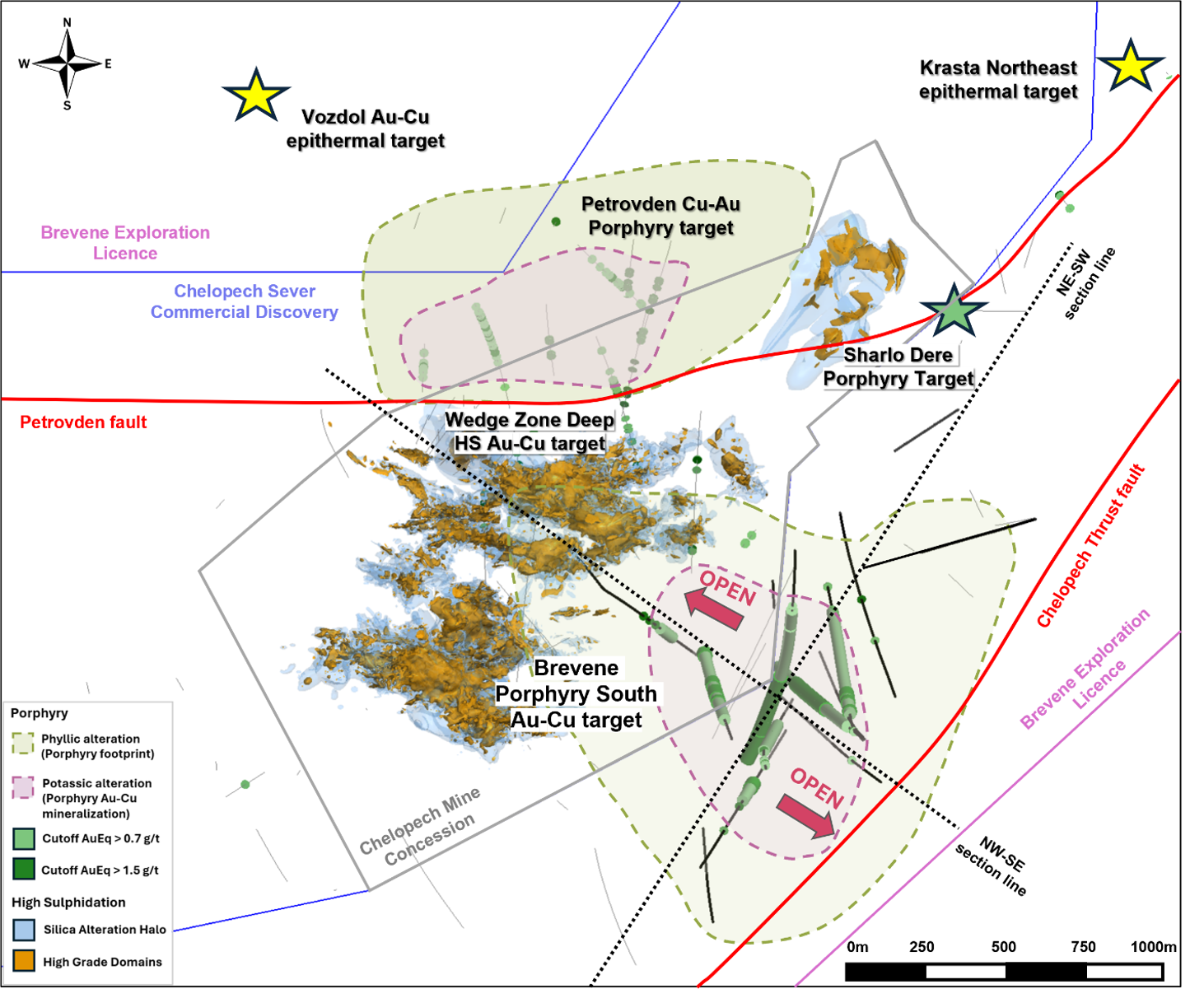
Figure 1. Broad plan view of the Chelopech area showing deep drill intercepts below -200 mRL, including all reported holes at the Brevene Porphyry South in bold, the interpreted footprint of mineralization as well as the projected silica alteration envelope associated with the high-sulphidation mineralization type. The projected extent of porphyry related phyllic and potassic alteration zones is estimated from drill core logging and geochemical indicators, including elevated Mo, paragonitic muscovite and high Zr/Ti ratios in the phyllic zone, and elevated K/Al and/or magnetite in the potassic zone.
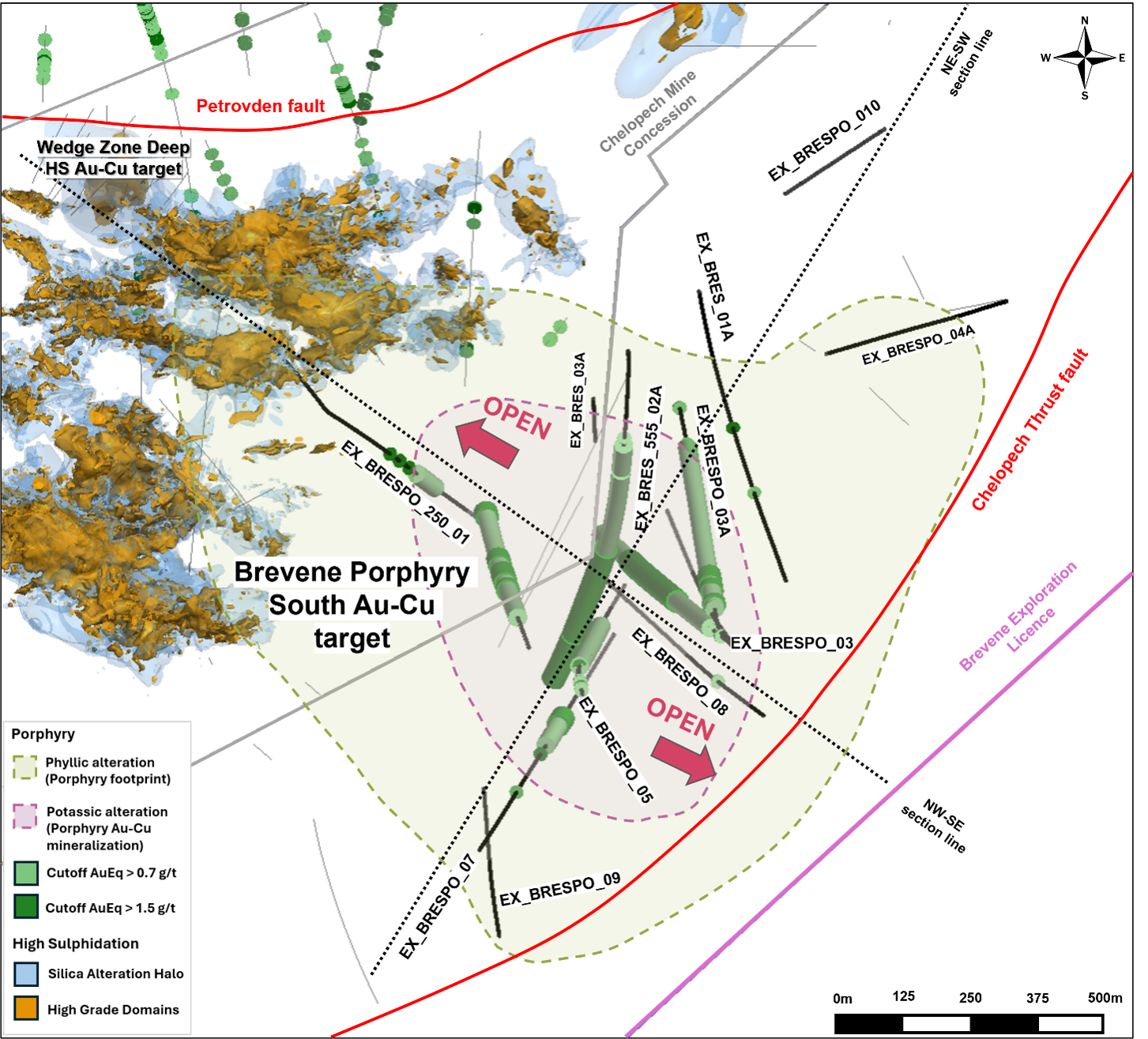
Figure 2. Detailed plan view of the Brevene Porphyry South prospect showing all drillhole intercepts and the interpreted mineralization footprint below -200 mRL, together with the projected silica alteration envelope associated with the high-sulphidation mineralization type.
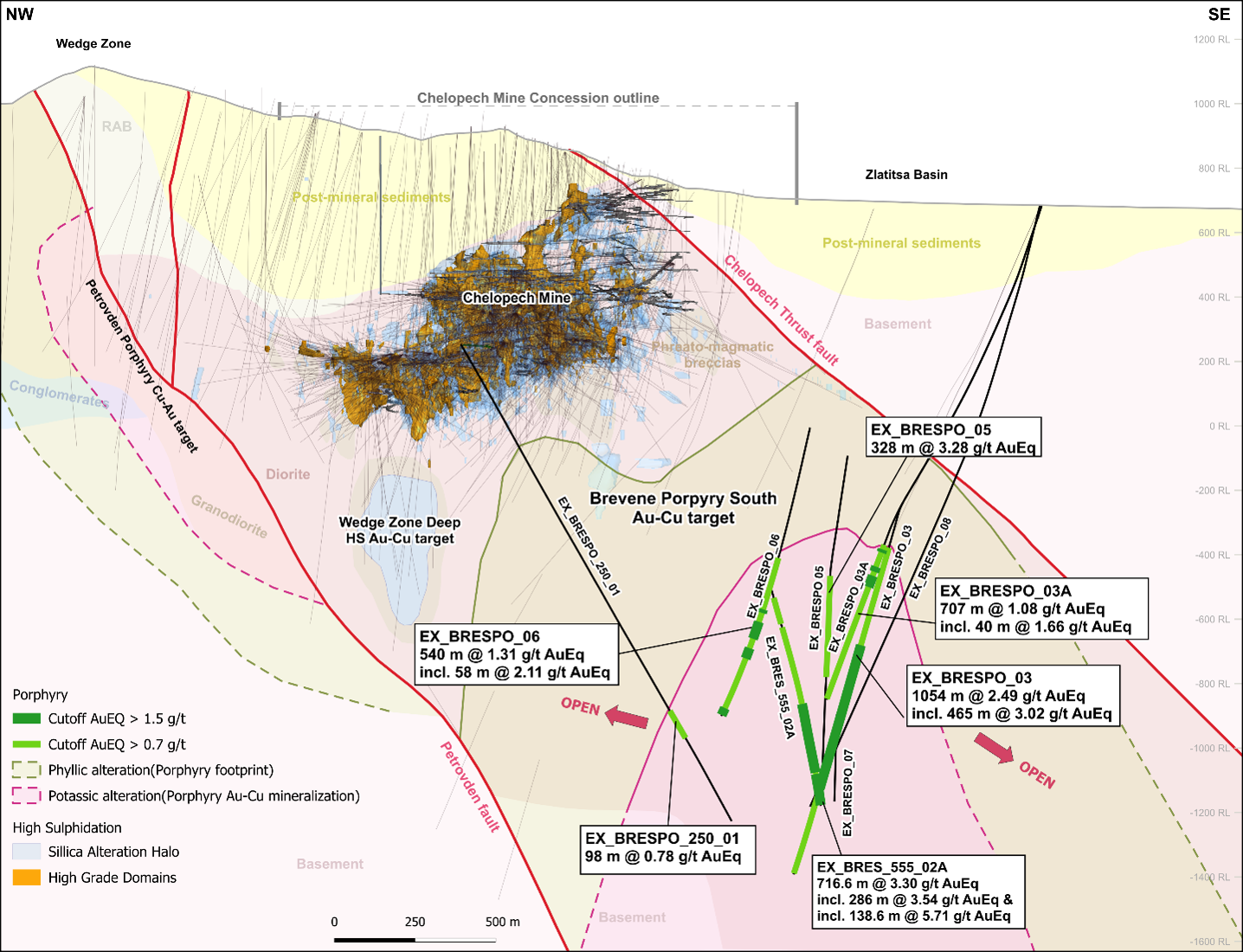
Figure 3. Northwest-southeast long section (6000 E, 500 metres thick) showing the location of the Brevene Porphyry South intercepts as well as the Wedge Zone Deep (“WZD”) prospect, the existing high-grade domains and mine infrastructure.
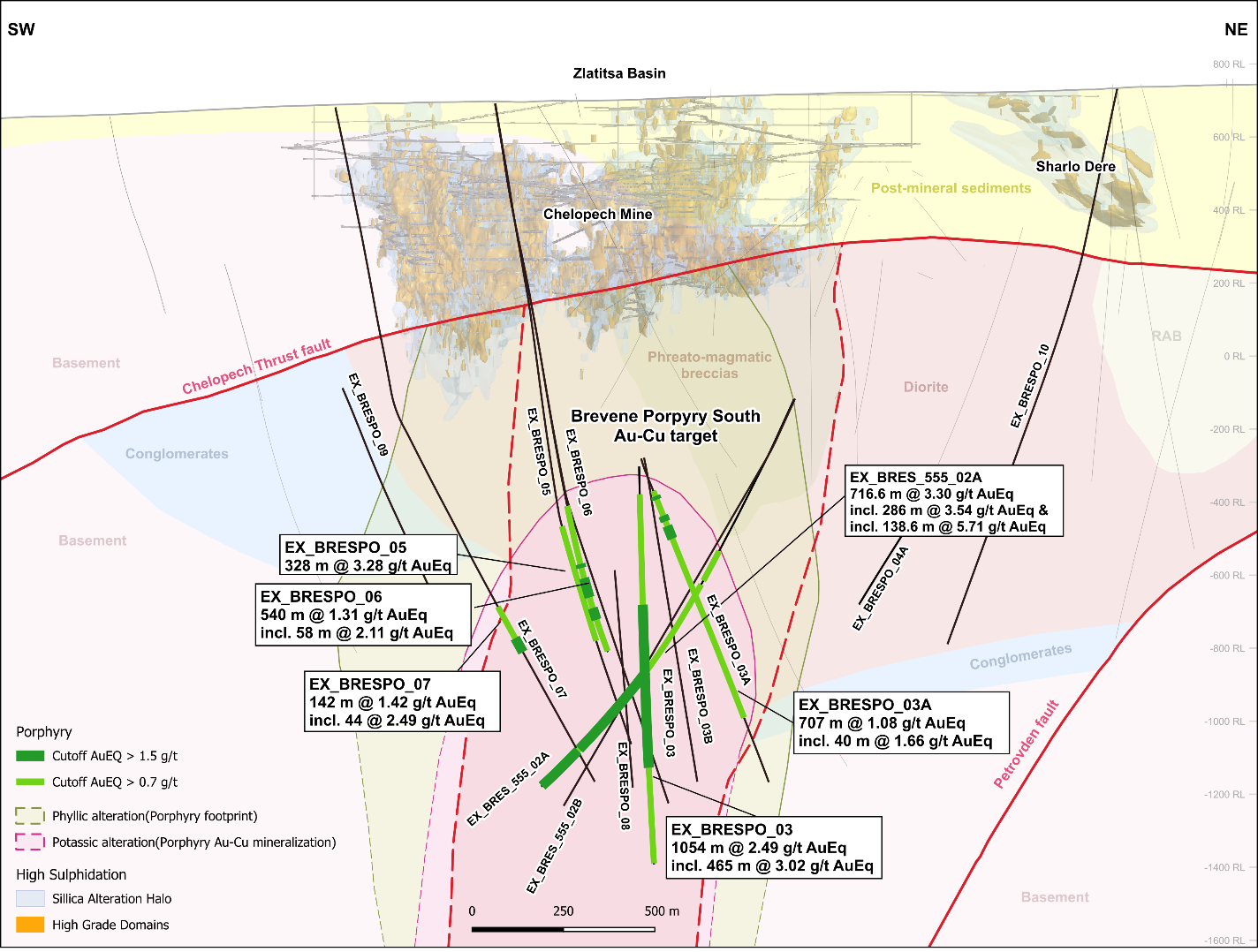
Figure 4. Northeast-southwest cross section (6770, 500 metres thick) showing the location of the Brevene Porphyry South intercepts as well as a projection of the existing high-grade domains and mine infrastructure, located approximately one kilometre northwest from the target.
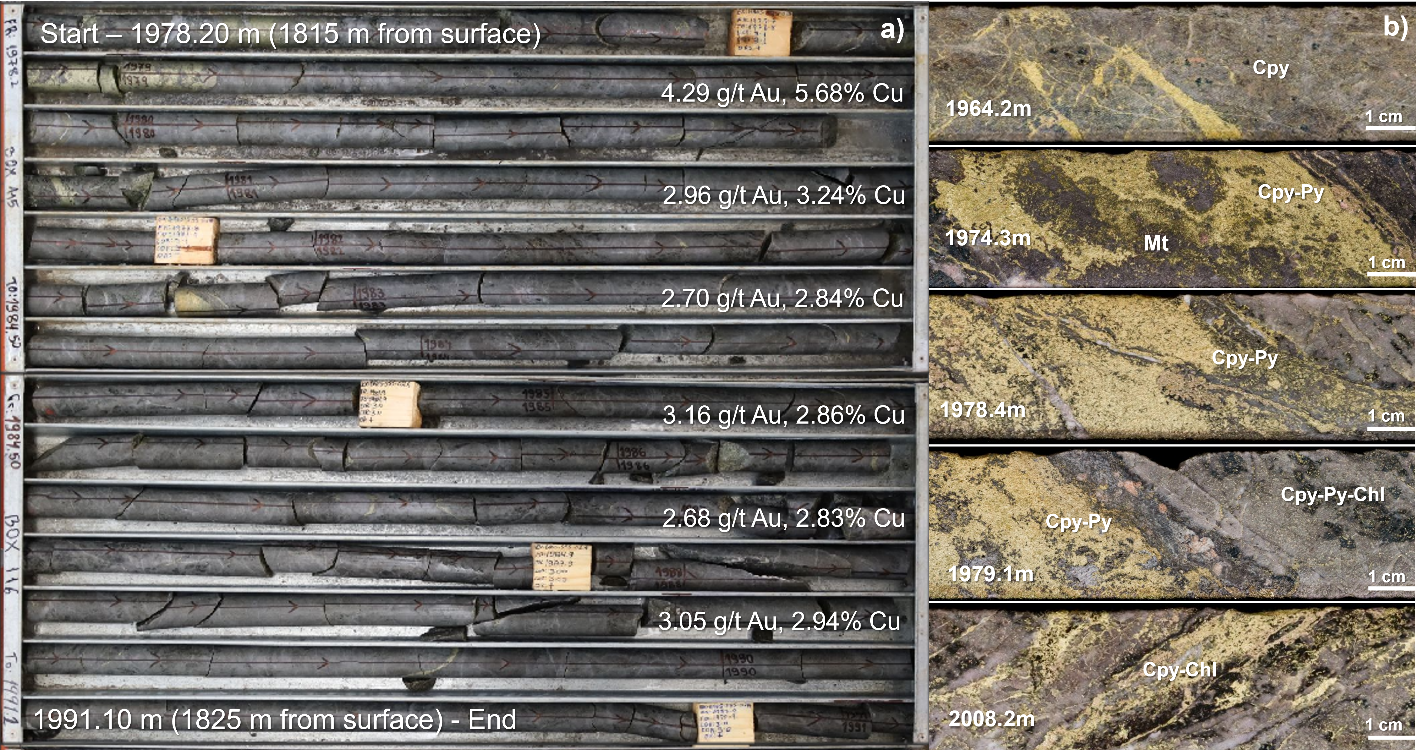
Figure 5. Images showing (a) the core photos from hole EX_BRES_555_02A between 1,978.20 m to 1,991.10 m downhole depth, (b) close-up views of porphyry style of mineralization within the interval. (Cpy – chalcopyrite, Py – pyrite, Chl – chlorite; Mt – magnetite)
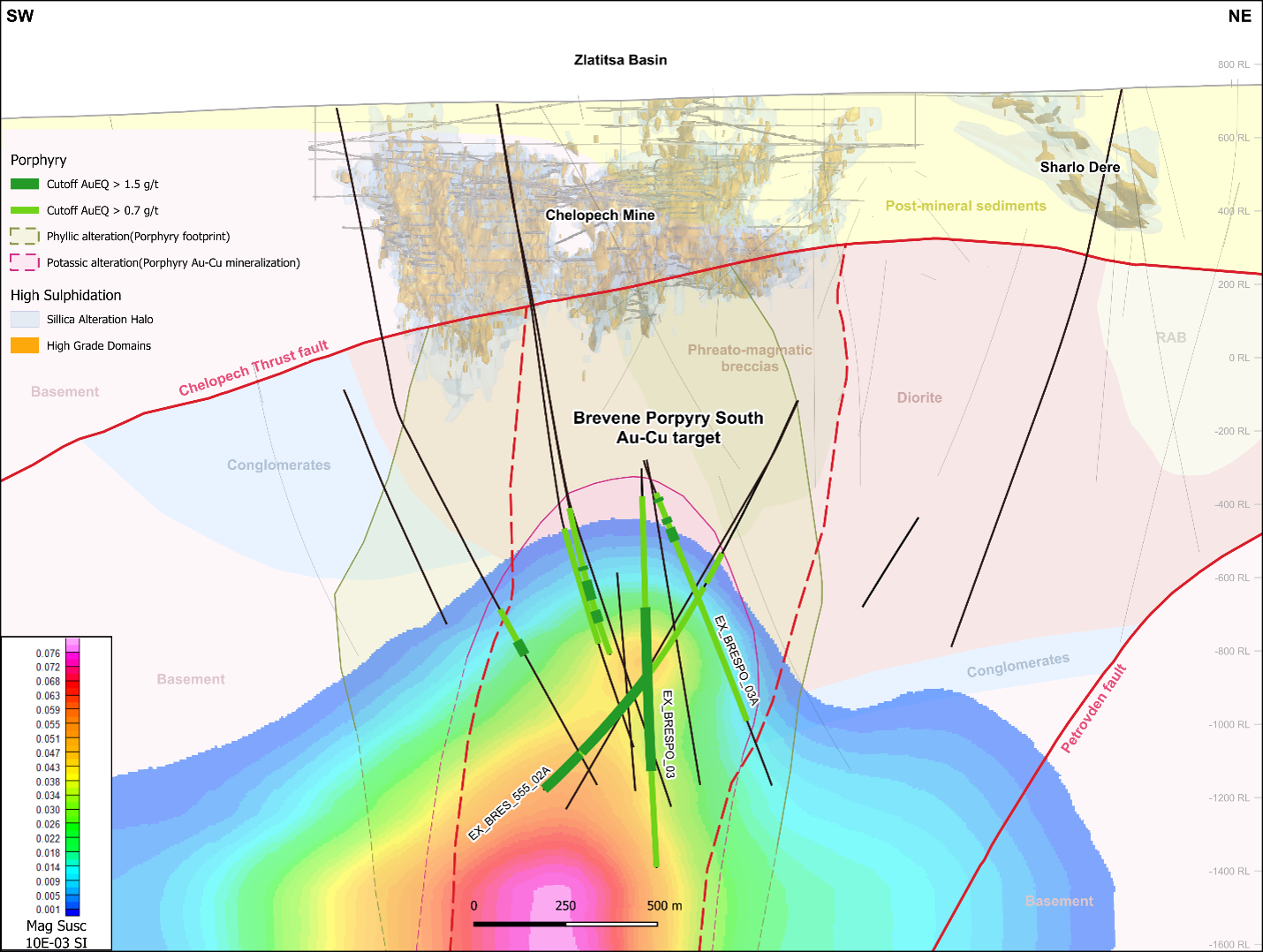
Figure 6. Northeast-southwest cross section displaying existing constrained 3D magnetic inversion model on the top of the geology interpretation at the Brevene Porphyry South target.
Sampling, Analysis and QAQC of Exploration Drill Core Samples
Most surface exploration diamond drill holes are collared with PQ size, continued with HQ, and are sometimes finished with NQ and BQ diameters. Underground exploration diamond drill holes are collared with HQ size, continued and finished with NQ, in isolated cases due to technical reasons with BQ. Triple tube core barrels and short runs are used whenever possible to improve recovery. Directional drilling techniques were utilized to facilitate target testing where appropriate. Within competent rock formations, a navigational curve was established and multiple daughter holes were branched from the same parent trajectory prior to completing the mother hole to its final depth. This method enabled efficient testing of multiple target positions from a single drill platform while improving drilling efficiency.
All drill core is cut lengthwise into two halves using a diamond saw; one half is sampled for assaying, and the other half is retained in core trays. The common length for sample intervals is two meters within mineralized zones, except drillholes EX_BRESPO_03 and EX_BRES_555_02A, where PQ, HQ and NQ diameter are sampled at one meter length. Weights of drill core samples range from three to eight kilograms, depending on the size of core, rock type, and recovery. A numbered tag is placed into each sample bag, and the samples are grouped into batches for laboratory submissions.
Drill core samples are shipped to the Company’s own exploration laboratory in Bor, Serbia, which is managed by SGS Minerals. SGS is independent of the Company. Quality control samples, comprising certified reference materials, blanks, and field duplicates, are inserted into each batch of samples and locations for crushed duplicates and pulp replicates are specified. All drill core and quality control samples are tabulated on sample submission forms that specify sample preparation procedures and codes for analytical methods. For internal quality control, the laboratory includes its own quality control samples comprising certified reference materials, blanks and pulp duplicates. All quality assurance and quality control monitoring data are reviewed and signed off by an independent QAQC geologist. Chain of custody records are maintained from sample shipments to the laboratory until analyses are completed and remaining sample materials are returned to the Company. The chain of custody is transferred from the Company to SGS at the laboratory door.
At the SGS Bor laboratory, the submitted drill core samples are dried at 105°C for a minimum of 12 hours and then jaw crushed to about 80% passing 4 millimetres. Sample preparation duplicates are created by riffle splitting crushed samples on a 1 in 20 basis. Larger samples are riffle-split prior to pulverizing, whereas smaller samples are pulverized entirely. Pulverizing specifications are 90% passing 75 microns. Gold analyses are done using a conventional 50-gram fire assay and atomic absorption spectrometry finish. Multi-element analyses for 49 elements, including Ag, Cu, Mo, As, Bi, Pb, Sb, and Zn, are done using a four-acid digestion and an ICP-MS finish. Samples returning over 10 ppm for Ag and 1% for Cu, Pb and Zn are re-analyzed using high grade methods with AAS. Sulphur is analyzed using an Eltra Analyzer equipped with an induction furnace.
Technical Information
Ross Overall, Director, Corporate Technical Services of the Company, who is a Qualified Person as defined under NI 43-101, and Stefan Metodiev, General Manager, Exploration Department have reviewed and approved the scientific and technical content of this news release. Mr. Overall has verified the accuracy of the information presented in this disclosure. This included verification to ensure all results reported in the disclosure have passed QAQC protocols, drill core inspection and review of assay data with geology, alteration and mineralization logging data. No limitations were imposed on Mr. Overall’s verification process.
About DPM Metals Inc.
DPM Metals Inc. is a Canadian-based international gold mining company with operations and projects located in Bulgaria, Bosnia and Herzegovina, Serbia and Ecuador. Our strategic objective is to become a mid-tier precious metals company, which is based on sustainable, responsible and efficient gold production from our portfolio, the development of quality assets, and maintaining a strong financial position to support growth in mineral reserves and production through disciplined strategic transactions. This strategy creates a platform for robust growth to deliver above-average returns for our shareholders. DPM trades on the Toronto Stock Exchange (symbol: DPM) and the Australian Securities Exchange as a Foreign Exempt Listing (symbol: DPM).
For further information please contact:
Jennifer Cameron
Director, Investor Relations
Tel: (416) 219-6177
jcameron@dpmmetals.com
Brutus Mining Inc. (CSE: BRU) (FSE: ZI3) is pleased to announce that it has closed its non-brokered ... READ MORE
Jaguar Uranium Corp. (NYSE American: JAGU) is pleased to announce an independent Mineral Resource E... READ MORE
Auro Metals Inc. (TSX-V: AURO) (OTCQB: AURFF), is pleased to announce the assay results of the fina... READ MORE
Endeavour Silver Corp. (NYSE: EXK) (TSX: EDR) is pleased to announce that repairs to the primary bal... READ MORE
Scorpio Gold Corp. (NASDAQ: SGLD) (TSX-V: SGLD) (OTCQB: SRCRF) (FSE: RY9) is pleased to announce re... READ MORE