








Copper Fox Metals Inc. (TSX-V: CUU) (OTCQX: CPFXF) (FSE: HPU) and its wholly owned subsidiary, Desert Fox Mineral Mountain Co. are pleased to report significant copper-molybdenum mineralization within a 278.97 meter (m) interval (1379.00m to 1657.97m) in diamond drillhole MM-02-2025 at its 100% owned Mineral Mountain porphyry copper project in Arizona. The Mineral Mountain porphyry copper system is in a prolific northeast trending porphyry copper belt approximately 25 kilometers (km) southwest of Rio Tinto and BHP’s giant Resolution porphyry copper-molybdenum deposit and 20km northeast of the recently commissioned Florence copper mine (Figure-1).
Elmer B. Stewart, President and CEO of Copper Fox, stated, “The concentrations of copper-molybdenum intersected in the lower portion of DDH MM-02-2025 are comparable to and within the range of copper-molybdenum grades seen in other Laramide age porphyry deposits in Arizona. The telescoping of multiple porphyry features (copper-molybdenum mineralization, quartz veining, multiple cross cutting sulphide vein assemblages, alteration patterns, magnetite sulphidization and appearance of bornite rimming chalcopyrite at depth) indicates that DDH MM-02-2025 did not reach the core of this porphyry system. These porphyry features provide strong support for a follow-up drilling program and strengthens our view that higher-grade mineralization could lie below the current drill depth.”
Next Steps
The porphyry features identified in DDH MM-02-2025 support the interpretation that the hotter part (the potassic core) of the porphyry system is located at depth. To gain a better understanding of the system prior to planning the next drilling program, additional core sampling followed by a review of all geological, structural, geochemical, geophysical and alteration data incorporating several geochemical vectoring techniques using the geochemical data (ICP-MS with 4-acid digestion) are planned. The objective of the vectoring is to map the trace element; mineral and alteration changes/patterns associated with the transition from high to lower temperatures within a porphyry system. High-temperature metals such as bismuth and molybdenum (Bi-Mo) indicate the core of the system whereas lower-temperature base metals such as antimony and arsenic (Sb-As) occur in the lower temperature margins of the system. Similarly major oxide data (Al, Na, K, Ca) can be used to map areas of lower temperature phyllic/argillic alteration and high-temperature potassium flooding in the Potassic zone.
2025 Drill Program Summary
The maiden two-hole drill program (2558.11m) tested the large surface porphyry footprint and underlying positive chargeability anomaly. DDH MM-01-2025 (860.76m) intersected eight intervals of copper-molybdenum enrichment in the outer portion of the porphyry system (see news release dated April 7, 2026). DDH MM-02-2025 (1697.35m) located approximately 1.2km northeast of DDH MM-01-2025 intersected at depth, multiple porphyry features typically observed in porphyry copper systems including consistent, significantly higher copper-molybdenum concentrations associated with strong to intense phyllic (quartz-sericite-pyrite) altered Pinal Schist and instances of bornite riming chalcopyrite towards the bottom of the hole (Figure-2).
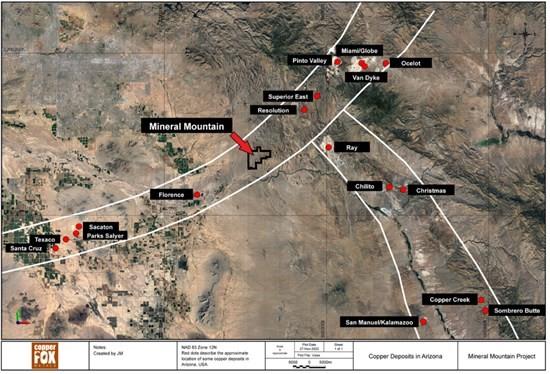
Figure-1: Regional setting of the Mineral Mountain porphyry copper project on NE trending porphyry copper belt, Arizona.
Analytical Results
Sampling in DDH MM-02-2025 commenced at a core depth of 896m based on the alteration phase, increased pyrite content, presence of quartz-base metal veining, fluorescent calcite and scheelite. The sampling program continued to the end of the hole at 1697.35m. Table-1 shows the progressively increasing weighted average copper-molybdenum-silver-rhenium concentrations for the core interval; from 1259.30m to 1657.97m.
Table-1: Weighted average grade of significant mineralized intervals in DDH MM-02-2025.
| DDH ID | From(m) | To (m) | Int. (m) | Cu (ppm) | Cu (%) | Mo (ppm) | Mo (%) | Ag (ppm) | Re (ppb) | Re (ppm) |
| MM-02-2025 | 1259.30 | 1379.00 | 119.70 | 590 | 0.059 | 51.6 | 0.005 | 0.45 | 120 | 0.120 |
| 1379.00 | 1437.00 | 58.00 | 1,441 | 0.144 | 136.5 | 0.014 | 0.62 | 128 | 0.130 | |
| including | 1382.00 | 1385.00 | 3.00 | 2,032 | 0.203 | 101.0 | 0.010 | 0.90 | 49 | 0.049 |
| including | 1415.00 | 1418.00 | 3.00 | 2,547 | 0.255 | 583.0 | 0.058 | 1.30 | 624 | 0.624 |
| including | 1435.80 | 1437.00 | 1.20 | 4,330 | 0.433 | 9.8 | 0.001 | 0.60 | <5 | <5 |
| 1469.89 | 1657.97 | 188.08 | 1,894 | 0.189 | 187.9 | 0.019 | 0.57 | 124 | 0.124 | |
| including | 1499.12 | 1555.00 | 55.88 | 2,641 | 0.264 | 360.0 | 0.036 | 0.80 | 235 | 0.235 |
| including | 1541.00 | 1549.00 | 8.00 | 7,090 | 0.709 | 524.0 | 0.052 | 2.28 | 531 | 0.414 |
Notes: m=meters; Cu=copper; ppm=parts per million; %= percent; Mo=molybdenum; Ag=silver; Re=rhenium; ppb=parts per billion. True thickness/widths of mineralization are unknown.
The analytical results from DDH MM-02-2025 indicate:
Figure-2 shows the interpreted relationship between the chargeability signature and analytical results from the 2025 drilling program.
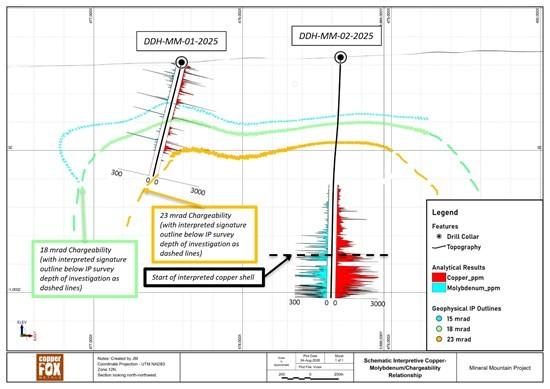
Figure-2: Schematic interpretative section showing copper-molybdenum mineralization/chargeability relationship.
A discussion of the analytical results for the core interval 896m to 1657m in DDH MM-02-2025 is provided below.
Interval 896m to 1259m: This interval is interpreted to represent the distal portion of the porphyry system characterized by generally low, copper (12.9 to 2,133 ppm) and molybdenum (0.1 to 123 ppm). Copper concentrations increase significantly (>500 ppm) toward the end of the interval with higher copper-molybdenum concentrations attributed to mineralized veins. Copper and molybdenum exhibit a negative correlation whereas the molybdenum and rhenium exhibit a positive correlation. The host rock is propylitic altered (chlorite-epidote ± actinolite) Pinal Schist and diabase dikes intruded by thin, un-mineralized, late-stage rhyolite porphyry dike. The alteration transitions down hole to progressively stronger phyllic (quartz-sericite-pyrite or “QSP”) alteration toward the bottom of the interval. Veining is generally weak but persistent consisting of quartz-pyrite ± chalcopyrite-molybdenite, with associated K-spar, sphalerite, scheelite/powellite, tourmaline, specularite and epidote/calcite. Classical porphyry style “D” veins occur in the lower portion of this interval. The intervals1217m-1259m and 1333-1346m exhibit higher copper concentration due to increased frequency of quartz-sulphide veining.
Interval 1259m to 1379m: This interval marks the transition from propylitic (chlorite-epidote-actinolite) to dominantly phyllic/QSP altered Pinal Schist and diabase dike. This interval exhibits consistently higher copper (25.9 to 1,406 ppm), molybdenum (2 to 515 ppm) and silver concentrations. The higher copper-molybdenum and silver concentrations are mostly associated with the diabase dike. Veining is mainly quartz-pyrite ± chalcopyrite-molybdenite, with associated gangue minerals consisting of albite, magnetite, epidote, calcite, specularite and scheelite.
Interval 1379 to 1435m: The host rock is Pinal Schist cut by a late-stage weakly mineralized quartz-eye porphyry dike. Alteration consists of early-stage chlorite-epidote overprinted by strong QSP alteration. Veining consists of quartz-chalcopyrite-pyrite ± molybdenite, quartz-pyrite-chalcopyrite-molybdenite and pyrite-chalcopyrite-molybdenite veins with locally stronger chalcopyrite near the schist-porphyry contact. The copper concentrations range from 222 ppm in the quartz-eye porphyry dike to a maximum of 4,330 ppm at the schist/porphyry contact. Molybdenum values range from 9.2 ppm associated with the quartz eye porphyry dike to 583 ppm in pervasively sericitized Pinal Schist. The molybdenum concentrations tend to increase toward the bottom of the interval. Silver exhibits a moderate correlation to copper values.
Interval 1435m to 1469m: This interval is a late-stage, weakly mineralized quartz-eye, quartz monzonite porphyry. This interval exhibits QSP alteration with subordinate intermediate argillic alteration. Veining is sparse, dominated by chalcopyrite-pyrite-chlorite veinlets and minor chalcopyrite veinlets at the lower contact with the schist.
Interval 1469m to 1657m: This interval is interpreted to represent the outer copper enriched pyritic portion of a porphyry system that typically contains copper concentrations in the order of 0.10%-0.20% and exhibits a broad, annular molybdenum “halo” that extends outward and upward from the higher copper concentrations typically observed in the inner potassic zone. The host rock is strong QSP altered Pinal Schist cut by several, thin late-stage un-mineralized quartz latite porphyry dikes. Metal concentrations within the interval are copper (332 to 14,800 ppm), molybdenum (1.8 to 3,160 ppm) and silver (0.1 to 6 ppm). Rhenium exhibits a moderate correlation with molybdenum with four samples exceeding 1,000 ppb. The interval 1541m – 1549m is a zone of quartz-pyrite-chalcopyrite-magnetite-molybdenite veining (“B” veins) that returned consistently high copper-molybdenum-silver-rhenium concentrations. Pervasive strong QSP alteration overprints earlier propylitic (chloritic) and relic potassic alteration toward the bottom of the interval. The copper-molybdenum occurs in abundant cross-cutting milky quartz veins carrying a combination of chalcopyrite (with localized bornite rims), pyrite, molybdenite ± magnetite, associated with K-feldspar, vugs/molds after anhydrite, calcite, chlorite, and minor apatite. Figure-3 shows a schematic representation of the lithologies, alteration, approximate sulphide content, and main sulphide vein types in DDH MM-02-2025.
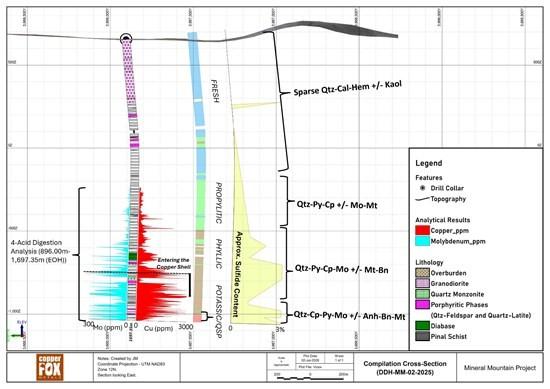
Figure-3: Schematic representation of lithologies, alteration, sulphide content and major vein types encountered in DDH MM-02-2025. Notes: Cu=copper, Mo=molybdenum, ppm=parts per million, m=meters. True thickness/widths of mineralization are unknown. The measurements of the alteration and sulphide boundaries are approximate.
The locations and drill collar co-ordinates for drillholes MM-01-2025 and MM-02-2025 are shown in Table-2 and Figure-4.
Table-2: Mineral Mountain 2025 drillhole information.
| DDH ID | Easting | Northing | Elev (masl) | Dip (deg) | Azi (deg) | Depth (m) |
| MM-01-2025 | 477590 | 3667582 | 619 | -75 | 290 | 860.76 |
| MM-02-2025 | 478660 | 3667905 | 663 | -85 | 180 | 1,697.35 |
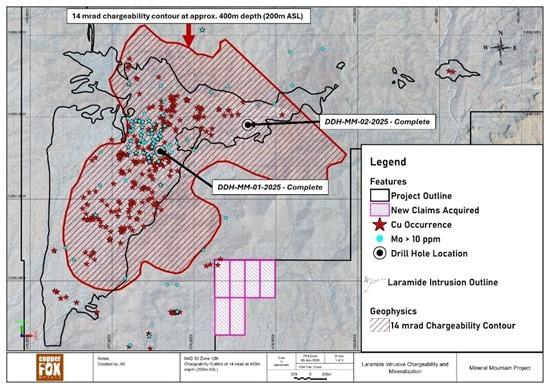
Figure-4: Mineral Mountain project drillhole location map superimposed on copper-molybdenum mineralization and 400m depth slice (below surface) of the 15mrad chargeability anomaly.
Quality Control (QA/QC)
A total of 351 drill core samples from DDH MM-02-2025 were sent for analysis. Copper Fox’s Quality Assurance/Quality Control program for DDH MM-02-2025 consisted of 11 split-core duplicates, 30 commercial certified reference material (CRM) standards, and 34 blanks. The matrix material of the CRM’s matches the Mineral Mountain geology. All standards are certified for 4-acid digestion.
Skyline Assayers and Laboratories Inc. (Accreditation 2953.01 and Standard ISO/IEC 17025:2017) located in Tucson, Arizona completed the sample preparation and analysis for the Mineral Mountain samples. Samples were prepared using preparation code SP-1 – crush to plus 75% -10 mesh, split and pulverize with standard steel to plus 95% -150 mesh. Analytical code TE-7 – was used for Trace Elements by Multi Acid (with HF), Ag, As, Hg, Sb, Se, Te concentrations were determined by Aqua Regia, ICP-OES/ICP-MS (49 elements).
Qualified Person
Elmer B. Stewart, MSc. P.Geo., President, and CEO of Copper Fox, is the Company’s non-independent, nominated Qualified Person pursuant to National Instrument 43-101, Standards for Disclosure for Mineral Projects, and has reviewed and approves the scientific and technical information disclosed in this news release.
About Copper Fox
Copper Fox is a Canadian resource company focused on copper development and exploration in the United States and Canada. Copper Fox and its subsidiaries own 100% of the Van Dyke ISCR project, a development stage, potential near term, mid-size copper mine in Arizona and a 25% interest in the Schaft Creek Joint Venture with Teck Resources Limited (75% interest and Operator) which hosts the Schaft Creek copper-gold-molybdenum-silver project in British Columbia’s Golden Triangle. In addition, Copper Fox owns 100% of the resource stage Eaglehead polymetallic porphyry copper project in northwestern British Columbia and the Sombrero Butte and Mineral Mountain advanced exploration stage porphyry copper projects located in the prolific Laramide age copper province in Arizona.
Brutus Mining Inc. (CSE: BRU) (FSE: ZI3) is pleased to announce that it has closed its non-brokered ... READ MORE
Jaguar Uranium Corp. (NYSE American: JAGU) is pleased to announce an independent Mineral Resource E... READ MORE
Auro Metals Inc. (TSX-V: AURO) (OTCQB: AURFF), is pleased to announce the assay results of the fina... READ MORE
Endeavour Silver Corp. (NYSE: EXK) (TSX: EDR) is pleased to announce that repairs to the primary bal... READ MORE
Scorpio Gold Corp. (NASDAQ: SGLD) (TSX-V: SGLD) (OTCQB: SRCRF) (FSE: RY9) is pleased to announce re... READ MORE