








Contango Silver and Gold Inc. (NYSE American: CTGO) (TSX: CTGO) announces additional gold assay results from its 2026 surface diamond drilling program at the Lucky Shot Project in Alaska. The Company also provides an update on underground exploration development and drilling currently underway from the West Drift Extension to test the KM vein system.
Highlights
*All reported assay interval lengths are downhole core lengths. True widths are not yet known and may be materially different.
Rick Van Nieuwenhuyse, the Company’s Chief Executive Officer said, “We are highly encouraged by the additional assay results from the Lucky Shot surface drill program completed earlier this summer. The results demonstrate the continuity of the Coleman segment of the Lucky Shot vein system as well as better constrain the location of previously mined zones of the Coleman segment. This information will be instrumental in completing an updated mineral resource estimate (MRE) in H1 of 2027 and then completing a feasibility level study targeting a 5 year mine plan delivering 40,000 to 50,000 ounces of annual production. In addition, the newly discovered KM vein adds significant excitement, and we look forward to driving consistent news flow as our underground program continues uninterrupted through the winter.”
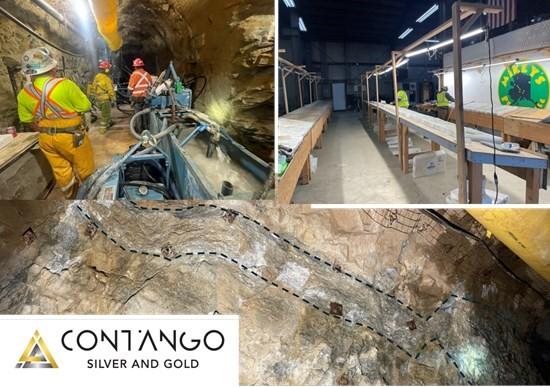
Figure 1. Lucky Shot exploration activities. Upper left: drilling station in the West Drift Extension. Upper right: the new core shack at the Lucky Shot Outpost. Lower image: the KM vein exposed in the West Drift Extension.
2026 Lucky Shot Surface Drill Program
The 2026 surface diamond drilling program began on June 22 and concluded on August 31, 2026. The Company completed approximately 5,800 meters in 27 holes from five drill pads, compared with a planned program of approximately 6,000 meters. Drilling targeted infill areas within the Coleman geological model and step-out areas to test the interpreted structural relationship between the Coleman and Lucky Shot vein systems (Figure 2).
This second assay release covers nine holes from Coleman Pads C, D, E and F. Seven holes returned the selected significant intervals in Table 1. LSS26007 and LSS26008 have no significant interval selected for reporting and are shown as N/S. Results from holes covered by the September 1, 2026 release are excluded from Table 1. Additional assays, including one interval in LSS26031, remain pending and will be reported following receipt, review and validation.
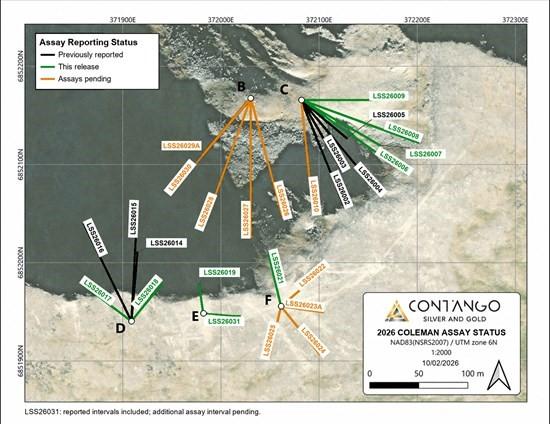
Figure 2. Plan view of the 2026 Coleman surface drill program showing drill pads, selected hole traces and assay reporting status on the map dated October 2, 2026. Black identifies previously reported holes, green identifies holes included in this release, and orange identifies holes with assays pending. LSS26031 includes reported intervals and an additional interval with assays pending. The map shows 26 labeled holes.
Selected Surface Drill Results
Table 1 summarizes the selected intervals from this assay batch. Vein assignments reflect the current geological interpretation and may change as additional data become available. These intervals were selected for their relevance to targeted or newly recognized vein structures; the table is not a complete listing of all sampled intervals and should not be interpreted as the average grade of a hole or vein. Previously reported holes and intervals without final assays are excluded from Table 1.
Table 1. Selected significant surface drill assay results – Coleman Pads C, D, E and F
| Drill station |
Hole ID | From (m) |
To (m) |
Length (m) |
Au (g/t) |
Vein | Visible gold observed* |
| Pad C | LSS26006 | 233.39 | 234.99 | 1.60 | 2.87 | CLMN 4 | |
| 251.31 | 252.53 | 1.22 | 7.19 | Unknown (CLMN 1?) | |||
| 260.75 | 261.05 | 0.30 | 5.88 | Unknown (CLMN 1?) | |||
| LSS26007 | N/S | ||||||
| LSS26008 | N/S | ||||||
| LSS26009 | 249.04 | 249.55 | 0.51 | 10.62 | CLMN 1 OR 4 | ||
| Pad D | LSS26017 | 126.54 | 126.84 | 0.30 | 46.32 | Unassigned | VG |
| 151.49 | 151.79 | 0.30 | 15.86 | CLMN 2/1 | VG | ||
| LSS26018 | 171.65 | 172.28 | 0.63 | 140.23 | CLMN 4 | VG | |
| 177.70 | 182.27 | 4.57 | 9.97 | CLMN 7 | VG | ||
| (includes) | 178.50 | 178.89 | 0.39 | 86.98 | |||
|
Pad E |
LSS26019 | 130.90 | 132.37 | 1.47 | 2.41 | Unassigned, shallower than modelled veins | |
| 158.70 | 159.24 | 0.54 | 3.10 | CLMN 1 | |||
| 169.20 | 171.94 | 2.74 | 13.80 | CLMN 4 | VG | ||
| (includes) | 169.60 | 169.90 | 0.30 | 118.36 | VG | ||
| 183.03 | 183.39 | 0.36 | 27.28 | Unassigned | VG | ||
| LSS26031 | 127.92 | 128.54 | 0.62 | 2.52 | Unassigned, shallower than modelled veins | ||
| 134.75 | 135.35 | 0.60 | 2.24 | CLMN 3 | |||
| 149.24 | 149.54 | 0.30 | 2.46 | CLMN 1 | |||
| 153.48 | 154.74 | 1.26 | 3.94 | CLMN 4 | |||
| 164.64 | 168.56 | 3.92 | Assay Pending | Unassigned | VG | ||
| Pad F | LSS26021 | 78.90 | 79.50 | 0.60 | 2.48 | Unassigned | |
| 177.23 | 179.02 | 1.79 | 3.22 | CLMN 3 | VG | ||
| 199.79 | 203.44 | 3.65 | 18.16 | CLMN 1 and 4 | VG | ||
| (includes) | 200.63 | 201.15 | 0.52 | 61.73 | VG | ||
| 205.20 | 205.50 | 0.30 | 2.70 | CLMN 4 | |||
Notes: All intervals are downhole core lengths; true widths are not yet known and may be materially different. Composite grades are length-weighted averages. “Includes” rows are contained within the preceding composite and are not additional intervals. N/S means no significant interval selected for reporting. Selected intervals represent targeted or newly recognized mineralized vein structures relevant to the current geological interpretation. CLMN = Coleman. Vein assignments are provisional. “Assay Pending” identifies an interval for which no final gold grade is reported.
*Visible gold is a qualitative observation made during core logging. It does not necessarily indicate higher grades, continuity, metallurgical performance or economic significance. Reported gold grades are based on laboratory assays. Blank entries mean no visible-gold was observed.
Coleman Pad C
LSS26006 intersected 2.87 g/t Au over 1.60 meters from the interpreted Coleman 4 vein and separate intervals returning 7.19 g/t Au over 1.22 meters and 5.88 g/t Au over 0.30 meters whose vein assignments remain uncertain. LSS26009 intersected 10.62 g/t Au over 0.51 meters, tentatively assigned to Coleman 1 or Coleman 4.
LSS26007 and LSS26008 tested northeast step-outs from the deeper Coleman area and intersected the Lucky Shot Fault. These holes provide additional structural control on the fault and constrain the interpreted northeastern extent of the Coleman veins toward it (Figure 3).
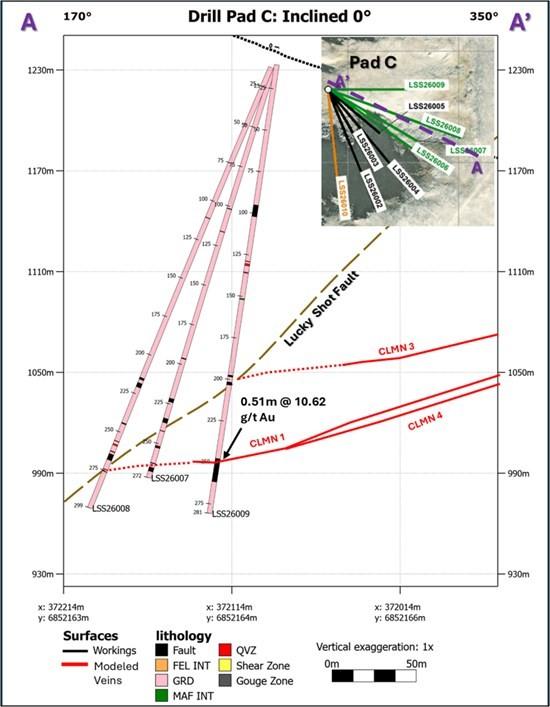
Figure 3. Section A-A′ through Coleman Pad C, showing LSS26007, LSS26008 and LSS26009, the reported LSS26009 gold assay interval, interpreted Coleman veins and the Lucky Shot Fault. The inset locates the section. All assay lengths are downhole lengths; true widths are not yet known.
Coleman Pad D
Pad D drilling targeted the central Coleman vein system from Lucky Shot Ridge to improve definition of the subparallel veins and their fault controls. The interpretation incorporates the modeled West Coleman Fault (Figure 4). LSS26017 intersected 46.32 g/t Au over 0.30 meters from an unassigned vein and 15.86 g/t Au over 0.30 meters from an interval provisionally assigned to Coleman 2/1.
LSS26018 intersected 140.23 g/t Au over 0.63 meters from the interpreted Coleman 4 vein and 9.97 g/t Au over 4.57 meters from Coleman 7, including 86.98 g/t Au over 0.39 meters.
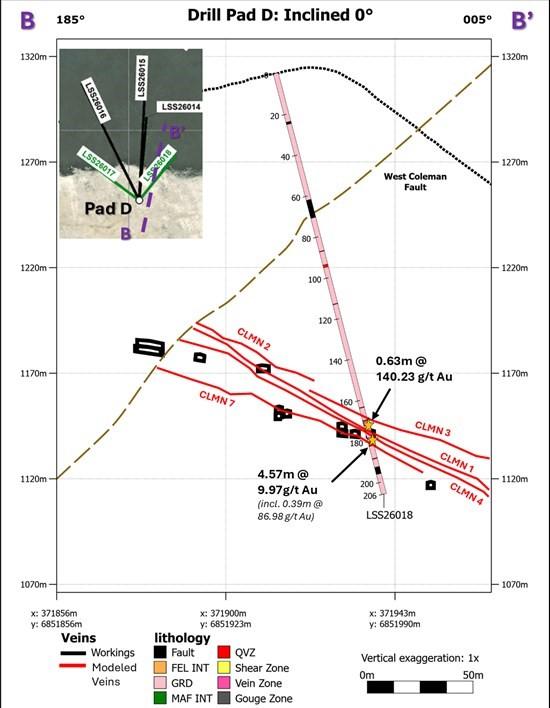
Figure 4. Section B-B′ through Coleman Pad D, looking west, showing LSS26018 assay results, interpreted Coleman veins and the West Coleman Fault. The inset locates the section. All assay lengths are downhole lengths; true widths are not yet known.
Coleman Pad E
LSS26019 intersected 13.80 g/t Au over 2.74 meters from the interpreted Coleman 4 vein, including 118.36 g/t Au over 0.30 meters, and 27.28 g/t Au over a separate 0.36-meter interval from an unassigned vein. Additional results include 2.41 g/t Au over 1.47 meters above the modeled veins and 3.10 g/t Au over 0.54 meters assigned to Coleman 1 (Figure 5).
LSS26031 intersected several intervals, including 3.94 g/t Au over 1.26 meters assigned to Coleman 4. A deeper, unassigned interval from 164.64 to 168.56 meters contains visible gold and has assays pending. Its 3.92-meter downhole length is listed separately as “Assay Pending” in Table 1. Visible gold does not establish the grade or economic significance of this interval.
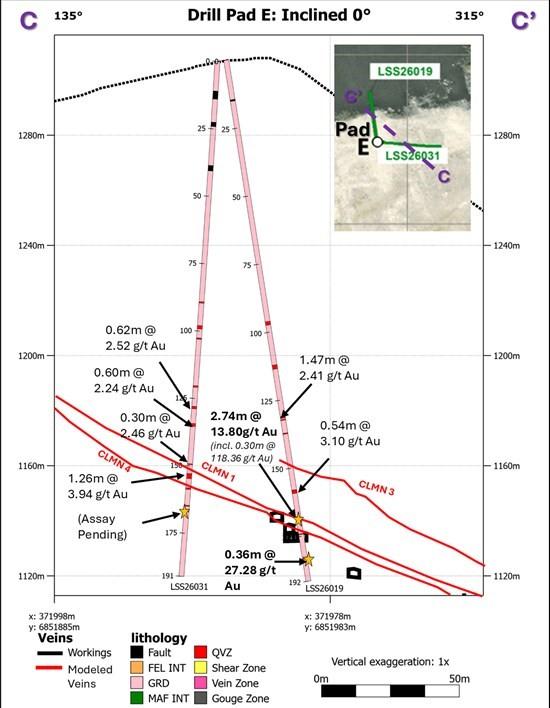
Figure 5. Section C-C′ through Coleman Pad E, looking southwest, showing LSS26019 and LSS26031, selected gold assay results and the interpreted veins. The deeper LSS26031 interval is marked as pending. All assay lengths are downhole lengths; true widths are not yet known.
Coleman Pad F
LSS26021 intersected 18.16 g/t Au over 3.65 meters across the interpreted Coleman 1 and Coleman 4 veins, including 61.73 g/t Au over 0.52 meters. Additional intervals include 3.22 g/t Au over 1.79 meters assigned to Coleman 3, 2.48 g/t Au over 0.60 meters from an unassigned interval, and 2.70 g/t Au over 0.30 meters assigned to Coleman 4. Figure 6 shows the current vein and Lucky Shot Fault interpretation. Assays for LSS26025 remain pending.
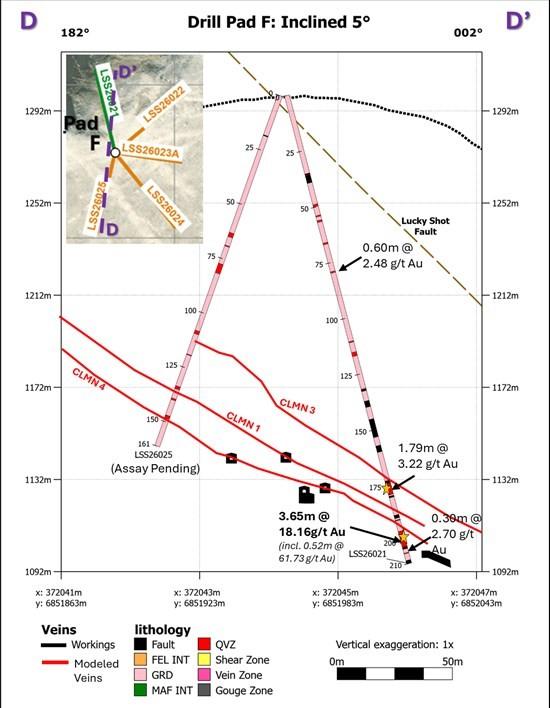
Figure 6. Section D-D′ through Coleman Pad F, looking west, showing LSS26021 assay results, LSS26025 with assays pending, interpreted Coleman veins and the Lucky Shot Fault. All assay lengths are downhole lengths; true widths are not yet known.
Dave Larimer, the Company’s Vice President of Exploration, commented, “What excites me about these results is seeing strong gold grades alongside new information that helps us understand the Coleman vein system. Each round of drilling sharpens that picture and helps us focus the next phase of our program. With drilling now underway on the KM vein system, we’re building on that progress through a disciplined process—testing our interpretations, evaluating the results and using what we learn to guide the next step at Lucky Shot.”
Underground Exploration Development
Underground exploration development continues on a two-shift, 24-hour schedule. To date, crews have completed 450 meters of the planned 830 meters of lateral development, representing approximately 54% of the program. Three headings are being advanced concurrently to improve the excavation cycle and exploration development rate (Figure 7).
The 2090W West Drift Extension is complete and now provides access for KM vein drilling. Development is planned to continue in the 2070E heading, the Enserch Tunnel extension and the 2300E heading. Subject to operating conditions and continued progress, the Company expects to complete this phase of underground exploration development in the middle of the fourth quarter of 2026.
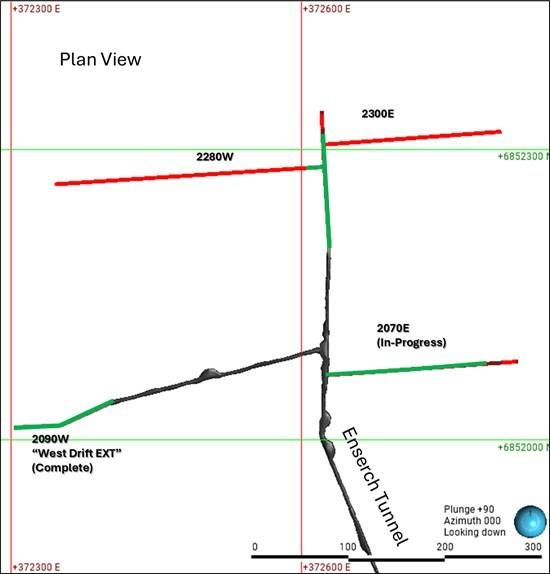
Figure 7. Plan view of underground exploration development. Green marks completed development and red marks planned or in-progress development. The 2090W West Drift Extension is complete, and work continues in the 2070E heading. Grid coordinates and scale-bar distances are in meters.
KM Vein Drilling Underway
Underground drilling from the West Drift Extension began on September 16, 2026, to test the geometry and continuity of the KM vein system (Figure 8). The program comprises approximately 1,140 meters in 17 planned holes from five drill stations. Ten holes have been completed from the first two stations, and drilling is underway from Station 346.
The program is designed to improve definition of the KM vein system and its interpreted relationship to the Lucky Shot Fault and the Lucky Shot vein system to the northeast. Assay results are expected during the fourth quarter of 2026 and will be reported following receipt, review and validation.
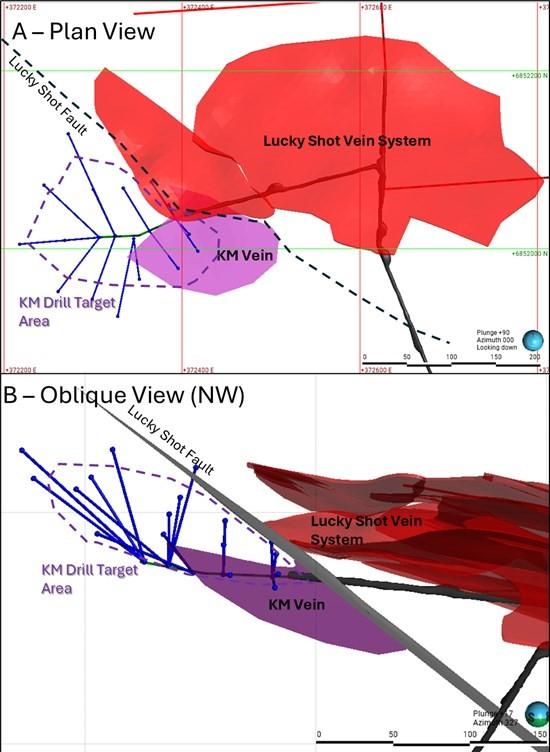
Figure 8. KM underground drilling from the 2090W West Drift Extension. A: plan view. B: oblique view looking northwest. Blue traces show drilling for the current program. Purple shows the KM vein and drill target area, with the interpreted Lucky Shot Fault and Lucky Shot vein system to the northeast. The colored vein surfaces and dashed target outline are geological interpretations, not mineral resource or mineral reserve boundaries. Plan-view grid coordinates and scale-bar distances are in meters.
Cautionary Note Regarding Exploration Results
The Company cautions that drill intercept lengths reported in this release are downhole core lengths. True widths are not yet known and may be materially different from reported interval lengths. Visible-gold observations are qualitative geological observations and do not necessarily correlate with higher gold grades, mineral continuity, metallurgical performance or economic significance. Reported gold grades are based on laboratory assays.
Lucky Shot is an exploration-stage property. No mineral reserves have been declared for the Lucky Shot Project, and the work described in this release is exploratory in nature. The exploration results reported in this release do not demonstrate economic viability. This release does not report a new or updated mineral resource or mineral reserve estimate. Modeled vein traces and surfaces illustrate geological interpretations and do not, by themselves, establish continuity of gold grade between drill intersections.
Quality Assurance and Quality Control
Contango’s drilling and sampling programs are conducted under the supervision of the Company’s Qualified Person. Drill core is systematically logged, photographed and sampled. The sampling, sample preparation, analytical and quality-control procedures for the results reported here are unchanged from those described in the Company’s September 1, 2026 news release.
Quality assurance and quality control procedures include the regular insertion of certified reference materials, blanks and duplicate samples into the analytical stream. Mineralized drill-core intervals are sampled as whole core, with shoulder samples extending beyond mineralized zones where appropriate. Samples are sealed and transported to the laboratory under documented chain-of-custody procedures.
Sample preparation was performed by Bureau Veritas North America in Fairbanks, Alaska. Gold analyses for the samples reported in this release were completed using a two-cycle PhotonAssay™ method by Paragon Geochemical in Vancouver, British Columbia. The published lower detection limit for the two-cycle PhotonAssay method is 0.015 g/t Au and the upper detection limit is 355 g/t Au. Samples returning gold values above the upper detection limit are re-assayed using a 50-gram charge fire assay with gravimetric finish through Bureau Veritas. Samples also undergo multi-element ICP-MS analysis to quantify minor- and trace-element associations.
Qualified Person
The scientific and technical information contained in this news release has been reviewed and approved by Dave Larimer, CPG, VP Exploration for Contango, who is a Qualified Person as defined by SEC Regulation S-K 1300. Mr. Larimer is not independent of the Company.
About Contango
Contango is a NYSE American and TSX listed company that engages in the exploration for and development and production of gold and associated minerals in Alaska and in the Golden Triangle in British Columbia. Contango holds a 30% interest in the Peak Gold JV, which leases approximately 675,000 acres of land for exploration and development on the Manh Choh project, with the remaining 70% owned by KG Mining (Alaska), Inc., an indirect subsidiary of Kinross Gold Corporation, operator of the Peak Gold JV. The Company and its subsidiaries also have (i) a lease on the Johnson Tract project, which consists of mineral rights to approximately 21,000 acres located near tidewater, 125 miles southwest of Anchorage, Alaska, from the underlying owner, CIRI, (ii) a lease on the Lucky Shot project, which consists of mineral rights to approximately 8,600 acres of State of Alaska and patented mining claims located in the Willow Mining District about 75 miles north of Anchorage, Alaska, from the underlying owner, Alaska Hardrock Inc., (iii) mineral rights to approximately 145,000 acres of State of Alaska mining claims, and (iv) mineral rights to approximately 11,700 acres of State of Alaska mining claims and upland mining leases, all of which give Contango the exclusive right to explore and develop minerals on these lands, and (v) mineral tenures of approximately 247,000 acres (100,000 ha) located in and around the Kitsault Valley in the Golden Triangle of northwest British Columbia.
by Jay Shidler, Director of Business Recruitment, Oklahoma Department of... READ MORE
Lodestar Metals Corp. (TSX-V: LSTR) (OTCQB: SVTNF) (FSE: PR90) ... READ MORE
And 6.45 m of 667 g/t Silver, Including 3.19 m of 1,339 g/t Silve... READ MORE
Alpha Exploration Ltd. (TSX-V: ALEX) is pleased to announce a ... READ MORE