








Canterra Minerals Corporation (TSX-V: CTM) (OTCQB: CTMCF) (FSE: DXZB) is pleased to report results of high-grade gold mineralization, including 31.5 metres (core length) averaging 10.89 g/t Au, from its fall 2025 diamond drilling at its 100%-owned Wilding Gold Project adjoining Equinox Gold’s Valentine Mine in central Newfoundland.
“These results demonstrate that Wilding has the potential to host a high-grade, district-scale gold system in one of Canada’s most attractive mining jurisdictions,” said Chris Pennimpede, President and CEO of Canterra. “As global uncertainty continues to drive interest in secure North American gold assets, we believe Canterra is well positioned to create long-term value through disciplined exploration next door to Atlantic Canada’s largest gold producer.”
Drilling Highlights
A total of 1,243 metres (m) of large diameter (HQ) core drilling were completed across 18 drill holes in fall 2025 at the Elm and Alder Zones as well as at Aspen, a new target:
Wilding Gold Project Fall 2025 Drill Highlights* (Table 1)
| Drill Hole | From (m) | To (m) | Length (m)* | Au (g/t) |
| WL-25-100 | 59.0 | 90.5 | 31.5 | 10.89 |
| including | 61.35 | 66.75 | 5.4 | 41.00 |
| including | 75.9 | 87.95 | 12.05 | 5.66 |
| WL-25-101 | 14.2 | 20.8 | 6.6 | 8.22 |
| Including | 15.35 | 17.5 | 2.15 | 24.74 |
| WL-25-95 | 5.1 | 9.2 | 4.1 | 6.16 |
| including | 6.2 | 7.2 | 1 | 20.96 |
| WL-25-90 | 58.3 | 60.3 | 2 | 8.41 |
| including | 59.3 | 60.3 | 1 | 13.74 |
| WL-25-93 | 7.4 | 11.65 | 4.25 | 2.59 |
*All reported intervals are downhole lengths. True widths have not yet been determined. Based on current structural interpretations, mineralized intervals in holes WL-25-90, WL-25-100, and WL-25-101 are interpreted to represent shallow-angle intersections of quartz-sulphide veins. As a result, reported downhole lengths may be significantly greater than true vein widths, however, additional drilling is required to make an accurate interpretation of true widths.
Drill Result Analysis
The fall 2025 drill program was designed to test for stacked extensional quartz-gold-tourmaline-pyrite vein packages along the known shear zones, testing geometries not previously drilled and new targets stemming from 2025 fieldwork and prospecting results (see September 8 and November 3, 2025 news releases). A key objective of the program was to test the “extensional vein set” concept and evaluate whether multiple vein orientations and stacked vein packages contribute to grade and continuity within the Wilding system. A total of 1,243.5 m of HQ core drilling was completed across 18 drill holes at the Elm and Alder zones and at a new target, Aspen.
In addition to confirming high-grade gold mineralization, the Fall 2025 drill program substantially expanded the interpreted alteration footprint at both the Elm and Alder zones. Widespread quartz-tourmaline-pyrite alteration was intersected beyond previously defined vein corridors, indicating a larger and more continuous hydrothermal system than previously recognized. At Elm, alteration envelopes extend laterally and vertically beyond high-grade intercepts in WL-25-100 and WL-25-101, while at Alder, multiple holes intersected consistent alteration even where vein thickness or grade was reduced. These results suggest that alteration mapping provides an effective vector toward mineralized structures and materially increases the prospective footprint of both systems.

Figure 1. Quartz-Tourmaline-Sulphide Vein with sheared altered Rogerson Lake conglomerate at Elm Zone in hole WL-25-101.
Hole WL-25-100 was designed to test the extensional veins in the immediate hanging wall of the known Elm vein system; however, the hole intersected the vein. The 31.5 m downhole interval (10.89 g/t Au) is interpreted to represent a low-angle intersection of the Elm vein system, which can result in an apparent thickness significantly greater than true vein width. True widths will be refined with additional drilling and structural measurements.
Hole WL-25-99 tested a new geophysical IP target area interpreted to be the potential northeast extension of the Alder Zone named the Aspen Target. This hole intersected vein material and associated hydrothermal alteration consistent with that observed at the established Elm and Alder Zones, further supporting the interpretation that alteration halos may extend beyond currently defined gold intercepts. Initial results reported anomalous gold grades up to 0.57 g/t Au and represent a successful first test of Aspen.
Results from WL-25-100 and WL-25-101 provide additional support for continuity of the Elm Zone vein system, as gold grades are consistently elevated where quartz-sulphide vein material and associated alteration are present. Together, these holes demonstrate repeatability of mineralization style and grade association within the Elm corridor and will be used to refine targeting for follow-up drilling.
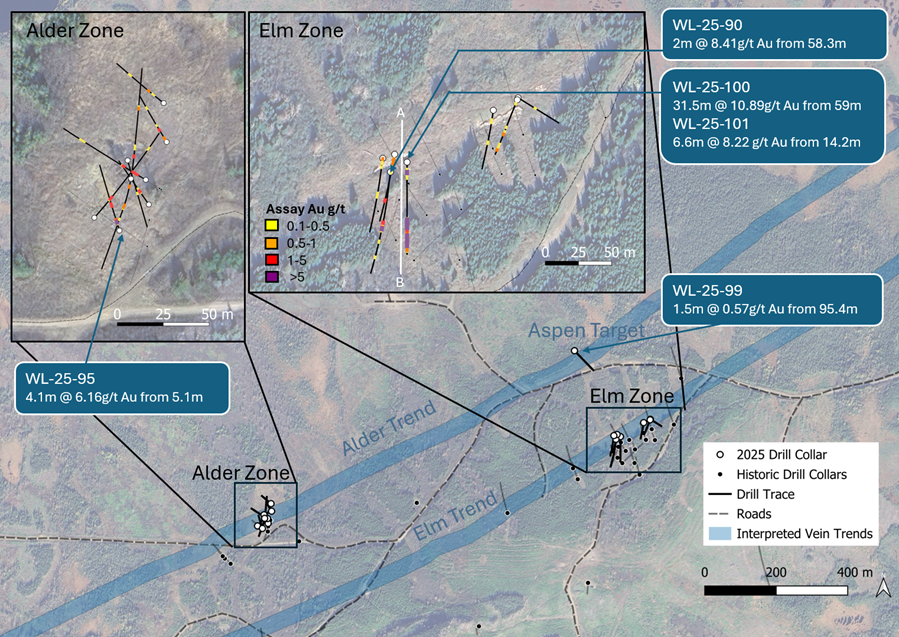
Figure 2. Plan view of Wilding Project 2025 Drill Program
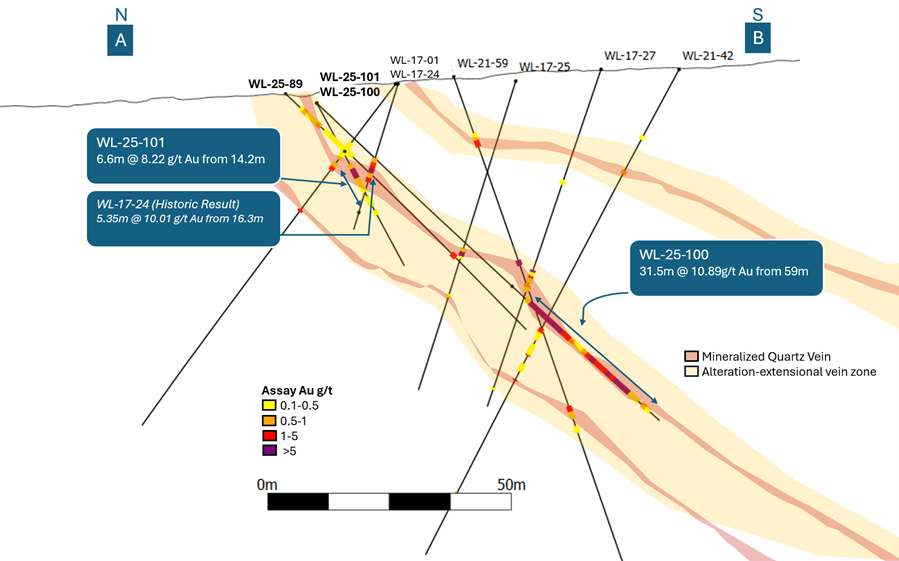
Figure 3. Cross Section of Elm Zone.
Table 2. Drill Collar details from this press release. Coordinates are given in UTM NAD 83 Zone 21 N.
| Hole number | Azimuth (°) | Dip (°) | Length (m) | Northing | Easting | Prospect |
| WL-25-102 | 325 | -45 | 41 | 5367977 | 517368 | Alder |
| WL-25-101 | 180 | -61 | 38 | 5368220 | 518353 | Elm |
| WL-25-100 | 180 | -44 | 96.5 | 5368220 | 518353 | Elm |
| WL-25-99 | 136 | -45 | 107 | 5368460 | 518225 | Aspen |
| WL-25-98 | 164.5 | -45 | 53 | 5368001 | 517356 | Alder |
| WL-25-97 | 308 | -45 | 47 | 5368033 | 517376 | Alder |
| WL-25-96 | 42 | -45 | 83 | 5367970 | 517338 | Alder |
| WL-25-95 | 343 | -45 | 53 | 5367963 | 517352 | Alder |
| WL-25-94 | 329 | -60 | 59 | 5368011 | 517378 | Alder |
| WL-25-93 | 300 | -44 | 74 | 5367991 | 517366 | Alder |
| WL-25-92 | 190 | -45 | 71 | 5367991 | 517358 | Alder |
| WL-25-91 | 10 | -45 | 86 | 5367991 | 517358 | Alder |
| WL-25-90 | 188 | -45 | 107 | 5368212 | 518341 | Elm |
| WL-25-89 | 191 | -43 | 71 | 5368226 | 518344 | Elm |
| WL-25-88 | 188 | -45 | 65 | 5368259 | 518418 | Elm |
| WL-25-87 | 122 | -44 | 50 | 5368268 | 518437 | Elm |
| WL-25-86 | 202 | -44 | 62 | 5368267 | 518436 | Elm |
| WL-25-85 | 188 | -43.5 | 80 | 5368223 | 518335 | Elm |
Table 3. Summary Gold Assay Results
| Drill Hole | From (m) | To (m) | Length (m)* | Au (g/t) | Prospect |
| WL-25-86 | No Significant Values | Elm | |||
| WL-25-87 | No Significant Values | Elm | |||
| WL-25-88 | No Significant Values | Elm | |||
| WL-25-89 | 48.4 | 49.6 | 1.2 | 3.09 | Elm |
| WL-25-90 | 52.7 | 53.7 | 1 | 2.54 | Elm |
| and | 58.3 | 60.3 | 2 | 8.41 | Elm |
| including | 59.3 | 60.3 | 1 | 13.74 | Elm |
| WL-25-91 | 16.7 | 17.7 | 1 | 1.90 | Alder |
| WL-25-92 | No Significant Values | Alder | |||
| WL-25-93 | 7.4 | 11.65 | 4.25 | 2.59 | Alder |
| and | 19.2 | 20.2 | 1 | 1.23 | Alder |
| WL-25-94 | 14.9 | 15.9 | 1 | 1.11 | Alder |
| WL-25-95 | 5.1 | 9.2 | 4.1 | 6.16 | Alder |
| including | 6.2 | 7.2 | 1 | 20.96 | Alder |
| and | 18.4 | 20.85 | 2.45 | 1.90 | Alder |
| WL-25-96 | 18.8 | 20.8 | 2 | 1.48 | Alder |
| WL-25-97 | 14.4 | 15.5 | 1.1 | 0.98 | Alder |
| WL-25-98 | No Significant Values | Alder | |||
| WL-25-99 | 95.4 | 96.9 | 1.5 | 0.57 | Aspen |
| WL-25-100 | 59. 0 | 90.5 | 31.5 | 10.89 | Elm |
| including | 61.35 | 66.75 | 5.4 | 41.00 | Elm |
| including | 62.35 | 65.7 | 3.35 | 46.50 | Elm |
| including | 75.9 | 87.95 | 12.05 | 5.66 | Elm |
| WL-25-101 | 14.2 | 20.8 | 6.6 | 8.22 | Elm |
| Including | 15.35 | 17.5 | 2.15 | 24.74 | Elm |
| WL-25-102 | 10.85 | 15.2 | 4.35 | 1.18 | Alder |
| including | 11.95 | 12.95 | 1 | 3.75 | Alder |
* All reported intersections are downhole lengths. True widths have not yet been determined. At the Elm Prospect, mineralized intervals are interpreted to represent low-angle intersections of the primary vein system, with multiple secondary vein orientations locally observed in drill core. This geometry may result in apparent interval thicknesses that exceed true vein widths.
Structural interpretations suggest that reported intervals in holes WL-25-90, WL-25-100, and WL-25-101 reflect shallow-angle intersections of high-grade veins, supporting vertical continuity and the potential for stacked mineralized structures. Estimated true widths are interpreted to be approximately 5–30% (WL-25-90, WL-25-100) and 20–45% (WL-25-101) of the reported downhole lengths.
Next Steps
Based on the encouraging results, the Company is planning follow-up drilling; both diamond drilling top of bedrock/base of till drilling to better constrain vein orientation, true width, and continuity. Follow-up holes are expected to:
This planned follow-up drilling program is designed to rapidly advance the Wilding by improving confidence in vein geometry, continuity, and scale. These efforts are expected to support future resource delineation and enhance the project’s strategic value within the central Newfoundland gold district.
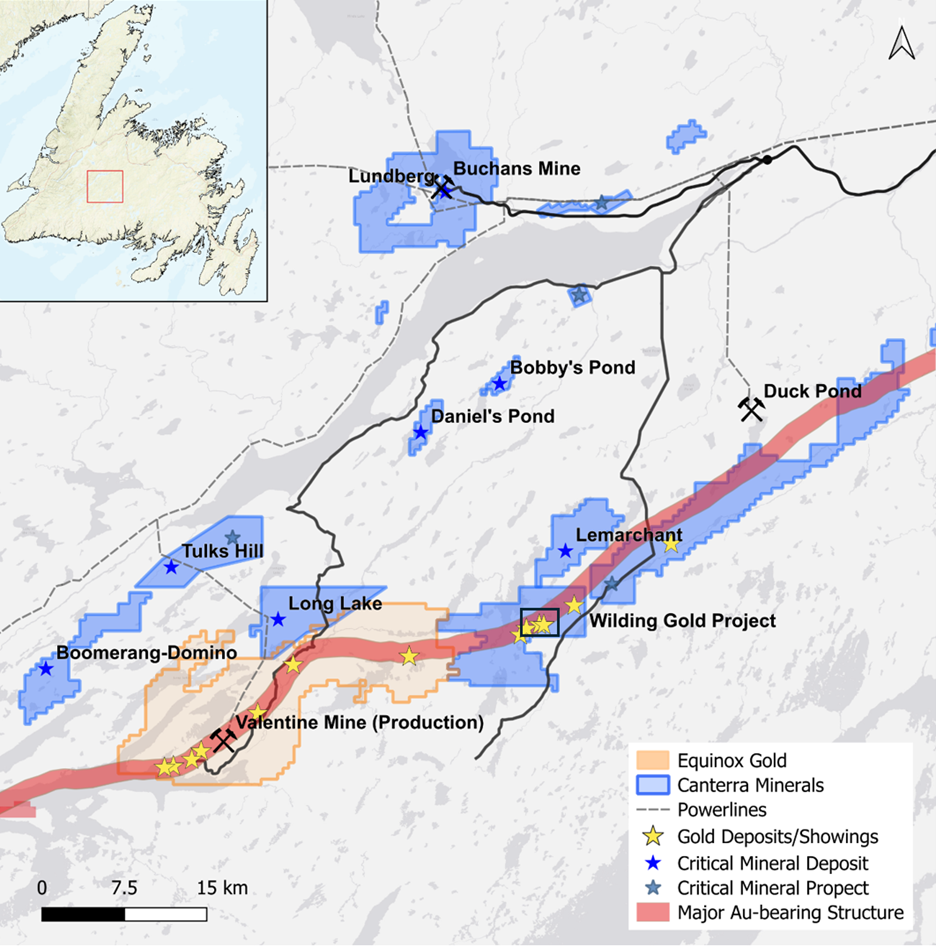
Figure 4. Map of Canterra Newfoundland Central Mining District Projects
Sampling and Analytical Methods
HQ drill core (63.5 mm diameter) was logged, photographed, and sampled at the Company’s secure core facility in Newfoundland. Core for sampling was selected by Canterra geologists with respect to lithological boundaries and mineralization and sawn in half, with one half retained for reference. Samples were delivered by Canterra personnel to Eastern Analytical Ltd. laboratory in Springdale, Newfoundland for preparation and analysis. Eastern Analytical is an independent accredited assay lab that conforms to the requirements of ISO/IEC 17025. Samples were analyzed using Eastern’s gold fire assay (Au-FAA30) method with atomic absorption finish. Samples returning elevated gold values >1g/t were re-analyzed with gravimetric finish. All reported assays are uncut. The Company maintains a quality assurance/quality control program that includes the insertion of certified reference materials, blanks, and duplicates. QAQC samples account for a minimum of 5% of the samples in addition to the laboratory’s internal quality assurance programs.
Qualified Person
The technical information contained in this news release has been reviewed and approved by Christopher Pennimpede, P.Geo., President and CEO of Canterra Minerals Corporation, who is a Qualified Person as defined under National Instrument 43-101.
Newfoundland and Labrador Junior Exploration Assistance & 2025 Exploration Program
Canterra would like to acknowledge the financial support it may receive from the Junior Exploration Assistance Program from the government of Newfoundland and Labrador related to the completion of its 2025 exploration programs.
About Canterra Minerals
Canterra is a diversified minerals exploration company focused on critical minerals and gold in central Newfoundland. The Company’s projects include six mineral deposits located in close proximity to the world-renowned, past producing Buchans Mine and Teck Resources’ Duck Pond Mine, which collectively produced copper, zinc, lead, silver and gold. Several of Canterra’s deposits support current and historical Mineral Resource Estimates prepared in accordance with National Instrument 43-101 and the Canadian Institute of Mining, Metallurgy, and Petroleum Definition Standards for Mineral Resources and Mineral Reserves. Canterra’s gold projects are located on-trend of Equinox Gold’s producing Valentine Mine and cover a ~55 km extension of the same interpreted structural corridor that hosts mineralization within Equinox Gold’s mine project. Drilling within the Wilding gold projects intersected multiple occurrences of orogenic-style gold mineralization within a large land position that remains underexplored.
Hudbay Minerals Inc. (TSX:HBM) (NYSE: HBM) today released its ann... READ MORE
Strategic acquisition of an established operating gold mine, loca... READ MORE
Cerro de Pasco Resources Inc. (TSX-V: CDPR) (OTCQB: GPPRF) (FRA: ... READ MORE
The Garneau Titanium Project Features Ilmenite-Rich Boulder with ... READ MORE
ValOre Metals Corp. (TSX‐V: VO) (OTCQB: KVLQF) (Frankfurt: KEQ0... READ MORE