







Hole 477 Yields 142,770 g/t Silver or 4,164 oz/t Silver over 0.3 m Within 1.1 m of 39,675 g/t Silver, All Within 3.0 m of 14,559 g/t Silver
Hole 480 Returned 5.0 m of 704 g/t Silver Including 1.4 m of 2,479 g/t Silver
Brixton Metals Corporation (TSX-V: BBB) (OTCQX: BBBXF) is pleased to announce a new brownfields discovery in the Shaft 4 area (S4) at its wholly owned Langis Silver Project, located in the historic silver mining camp of Cobalt, Ontario, Canada. Brixton has not drilled in this area previously, and hole 477 is the first hole ever. Drilling at the Shaft 4 area has intersected native silver in veins at shallow vertical depths of approximately 50 to 55 m, within the upper section of the Huronian conglomerate. Shaft 4 area is the second brownfields discovery at Langis this year, following the discovery of the Shaft 6 South East area (S6-SE) announced on July 21, 2026. The Company is also reporting results from 28 holes (6,741 m) in the S4, S6-SE, Shaft 6 (S6), Shaft 6 West (S6-W), and Shaft 3 East (S3E) areas. So far in 2026, the Company has completed 49,946.55 m across 234 drill holes, working toward its near-term objective of establishing a maiden Mineral Resource Estimate at Langis.
Highlights
Chairman and CEO, Gary R. Thompson, stated, “We are thrilled with this new brownfields discovery in the Shaft 4 area, our second new discovery and a record-topping intercept at Langis this year after hole LM-26-377. Hole 377 yielded 14.00 m of 7,150 g/t silver, including 0.65 m of 89,125 g/t silver. Hole LM-26-477 intercepted 4,164 oz/t silver, or 142,770 g/t silver, the highest-grade silver intercept ever drilled on the project. Based on the publicly available data, hole 477 ranks as the highest-grade silver drill intercept reported globally.”
Figure 1. Langis Silver Project location map of drilling area and mineral claims.
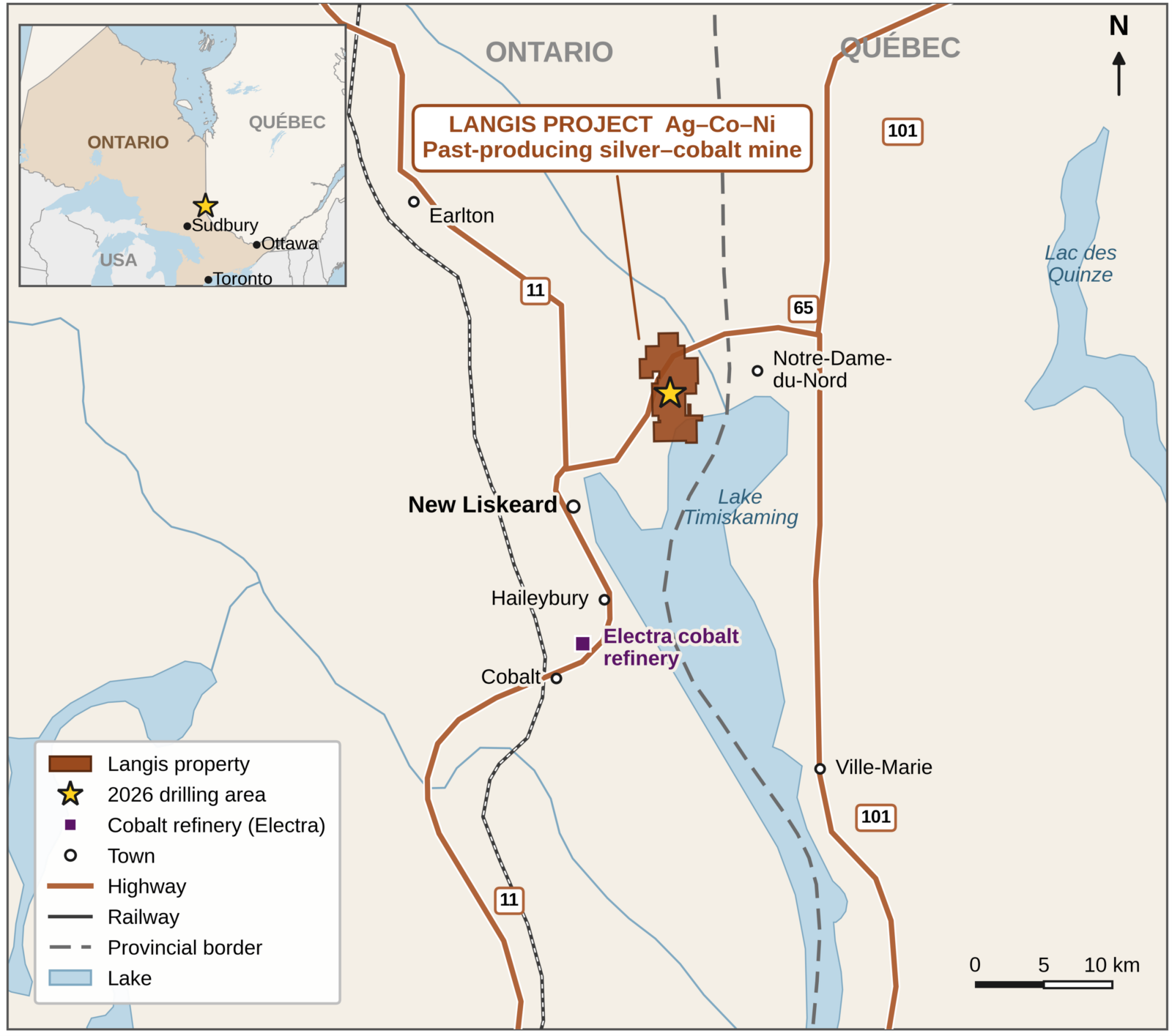
Figure 2. HQ core photographs of the cut surface from hole LM-26-477 at 70.08–70.33 m depth showing abundant native silver and lesser cobaltite in a carbonate vein, Shaft 4 (S4) area.
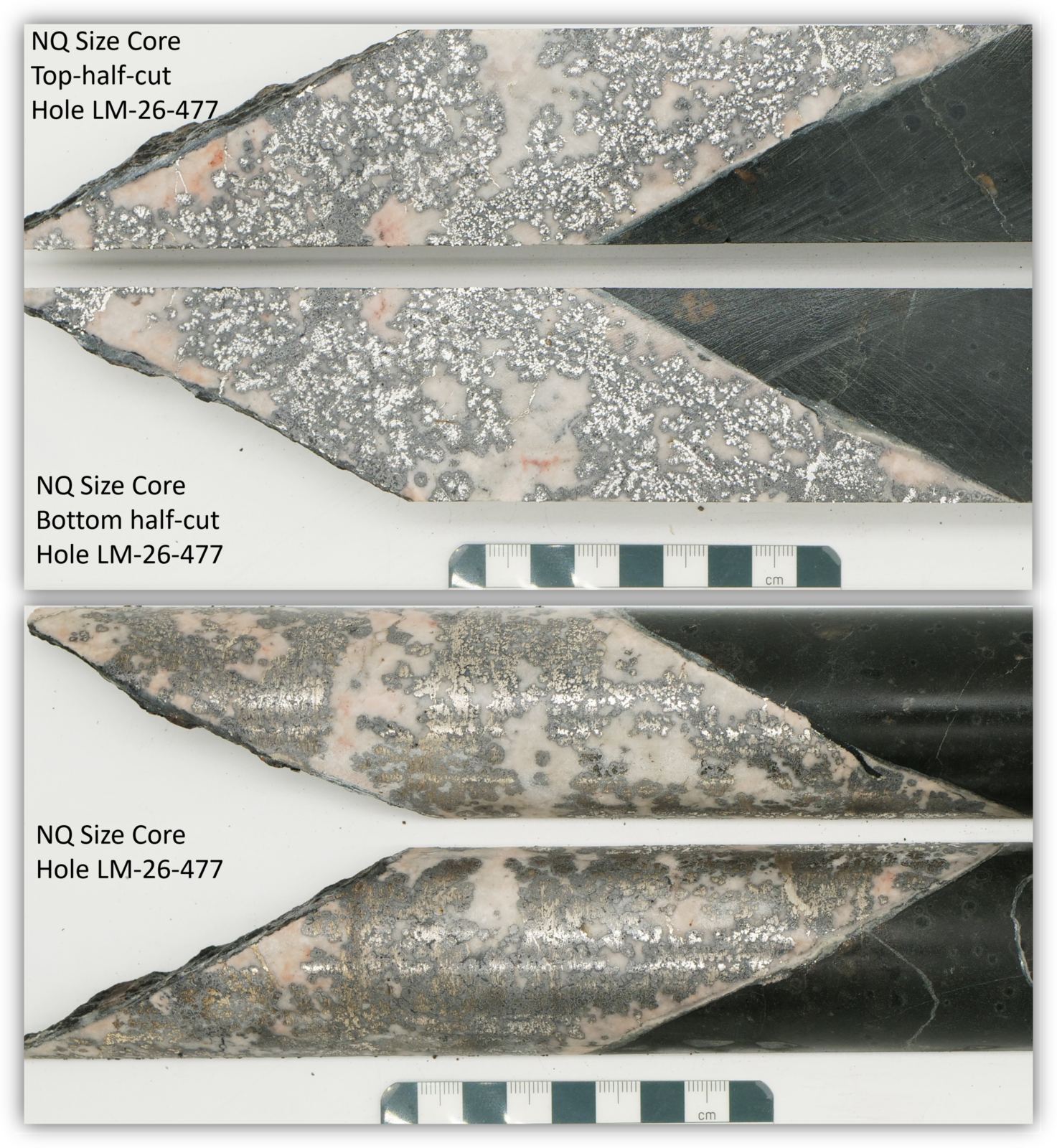
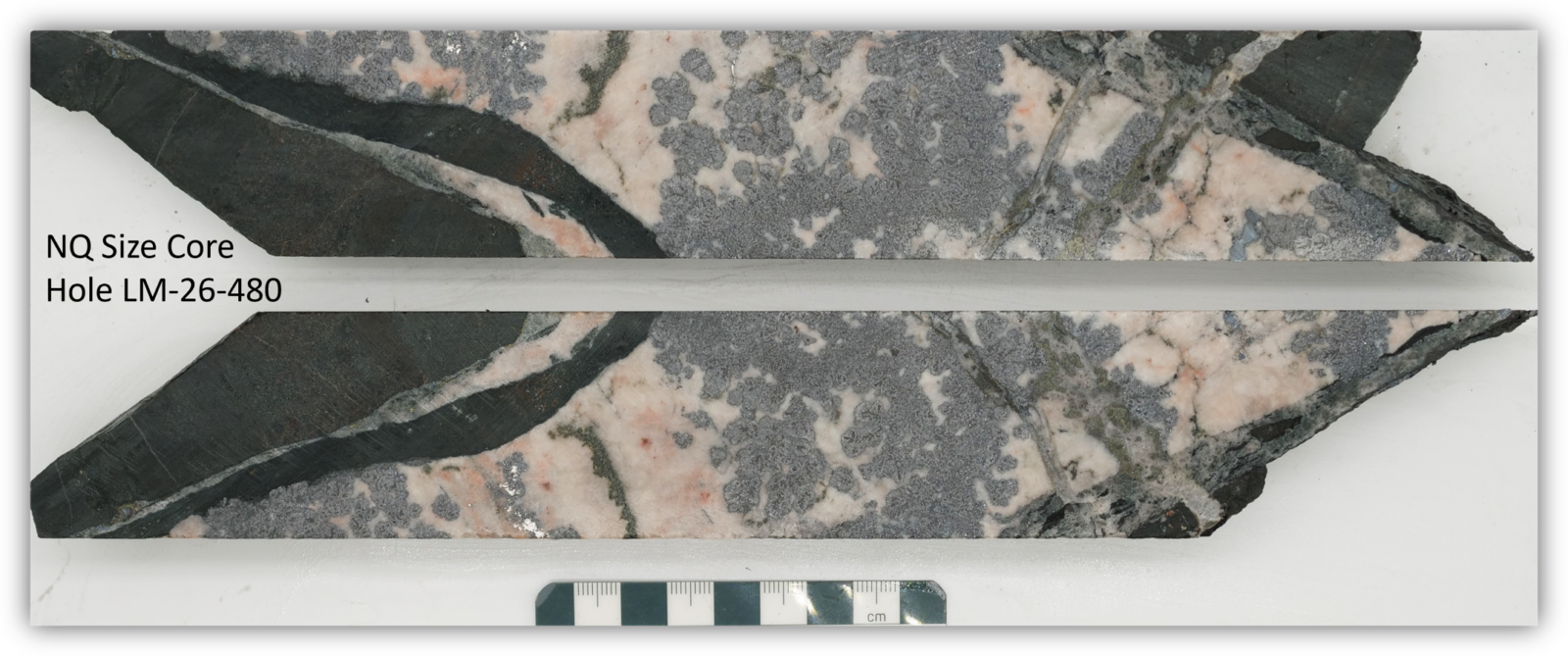
Figure 3. HQ core photograph of hole LM-26-480 at 69.20-69.45 m depth showing cobaltite and lesser native silver in a carbonate vein, Shaft 4 (S4) area. Native silver shows a bright white.
Discussion
Shaft 4 (S4)
Shaft 4 (S4) is a new brownfields discovery area at Langis where no historic mine workings exist (Figure 4). Drilling at S4 has intersected native silver in veins at shallow vertical depths of approximately 50 to 55 m, within the upper section of the Huronian conglomerate (Figures 2 and 3). Most known mineralization on the project sits at the lower contact of the conglomerate, on the Huronian Unconformity. The S4 veins matter for two reasons: they give shallower silver intercepts than are typical at Langis, and they raise the possibility that the lower contact beneath S4 is also mineralized. The Company is actively drilling the lower contact beneath the shallow S4 veins.
The very high-grade silver intersected in hole LM-26-477 is an encouraging result for this area. Silver observed at S4 occurs mainly as native silver, locally associated with arsenide and nickel minerals. This mineralization style has also been observed elsewhere on the property, including at Shaft 6. The Company targeted this area based on a gravity (HGRAV) anomaly with a geometry and geophysical response similar to that at Shaft 6. A similar geophysical response does not necessarily indicate similar mineralization. The Company is drilling this target on a tight grid, and several additional holes have intersected visible silver mineralization. Visual observations are not a substitute for laboratory assays, which are pending and will be reported once received and validated.
Figure 4. Plan map of Langis showing the drill hole collars and traces reported in this news release, other 2026 drill collars, and historic and Brixton silver assays projected to surface. Dashed lines show long sections A–A’ and B–B’ (Figure 5).
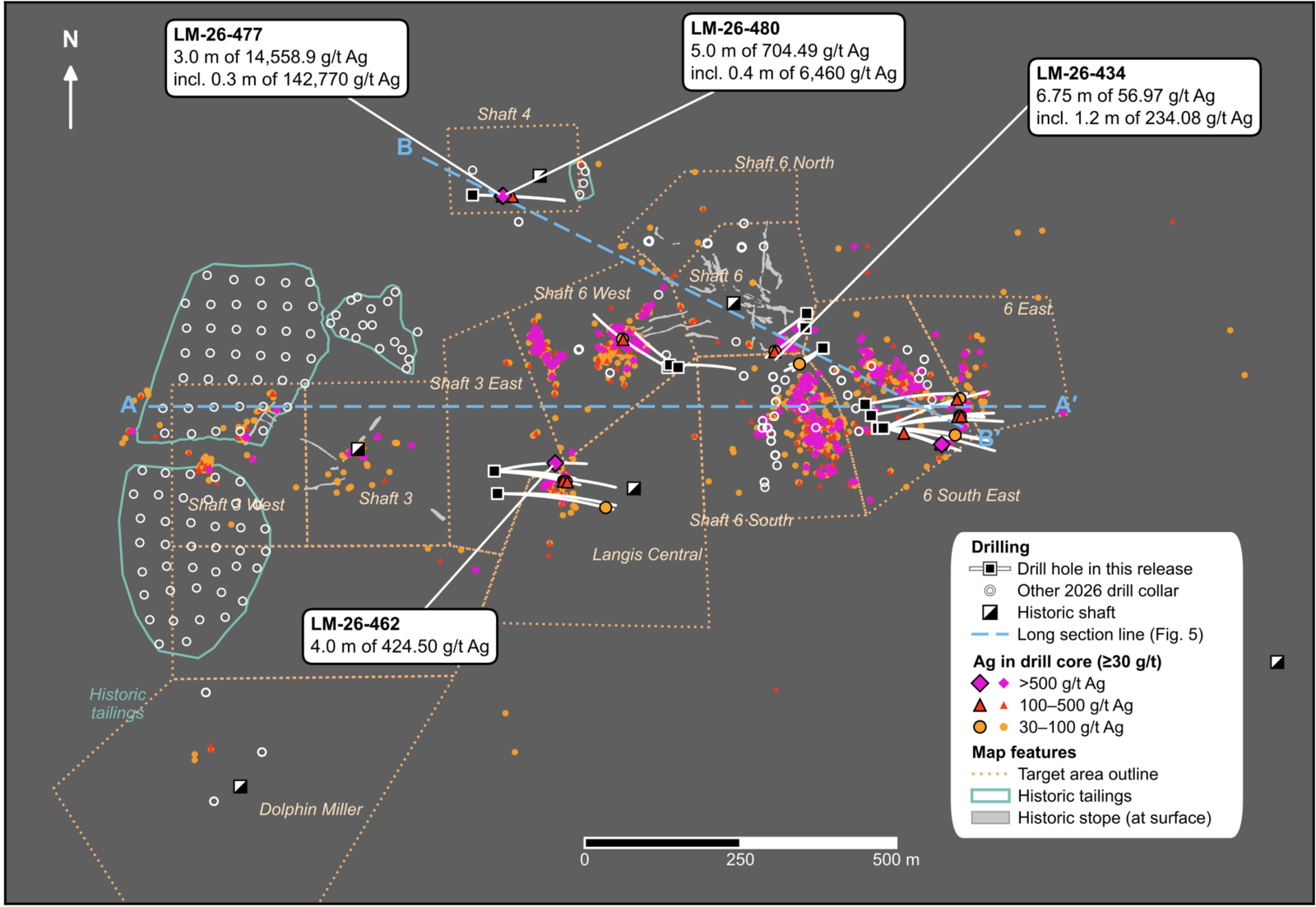
Symbols show individual drill core samples ≥30 g/t Ag projected to surface; larger outlined symbols are samples from holes reported in this news release. They are a visual aid only. They are not a geological model, a mineral resource or a mineral reserve, and they do not imply continuity of mineralization between drill holes. Reported intercepts are core lengths; true widths are not yet known.
Table 1. Selected assay intervals from drill holes in the Shaft 4 (S4) area.
| Hole ID | From (m) | To (m) | Length (m) | Ag (g/t) | ||||
| LM-26-477 | 68.50 | 71.50 | 3.00 | 14,558.90 | ||||
| including | 69.50 | 70.60 | 1.10 | 39,675.00 | ||||
| including | 70.00 | 70. | .30 | 142,770.00 | ||||
| LM-26-477 | 92.50 | 93.00 | 0.50 | 103.00 | ||||
| LM-26-480 | 67.00 | 72.00 | 5.00 | 704.49 | ||||
| including | 68.65 | 70.05 | 1.40 | 2,478.93 | ||||
| including | 69.15 | 69.55 | 0.40 | 6,460.00 |
Note for all assay tables: All assay values are weighted averages. Reported intervals are drilling lengths, and the true widths of the mineralized intervals have not yet been determined. Reported intervals are length-weighted composites calculated at a 5 g/t Ag cut-off over contiguous samples, with limited internal dilution. A hole is reported as a significant intercept only where it contains a sub-interval exceeding 50 g/t Ag; otherwise, it is reported as no significant intercepts. Higher-grade “including” intervals reflect geological interpretation.
Shaft 6 South East (S6-SE)
Drilling in the S6-SE area (Table 2) continued to test this zone. Hole LM-26-457 returned 7.00 m of 135.47 g/t silver from 208.00 m depth, including 4.50 m of 205.11 g/t silver, hosted in Keewatin mafic volcanic rocks below the conglomerate. Holes LM-26-411 and LM-26-413 intersected narrower mineralization in the conglomerate at depths of approximately 226 m to 239 m, and hole LM-26-453 returned 0.70 m of 242.00 g/t silver from 66.15 m depth.
Table 2. Selected assay intervals from drill holes in the Shaft 6 South East (S6-SE) zone.
| Hole ID | From (m) | To (m) | Length (m) | Ag (g/t) | |
| LM-26-411 | 226.00 | 226.65 | 0.65 | 182.00 | |
| LM-26-411 | 233.75 | 237.30 | 3.55 | 38.78 | |
| including | 233.75 | 234.25 | 0.50 | 85.20 | |
| including | 236.80 | 237.30 | 0.50 | 141.00 | |
| LM-26-413 | 230.45 | 231.60 | 1.15 | 60.00 | |
| LM-26-453 | 66.15 | 66.85 | 0.70 | 242.00 | |
| LM-26-457 | 208.00 | 215.00 | 7.00 | 135.47 | |
| including | 209.00 | 213.50 | 4.50 | 205.11 | |
| LM-26-457 | 216.50 | 217.00 | 0.50 | 80.30 | |
| LM-26-463 | 220.00 | 222.00 | 2.00 | 170.63 | |
| including | 220.00 | 221.00 | 1.00 | 330.00 | |
| LM-26-463 | 227.00 | 229.00 | 2.00 | 76.30 | |
No significant intercepts were returned from holes LM-26-397, LM-26-409, LM-26-415, LM-26-447, LM-26-451, LM-26-459, and LM-26-461. |
|||||
Shaft 6 (S6)
In the Shaft 6 (S6) area (Table 3), hole LM-26-434 returned 6.75 m of 56.97 g/t silver from 132.25 m depth, including 1.20 m of 234.08 g/t silver, and hole LM-26-452 returned 1.00 m of 57.40 g/t silver from 124.00 m depth.
Table 3. Selected assay intervals from drill holes in the Shaft 6 (S6) zone.
| Hole ID | From (m) | To (m) | Length (m) | Ag (g/t) |
| LM-26-434 | 132.25 | 139.00 | 6.75 | 56.97 |
| including | 136.65 | 137.85 | 1.20 | 234.08 |
| LM-26-452 | 124.00 | 125.00 | 1.00 | 57.40 |
No significant intercepts were returned from holes LM-26-448, LM-26-450, and LM-26-454. |
||||
Shaft 6 West (S6-W)
Drilling in the Shaft 6 West (S6-W) area (Table 4) followed up on the initial results reported in the news release dated September 2, 2026, which confirmed mineralization around the historic mine workings. Hole LM-26-410 returned 4.00 m of 159.20 g/t silver from 127.00 m depth, including 2.00 m of 247.00 g/t silver.
Brixton is looking to potentially expand this mineralization at S6-W to demonstrate continuity, as the Company has been doing in the Shaft 6 South East (S6-SE) area.
Table 4. Selected assay intervals from drill holes in the Shaft 6 West (S6-W) zone.
| Hole ID | From (m) | To (m) | Length (m) | Ag (g/t) |
| LM-26-410 | 127.00 | 131.00 | 4.00 | 159.20 |
| including | 127.00 | 129.00 | 2.00 | 247.00 |
No significant intercepts were returned from hole LM-26-414 and LM-26-418. |
||||
Shaft 3 East (S3E)
In the Shaft 3 East (S3E) area (Table 5), hole LM-26-456 returned 4.10 m of 61.23 g/t silver from 164.50 m depth, including 0.55 m of 182.00 g/t silver, and 3.30 m of 49.52 g/t silver from 172.00 m, including 0.60 m of 193.00 g/t silver. Hole LM-26-462 returned 4.00 m of 424.50 g/t silver from 153.00 m depth.
Table 5. Selected assay intervals from drill holes in the Shaft 3 East (S3E) zone.
| Hole ID | From (m) | To (m) | Length (m) | Ag (g/t) |
| LM-26-456 | 164.50 | 168.60 | 4.10 | 61.23 |
| including | 165.00 | 165.55 | 0.55 | 182.00 |
| LM-26-456 | 172.00 | 175.30 | 3.30 | 49.52 |
| including | 174.70 | 175.30 | 0.60 | 193.00 |
| LM-26-462 | 153.00 | 157.00 | 4.00 | 424.50 |
|
No significant intercepts were returned from holes LM-26-455, LM-26-458, LM-26-464 and LM-26-466. |
||||
Figure 5. Long sections A–A’ (west–east along 5,270,760 m N, looking north, holes within ±170 m) and B–B’ (Shaft 4 to Shaft 6, looking 027°, holes within ±50 m); section traces shown in Figure 4. Drill holes reported in this news release are shown in black with reported intercepts as thick bars, and previously reported holes in grey. Silver assays ≥30 g/t Ag from historic and Brixton drilling are projected to the section planes.
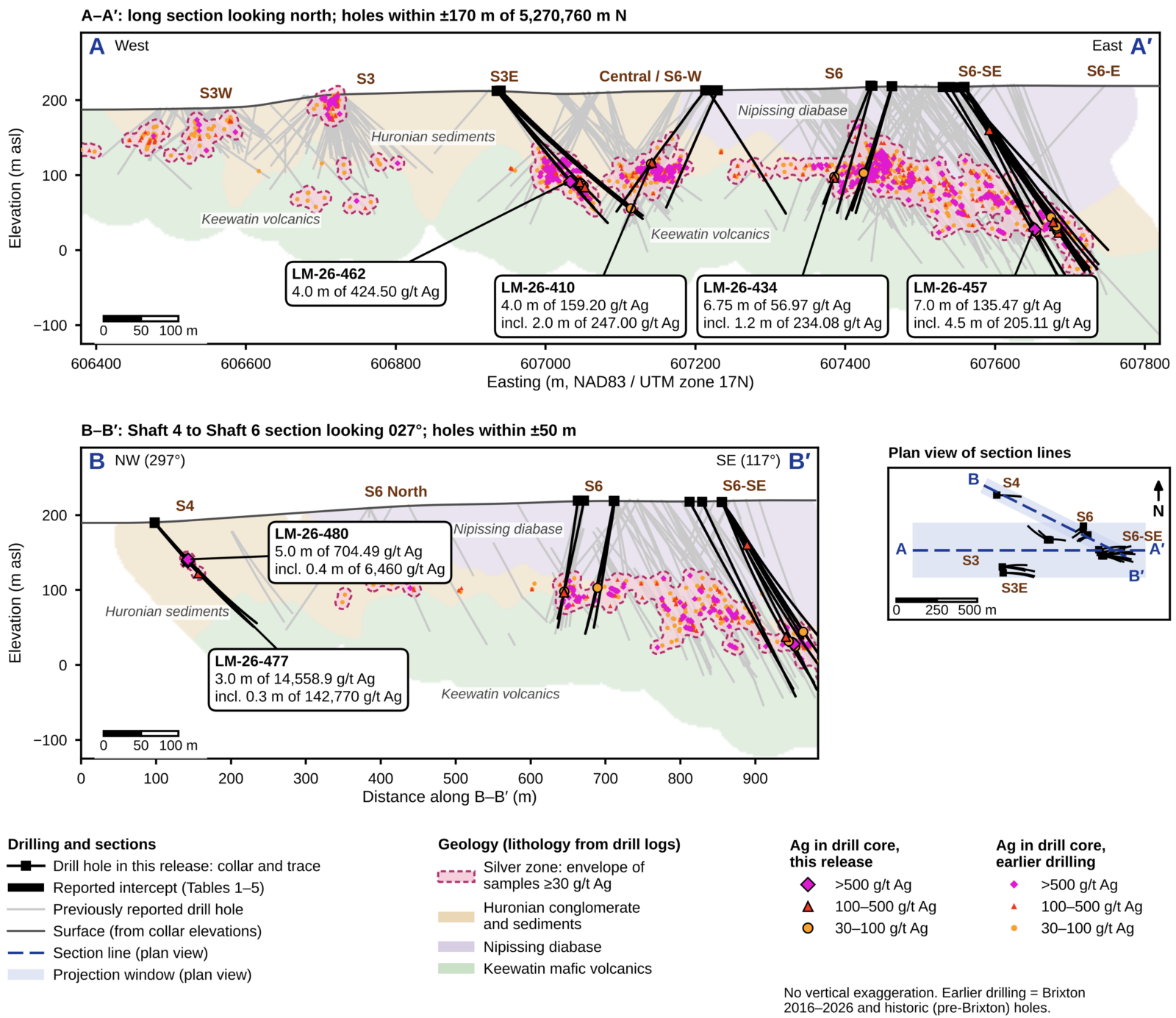
Shaded zones are envelopes around samples ≥30 g/t Ag. Background lithology (Huronian conglomerate and sediments, Nipissing diabase, Keewatin mafic volcanics) is interpolated from drill logs. No vertical exaggeration. Projection: samples up to 170 m (A–A’) or 50 m (B–B’) from the section line appear together, so intercepts that look close on the section may be separated in three dimensions. Shaded zones are a visual aid only, with the same limitations as noted under Figure 4. Reported intercepts are core lengths; true widths are not yet known.
Figure 6. Plan map of the Shaft 4 and Shaft 6 areas showing the ten best drill intervals reported by Brixton in 2026, including results from this news release.
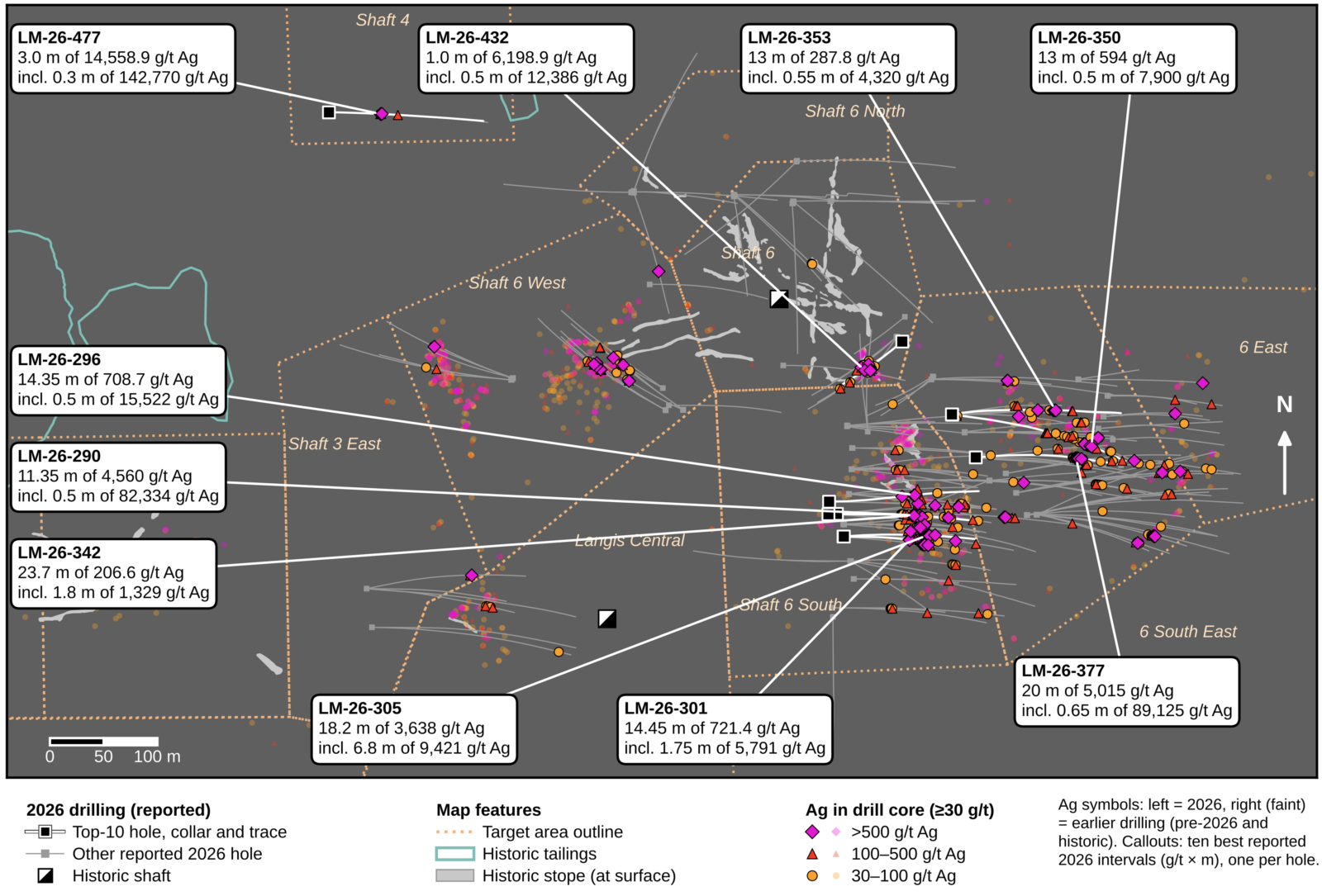
Intervals are ranked by grade × length (g/t Ag × m), one interval per hole, as previously reported in Brixton’s 2026 news releases or in Tables 1 to 5 of this release. Only 2026 holes with reported assays are drawn. Symbols show individual drill core samples ≥30 g/t Ag projected to surface: outlined symbols are from 2026 drilling, faint symbols are from earlier Brixton and historic (pre-Brixton) drilling, shown for context only. They are a visual aid only and do not imply continuity of mineralization between drill holes. Reported intercepts are core lengths; true widths are not yet known.
Table 6. Drill hole collar information for reported holes.
| Hole ID | Pad ID | Easting (m) |
Northing (m) |
Elevation (m) |
Azimuth | Dip | Depth (m) |
Zone |
| LM-26-397 | LM-2026-070 | 607530 | 5270763 | 217.7 | 80 | -50 | 300.00 | Shaft 6-SE |
| LM-26-409 | LM-2026-071 | 607540 | 5270745 | 217.5 | 80 | -60 | 300.00 | Shaft 6-SE |
| LM-26-410 | LM-2026-039 | 607213 | 5270823 | 213.0 | 300 | -45 | 219.00 | Shaft 6-W |
| LM-26-411 | LM-2026-072 | 607550 | 5270725 | 217.3 | 80 | -55 | 300.00 | Shaft 6-SE |
| LM-26-413 | LM-2026-072 | 607550 | 5270725 | 217.3 | 80 | -50 | 300.00 | Shaft 6-SE |
| LM-26-414 | LM-2026-039 | 607216 | 5270827 | 213.0 | 90 | -55 | 195.00 | Shaft 6-W |
| LM-26-415 | LM-2026-072 | 607550 | 5270725 | 217.3 | 80 | -45 | 297.00 | Shaft 6-SE |
| LM-26-418 | LM-2026-092 | 607230 | 5270823 | 213.1 | 305 | -60 | 180.00 | Shaft 6-W |
| LM-26-434 | LM-2026-102 | 607434 | 5270886 | 219.4 | 230 | -62 | 177.00 | Shaft 6 |
| LM-26-447 | LM-2026-094 | 607559 | 5270725 | 217.4 | 90 | -56 | 300.00 | Shaft 6-SE |
| LM-26-448 | LM-2026-104 | 607436 | 5270910 | 219.1 | 230 | -70 | 180.00 | Shaft6 |
| LM-26-450 | LM-2026-105 | 607462 | 5270854 | 218.7 | 230 | -70 | 180.00 | Shaft6 |
| LM-26-451 | LM-2026-094 | 607559 | 5270725 | 217.4 | 96 | -50 | 300.00 | Shaft 6-SE |
| LM-26-452 | LM-2026-105 | 607463 | 5270853 | 218.7 | 220 | -70 | 192.00 | Shaft6 |
| LM-26-453 | LM-2026-094 | 607559 | 5270725 | 217.4 | 100 | -58 | 213.00 | Shaft 6-SE |
| LM-26-454 | LM-2026-105 | 607462 | 5270854 | 218.7 | 240 | -70 | 177.00 | Shaft6 |
| LM-26-455 | LM-2026-100 | 606935 | 5270656 | 212.3 | 90 | -50 | 204.00 | Shaft 3 |
| LM-26-456 | LM-2026-100 | 606935 | 5270656 | 212.3 | 95 | -50 | 205.00 | Shaft 3 |
| LM-26-457 | LM-2026-094 | 607559 | 5270725 | 217.4 | 100 | -62 | 282.00 | Shaft 6-SE |
| LM-26-458 | LM-2026-100 | 606935 | 5270656 | 212.3 | 95 | -45 | 261.00 | Shaft 3 |
| LM-26-459 | LM-2026-094 | 607559 | 5270725 | 217.4 | 90 | -56 | 300.00 | Shaft 6-SE |
| LM-26-461 | LM-2026-094 | 607559 | 5270725 | 217.4 | 76 | -57 | 303.00 | Shaft 6-SE |
| LM-26-462 | LM-2026-100 | 606935 | 5270656 | 212.3 | 80 | -50 | 231.00 | Shaft 3 |
| LM-26-463 | LM-2026-094 | 607559 | 5270725 | 217.4 | 68 | -56 | 300.00 | Shaft 6-SE |
| LM-26-464 | LM-2026-010 | 606940 | 5270620 | 212.9 | 90 | -45 | 255.00 | Shaft 3 |
| LM-26-466 | LM-2026-010 | 606940 | 5270620 | 212.9 | 90 | -50 | 252.00 | Shaft 3 |
| LM-26-477 | LM-2026-044 | 606900 | 5271100 | 189.5 | 90 | -50 | 201.00 | Shaft 4 |
| LM-26-480 | LM-2026-044 | 606900 | 5271100 | 190.1 | 90 | -45 | 201.00 | Shaft 4 |
Quality Assurance & Quality Control
Quality assurance and quality control protocols for drill core sampling were developed by Brixton. Core samples were mostly taken at 2.0 m intervals. High-grade intervals were taken at 0.50 m to 1.00 m intervals. Blanks, duplicates (lab pulp), and certified reference materials were inserted at a combined rate of up to 15%. Core samples were cut in half, bagged, zip-tied, and sent directly to the ALS Minerals preparation facility in Sudbury, Ontario. ALS Minerals Laboratories is registered to ISO 9001:2015 and accredited to ISO/IEC 17025:2017 for laboratory procedures. Samples were analyzed at ALS Laboratory Facilities in North Vancouver, British Columbia, for gold by fire assay with an atomic absorption finish. Ag, Pb, Cu, and Zn, as well as 48 additional elements, were analyzed using a four-acid digestion with an ICP-MS finish. Overlimit silver samples were analyzed using fire assay and gravimetric finish, and/or fire assay and gravimetric finish on concentrates. The certified reference materials were acquired from CDN Resource Laboratories Ltd. of Langley, British Columbia, and the standards inserted varied with the type and abundance of mineralization observed in the primary sample. Blank material used consisted of non-mineralized siliceous landscaping rock. A copy of the QAQC protocols is available on the Company’s website.
About the Langis Project
An Exploration Target of 1.0 to 2.0 million tonnes grading 400 to 800 g/t silver has been conceptualized for the project. Note: The potential quantity and grade of the Exploration Target are conceptual. Insufficient exploration has been completed to define a mineral resource, and there is no certainty that further exploration will result in the target being delineated as a mineral resource.
The wholly owned Langis Silver Project, located approximately 500 km north of Toronto, Ontario, Canada, includes a former producing mine and benefits from excellent infrastructure, including all-season road access, power, rail connections, and a refiner. Silver mineralization occurs as native silver and in steeply to moderately dipping veins, veinlets, disseminations, rosettes, and fracture infill, often associated with minerals such as calcite, hematite, pyrite, cobaltite, chalcopyrite, niccolite, and gold. Mineralization is hosted across three principal rock types: Archean Keewatin volcanic and metasedimentary rocks, Proterozoic Coleman Member sedimentary rocks of the Huronian Supergroup, and Proterozoic Nipissing diabase. The geological deposit model for the area is a continental-rift extensional depositional environment. The Langis Mine produced 10.4 million ounces of silver intermittently between 1908 and 1989 at a head grade of 20 to 25 opt, with reported recoveries of 88% to 98%. Previous operators developed over 10 km of underground workings; however, shafts and openings have been capped and sealed. Historically, reported silver mines in the Cobalt Camp have collectively produced over 445 million ounces of silver. We also understand, through personal communication with mine workers in the camp, that ultra-high-grade native silver collector pieces did not make it through the mills, suggesting that the camp’s actual silver production is significantly higher than the reported numbers. The historic production figures referenced above are sourced from third-party records and personal communications, have not been verified by Brixton or by the Qualified Person, and should not be relied upon.
Qualified Person (QP)
Mr. Gary Thompson, P.Geo., is the Chairman and CEO and a senior geologist for the Company who is a Qualified Person as defined by National Instrument 43-101. Mr. Thompson has verified the referenced data and analytical results disclosed in this press release and has approved the technical information presented herein.
About Brixton Metals Corporation
Brixton Metals is a Canadian exploration company focused on advancing its mining projects. Brixton wholly owns five exploration projects: the Thorn copper-gold-silver-molybdenum Project in NW British Columbia; the Hog Heaven copper-silver-gold Project in NW Montana, USA, which is optioned to Ivanhoe Electric Inc.; the Langis and Hudson Bay silver Projects in Ontario; and the Atlin Goldfields Project in northwest BC. Brixton holds an option to acquire a 100% interest in the silver-focused Silvergruvan Project in Sweden.
Hercules Metals Corp. (TSX-V: BIG) (OTCQB: BADEF) is pleased to a... READ MORE
Yukon Metals Corp. (CSE: YMC) (FSE: E770) (OTCQB: YMMCF) is pleas... READ MORE
Aben Gold Corp. (TSX-V: ABM) (OTCID: ABNAF) (Frankfurt: ML1) i... READ MORE
Highlights Selkirk Copper has completed a two-phase drill program... READ MORE