







Brixton Metals Corporation (TSX-V: BBB) (OTCQB: BBBXF) is pleased to announce the first results from its ongoing exploration program at the wholly owned Langis Silver Project. The past producing Langis mine site is located approximately 500 kilometres north of Toronto and benefits from excellent infrastructure, including all-season road access, power, rail connections, and a refiner. The 2026 drill campaign represents a significant milestone for the Langis Project, focused on both expansion and infill drilling of established high-grade silver zones and the evaluation of new mineralized areas along key structural trends. To date in 2026, approximately 6226 metres have been completed in 32 drill holes, and assay results from 9 holes are reported herein.
Highlights
Chairman, CEO, Gary R. Thompson stated, “We are delighted to report the first batch of drill results from the Langis 2026 drill program. Langis continues to deliver strong silver grades at shallow depths and silver mineralization remains open in multiple directions. Drilling continues in the Shaft 6 area with the goal of developing new mineralized trends away from the underground workings. In addition, Brixton plans to evaluate and quantify silver in its tailings on private patents at Langis. Samples collected by the previous owners returned between 1.5 and 4.0 opt silver from these tailings. Sonic grid drilling and metallurgical work is planned as soon as spring arrives.”
Chairman & CEO Gary Thompson provides a video summary of the news release: https://youtu.be/E0wFyZdoYDM
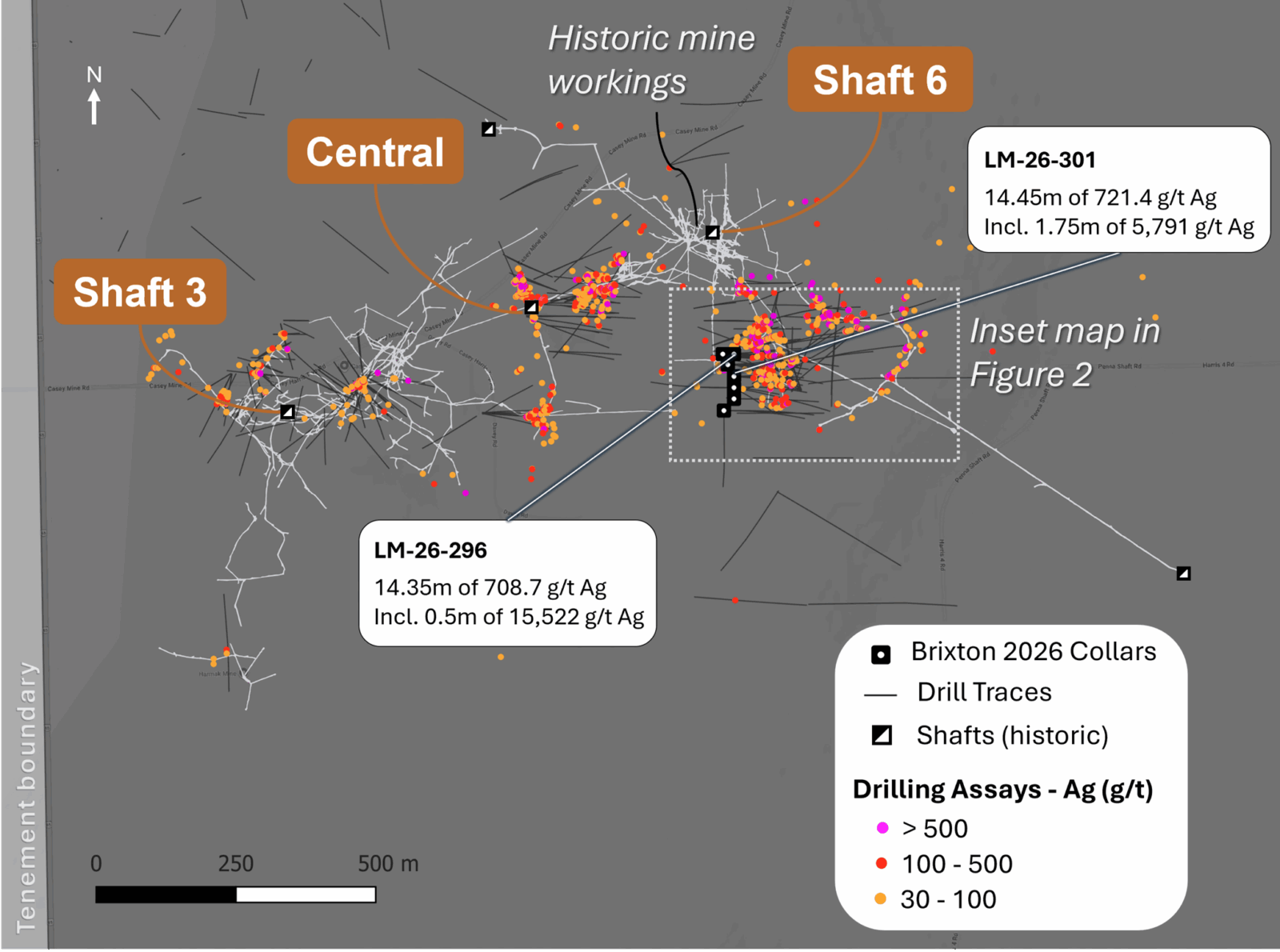
Figure 1. Location map of drill holes referenced in this news release within the Langis project.
Discussion
The initial drill holes for this season were positioned to evaluate silver mineralization south of the Shaft 6 area (Figures 1 & 2). Previous exploration campaigns in this region identified silver predominantly hosted within vertical, dilatant zones and shear veins, manifesting as native silver. Several holes reported in this release successfully intercepted silver mineralization (Table 1). Notably, holes LM-26-296 and LM-26-301 returned continuous silver mineralization over a 10‑plus‑metre interval, highlighted by localized very high‑grade zones (Figures 3 & 4).
Silver mineralization in hole LM-26-296 is hosted by sulfosalts, with associated cobalt and nickel arsenide minerals observed (Figure 5). In contrast, silver mineralization in hole LM-26-301 occurs primarily as visible native silver (Figure 6 & 7). These variations in mineral association may reflect different stages of mineralization and or localized remobilization of silver. The collars of holes LM-26-296 and LM-26-301 are located approximately 40 metres apart, supporting the continuity of mineralization within this target area. Drilling continues in the Langis Shaft 6 area, focusing on expanding and infilling known silver mineralization.
Figure 2. Detailed map of drill holes in this news release of the Shaft 6 area.
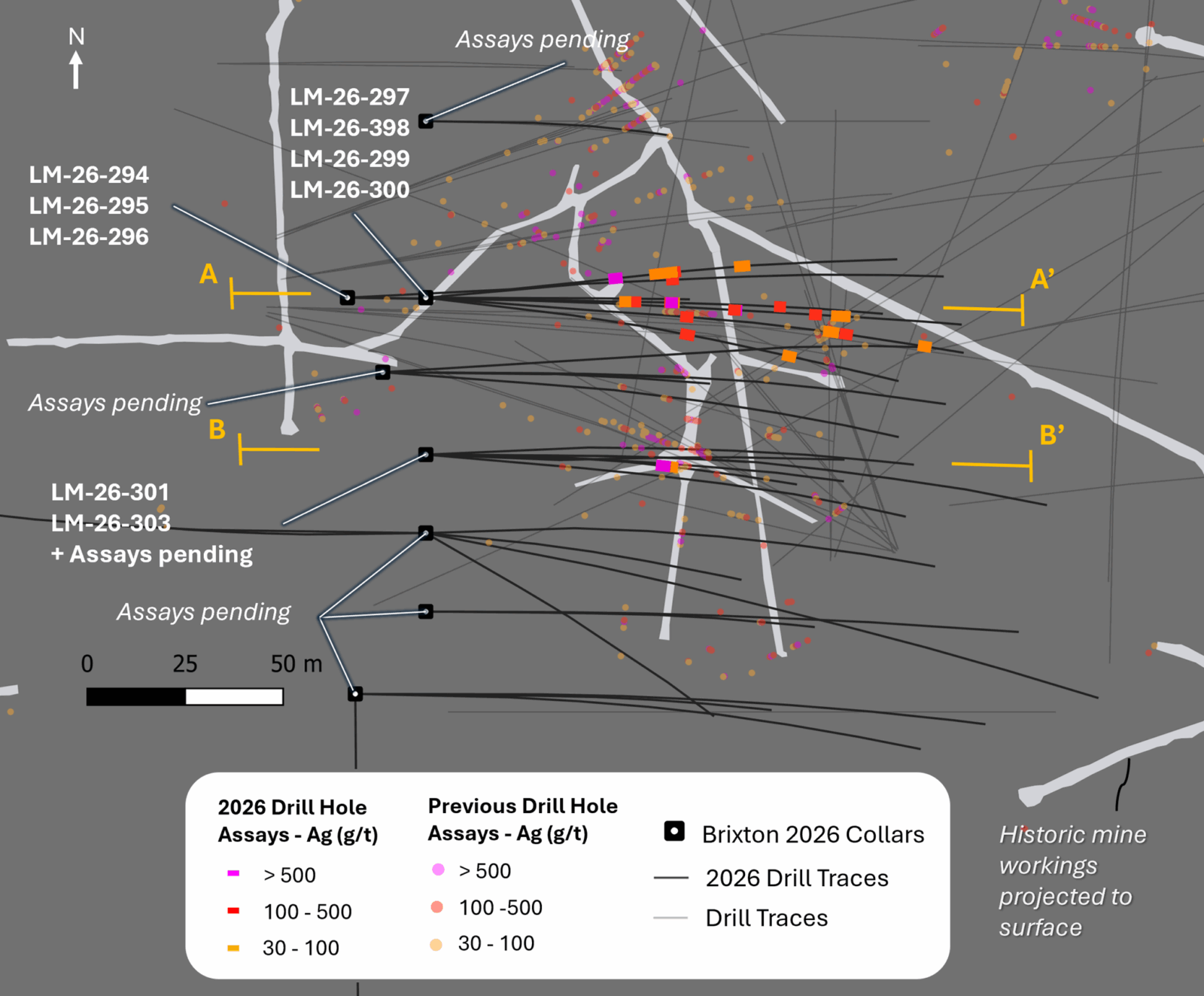
Figure 3. A to A’ Cross Section Looking North showing drillholes LM-26-296 and LM-26-300
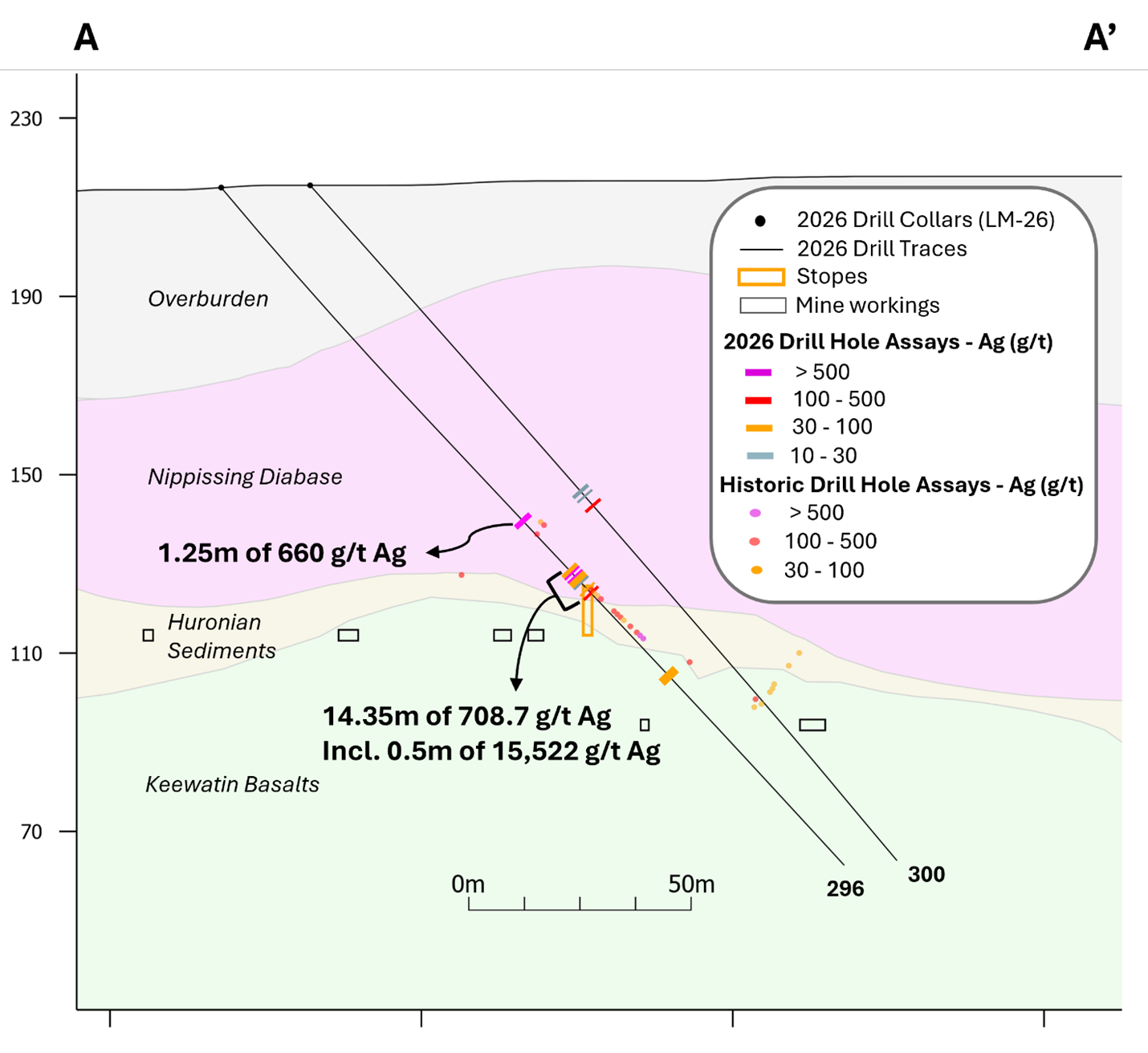
This cross-section displays only drill holes oriented subparallel to the section (85° ±4° azimuth); drillholes with other orientations are omitted. Lithological contacts are interpretive and based on prior drilling.
Figure 4. B to B’ Cross Section Looking North showing drillholes LM-26-301 and LM-26-303.
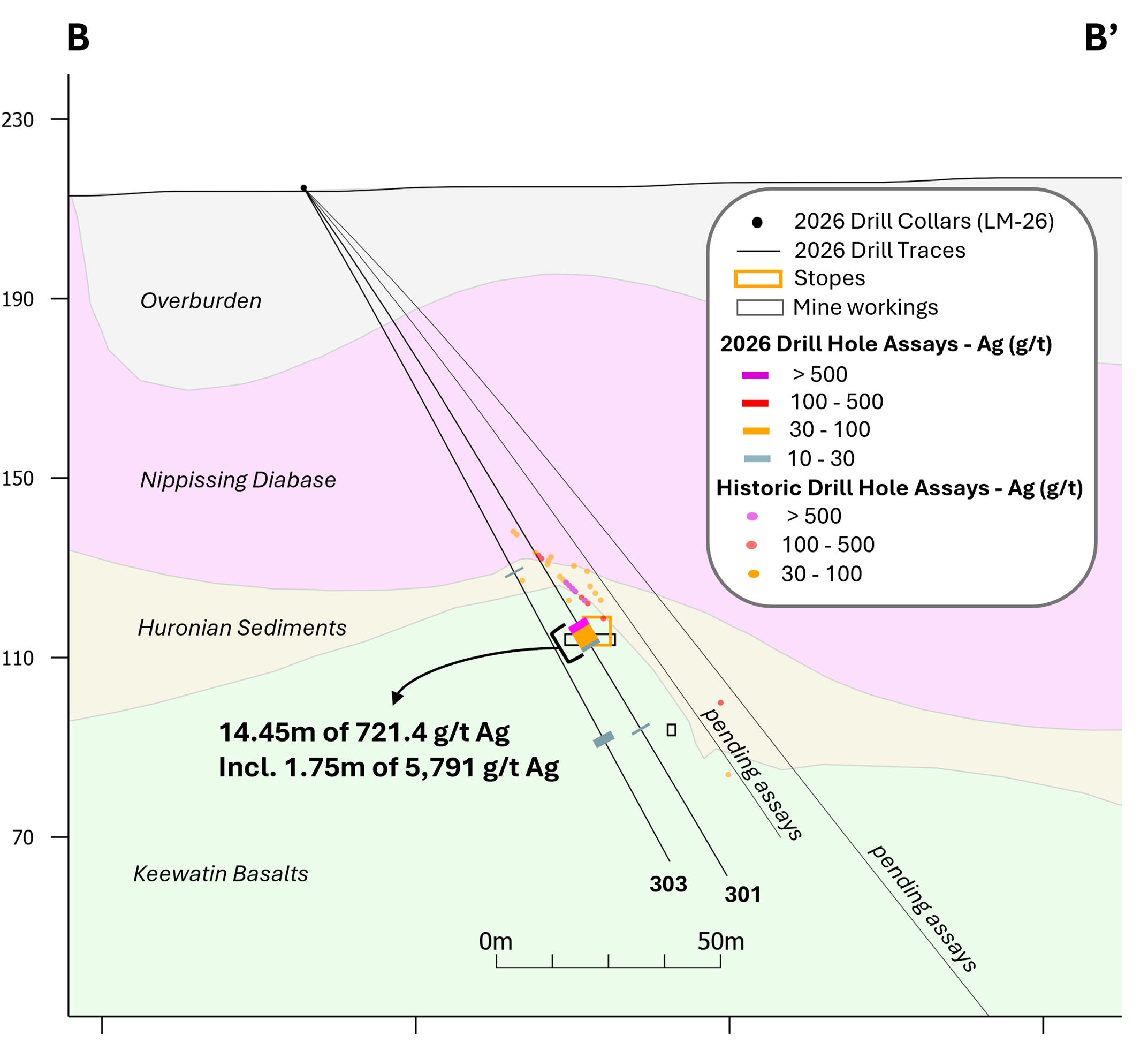
This cross-section displays only drill holes oriented subparallel to the section (90° ±4° azimuth); drillholes with other orientations are omitted. Lithological contacts are interpretive and based on prior drilling.
Figure 5. Photograph of NQ Core LM-26-296 at 118.6m, of native silver and sulfosalt vein.
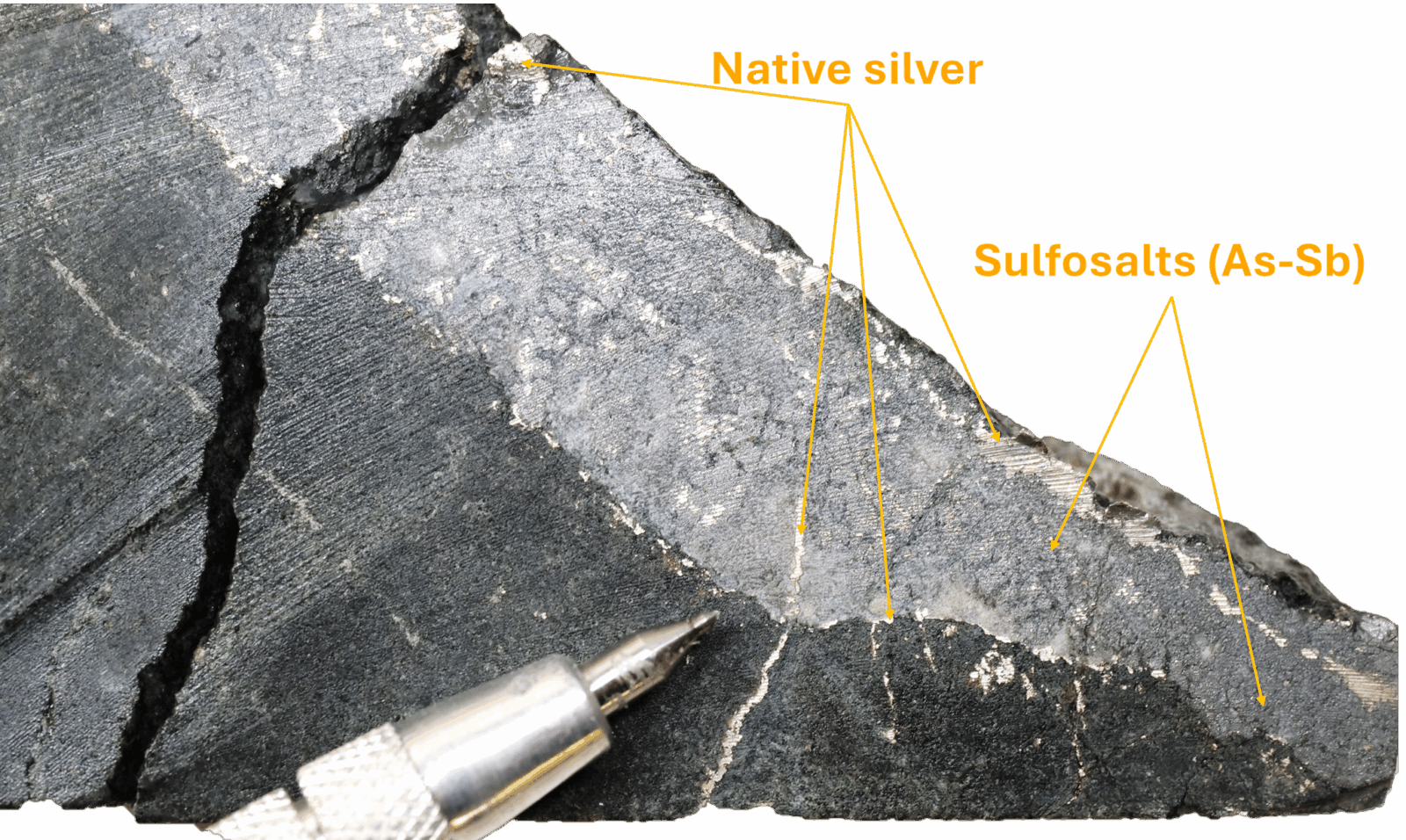
Figure 6. Photograph of NQ Core LM-26-301 at 115.65m, of native silver within carbonate veins.
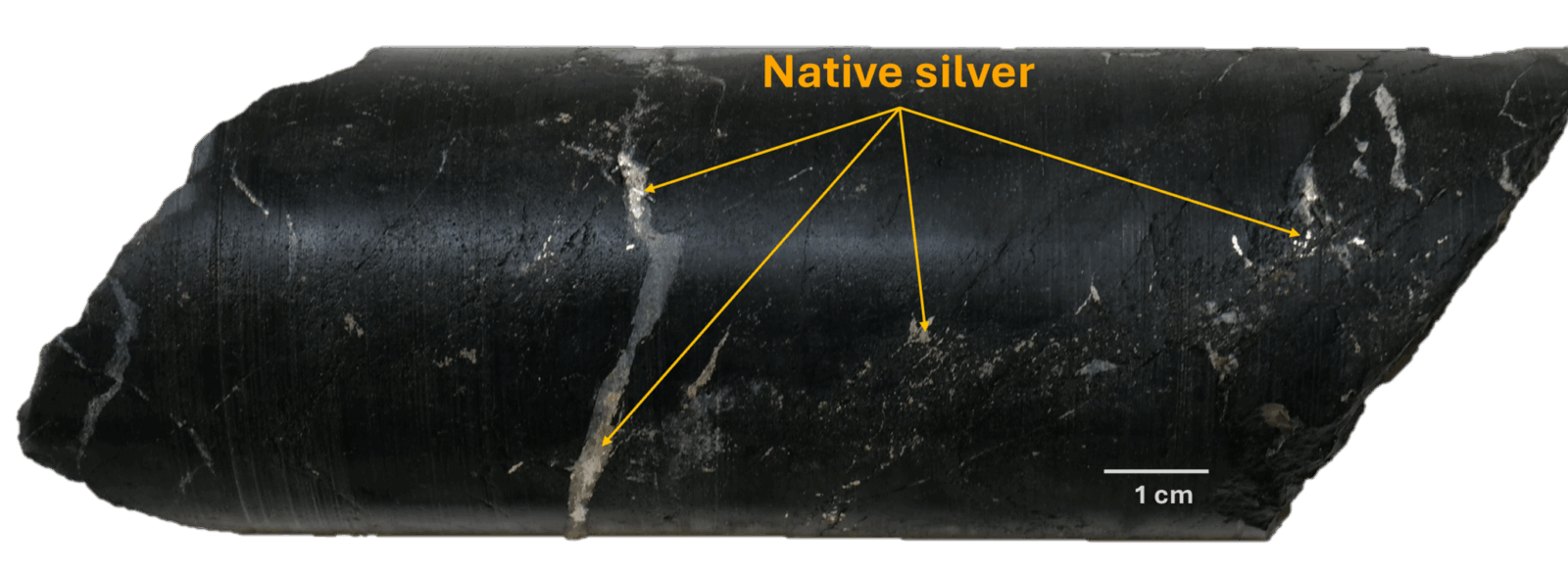
Table 1. Select Assay Intervals for Silver.
| Hole ID | From | To | Interval | Silver |
| meter | meter | meter | g/t | |
| LM-26-294 | 132.00 | 136.25 | 4.25 | 135.27 |
| including | 134.75 | 135.75 | 1.00 | 546.00 |
| LM-26-294 | 163.00 | 173.65 | 10.65 | 61.15 |
| including | 163.00 | 165.00 | 2.00 | 142.55 |
| including | 170.65 | 173.65 | 3.00 | 110.06 |
| LM-26-295 | 105.00 | 131.00 | 26.00 | 54.01 |
| including | 105.80 | 110.00 | 4.20 | 176.24 |
| including | 123.00 | 124.00 | 1.00 | 461.50 |
| LM-26-296 | 100.50 | 101.75 | 1.25 | 660.00 |
| LM-26-296 | 116.00 | 130.35 | 14.35 | 708.71 |
| including | 118.00 | 118.50 | 0.50 | 15,522.00 |
| LM-26-297 | No Significant Intervals | |||
| LM-26-298 | 98.45 | 99.35 | 0.90 | 282.00 |
| 151.70 | 162.00 | 10.30 | 22.33 | |
| 187.00 | 190.00 | 3.00 | 38.07 | |
| LM-26-299 | 108.00 | 113.00 | 5.00 | 72.16 |
| 153.00 | 154.30 | 1.30 | 41.60 | |
| LM-26-300 | 91.40 | 96.40 | 5.00 | 39.94 |
| LM-26-301 | 109.55 | 124.00 | 14.45 | 721.40 |
| including | 114.50 | 116.25 | 1.75 | 5,791.43 |
| LM-26-303 | 97.00 | 98.00 | 1.00 | 8.64 |
| 102.85 | 103.90 | 1.05 | 9.70 | |
| 139.00 | 141.00 | 2.00 | 29.90 | |
Assay values are weighted averages. Reported intervals are drilling length, and the true width of the mineralized intervals has not yet been determined.
Figure 7. NQ sized Core in LM-26-301 at 115.50m depth of native silver.
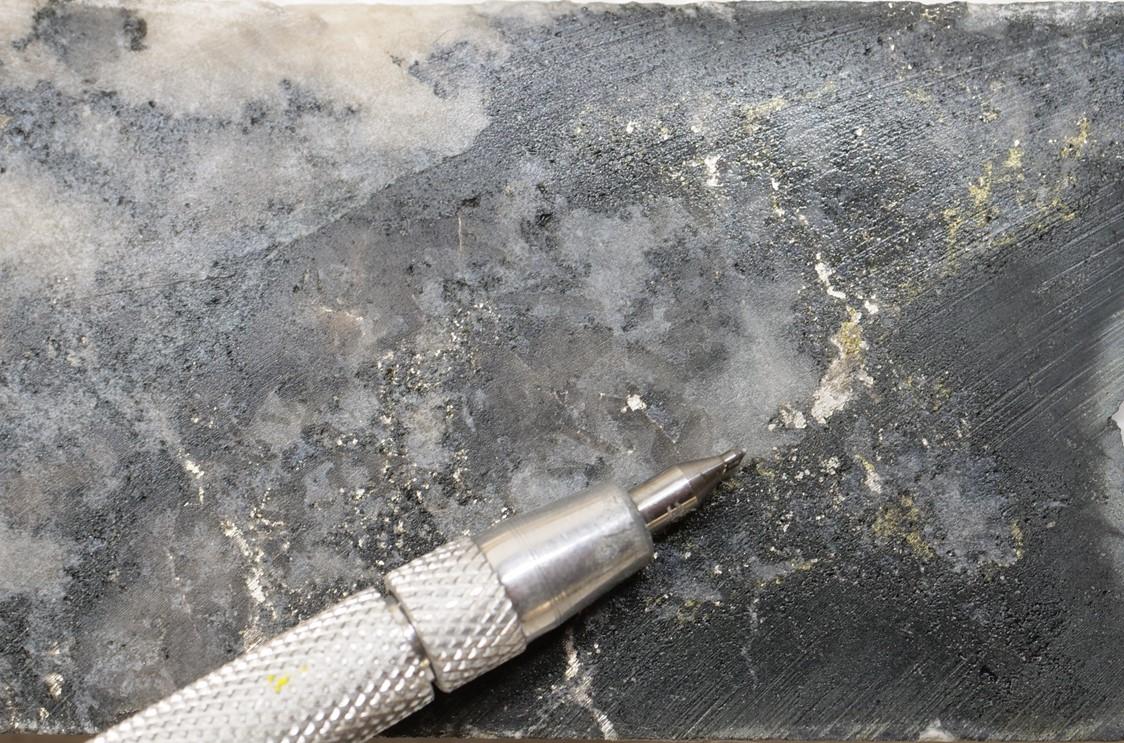
Table 2. Drill Collar Information.
| Hole ID | Easting (m) |
Northing (m) |
Elevation (m) |
Azimuth | Dip | Depth (m) |
| LM-26-294 | 607365 | 5270745 | 214 | 90 | -45 | 213.00 |
| LM-26-295 | 607365 | 5270745 | 214 | 90 | -48 | 204.00 |
| LM-26-296 | 607365 | 5270745 | 214 | 85 | -45 | 207.00 |
| LM-26-297 | 607385 | 5270745 | 214 | 90 | -48 | 101.50 |
| LM-26-298 | 607385 | 5270745 | 214 | 95 | -45 | 203.00 |
| LM-26-299 | 607385 | 5270745 | 214 | 96 | -50 | 150.00 |
| LM-26-300 | 607385 | 5270745 | 214 | 83 | -48 | 201.00 |
| LM-26-301 | 607385 | 5270705 | 214 | 90 | -55 | 180.00 |
| LM-26-303 | 607385 | 5270705 | 214 | 90 | -60 | 171.00 |
About the Langis Silver Project
The wholly owned Langis Silver Project includes a former producing Langis silver mine operated by Agnico and was closed in 1989 due to low silver prices. The Langis Silver Project is located approximately 500 kilometres north of Toronto, Ontario, Canada, with excellent infrastructure. Silver mineralization is found as visible native silver and occurs in steeply to moderately dipping veins, veinlets, disseminations, rosettes, and fracture infill, often associated with minerals such as calcite, hematite, pyrite, cobaltite, chalcopyrite, niccolite and gold. Mineralization is hosted across three principal rock types: Archean Keewatin volcanic and metasedimentary rocks, Proterozoic Coleman Member sedimentary rocks of the Huronian Supergroup, and Proterozoic Nipissing diabase. The geological ore deposit model for this area is a continental-rift extensional depositional environment. Intermittently from 1908 to 1989, the Langis Mine produced 10.4 million ounces of silver at a head grade of 25 opt. Reported silver recoveries at Langis were 88% to 98%. Over 10km of underground workings were developed by previous operators; however, shafts and openings have been capped and sealed. Historically, mines in the Cobalt Camp have collectively produced over 500 million ounces of silver.
Quality Assurance & Quality Control
Quality assurance and quality control protocols for drill core sampling were developed by Brixton. Core samples were mostly taken at 1.5m intervals. High-grade intervals were taken at 0.50m to 1.00m intervals. Blank, duplicate (lab pulp), and certified reference materials were inserted at a combined rate of up to 15%. Core samples were cut in half, bagged, zip-tied, and sent directly to the ALS Minerals preparation facility in Sudbury, Ontario. ALS Minerals Laboratories is registered to ISO 9001:2008 and ISO 17025 accreditations for laboratory procedures. Samples were analyzed at ALS Laboratory Facilities in North Vancouver, British Columbia, for gold by fire assay with an atomic absorption finish. Ag, Pb, Cu, and Zn, as well as 48 additional elements, were analyzed using a four-acid digestion with an ICP-MS finish. Over-limits for silver were analyzed using fire assay and gravimetric finish, and/or fire assay and gravimetric finish on concentrates. The certified reference materials were acquired from CDN Resource Laboratories Ltd. of Langley, British Columbia, and the standards inserted varied with the type and abundance of mineralization observed in the primary sample. Blank material used consisted of non-mineralized siliceous landscaping rock. A copy of the QAQC protocols is available on the Company’s website.
Qualified Person
Mr. Martin Ethier, P.Geo., is a consultant for the Company who is a Qualified Person as defined by National Instrument 43-101. Mr. Ethier has verified the referenced data and analytical results disclosed in this press release and has approved the technical information presented herein.
About Brixton Metals Corporation
Brixton Metals is a Canadian exploration company focused on the advancement of its mining projects. Brixton wholly owns four exploration projects: Brixton’s flagship Thorn copper-gold-silver-molybdenum Project, the Hog Heaven copper-gold-silver Project in NW Montana, USA, which is optioned to Ivanhoe Electric Inc., the Langis and HudBay silver Projects in Ontario and the Atlin Goldfields Project located in northwest BC, which is optioned to Eldorado Gold Corporation.
Goliath Resources Limited (TSX-V: GOT) (OTCQX: GOTRF) (Frankfurt:... READ MORE
Critical Metals Corp. (Nasdaq: CRML) a leading critical minerals ... READ MORE
Greenridge Exploration Inc. (CSE: GXP) (FRA: HW3) (OTCQB: GXPLF),... READ MORE
Uranium Sales at $101 per Pound – Demonstrating the Strengt... READ MORE