






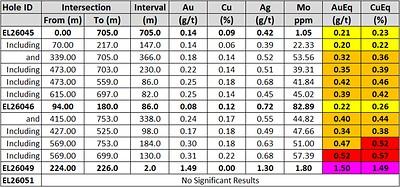
Arras Minerals Corp. (TSX-V: ARK) (OTCQB: ARRKF) is pleased to provide additional results from the Berezski Central target, where drill holes EL26045 and EL26046 have returned significant intercepts of copper-gold mineralization.
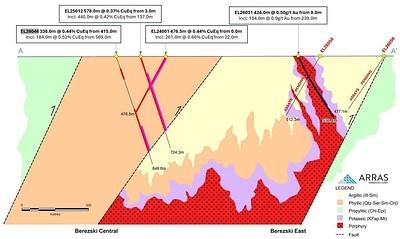
Drill hole EL26046 intersected multiple zones of copper-gold mineralization, including 184 metres grading 0.52% CuEq within a broader interval of 338 metres grading 0.44% CuEq starting at a depth of 415 metres. Of particular significance, drill hole EL26045 intersected continuous copper-gold mineralization from surface to the end of the hole, returning 705 metres grading 0.23% CuEq, including a higher-grade interval of 366 metres grading 0.36% CuEq starting at a depth of 339 metres.
Highlights
Mineralization in both holes is associated with disseminated chalcopyrite and quartz-chalcopyrite-molybdenite veining.
Tim Barry, CEO of Arras Minerals commented, “These latest results from Berezski Central are demonstrating the growing scale and continuity of the copper-gold mineralization we are discovering at Berezski Central. Hole EL26045 returned an impressive 705 metres of continuous mineralization from surface, including a higher-grade interval of 366 metres grading 0.36% CuEq from 339m depth. Meanwhile, hole EL26046 returned multiple mineralized zones, including a deeper interval of 184 metres grading 0.52% CuEq.” He went on to add, “Over the past 10 months at Berezski Central alone, we have made significant progress with mineralization now defined over an area exceeding 1,000 metres by 600 metres and to depths of more than 700 metres. Importantly, the KGK drilling results suggest that the system could extend considerably beyond these dimensions. We believe Berezski Central has the potential to develop into a much larger copper-gold discovery, and we are excited by the opportunities ahead as we continue to test its scale, continuity and overall potential.”
Berezski Central – Continued Expansion
In Q1 2025, the Company announced the initial drill results from Berezski Central, highlighting wide zones of copper-gold mineralization starting immediately below surface. Over the past 12 months, the Company has substantially enlarged the footprint of the Berezski Central deposit, and mineralization is now defined over a length of 1,000 meters, by a width of 600 meters and to depths exceeding 700 meters.
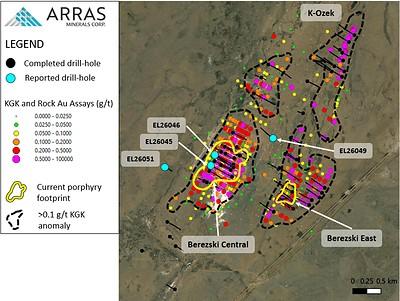
The expansion of the Berezski Central footprint over the past 10 months has been significant, and, most importantly, the results from top of bedrock (KGK) drilling indicate that the mineralized zone can be significantly extended beyond the current drilling limits, potentially by an additional 50–100% (see Figure 1).
Recent exploration drilling has targeted a number of these KGK gold anomalies, and in drill holes targeting the zone to the east of Berezski East, drilling has encountered wide intervals of stockwork pyrite veining and several epithermal-type quartz-sulphide veins. Additionally, drilling to the northeast of Berezski Central has intersected multiple zones of porphyry-style veining. While assay results remain pending, these visual observations are highly encouraging as they strongly support the model of multiple porphyry systems along the Berezski Trend and the presence of a potentially large epithermal gold system running along its eastern margin.
| Notes: Copper and gold equivalent calculations use the following metal prices: US$3.75/lb copper, US$3,000/oz gold, US$35/oz silver and US$30/lb molybdenum. Metallurgical recoveries are Cu 90%, Au 85%, Ag 75% and Mo 80%. All intervals are presented as core lengths; true thicknesses of mineralization are currently unknown.
|
| Notes: Copper and gold equivalent calculations use the following metal prices: US$3.75/lb copper, US$3,000/oz gold, US$35/oz silver and US$30/lb molybdenum. Metallurgical recoveries are Cu 90%, Au 85%, Ag 75% and Mo 80%. All intervals are presented as core lengths; true thicknesses of mineralization are currently unknown. |
Table 1. Summary of drill-hole assay results.
| Notes: Copper and gold equivalent calculations use the following metal prices: US$3.75/lb copper, US$3,000/oz gold, US$35/oz silver and US$30/lb molybdenum. Metallurgical recoveries are Cu 90%, Au 85%, Ag 75% and Mo 80%. All intervals are presented as core lengths; true thicknesses of mineralization are currently unknown |
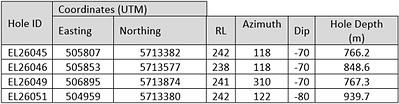
Table 2. Drill-hole collar locations
Drill-Hole Summaries
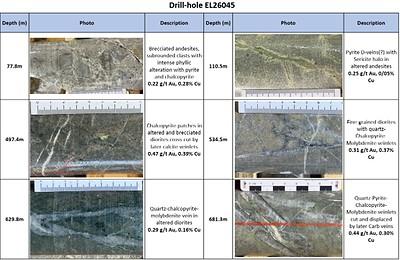
EL26045 was drilled to test the southern continuation of Berezski Central mineralisation. The hole was collared in altered and fractured andesites to a depth of 209.1 m before passing into fine- to medium-grained diorites. The upper part of the drill hole is dominated by argillic alteration, while alteration in the deeper diorite is predominantly phyllic. Two intervals of silicification were intersected, consisting of massive quartz with local vuggy quartz development. Minor potassic alteration was observed just before the hole intersected a major fault at 748 m depth, after which alteration decreases significantly.
Mineralization is dominated by pyrite with chalcopyrite and minor molybdenite. Pyrite is generally disseminated, with local zones of pyrite veining. Chalcopyrite occurs initially as disseminations and later in quartz-sulphide and gypsum-bearing veins and in local patches. Molybdenite is present as trace amounts in gypsum-bearing fractures and within quartz-sulphide veins.
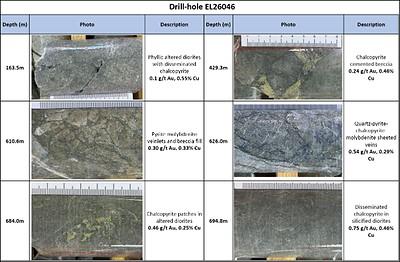
EL26046 is located at Berezski Central. The aim of the drill hole was to test the western margin of the Berezski Central target. It intersected fractured and locally brecciated andesite from surface to 97.4 m depth, before intersecting fractured and phyllic-altered diorites. A major fault was intersected at 774.8 m depth, and in the footwall of the fault, the rock changed to propylitic-altered andesites to the end of the hole.
Mineralization is dominated by pyrite, chalcopyrite and minor molybdenite, with local sphalerite and galena. Chalcopyrite appears as disseminations, patches and quartz-sulphide veins. Molybdenite is observed as trace amounts in gypsum-bearing veins, becoming more common at depth within quartz-sulphide veins together with chalcopyrite. From 526.4 to 602.8 m depth, minor sphalerite and galena occur as patches and veins.
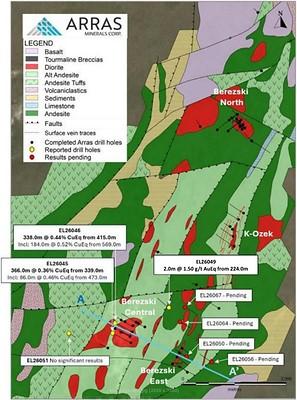
EL26049 is located approximately 1,000 m to the north-east of Berezski Central and tests a large IP chargeability high and a soil geochemical anomaly. The hole intersected relatively fresh andesites and andesite breccias to the end of the drill hole at 767.3 m depth. Several post-mineral dykes were also intersected. Alteration consisted of weak to moderate propylitic alteration overprinted by weak to moderate argillic alteration. Mineralization consisted of minor pyrite veining and zones of disseminated pyrite.
EL26051 was designed to test a large conductivity anomaly to the west of Berezski Central. The hole intersected volcaniclastic rocks (andesites with minor tuffaceous layers), cut by two medium-grained diorite intervals from 432.2 to 757.2 m and 915.8 to 938.7 m depth. Alteration is generally weakly propylitic with local weak argillic alteration. The diorites are generally fresh with minor argillic alteration along fractures and faults, and mineralization is generally weak, consisting of zones of sparse disseminated pyrite.
Exploration Update
Four diamond drill rigs are currently operating at Elemes with approximately 39,000 meters of drilling completed in 2026. Drilling is expected to continue into early December, which will likely extend the drill program to approximately 44,000 meters. Laboratory turnaround times, while still significantly delayed compared to last year, are improving. We expect further drill results to be released over the next five weeks, with releases continuing into Q1 2027.
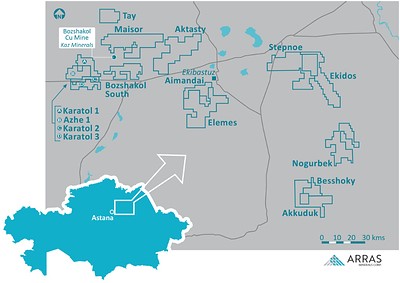
Elemes Project Overview: The Elemes Project comprises two exploration licences covering 531 square kilometres in northeastern Kazakhstan, approximately 13 km southwest of Ekibastuz and about 20 km from Arras’s operational base. The project benefits from established infrastructure, including a paved highway crossing the licence area and access to power, heavy rail and other utilities within approximately 15 km.
Situated within the prolific Bozshakol-Chingiz metallogenic belt, Elemes lies near significant regional deposits, including the Beskauga porphyry copper-gold-silver deposit (~80 km east) and KAZ Minerals’ Bozshakol copper-gold mine (~60 km northwest), which reported mined grades in Q1 2025 of 0.37% copper and 0.20 g/t gold. 1
Geologically, the property is underlain by interbedded intermediate volcanic and sedimentary rocks intruded by multiple phases of diorite and monzodiorite porphyry. Copper-gold mineralization occurs in sheeted and stockwork quartz-chalcopyrite veins associated with these intrusions. High-grade low-sulphidation epithermal veins have also been mapped on the property and represent an additional exploration target.
Property-wide soil sampling programs defined two extensive Cu-Mo-As geochemical trends: Berezski and Aimandai. A Phase 1 drill program on the Berezski Trend in late 2024 returned porphyry- and epithermal-style copper-gold mineralization, with results announced in Q1 2025. Approximately 10,000 metres of diamond drilling was completed in 2025, and a further 40,000 metres of drilling is expected to be completed by the end of 2026.
Issuance of DSUs
The Company has granted an aggregate of 37,184 deferred share units (“DSU”) to certain independent directors at a price of C$1.01 per DSU. The DSUs were granted in consideration for services rendered by the directors for the quarter ended October 31, 2026, in lieu of cash. The DSUs were granted in accordance with the Company’s Equity Incentive Plan and were priced based on the volume weighted average price of the Company’s common shares on the TSX Venture Exchange for the last five trading days immediately preceding the grant date. To date, the Company has issued a total of 268,805 DSUs to its independent directors.
References
1Bozshakol Q3, 2025 Report
https://kazminerals.com/app/uploads/2025/12/q3-2025-production-report_final.pdf
Quality Assurance and Quality Control
The Company adheres to CIM Best Practices Guidelines for exploration-related activities conducted on its property. Quality Assurance and Quality Control (QA/QC) procedures are overseen by the Qualified Person.
Arras Minerals QA/QC protocols are maintained through the insertion of certified reference material (standards), blanks and field duplicates within the sample stream. Drill core is cut at Arras Minerals’ operations base in Ekibastuz, Kazakhstan, by Company personnel. Diamond drill core was sawn in half with a diamond saw and sampled at maximum 2-metre intervals, stopping at geological boundaries, with one-half placed in sealed bags and shipped to the laboratory and the other half retained on site.
Each bagged core sample was shipped to ALS Laboratory in Karaganda, Kazakhstan. Samples were dried, crushed and pulverized to >80% passing -200 mesh. The prepared sample splits were sent to the ALS Chemex geochemical laboratories in Loughrea, County Galway, Ireland and Lima, Peru for multi-element analysis. Multi-element analyses were completed by ICP-MS following a four-acid digestion (method ME-MS61) and samples containing >1.0% copper were analyzed via method Cu-OG62.
Gold analysis was conducted by ALS Chemex at the analytical laboratory in Karaganda, Kazakhstan. Gold was analyzed by fire assay (30 g) with an AA (atomic absorption) finish (method Au-AA23) with a detection limit of 0.005 g/t gold. Samples containing greater than 10.0 g/t gold were analyzed by fire assay with a gravimetric finish (method Au-GRA21).
ALS is an accredited laboratory that is independent of the Company. Chain of custody is maintained from the drill to the submission to the laboratory preparation facility.
Qualified Person: The scientific and technical disclosure for this news release has been prepared under the supervision of, and approved by Matthew Booth, Vice President of Exploration, of Arras Minerals Corp., a Qualified Person for the purposes of NI 43-101. Mr. Booth has reviewed and approved this release. Mr. Booth has over 20 years of mineral exploration experience and is a Qualified Person and a member of the American Institute of Professional Geologists (CPG 12044).
About Arras Minerals Corp:
Arras is a Canadian exploration and development company advancing a portfolio of copper and gold assets in northeastern Kazakhstan, including the Elemes copper-gold porphyry project, where initial drill results in 2025 identified porphyry-style mineralization across a 10 km strike length. The Company has established one of the country’s largest land packages prospective for copper and gold.
Millennial Potash Corp. (TSX-V: MLP) (OTCQB: MLPNF) (FSE: X0D) is... READ MORE
SIGNFICANT GROWTH IN CASH POSITION Cash totaled $450.7M at Septem... READ MORE
Highlights: Every hole mineralized: All nine Phase 1 holes inters... READ MORE
Group Eleven Resources Corp. (TSX-V: ZNG) (OTCQB: GRLVF) (FSE: 3G... READ MORE