







Arizona Eagle Mining Corp. (TSX-V: AZEM) (OTCQB: AZEMF) is pleased to announce results from the final five holes of its Phase 1 drill program on the highly prospective Eagle Project, located in the historic McCabe gold-silver mining district in Arizona. The Phase 1 Drill Program’s objective was to target multiple northeasterly-striking, steeply-dipping sulphide-bearing quartz veins that may extend beyond the area covered by the historical resource estimate of approximately 880,000 ounces of gold at 11.7 g/t at McCabe.
These initial drill holes targeted the potential to the northeast, outside the area covered by the Historical Estimate, and intersected high-grade gold mineralization that remains open along strike, extending the mineralized strike by about 50 metres beyond the approximate 750 metre strike length covered by the Historical Estimate.
Drill holes Eagle-26-05 and Eagle-26-06, located approximately 200 metres and 250 metres northeast, respectively, of the McCabe Mine, both intersected high-grade zinc-silver VMS type mineralization. These intervals are on strike with three past-producing silver mines, recently acquired by Arizona Eagle, which are located approximately one kilometre northeast of the McCabe Mine. The zinc-silver VMS intervals appear to have many similarities to the past-producing Iron King Mine1, located approximately four kilometres on strike to the northeast of the McCabe Mine. Historic records at the Iron King Mine reported production from 1903 to 1969 of 5.7 million tons at a grade of 2.6 g/t gold, 98 g/t silver, 4.9% zinc, 1.8% lead, and 0.1% copper. The Iron King Mine was mined to depths below 1,000m, whereas the vertical depths of the VMS intervals reported in this release are at only approximately 150 metres.
Kevin Reid, Chief Executive Officer of Arizona Eagle, commented:
“The recently concluded Phase 1 drill program has validated our belief that high-grade gold and silver mineralization remains open beyond the area covered by the Historical Estimate. With the system open along strike and our drilling now stepping out toward our recently acquired Eagle Silver Project, we are excited about the district-scale exploration potential we are unlocking. Our second hole successfully tested the northeast extension beyond an interpreted fault offset where historic mining and underground exploration stopped. This shows the potential to define additional mineralization northeast of the area covered by the Historical Estimate. Holes five and six have intersected zinc-silver VMS type mineralization, which appears to be similar to that of the past-producing Iron King Mine, located four kilometers to the north. Initial drilling and sampling have identified a number of exploration targets on the Eagle Project in various types of mineralization. We are now compiling these results and have also commissioned a detailed SkyTem airborne geophysical survey to help delineate mineralization types and refine targets for a Phase 2 drill program.”
| HoleID | From (m) |
To (m) |
Length* (m) |
Au (g/t) |
Ag (g/t) |
Cu (ppm) |
Zn (%) |
Pb (%) |
| Eagle-26-01 | 355.7 | 356.9 | 1.2 | 2.73 | 3.28 | – | – | – |
| 410.9 | 412.4 | 1.5 | 2.23 | 6.03 | – | – | – | |
| 442.6 | 443.5 | 0.9 | 5.09 | 16.35 | – | – | – | |
| 446.8 | 447.6 | 0.8 | 1.86 | 1.50 | – | – | – | |
| Eagle-26-02 | 402.6 | 406.8 | 4.2 | 5.73 | 5.90 | – | – | – |
| including | 404.2 | 406.8 | 2.6 | 8.05 | 7.73 | – | – | – |
| and including | 406.0 | 406.8 | 0.8 | 11.35 | 11.15 | – | – | – |
| Eagle-26-02a | 375.5 | 377.2 | 1.7 | 1.16 | 7.38 | – | – | – |
| 379.6 | 382.4 | 2.8 | 0.54 | 5.99 | – | – | – | |
| Eagle-26-03 | 397.1 | 398.7 | 1.6 | 0.95 | 4.90 | 237 | 0.7 | 0.05 |
| Eagle-26-04 | 384.4 | 388.3 | 3.9 | 0.52 | 4.34 | 162 | 0.6 | 0.08 |
| Eagle-26-05 | 206.7 | 218.5 | 11.8 | 0.17 | 9.17 | 130 | 1.7 | 0.25 |
| including | 206.7 | 208.2 | 1.5 | 0.38 | 14.45 | 118 | 2.4 | 0.48 |
| including | 211.5 | 213.7 | 2.2 | 0.66 | 36.30 | 379 | 6.9 | 0.97 |
| 240.8 | 242.3 | 1.5 | 0.26 | 7.09 | 73 | 1.3 | 0.27 | |
| Eagle-26-06 | 223.1 | 224.0 | 0.9 | 0.79 | 8.15 | 236 | 17.1 | 0.01 |
| including | 223.4 | 224.0 | 0.6 | 1.17 | 12.05 | 345 | 25.5 | 0.01 |
| 274.9 | 275.5 | 0.6 | 0.46 | 9.22 | 361 | 3.0 | 0.03 | |
| 327.5 | 328.7 | 1.2 | 0.18 | 5.76 | 174 | 2.9 | 0.06 |
Table 1. Phase 1 Drilling assay intercepts (*more drilling is required to confirm true widths)
Drill Hole Descriptions:
EAGLE-26-03, EAGLE-26-04, EAGLE-26-05 and EAGLE-26-06 were designed to test the northeastern extension of the McCabe-Sooner mineralized system beyond the limits of the historical underground workings. Holes EAGLE-26-03 and EAGLE-26-04 intersected a sulphide-rich shear zone from approximately 390 to 400 m and 380 to 388 m downhole (vertical depths of approximately 150 metres), respectively, approximately along strike from the historically mined mineralization. The shear zone interval is characterized by blebby and banded arsenopyrite, pyrite, sphalerite, galena and tetrahedrite, accompanied by subordinate ductilely deformed quartz veining.
Stepping out further northeast, holes EAGLE-26-05 and EAGLE-26-06 intersected mineralization at shallower downhole depths (from 205-220 m and from 222-225 m downhole, respectively) and relatively off-strike from mineralization encountered in EAGLE-26-03 and EAGLE-26-04, suggesting post-mineral fault displacement, a bend or jog in the principal structure, or a separate mineralized structure. Additionally, the mineralization character changes from pyrite-arsenopyrite dominant to a more sphalerite-galena rich sulfide assemblage. The sulfides occur as semi-massive to matrix-fill within quartz-carbonate breccia veins. Cross-cutting relationships indicate that several generations of veining and deformation are present within the mineralized zone.
The mineralized shear zone cuts the Proterozoic Spud Mountain Volcanics, an assemblage of andesitic to basaltic flows and volcaniclastic rocks ranging from agglomerate and volcanic breccia to lapilli tuff and feldspar-crystal tuff. The sequence has been metamorphosed to lower greenschist facies and displays variable foliation development, although primary volcanic textures are well preserved.
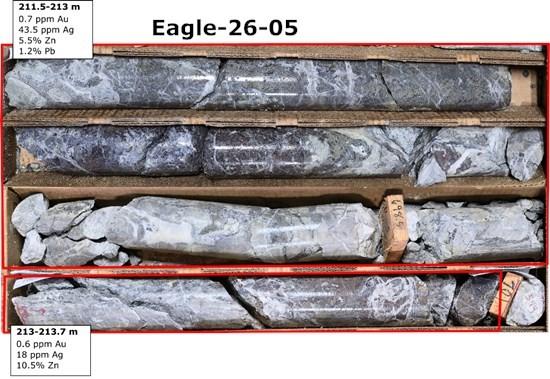
Figure 1. VMS mineralization in drill hole Eagle-26-05, located 200 m NE of the McCabe Mine, and 800m SW of three recently acquired past-producing silver mines (the Silver Parcels).
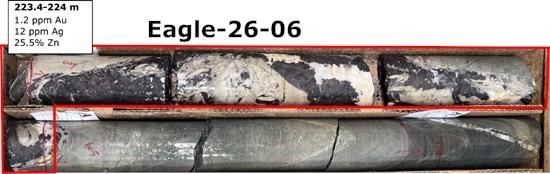
Figure 2. VMS mineralization in drill hole Eagle-26-06, located 200 m NE of the McCabe Mine, and 800m SW of three recently acquired past-producing silver mines (the Silver Parcels).
EAGLE-26-07 tested the southwestern extension of the mineralized structure near smaller-scale historical workings, including the Little Kicker shaft, where quartz-sulfide mineralization is exposed at surface. Although the target horizon was not intersected, drilling encountered gold mineralization typical of the McCabe system. The hole intersected two separate mineralized zones. The upper zone (from 122-130 m downhole) comprises an oxidized gossanous fault and shear zone developed along the contact between Cretaceous tonalite and Proterozoic metavolcanic rocks. A second, deeper zone (from 337-342 m downhole) comprises shear bands, veinlets, and fracture-fill sulphides, primarily pyrite and pyrrhotite, within strongly sericite-altered tonalite.
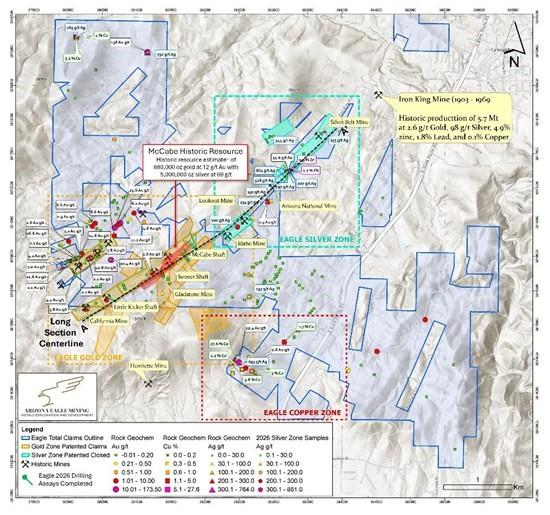
Figure 3. Plan map displaying Eagle Project patented and BLM claims totaling 4,169 acres.
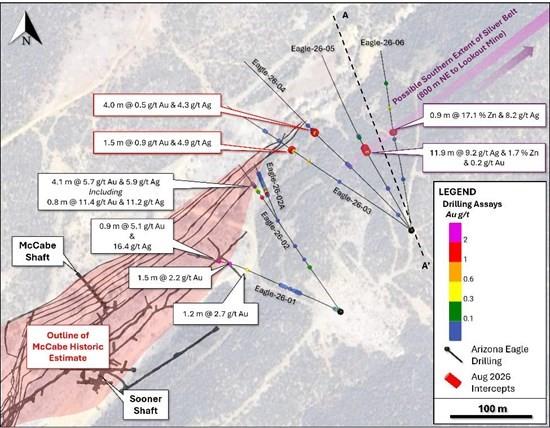
Figure 4. Plan view of Phase 1 drill holes numbers one through six.
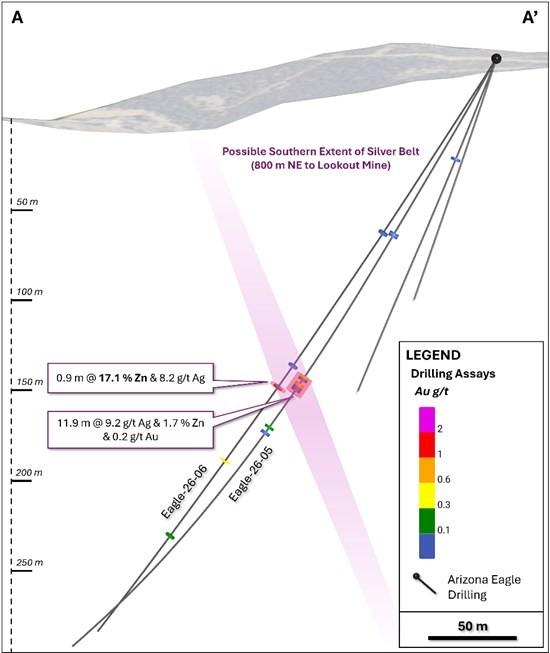
Figure 5. Cross section displaying holes 5 and 6, which intersected zinc-silver VMS type mineralization at a vertical depth of approximately 150 metres.
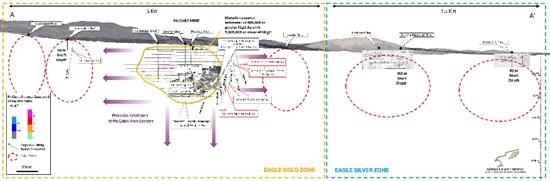
Figure 6. Long section showing drill targets at Eagle Gold Zone (3 km of strike), with Eagle Silver Zone extending to NE (1.5 km of strike).
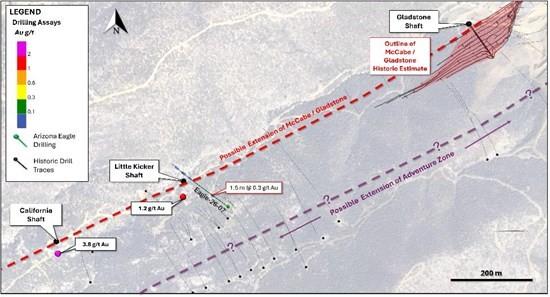
Figure 7. Plan map displaying drill hole Eagle-26-07 located approximately 600 metres southwest of the McCabe Mine. Although the target horizon was not intersected, drilling encountered gold mineralization typical of the McCabe system.
Eagle Project Overview
Arizona Eagle holds a 100% interest in the Eagle Project located in Yavapai County, Arizona. The Eagle Project is anchored by the past-producing gold and silver McCabe Mine, situated on 348 acres of private land. Stan West Mining historically invested more than US$35 million (approximately C$110 million in today’s dollars) to drill and develop the mine. In 1984, Stan West Mining published a historic estimate of approximately 880,000 ounces of gold grading 11.7 g/t and 5 million ounces of silver grading 69 g/t (the Historical Estimate) 2, defined to a maximum depth of approximately 440 metres. and open in all directions. See “Cautionary Note Regarding the Historical Estimate” below.
Over the past two years, Arizona Eagle has expanded its total land position to 4,169 acres through staking and acquisitions surrounding the McCabe Mine, including a pending acquisition that will consolidate the Eagle Silver Project. During this time, the Company completed exploration programs focused on geological mapping, surface sampling, helicopter-borne VTEM surveys and ground-based induced polarization surveys that identified multiple parallel mineralized structures not historically drill-tested.
Phase 1 Drill Program
In the first quarter of 2026, the Company initiated Phase 1 drill program of 7 holes. The drill program was designed in part to explore the lateral and vertical continuity of the McCabe veins in and around the historic resource. Results of the first 2 holes were announced on May 6th, 2026, with the remaining 5 holes released above.
Phase 2 Drill Program
The Company recently completed a sampling program on the newly acquired Silver Parcels, with results pending. A SkyTem geophysical survey is also planned to test for structural continuity between the McCabe Mine and the three past-producing silver mines, on strike to the northeast. Results of the sampling and geophysics will be used to define expansion targets on strike, as well as guide resource definition drilling at the McCabe Mine.
| HoleID | Easting | Northing | Elevation (m) |
Depth (m) |
Dip | Azimuth | Branch Depth (m) |
| Eagle-26-01 | 381779 | 3815951 | 1560 | 537 | -72 | 297° | – |
| Eagle-26-02 | 381779 | 3815951 | 1560 | 468 | -65 | 327° | – |
| Eagle-26-02a | 381779 | 3815951 | 1560 | 442 | -61.8 | 331° | 296 |
| Eagle-26-03 | 381866 | 3816051 | 1561 | 582 | -67 | 305° | – |
| Eagle-26-04 | 381866 | 3816051 | 1561 | 640 | -66.5 | 321° | – |
| Eagle-26-05 | 381866 | 3816051 | 1561 | 406 | -60 | 332° | – |
| Eagle-26-06 | 381866 | 3816051 | 1561 | 396 | -58 | 353° | – |
| Eagle-26-07 | 380674 | 3815336 | 1618 | 413 | -69 | 306° | – |
Table 2. Drill hole collar locations (all coordinates in datum WGS84 UTM Zone 12)
Sampling Procedures
All of Arizona Eagle’s drill sample assay results have been independently monitored through a quality assurance/quality control protocol which includes the insertion of blind standard reference materials and blanks at regular intervals. Logging and sampling were completed at Arizona Eagle’s core handling facilities located near Dewey-Humboldt, Arizona. Drill core was diamond sawn on site and half drill-core samples were securely transported to ALS Laboratories’ (“ALS”) sample preparation facility in Tucson, Arizona. Sample pulps were sent to ALS’s labs in Vancouver, Canada for analysis.
Gold content was determined by fire assay of a 30-gram charge with ICP finish (ALS method Au-AA23). Silver and 32 other elements were analyzed by ICP methods with four-acid digestion (ALS method ME-ICP61a). Over-limit samples for Au, Ag, Cu, and Zn were determined by ore-grade analyses Au-GRA21, Ag-OG62, Cu-OG62, and Zn-OG62, respectively.
ALS Laboratories is independent of the Company. and its Vancouver facility is ISO 17025 accredited. ALS also performed its own internal QA/QC procedures to assure the accuracy and integrity of results. Parameters for ALS’ internal and Arizona Eagle’s external blind quality control samples were acceptable for the samples analyzed. The Company is not aware of any drilling, sampling, recovery, or other factors that could materially affect the accuracy or reliability of the data referred to herein.
About Arizona Eagle Mining Corp.
Arizona Eagle is a mineral exploration company focused on the acquisition, exploration and development of mineral properties. Arizona Eagle’s principal asset is the Eagle Project, a 4,169-acre property comprised of patented and unpatented claims located near the town of Prescott Valley in Yavapai County, Arizona. The Eagle Project is centered on the past-producing McCabe Mine, a high-grade gold-silver deposit, and includes multiple parallel structures hosting past-producing mines that remain largely untested by modern drilling. While Arizona Eagle’s primary focus will be on the exploration and development of the Eagle Project, it will continue to own Core Nickel’s land portfolio in the Thompson Nickel Belt of northern Manitoba.
The scientific and technical information contained in this news release has been reviewed and approved by Clyde Smith, PhD, Vice-President, Exploration of the Company, who is a Qualified Person as defined under National Instrument 43-101 – Standards of Disclosure for Mineral Projects. Mr. Smith supervised the drill program and verified the data disclosed, including sampling, analytical and QA/QC data, underlying the technical information in this news release, including reviewing the reports of ALS, methodologies, results, and all procedures undertaken for quality assurance and quality control in a manner consistent with industry practice, and all matters were consistent and accurate according to his professional judgement. There were no limitations on the verification process. Mr. Smith has also reviewed and approved the disclosure in this news release regarding the Historical Estimate; he has not, however, performed the work necessary to verify or upgrade the Historical Estimate as current mineral resources or current mineral reserves.
Brutus Mining Inc. (CSE: BRU) (FSE: ZI3) is pleased to announce that it has closed its non-brokered ... READ MORE
Jaguar Uranium Corp. (NYSE American: JAGU) is pleased to announce an independent Mineral Resource E... READ MORE
Auro Metals Inc. (TSX-V: AURO) (OTCQB: AURFF), is pleased to announce the assay results of the fina... READ MORE
Endeavour Silver Corp. (NYSE: EXK) (TSX: EDR) is pleased to announce that repairs to the primary bal... READ MORE
Scorpio Gold Corp. (NASDAQ: SGLD) (TSX-V: SGLD) (OTCQB: SRCRF) (FSE: RY9) is pleased to announce re... READ MORE