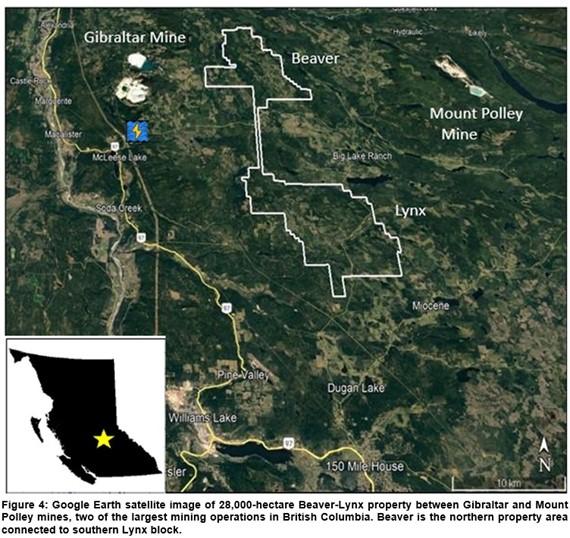
| Inomin Mines Inc. (TSX-V: MINE) announces the latest and complete results from diamond drilling program at the 28,000 hectare Beaver-Lynx project in south-central, British Columbia, demonstrating the district‑scale potential of the property. The 2025 drilling program focused on the South and North zones, and was completed in collaboration with Sumitomo Metal Mining Canada Ltd.
Key Highlights
• All 13 drill holes in the South and North zones intersected significant
serpentinized mineralization including nickel (Ni) and magnesium (Mg)
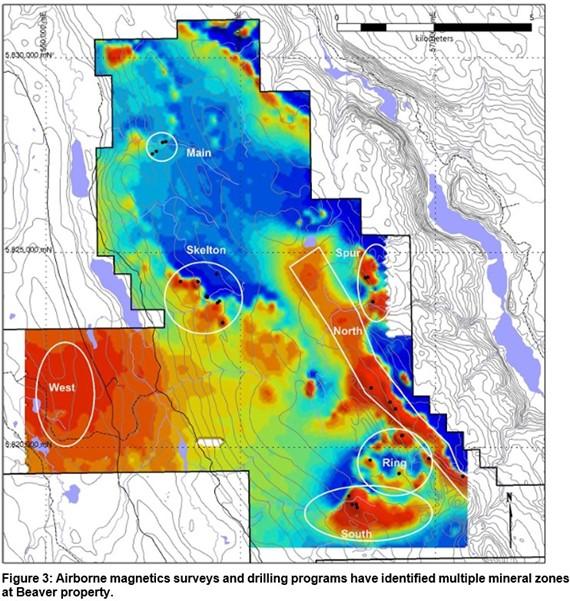
• Drilling confirms a ~500,000 m² mineralized footprint at the Beaver South zone
• North Zone drilling confirms additional mineralization extending along a 7‑km
trend
A Growing, Multi‑Metal Discovery
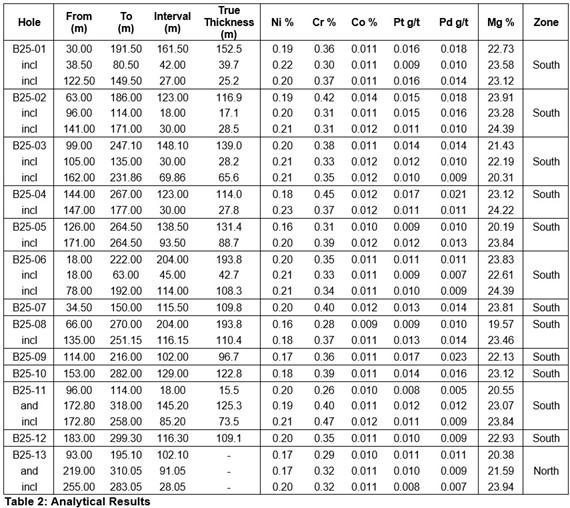
The latest drilling results (holes B25-11, 12, 13) continue to outline broad intervals of nickel‑cobalt‑magnesium mineralization across a large area, reinforcing Beaver‑Lynx as a major new critical minerals system. Latest analytical results also include analyses for platinum and palladium, elements generally associated with ultramafic deposits. PGMs were encountered in both the South and North zones and are expected to be present across other drill‑defined mineralized areas.
South Zone
Drill Hole B25‑11:
145.2 m grading 0.19% Ni,0.011% Co, 0.40% Cr, 0.012g/t Pt, 0.012g/t Pd, 23.07% Mg
Drill Hole B25‑12:
116.3 m grading 0.20% Ni, 0.011% Co, 0.35% Cr, 0.010g/t Pt, 0.009 g/t Pd, 22.93% Mg,
• Located ~1,000 m from B25‑11, confirming extensive length of mineralized area.
North Zone
Drill Hole B25‑13:
102.1 m grading 0.17% Ni, 0.010% Co, 0.29% Cr, 0.011g/t Pt, 0.011 g/t Pd, 20.38% Mg
2025 Beaver-Lynx Drilling Program
The 2025 drilling program at Beaver‑Lynx consisted of thirteen diamond drill holes totaling 3,361.8 meters(m). Drilling was carried out using HQ‑sized core to manage the challenging ground conditions, with NQ downsizing often required at depth where maintaining hole stability became difficult.
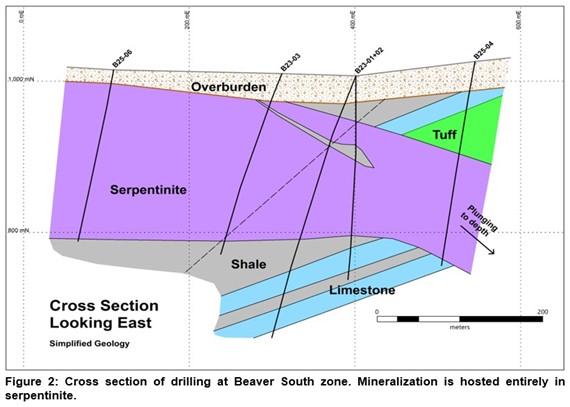
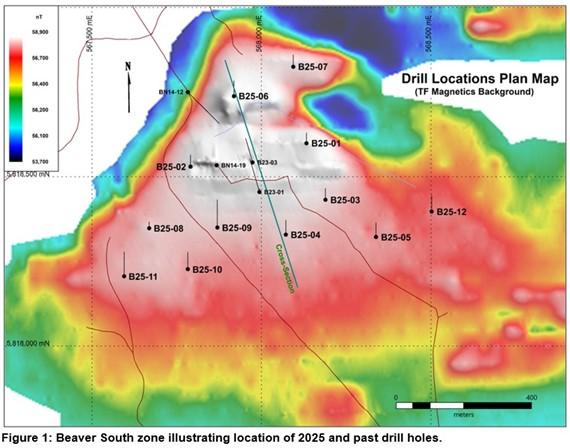
In the South zone, twelve holes were completed on approximately 200‑meter centers. This drilling was designed to evaluate the continuity of mineralization previously outlined by earlier programs.
A single hole was drilled in the North zone to test a new high‑priority target aimed at expanding the zone’s discovery footprint. This hole successfully intersected significant mineralization associated with strong magnetic features that extend for more than 7 kilometers along strike, further demonstrating the scale of the system.
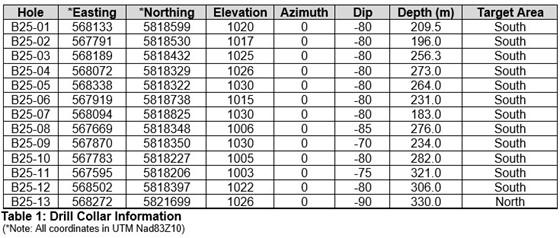
All holes were oriented to intersect mineralization as perpendicular as possible. A Reflex instrument was used to measure for azimuth and dip deviations, however, dip readings were found to be unreliable due the high concentrations of magnetite in the rocks. Collar information for all drillholes is itemized in the following table.
A plan map illustrating the drill collar locations in relation to the magnetics in the rocks in the South zone is located in Figure 1.
|