







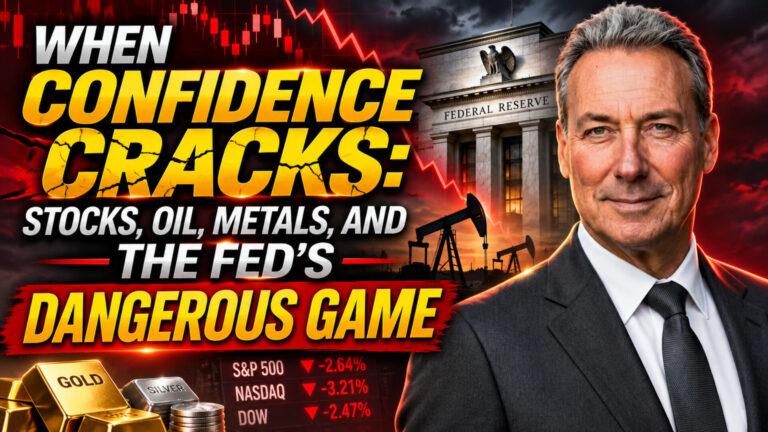
There are weeks when the markets tell us very little, and there are weeks when they tell us a great deal. This was one of the latter.
Across the financial landscape, we are witnessing something that deserves serious attention. Equities are under pressure, precious metals are being liquidated, oil is sending conflicting economic signals, and the Federal Reserve continues to project an image of strength through its increasingly aggressive monetary policy.
Meanwhile, reports of cyberattacks against critical infrastructure in Europe raise another question: just how resilient is the highly interconnected system upon which modern civilization depends?
At first glance, these developments may appear unrelated. I would argue they share a common thread.
The financial system is becoming increasingly vulnerable to disruptions, and confidence remains the most important currency of all.
For years, the American stock market has benefited from an extraordinary concentration of capital in a relatively small number of technology companies. Artificial intelligence became the latest justification for increasingly ambitious valuations, enormous capital expenditures, and expectations of future profitability.
Now those expectations are being tested.
Friday’s selloff pushed the S&P 500 into correction territory, more than 10% below its October peak. The Nasdaq suffered particularly severe losses as investors questioned whether the extraordinary spending on artificial intelligence would produce the anticipated returns. The selling was not confined to technology. The Dow Jones Industrial Average and smaller companies also came under pressure.
This is important because market leadership works in both directions.
When a handful of large companies account for a disproportionate share of index performance, their strength can disguise weakness elsewhere. When those same companies stumble, the apparent diversification of the broader market offers less protection than investors expect.
And this is not simply an American phenomenon.
Asian and European markets have also experienced significant selling pressure. Canada’s resource-heavy market has been particularly vulnerable as concerns about global growth have weighed on commodity producers.
The larger question is whether we are experiencing another ordinary correction or the beginning of a more substantial repricing of financial assets.
We cannot know the answer with certainty today. However, elevated interest rates, expensive equity valuations, and growing concerns about economic growth are not a particularly comfortable combination.
The lesson is one we have emphasized for decades: price is what you pay, but value is what you receive.
And the two can diverge for a very long time.
Oil deserves far more attention than it typically receives from precious metals investors.
Energy is not simply another commodity. It is an essential input into transportation, agriculture, manufacturing, mining, and nearly every aspect of economic activity.
When oil prices rise sharply, the consequences eventually work their way through the economy. Transportation costs increase, production becomes more expensive, and consumers have less discretionary income.
Yet falling oil prices are not necessarily good news either.
They can reflect expectations of weakening industrial demand, slower economic activity, or deteriorating consumer conditions.
This week, crude oil came under pressure amid concerns about global growth, even as geopolitical risks remained elevated.
That creates a difficult environment for central bankers.
Higher energy costs can aggravate inflation. Lower energy prices may provide temporary relief, but if they reflect a weakening economy, corporate profits and employment may suffer.
For investors in the resource sector, this distinction matters.
Mining companies consume substantial quantities of energy. Lower fuel costs can improve operating margins, provided the prices of the metals they produce remain reasonably firm. But a broad economic contraction can also weaken demand for industrial commodities.
My view is that energy remains a strategic asset, and investors should resist the temptation to interpret every short-term move in crude oil as a definitive economic forecast.
The underlying reality has not changed: modern economies cannot function without affordable, reliable energy.
For precious metals investors, the past several weeks have been particularly frustrating.
Gold, which had previously demonstrated considerable strength, has suffered a significant correction. Silver has experienced an even more dramatic reversal from its January highs, and the mining shares have again reminded investors that leverage works in both directions.
Gold traded near $3,500 this week, while silver fell into the low $40s. Higher interest-rate expectations, a stronger dollar, and liquidation across financial markets have contributed to the weakness.
The question I continue to hear is whether the precious metals bull market is over.
My answer is that we must distinguish between a market correction and a change in the underlying monetary fundamentals.
Gold does not become less valuable as monetary insurance simply because its quoted dollar price declines. Silver does not lose its industrial importance because speculative investors decide to liquidate positions.
However, we must also acknowledge that markets can remain disconnected from fundamentals longer than most investors expect.
When leveraged positions are unwound, investors frequently sell whatever they can, not necessarily what they want to sell. This is why gold can decline during the initial stages of a financial panic.
Silver is even more vulnerable because it combines monetary demand with industrial demand and a relatively small, volatile market.
The mining shares face an additional challenge. Even well-managed companies can experience substantial selling when investors reduce exposure to equities generally.
I remain constructive on the long-term monetary case for gold and silver, but I am not suggesting that the correction has necessarily ended.
Patience, liquidity, and position sizing remain essential.
Remember, the objective is not to predict every short-term market movement. It is to preserve purchasing power and participate intelligently in the larger trend.
Perhaps the most important development this week has been the Federal Reserve’s increasingly aggressive language.
Federal Reserve officials are warning that inflation remains too persistent, and additional rate increases may be necessary. Governor Christopher Waller has even discussed the possibility of a half-percentage-point increase, while the minutes of the latest meeting suggest policymakers are preparing for further tightening.
The Fed wants the public to believe it is firmly in control.
But control over the overnight lending rate is not the same as control over the economy.
The United States carries an enormous debt burden. Higher interest rates increase refinancing costs, place additional pressure on government finances, and eventually affect businesses, consumers, and financial institutions.
Here is the contradiction.
The Fed is attempting to defend the purchasing power of the dollar through monetary restraint, while the fiscal authorities continue operating a system dependent upon borrowing.
One institution is attempting to apply the brakes while another continues pressing the accelerator.
This cannot continue indefinitely without consequences.
I have often said that the greatest threat to the monetary system is not simply inflation. It is the loss of confidence in the institutions responsible for managing money.
The Fed may continue raising rates. But if financial markets, employment, or credit conditions deteriorate sufficiently, policymakers could eventually face a very different set of priorities.
That is when the real test begins.
Will they defend the currency, or will they defend the financial system?
History suggests that when those objectives come into direct conflict, protecting the financial system often takes precedence.
Another development deserving attention involves the reported cyberattacks against refrigeration systems in Europe.
Reports indicate that attackers manipulated internet-connected refrigeration controls at supermarkets across several European countries, causing food spoilage and operational disruptions. Cybersecurity researchers also identified suspicious activity preceding the incidents. The identity and ultimate motivation of those responsible remain uncertain.
We should be careful not to turn every cyber incident into a prediction of imminent catastrophe.
Nevertheless, the implications are worth considering.
Modern infrastructure depends upon interconnected computer systems. Food distribution, banking, energy, telecommunications, and payment processing increasingly rely upon digital networks.
This creates efficiencies, but it also introduces vulnerabilities.
The concern is not simply whether someone can interfere with a supermarket freezer. It is what happens when similar weaknesses exist in systems that are more essential to daily life.
For investors, this reinforces a principle we have discussed for many years: diversification should extend beyond financial assets.
Having some physical cash, essential supplies, and precious metals outside the banking system is not an expression of fear. It is a reasonable approach to resilience.
We insure our homes against events we hope never occur. Financial preparedness follows the same logic.
We are entering a period in which financial markets may become increasingly sensitive to monetary policy, geopolitical developments, and questions about economic growth.
I am watching the bond market closely, particularly whether yields begin signaling concern about government financing rather than simply inflation.
I am also watching gold relative to the broader equity market, silver’s ability to establish a durable base, and whether mining shares begin showing relative strength.
For our subscribers, the message remains consistent.
Protect capital. Avoid excessive leverage. Maintain liquidity. Do not confuse a low price with an immediate buying opportunity, and do not allow temporary market weakness to force emotional decisions.
There will be opportunities ahead, particularly among quality resource companies whose underlying assets may eventually command much greater valuations.
But there is no requirement to capture every dollar of a market advance.
The financial system rests upon confidence, and confidence can change far more quickly than the institutions managing that system would like to admit.
Gold and silver are not promises made by governments. They are assets that exist independently of those promises.
That distinction may become increasingly important in the years ahead.
As always, stay informed, stay disciplined, and remember that the purpose of investing is not simply to become wealthier on paper. It is to preserve and increase real purchasing power.
Until next time,
David Morgan
The Morgan Report
Money, Metals, and Mining
Markets like these demonstrate why independent research, disciplined portfolio management, and an understanding of monetary history are so important.
At The Morgan Report, we work to separate market noise from genuine investment opportunities, with an emphasis on precious metals, mining equities, and the larger monetary picture.
When you become a paid member, you also receive a complimentary 30-minute personal consultation with me. It is an opportunity to discuss your questions, better understand our investment approach, and make more informed decisions in a challenging market.
Subscribe today for the full report and portfolio.The Knowledge You Need to Build and Preserve Your Wealth
In this presentation, Jeffrey Christian of CPM Group examines the sharp decline in gold and s... READ MORE
Arizona Gold & Silver Inc. (TSX-V: AZS) (OTCQB: AZASF) is pleased to announce that the Company a... READ MORE
On The Ellis Martin Report and Money Talk Radio, Ellis Martin welcomes Nicole Brewster, President an... READ MORE
Stallion Uranium Corp. (TSX-V: STUD) (OTCQB: STLNF) (FSE: B76) is pleased to announce the commenceme... READ MORE