








Highlights:
Q2 Metals Corp. (TSX-V: QTWO) (OTCQB: QUEXF) (FSE: 458) is pleased to announce the results from a Preliminary Economic Assessment for the Cisco Lithium Project. The PEA is the first conceptual assessment of the economics of the staged development of the Project and outlines the Cisco Project’s potential to be among the largest and lowest cost spodumene concentrate producers in the world.
“Combining an already globally significant open pit resource with access to established infrastructure and strong community partnerships, the Cisco Project has emerged as a strategically important spodumene lithium project in a premier mining jurisdiction. This PEA marks an important milestone for Q2 in unlocking the Cisco Project’s full long-term potential as it advances toward future stages of development,” Alicia Milne, Q2 Metals President and CEO, stated.
“In just two and a half years, our dedicated team has advanced Cisco from a new discovery at acquisition to the PEA-stage and its position among the top global spodumene lithium projects. The technical merits of the Cisco Deposit, in terms of scale, grade and continuity, have combined with its proximity to transportation infrastructure to create a project of major scale, with a preliminary AISC within the lowest quartile of industry peers.
We are focused on advancing Cisco toward becoming a prominent new source of lithium to meet anticipated future demand around the world. Delivery of this PEA marks a major milestone and turning point as we transition from pure exploration to establishing Cisco as a key component of Canada’s broader critical minerals strategy and a major contributor to the local and regional economies. The potential production profile outlined in the study reflects the scale of the deposit itself, which was recognized as “Discovery of the Year” by the Association de l’Exploration Minière du Québec this November.
The Cisco Deposit will continue to evolve with our 2026 drill campaign. Q2 is well-capitalized to continue aggressive exploration and infrastructure development as we look ahead to future catalysts and milestones.”
Preliminary Economic Assessment Overview
The PEA, prepared by independent Canadian firm BBA Consultants, describes the Cisco Project’s value proposition through project economics, long-term cash flow generation, and attractive returns over the life of mine. A thorough evaluation of the Project’s technical and strategic advantages underscore its potential to become one of the largest, low-cost producers of spodumene concentrate globally, with an all-in sustaining cost of C$454/tonne of spodumene concentrate grading 5.5% Li₂O.
The production profile and mine life reflect the scale of the mineral resource demonstrating the Cisco Project’s potential to become a major, long-term producer of high-quality spodumene concentrate.
The PEA mine plan contemplates a conventional open-pit truck-and-shovel mining operation, leveraging favourable near-surface geometry and continuity. The PEA has been designed as a two-phase development reaching 10 million tonnes per annum of plant feed, with an estimated initial capital of C$2,926 million including mine pre-production and mobile equipment, and an after-tax 3-year payback after start of production.
Life-of-mine operating costs for the mine complex are estimated at C$11,913 million, equivalent to C$256.16/tonne of concentrate on a site operating cost basis (before concentrate transportation). The production basis comprises approximately 28 years of operations, processing 264.2 million tonnes of material mined and producing 46.5 Mt of SC5.5.
The PEA is an AACE Class 5 estimate with a target accuracy range of −30% to +50%, developed in Q3 2026, and expressed in constant Canadian dollars. Readers should note the early-stage nature of the estimate when evaluating the PEA results.
| Table 1: Key Financial Assumptions | ||
| Assumption | Unit | Value |
| Exchange Rate | US$/C$ | 1.39 |
| Reference price: Long-term SC6.0 Price (CIF China) | US$/t | 1,900 |
| Long-term SC5.5 Price (CIF China) | US$/t | 1,742 |
| Long-term SC5.5 Price (FOB port in province of Québec) | US$/t | 1,647 |
| Long-term SC5.5 Price (FOB port in province of Québec) | C$/t | 2,289 |
| Discount Rate | % | 8 |
|
Table 2: Cisco Project PEA Financial Results |
||
| Results | Unit | Value |
| Valuations | ||
| Pre-tax NPV8 | C$ million | 23,052 |
| Pre-tax IRR | % | 48.5 |
| After-tax NPV8 | C$ million | 13,490 |
| After-tax IRR | % | 38.7 |
| Payback Period After-Tax (Start of Production) | Years | 3.0 |
| Revenues | ||
| Pre‐Tax Cash Flow (Total, Undiscounted) | C$ million | 81,216 |
| Estimated Investment Tax Credit | C$ million | 101 |
| Estimated Total Taxes | C$ million | 34,437 |
| After‐Tax Cash Flow (Total, Undiscounted) | C$ million | 46,879 |
| Total Gross Revenue | C$ million | 106,441 |
| Costs | ||
| Initial Capital Cost (Y-2 to Y3) | C$ million | 2,926 |
| Sustaining Capital Cost | C$ million | 589 |
| Operating Cost | C$ million | 11,913 |
| Concentrate Transportation Loss | C$ million | 106 |
| Concentrate Transportation Cost | C$ million | 8,486 |
| Royalty Cost (1%GOR) | C$ million | 1,064 |
| Closure and Reclamation Cost | C$ million | 141 |
| Total Project Cost | C$ million | 25,225 |
| Industry Cost Metrics (C$/tonne SC5.5) | ||
| Cash Costs | C$/t SC5.5 | 439 |
| All-in Sustaining Costs before Royalties (FOB port in province of Québec) |
C$/t SC5.5 | 454 |
The PEA for the Cisco Project is preliminary in nature and is based solely on Inferred Mineral Resources that are considered too speculative geologically to have economic considerations applied to them that would enable them to be categorized as Mineral Reserves. There is no certainty that the results of the PEA will be realized. Mineral Resources that are not Mineral Reserves do not have demonstrated economic viability.
Sensitivity Analysis
At a base-case long-term SC6 price of $1,900 (CIF China) and an exchange rate of C$1.39 per US$1.00, the Cisco Project generates a pre-tax NPV8 of C$23,052 million and an IRR of 48.5%, and an after-tax NPV8 of C$13,490 million and an IRR of 38.7%, based on a cumulative effective tax rate of 42.3%. The results indicate that the Cisco Project maintains a positive Net Present Value and Internal Rate of Return across the ranges evaluated when each sensitivity parameter is assessed independently.
| Table 3: Summary of After-Tax NPV8 sensitivity results | |||||||
| Sensitivity | -30% | -20% | -10% | 0% | 10% | 20% | 30% |
| Li2O DMS Feed Grade (±30%) | 8,126 | 9,916 | 11,702 | 13,490 | 15,267 | 17,046 | 18,823 |
| Price (±30%) | 7,691 | 9,627 | 11,558 | 13,490 | 15,411 | 17,332 | 19,251 |
| Exchange Rate (US$:C$) (±30%) | 7,691 | 9,627 | 11,558 | 13,490 | 15,411 | 17,332 | 19,251 |
| Recovery (±20%) | 9,916 | 11,702 | 13,490 | 15,267 | 17,046 | ||
| Initial Capital (±30%) | 13,937 | 13,788 | 13,638 | 13,490 | 13,334 | 13,179 | 13,026 |
| Sustaining Capital (±30%) | 13,520 | 13,510 | 13,500 | 13,490 | 13,480 | 13,470 | 13,460 |
| Operating (±30%) | 14,241 | 13,990 | 13,740 | 13,490 | 13,237 | 12,982 | 12,728 |
|
Table 4: Summary of After-tax IRR sensitivity results |
|||||||
| Sensitivity | -30% | -20% | -10% | 0% | 10% | 20% | 30% |
| Li2O DMS Feed Grade (±30%) | 28.5% | 32.1% | 35.5% | 38.7% | 41.8% | 44.7% | 47.5% |
| Price (±30%) | 27.6% | 31.5% | 35.2% | 38.7% | 42.0% | 45.1% | 48.1% |
| Exchange Rate (US$:C$) (±30%) | 27.6% | 31.5% | 35.2% | 38.7% | 42.0% | 45.1% | 48.1% |
| Recovery (±20%) | 32.1% | 35.5% | 38.7% | 41.8% | 44.7% | ||
| Initial Capital (±30%) | 47.5% | 44.0% | 41.2% | 38.7% | 36.6% | 34.7% | 33.0% |
| Sustaining Capital (±30%) | 38.8% | 38.8% | 38.7% | 38.7% | 38.7% | 38.7% | 38.7% |
| Operating (±30%) | 41.0% | 40.2% | 39.5% | 38.7% | 38.0% | 37.2% | 36.4% |
|
Table 5: Price of Spodumene Concentrate 5.5% Li2O |
|||||||
| % Variation | -30% | -20% | -10% | 0% | 10% | 20% | 30% |
| LOM Average Price (C$/t) | $1,602 | $1,831 | $2,060 | $2,289 | $2,518 | $2,747 | $2,976 |
| NPV 6% | 10,464 | 12,931 | 15,392 | 17,856 | 20,308 | 22,761 | 25,212 |
| NPV 8% | 7,691 | 9,627 | 11,558 | 13,490 | 15,411 | 17,332 | 19,251 |
| NPV 10% | 5,705 | 7,259 | 8,808 | 10,357 | 11,895 | 13,434 | 14,970 |
| IRR | 27.6% | 31.5% | 35.2% | 38.7% | 42.0% | 45.1% | 48.1% |
| Payback Period (start of investment) |
6.1 | 5.6 | 5.2 | 5.0 | 4.7 | 4.5 | 4.3 |
| Payback Period (start of production) |
4.1 | 3.6 | 3.2 | 3.0 | 2.7 | 2.5 | 2.3 |
Project Summary
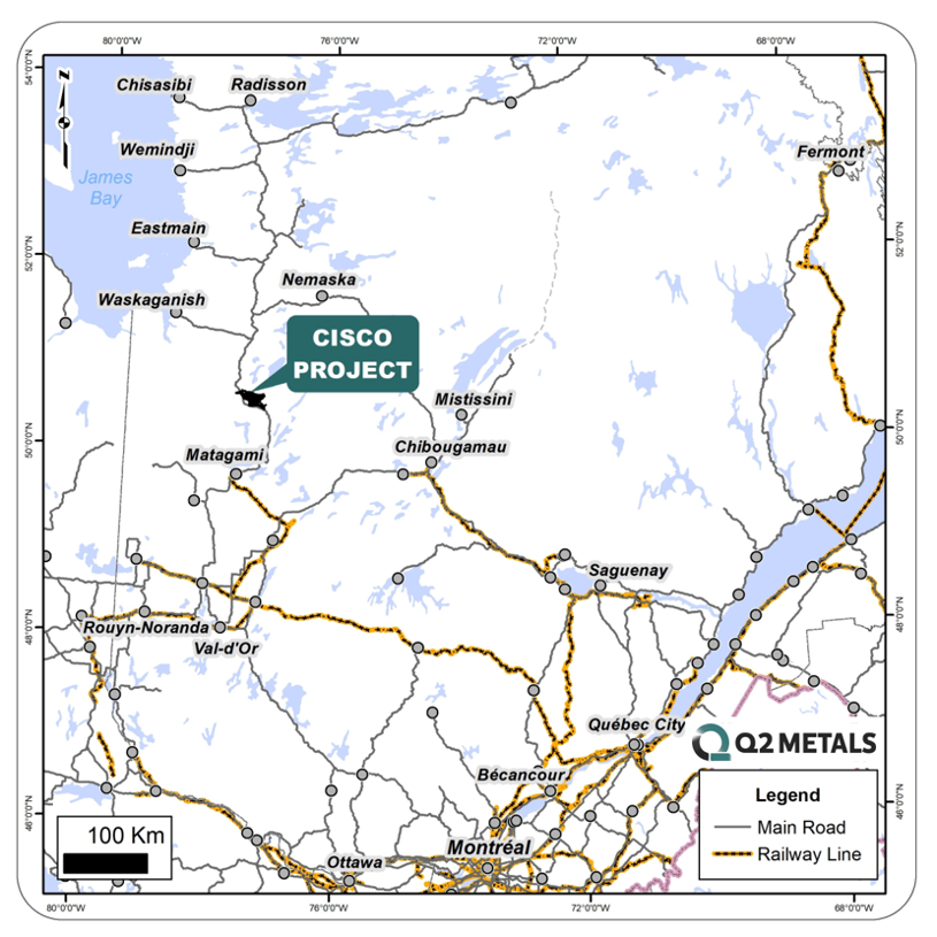
The Cisco Project is primarily located within the greater Nemaska traditional territory of the Eeyou Istchee James Bay region of Quebec, Canada. The Project comprises 801 Exclusive Exploration Rights totalling 41,253 hectares and the deposit is 6.5 kilometres from the paved, all-season Billy Diamond Highway, providing strategic year-round direct access to rail infrastructure in the Town of Matagami, approximately ~150 km to the south. The Project benefits from access to regional transportation infrastructure, including the CN rail network in Matagami which connects to deep-water port facilities along the St. Lawrence Seaway, serving global markets.
Beyond its technical merits, the Cisco Project is being advanced with a strong focus on community engagement and responsible development. The Company maintains ongoing dialogue with the Cree Nation Government, the Cree Nations of Nemaska and Waswanipi, local tallymen, the Town of Matagami, and the Eeyou Istchee James Bay Regional Government. The Company has also developed partnerships with Cree-owned and regional businesses and continues to advance environmental and land-use baseline studies to support future permitting, engineering, and project planning activities.
Figure 1: Cisco Project, Eeyou Istchee James Bay Quebec Canada
Updated Inferred Mineral Resource Estimate
An updated Inferred Mineral Resource Estimate has been used as the basis for the PEA. The Inferred Mineral Resource Estimate for the Cisco Project, with an effective date of May 26, 2026, was prepared by Todd McCracken, P.Geo. of BBA, an independent Qualified Person.
The May 2026 MRE supersedes the Company’s previously disclosed Inferred Mineral Resource Estimate for the Cisco Project with an effective date of April 20, 2026, as announced in the Company’s news release of April 20, 2026.
The May 2026 MRE is based on the same original dataset of 75 holes across 33,343 m of drilling completed through December 2025 and reflects revisions to the classification wireframes. The revisions to the wireframe classification resulted in an increase to the total Inferred Mineral Resources tonnage by less than approximately 1%. The contained Li2O increased by approximately 1%. The May 2026 MRE is therefore a reclassification of the existing dataset rather than a new drilling-based increase in the geological inventory. Readers should no longer rely on the April 2026 MRE and the assumptions therein.
In accordance with National Instrument 43-101 – Standards for Disclosure of Mineral Projects, the technical report supporting the PEA and the May 2026 MRE be filed on SEDAR+ within 45 days of this news release.
The Mineral Resource Estimate assumptions include open-pit and underground-constrained Mineral Resources reported using a SC6 price of US$1,500/tonne, Free on Board Bécancour, an exchange rate of US$0.70 per C$1.00, and respective reporting cut-off grades of 0.40% and 0.70% Li₂O. These parameters were used to establish reasonable prospects for eventual economic extraction for Mineral Resource reporting purposes. The PEA assumptions apply to the development scenario and economic analysis; no underground mining operation is contemplated in the PEA.
|
Table 6: NI 43-101 Mineral Resource Statement for the Cisco Deposit |
||||||
| Classification | Scenario | Cut-off Grade (% Li2O) |
Mass (‘000 t) |
Li2O (%) | Li2O (‘000 t) |
LCE (‘000 t) |
| Inferred | Open Pit | 0.4 | 271,575 | 1.37 | 3,724 | 9,208 |
| Underground | 0.7 | 25,802 | 1.30 | 335 | 829 | |
| Total | Combined | 297,377 | 1.36 | 4,059 | 10,037 | |
Mining Methods
The mine plan in the PEA contemplates a conventional open-pit truck-and-shovel mining operation, leveraging the Cisco Deposit’s favourable near-surface geometry and continuity. The mine plan comprises seven phases over a 28-year mine life following a one-year open-pit pre-production period.
The ultimate pit shell was evaluated using Deswik.GO and contains 908.4 Mt of material: 264.2 Mt of mineralized material averaging diluted grades of 1.32% Li₂O and 1.10% Fe, 624.6 Mt of waste rock and 19.6 Mt of overburden. The overall strip ratio is 2.44:1. The shell is approximately 1,280 m wide, 1,600 m long and 570 m deep with a metallurgical cut-off grade of 0.50% Li₂O being applied.
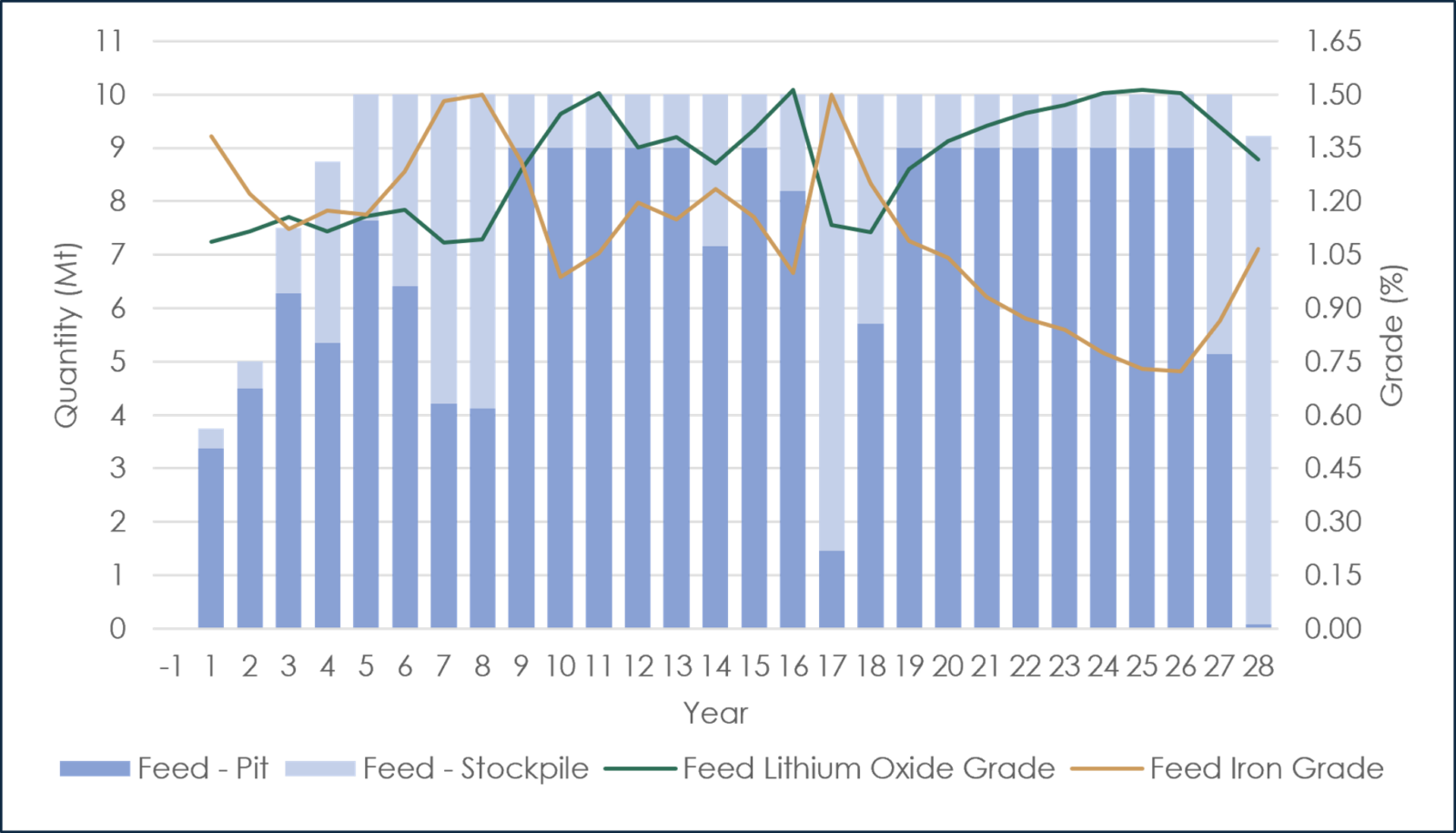
As the Project is being built in two phases, a 5 Mtpa processing facility will be built at the beginning of the Project. Expansion of the process plant to 10 Mtpa will begin in the second year of operation. The following ramp-up of processing capacities were considered:
A pre-production period has also been included to mine approximately 10 Mt of material. Waste rock extracted in this period will be used for construction needs, and mineralized material will be stockpiled for future processing. Total material mined peaks at approximately 45 Mt annually, and material movement (including stockpile rehandling) totals 977 Mt over the LOM.
Figure 2: Mine Plan
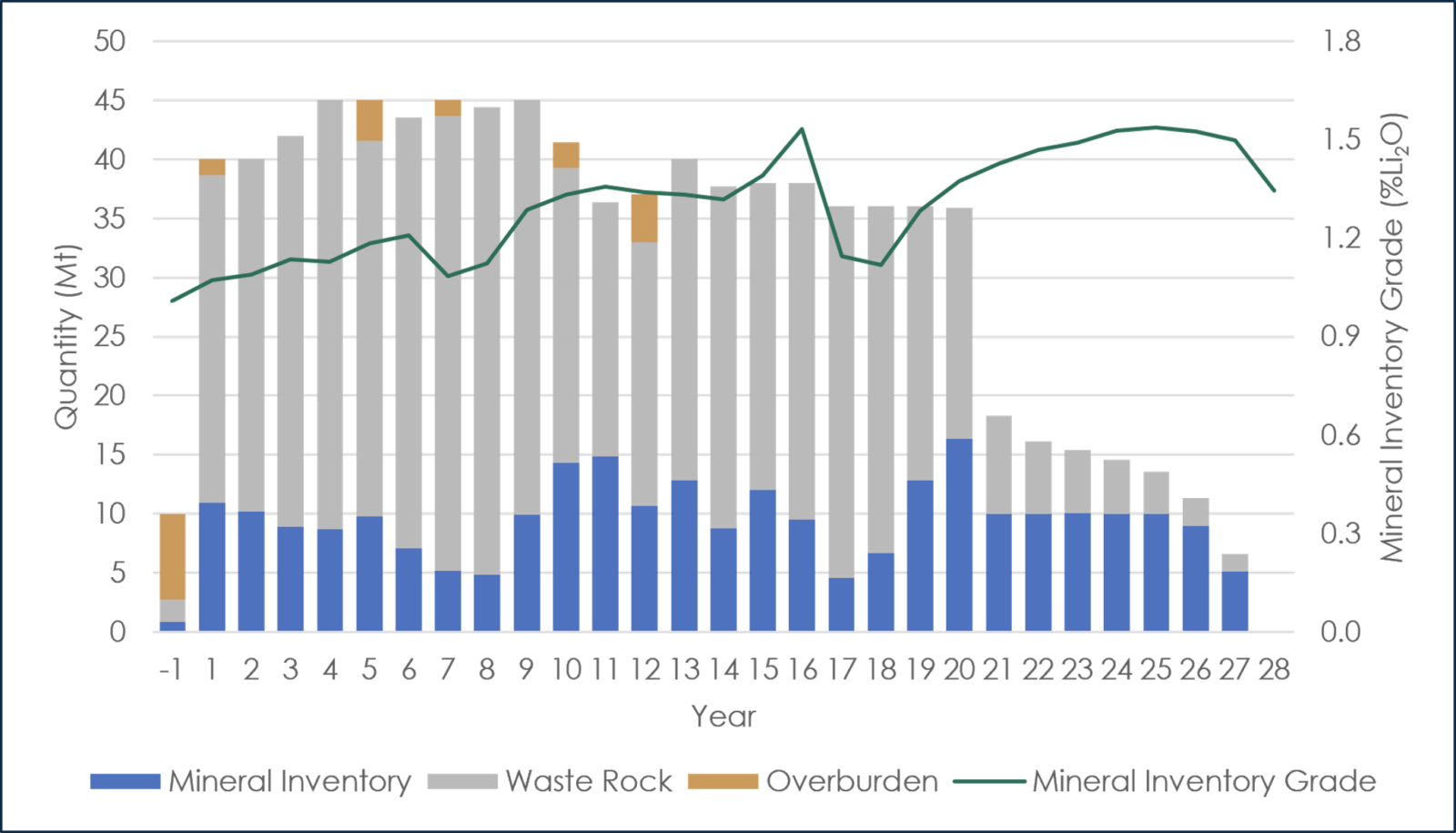
Figure 3: Feed Plan
| Table 7: Cisco Project Production Metrics | ||
| Assumption | Unit | Value |
| Project Timeline | ||
| Construction Period | years | 2 |
| Open Pit Pre-Production Period | years | 1 |
| Life of Mine (LOM) | years | 28 |
| Total Project Life | years | 30 |
| Mine Physicals | ||
| Total Mineralized Material Mined | Mt | 264 |
| Total Waste Rock + Overburden | Mt | 644 |
| Total Material Moved (inc. Stockpile movement) | Mt | 977 |
| Average Strip Ratio | t:t | 2.44 |
| Average Annual DMS Plant Feed (Phase 1) | Mtpa | 5 |
| Average Annual DMS Plant Feed (Phase 2) | Mtpa | 10 |
| Concentrate Production | ||
| Product Concentrate Grade | % Li20 | 5.5 |
| LOM Average Feed Head Grade | % Li20 | 1.32 |
| LOM Average Recovery | % | 73.3 |
| LOM SC5.5 Produced | Mt | 46.5 |
| LOM Average Annual Concentrate Production | Mtpa | 1.7 |
| Concentrate Moisture | % | 8 |
Metallurgical Testing
Metallurgical testwork was completed on three composite samples to characterize the Cisco Project mineralization and assess potential processing methods for lithium recovery. Mineralogical characterization identified spodumene as the principal lithium-bearing mineral, with head grades ranging from approximately 1.53% to 1.68% Li₂O and generally favourable spodumene liberation. The composites provide an initial indication of processing response; additional variability testing is currently underway and additional testing is planned for subsequent study phases.
Comminution testing indicated abrasive material that was classified as very easy to crush based on the combined French abrasion and crushability test sample.
Heavy liquid separation testing demonstrated good potential for dense media separation, although laboratory heavy liquid separation recoveries were considered optimistic relative to expected commercial performance. Limited flotation testing indicated that flotation of DMS middlings and fines could provide additional lithium recovery, supporting the selection of a combined DMS and flotation flowsheet for the PEA.
Based on the available testwork and engineering scale-up assumptions, the PEA mass balance predicts an overall lithium recovery of approximately 73.3% to combined DMS and flotation concentrates grading approximately 5.5% Li₂O and 0.62% Fe.
The available testwork is preliminary and does not fully characterize deposit variability, and the complete PEA flowsheet has not been demonstrated through an integrated test program.
Processing
The PEA process flowsheet was developed based on the preliminary metallurgical testwork and conventional spodumene processing practices and consists of three-stage crushing, two-stage DMS, grinding, magnetic separation, spodumene flotation, and concentrate and tailings dewatering and filtration.
The Project has been planned as a phased development, with the crushing plant initially sized for 10 Mtpa, while the concentrator is installed at 5 Mtpa in Phase 1 and is subsequently expanded to 10 Mtpa in Phase 2.
The DMS circuit recovers coarse, liberated spodumene through rougher and cleaner stages, while DMS floats and fines are ground and processed by magnetic separation and flotation to maximize lithium recovery and control concentrate iron content.
The process design targets a combined spodumene concentrate grading approximately 5.5% Li₂O, while minimizing iron content with a projected overall lithium recovery of approximately 73.3%. At the ultimate 10 Mtpa processing rate, the facility is expected to produce approximately 1.76 Mtpa of spodumene concentrate (steady state), with concentrate filtered (flotation) or screened (DMS) prior to storage and shipment.
Project Infrastructure
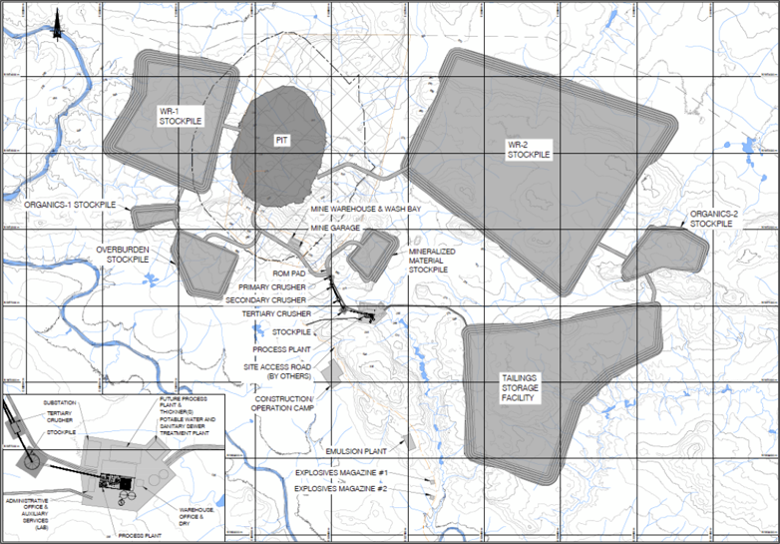
Project infrastructure major facilities comprise the open pit, process plant and tailings filtration plant, waste rock and overburden storage areas, a filtered-stack tailings facility, permanent operations camp, garage, warehouse and administration building.
Figure 4: Project overall site plan
Spodumene Concentrate Transportation
The Cisco Project is located approximately 150 km north of the Matagami Transshipment Facility (cour de transbordement de Matagami), an existing bulk-handling facility that provides access to the rail network for the transportation of mining products and other bulk materials. The Project’s proximity to existing road infrastructure and an established rail-linked transshipment facility is expected to support the efficient movement of spodumene concentrate to downstream markets.
Spodumene concentrate produced by the Project will be transported in 49-t highway trucks along an approximately 15.5 km access road connecting the site to the all-season Billy Diamond Highway. The concentrate will then be hauled to the Matagami Transshipment Facility where it will be transferred into railcars for transport to a selected export port.
The availability of established transportation infrastructure, including year-round road access and close proximity to existing rail infrastructure is expected to reduce the need for additional transportation infrastructure development in support of concentrate shipments.
Power Supply and Distribution
Preliminary power demand for the Project is estimated at approximately 45 MW and 62 MW for the 5 Mtpa and 10 Mtpa operating scenarios, respectively. Power is expected to be supplied via a new approximately 200 km, 161 kV transmission line with a maximum capacity of approximately 100 MW. The transmission system would require two substations: an off-site connection substation and an on-site distribution substation.
The two nearest Hydro-Québec transmission facilities capable of supplying the Project are the Nemiscau Substation, located northeast of the Project site, and the Abitibi Substation, located to the southeast. Both facilities are connected to Hydro-Québec’s 315 kV transmission network and are understood to have sufficient capacity to meet the Project’s anticipated power requirements.
Although the Nemiscau Substation is located slightly farther from the Project site, it is considered the preferred point of supply due to the availability of existing road infrastructure along the corridor between the substation and the Project. The presence of established access routes is expected to facilitate transmission line construction and ongoing maintenance activities. The transmission line distance from the Nemiscau Substation is estimated at approximately 200 km, compared with approximately 175 km from the Abitibi Substation. However, the Abitibi route would require the development of substantial new access infrastructure along much of the corridor.
As the Project advances, alternative infrastructure development and ownership arrangements may be evaluated as part of future engineering and project development studies. These could include arrangements involving third parties for the development, ownership, operation or maintenance of transmission infrastructure, where such arrangements are demonstrated to be technically and economically viable and are aligned with the Project requirements. For the purposes of the PEA, it is assumed that the transmission line would be constructed, owned, operated, and maintained by the Company.
Environmental Studies, Permitting and Community Engagement
The Project is located on Category III lands in Eeyou Istchee James Bay and will be subject to the provincial environmental and social impact assessment and review process applicable under James Bay and Northern Québec Agreement as well as the federal assessment provisions for new metal mines and mills with ore production capacity of 5,000 t/day or more.
Environmental Studies
To date, environmental baseline data collection efforts remain preliminary, with field surveys being initiated in 2026. As proposed Project-specific infrastructure and associated activities are further defined, the environmental baseline work will be refined accordingly. Key considerations include the characterization of vegetation and wetlands, fish and fish habitat, fauna including woodland caribou distribution and available high-value habitats, migratory birds, surface and groundwater quality and quantity, traditional land use, and Indigenous health and socio-economic conditions.
Conceptual closure planning will be developed with community partners and refined as the Project advances. The proposed approach targets public safety, contaminant control, physical stability, and land restoration compatible with post-closure use. Fish habitat compensation costs remain unquantified.
Permitting and Community Engagement
The Project lies within a governance framework established by the JBNQA and the Agreement Concerning a New Relationship Between the Government of Québec and the Crees of Québec (Paix des Braves), with Cree rights and traditional land use central to development planning. Category III lands carry specific Cree harvesting and outfitting rights without exclusive land ownership. The 2024 Cree Nation Mining Policy emphasizes environmental protection, respect for rights, sustained engagement, and economic participation through employment, training, and services.
Recognizing the importance of community involvement and social responsibility, engagement with First Nations and other stakeholders has been ongoing since 2024, with initial Project community-based public information sessions held in 2026. Activities have focused on sharing Project information and gathering preliminary concerns, interests, and recommendations.
The Company is committed to environmental stewardship and social responsibility and continued engagement with First Nations and other stakeholders will include environmental baseline findings, land-use information, and input on mitigation and habitat compensation measures as Project design advances.
Spodumene Concentrate Pricing
Lithium market fundamentals are expected to remain constructive over the next decade. Continued growth in consumption, combined with uncertainty over the timing of new production, supports the long-term outlook for spodumene concentrate prices. This environment also increases the strategic relevance of large-scale lithium projects located in jurisdictions that support responsible mine development.
Lithium demand is expected to remain on a long-term growth trajectory, supported by two increasingly important end markets. Electric-vehicle adoption continues to be the principal source of consumption, while the rapid deployment of battery energy storage systems is expanding the role of stationary storage. This broader end-use profile reinforces demand beyond the automotive market.
The supply response is less certain. Forecasts rely heavily on additional mine and processing capacity from projects that remain unbuilt, unfunded, or inactive. Their contribution will depend on access to capital, permitting progress, successful project execution, and market conditions. These factors create uncertainty regarding both the timing and volume of new supply available to meet projected consumption.
Against this market backdrop, the PEA adopts a long-term spodumene concentrate price of US$1,900/t on an SC6.0, CIF China basis. The selected value reflects a review of independent benchmarks, including specialist commodity-market research, consensus forecasts from established financial institutions, and assumptions reported in recent NI 43-101-compliant technical reports. Rather than reflecting short-term commodity-price fluctuations, the assumption is intended to represent conditions over the Project’s operating life. The conversion to US$1,647/t SC5.5 FOB Québec incorporates grade adjustment, freight, handling and location differentials.
Capital and Operating Costs
The PEA outlines a two-phase development of the Cisco Project reaching 10 Mtpa of plant feed from Year 5 onward, with estimated initial capital of C$2,926 M and sustaining capital of C$589M. Phase 1 capital costs are classified as initial capital. Phase 2 capital costs incurred before the second plant reached its nameplate of 5Mtpa in Year 4 are also classified as initial capital.
LOM operating costs for the mine complex are estimated at C$11,913 M, equivalent to C$256.16/t of concentrate on a site operating cost basis. The production basis comprises approximately 28 years of operations, processing 264.2 Mt and producing 46.5 Mt of SC5.5.
Capital Costs
The capital estimate is an AACE Class 5 estimate with a target accuracy range of −30% to +50%, developed in Q3 2026 and expressed in constant Canadian dollars. Readers should note the early-stage nature of the estimate when evaluating the PEA results.
The total LOM capital cost, including sustaining capital, is estimated at C$3,515 million. This includes direct costs, indirect costs, contingency, off-site costs, mine equipment, capitalized mine pre-production costs, environmental disturbance compensation, and a royalties buy-back payment. The estimate comprises:
|
Table 8: Total Process Plant and Infrastructure Capital Costs (excluding mining equipment, mine pre-production costs, environmental compensation and royalties |
|||
| Description | Phase 1 C$ million |
Phase 2 C$ million |
Phase 1 & 2 C$ million |
| DIRECT COSTS | |||
| Process Plant | 479.6 | 269.7 | 749.3 |
| Onsite Energy & Site Power Distribution | 59.6 | 4.9 | 64.5 |
| Mine Surface Infrastructure | 50.2 | 14.8 | 65.0 |
| Onsite Infrastructure | 140.6 | 34.7 | 175.3 |
| TMF | 85.6 | 28.5 | 114.1 |
| Water Management | 120.8 | 0.0 | 120.8 |
| TOTAL DIRECT COSTS (excluding Mining & Off-Site) | 936.4 | 352.5 | 1,288.9 |
| INDIRECT COSTS | |||
| Owner’s Costs | 74.9 | 28.2 | 103.1 |
| EPCM Services | 122.9 | 43.6 | 166.5 |
| Temporary Facilities & Utilities + Heavy Lift Cranes + POV | 65.1 | 22.5 | 87.7 |
| Contractor Travel | 17.1 | 7.5 | 24.6 |
| Temporary Construction Camp & Catering | 32.9 | 20.9 | 53.8 |
| Freight, Spares Parts, Vendor Reps | 28.5 | 17.5 | 46.0 |
| TOTAL INDIRECT COSTS | 341.6 | 140.2 | 481.7 |
| TOTAL DIRECT + INDIRECT COSTS (excluding Mining & Off-Site) |
1,278.0 | 492.7 | 1,770.6 |
| CONTINGENCY | 255.6 | 98.5 | 354.1 |
| TOTAL CAPEX (excluding Mining & Off-Site) | 1,533.6 | 591.2 | 2,124.8 |
| OFF-SITE | |||
| OFF-SITE ENERGY & POWER | 485.0 | 0.0 | 485.0 |
| OFF-SITE – Concentrate Transport Capex | 15.0 | 0.0 | 15.0 |
| TOTAL CAPEX (including Off-Site) | 2,033.6 | 591.2 | 2,624.8 |
Operating Costs
Operating costs are developed from first principles based on recent precedent projects with similar mining methodologies and locations. The total LOM operating costs for the Project are estimated to be C$11,912.6 million, or C$256.16/t of concentrate on a site cash operating basis.
The mining operation will extract 908.4 Mt and move 977.0 Mt (including stockpile rehandling) over the LOM. Total mining operating costs are estimated to be C$4,505.6 million or C$4.96/t mined (pit material basis) with hauling representing the largest mining activity cost.
Processing operating costs average C$89.51/t; reagents account for 32% of process costs, personnel for 21%, and equipment consumables and maintenance for 17%. General and administrative (G&A) costs are estimated at C$45.45/t, while camp costs average C$13.27/t.
|
Table 9: Summary of Operating Costs
|
||
| Operating Cost | Total | Unit Cost |
| C$ million | C$/t conc. | |
| Open Pit | 4,505.6 | 96.9 |
| Process | 4,162.6 | 89.5 |
| Tailings Transportation | 368.1 | 7.9 |
| Water Management and Treatment | 145.3 | 3.1 |
| General and Administrative | 2,113.7 | 45.5 |
| Camp Operation | 617.2 | 13.3 |
| Total Cash Operating Cost at Site | 11,912.6 | 256.2 |
| Transportation | 8,485.9 | 182.5 |
| Total Cash Operating Cost | 20,398.5 | 438.6 |
| Sustaining Capital (inc. closure) | 729.8 | 15.7 |
| All-in Sustaining Cost | 21,128.3 | 454.3 |
Opportunities and Next Steps
With the completion of the PEA, the Company intends to continue to advance the Cisco Project with a clear and defined pathway. Key workstreams include:
Geological work:
Engineering Studies and Data Collection Programs:
Environmental, Permitting & Community Engagement:
Together, these workstreams will continue to advance and de-risk the Cisco Project.
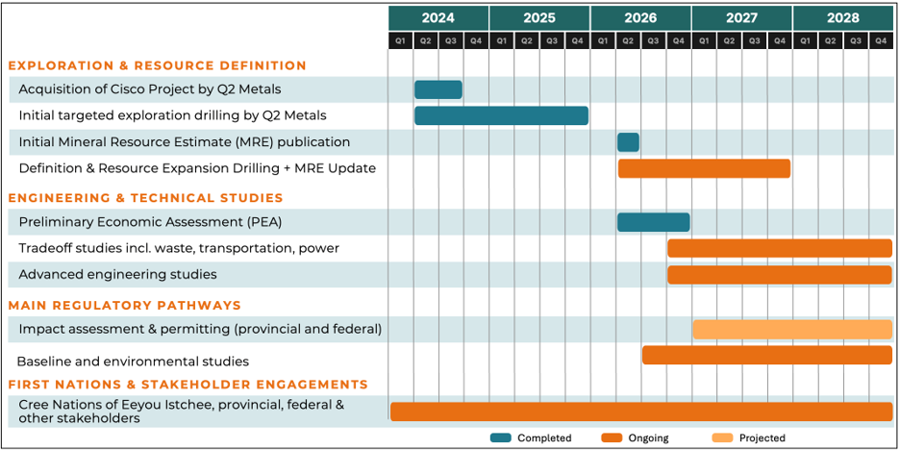
Figure 5: Project Pathway – 2024 through 2028
CTM-ITC Tax Credits
The Company and its external tax advisors have undertaken a preliminary assessment of the Canadian and Quebec government incentives and tax credits that may be available for the Project.
The Clean Technology Manufacturing Investment Tax Credit in Canada (“CTM-ITC”) provides a refundable federal tax credit designed to encourage investment in clean technology manufacturing, processing and critical mineral extraction and processing projects in Canada. The tax credit is legislated to provide a 30% refundable tax credit on eligible capital investments and activities through to 2031, after which it is scheduled to phase down to 20% in 2032, 10% in 2033, and 5% in 2034. The rate is 0% after 2034.
Based on this preliminary assessment, approximately $658 million of the Project’s estimated initial capital costs included in the PEA may qualify for the CTM-ITC. After consideration of timing, eligible-cost definitions, labour content and the legislated phase-down schedule, the PEA incorporates a potential refundable investment credit of approximately $95 – $101 million. There is no guarantee that the Company will be able to access all or part of the CTM-ITC. The CTM-ITC program is currently scheduled to expire in 2034 and there is no guarantee that it will be extended.
The Province of Quebec also has a tax holiday for large investment projects. A qualifying company can receive an income tax holiday that is capped at 20% of eligible investment expenditures. The cumulative eligible investment base is capped at C$1 billion per project. Pending submission and approval, the tax holiday could provide income tax savings of up to $200 million over the first 10 years of production. There is no guarantee that the Company will be able to access the tax holiday program.
The Company intends to evaluate and pursue federal and provincial funding programs, grants, tax incentives, and strategic support initiatives that may be available for the Project. While no assurance can be provided that any additional funding or incentives will be secured, the Company believes there may be opportunities to further enhance Project economics through participation in eligible government support programs.
PEA Technical Report & Technical Disclosure
The Preliminary Economic Assessment was prepared by BBA Consultants. The study was completed by the following Qualified Persons as defined by NI 43-101: Todd McCracken, P.Geo. Director – Mining & Geology; Dario Evangelista, P. Eng., Senior Mining Engineer; Patricia Dupuis, P.Eng., Senior Process Engineer; Isabelle Leblanc, P.Eng., VP Mining & Metals and Geraldine Cosset P.Eng, M.Sc.A, Principal Tailings Engineer.
All are independent of the Company in accordance with NI 43-101. They are not aware of any environmental, permitting, legal, title, taxation, socio-economic, marketing, political, or other relevant factors that could materially affect the results of the PEA.
Additional scientific and technical information in this news release not specific to the PEA has been prepared under the supervision of and approved by Neil (Sage) McCallum, B.Sc., P.Geol, Qualified Person (QP) as defined by NI 43-101, and a registered permit holder with the Ordre des Géologues du Québec and member in good standing with the Professional Geoscientists of Ontario. Neil (Sage) McCallum is a director and the Vice President Exploration for Q2 Metals and has reviewed and approved the technical information in this news release.
The effective date of the PEA will be provided in the NI 43-101 Technical Report, which will be filed on the Company’s website and under its SEDAR+ profile within the required 45-day period. The scientific and technical information contained herein has been reviewed and approved by the aforementioned Qualified Persons.
About Q2 Metals
Q2 Metals is a Canadian mineral exploration company focused on advancing the Cisco Lithium Project which is located within the greater Nemaska traditional territory of the Eeyou Istchee, James Bay region of Québec, Canada. The Cisco Deposit is strategically situated just 6.5 km from the Billy Diamond Highway, providing access to rail infrastructure in the Town of Matagami, ~150 km to the south, with connections to deep seaports beyond.
The current Inferred Mineral Resource Estimate on the Cisco Deposit outlines a pit-constrained resource of 271.6 Mt grading 1.37% Li2O at a 0.4% Li2O cut-off grade and an additional underground-constrained resource of 25.8Mt grading 1.30% Li2O Inferred at a 0.7% Li2O cut-off grade. Together, these support a combined inferred mineral resource of 297.4 Mt grading 1.36% Li2O. The Cisco Deposit remains open along strike, with several additional high-priority targets identified across the broader 41,253 ha project area.
“With a significantly expanded resource at Lundberg and now hig... READ MORE
NexGold Mining Corp. (TSX-V: NEXG) (OTCQX: NXGCF) is pleased to ... READ MORE
Premier American Uranium Inc. (TSX-V: PUR) (OTCQB: PAUIF) is plea... READ MORE
Copper-bearing mineralization logged in all eight holes along an ... READ MORE