








Drilling Confirms High-Grade Mineralization Within the Planned Oculto Pit and Extends Broad Oxide Gold Zone East Towards Oculto East
AbraSilver Resource Corp. (TSX: ABRA) (OTCQX: ABBRF) is pleased to report assay results from two additional diamond drill holes, DDH-26-064 and DDH-26-063A, completed at the Oculto deposit as part of the ongoing Phase VI exploration program at its wholly-owned Diablillos project in Argentina.
DDH-26-064 was drilled as an infill hole within the planned Oculto open pit and intersected 75.0 m grading 2.44 g/t gold and 106 g/t silver in oxides. The interval includes 8.0 m at 5.94 g/t gold and 7.0 m at 7.97 g/t gold, as well as a separate silver-rich interval of 5.0 m at 556 g/t silver. The results confirm the continuity of high-grade gold and silver mineralization within the planned open pit and will be incorporated into the updated Mineral Resource estimate. DDH-26-063A, drilled further east, intersected 253.0 m grading 0.54 g/t gold in oxides. Much of this interval is below the current open pit design and extends the broad gold zone east of the Cross Breccia toward Oculto East.
Highlight Drill Results: Widths are reported as drilled; true widths are not yet known.
John Miniotis, President and CEO, commented, “DDH-26-064 returned a wide, high-grade gold and silver intercept within the planned Oculto open pit, confirming the continuity of high-grade mineralization in an area that is important to the mine plan. DDH-26-063A extends the broad oxide gold zone east of the Cross Breccia toward Oculto East, where it remains open to further exploration. Along with the high-grade results from DDH-26-061 reported last month, this gives us further exploration targets to follow up as we continue to drill in the area. In parallel, all activities remain on schedule for a final construction decision in Q2 2027, and we look forward to releasing the Heap Leach PEA shortly.”
Table 1 – Summary of Drill Intercepts
Intercepts greater than 25 gram-metres gold or 2,000 gram-metres silver shown in bolded text:
| Drill Hole | Area | From (m) |
To (m) |
Type | Interval (m) |
Au g/t |
Ag g/t |
Cu % |
|
| DDH-26-063A | Oculto East | 116.0 | 369.0 | Oxides | 253.0 | 0.54 | 9.8 | – | |
| Including | 229.0 | 233.0 | Oxides | 4.0 | 2.24 | 7.8 | – | ||
| DDH-26-064 | Oculto | 110.0 | 113.0 | Oxides | 3.0 | 0.96 | 9.9 | – | |
| 158.0 | 163.0 | Oxides | 5.0 | 0.18 | 556.4 | – | |||
| 170.0 | 172.0 | Oxides | 2.0 | 0.15 | 119.6 | – | |||
| 220.0 | 295.0 | Oxides | 75.0 | 2.44 | 106.3 | – | |||
| Including | 228.0 | 236.0 | Oxides | 8.0 | 5.94 | 63.5 | – | ||
| Including | 252.0 | 259.0 | Oxides | 7.0 | 7.97 | 78.3 | – | ||
| 310.0 | 326.5 | Sulphides | 16.5 | 1.50 | 11.1 | 0.44 |
Note: All results are rounded. Assays are uncut and undiluted. Widths are drilled widths. True widths are unknown. Including intervals are contained within the main interval above them.
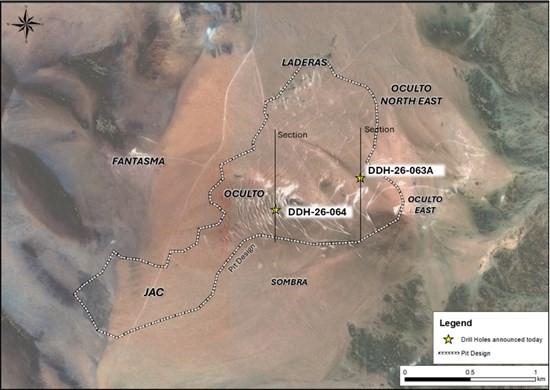
Figure 1 – Plan View of Drill Results
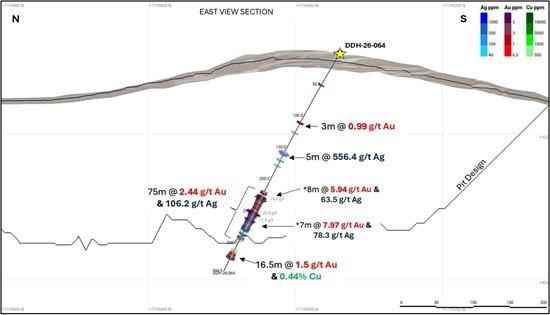
Figure 2 – Section Through Hole DDH-26-064 Looking East
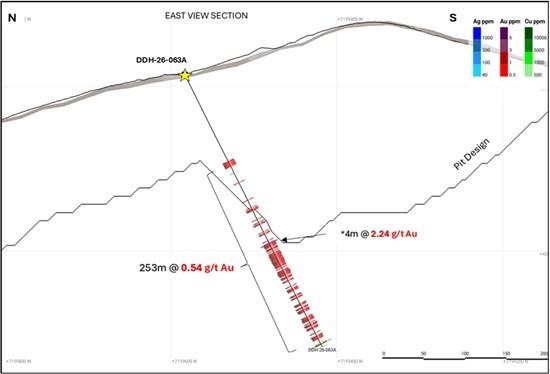
Figure 3 – Section Through Hole DDH-26-063A Looking East
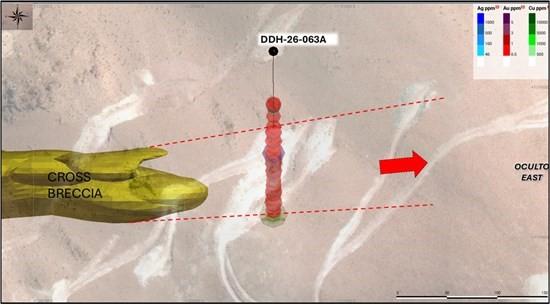
Figure 4 – Plan View Showing Eastward Extension of the Broad Gold Zone
Oculto – DDH-26-064
DDH-26-064 was drilled within the planned Oculto open pit as part of an infill program to confirm the continuity and grade of mineralized zones ahead of the updated Mineral Resource estimate. The hole intersected each of the three mineralized zones typically seen at Oculto: the shallow gold zone, the silver-enriched zone and the deeper gold zone.
The silver-enriched zone returned 5.0 m grading 556 g/t silver from 158.0 m. Below this, the deeper gold zone returned 75.0 m grading 2.44 g/t gold and 106 g/t silver from 220.0 m to 295.0 m downhole. This interval includes 8.0 m at 5.94 g/t gold from 228.0 m and 7.0 m at 7.97 g/t gold from 252.0 m. All of these intervals are oxide-hosted.
Near the bottom of the hole, DDH-26-064 intersected 16.5 m grading 1.50 g/t gold, 11 g/t silver and 0.44% copper in sulphides from 310.0 m, below the base of oxidation.
Oculto East – DDH-26-063A
DDH-26-063A was drilled at the eastern margin of the Oculto deposit to test the eastward continuation of gold mineralization associated with the Cross Breccia. The hole intersected 253.0 m grading 0.54 g/t gold and 10 g/t silver in oxides from 116.0 m to 369.0 m downhole, including 4.0 m at 2.24 g/t gold from 229.0 m. Much of the interval is below the current open pit design (Figure 3).
The intercept extends the broad oxide gold zone east of the Cross Breccia toward Oculto East (Figure 4). In this area, DDH-26-061 recently returned 228.0 m grading 1.79 g/t gold, including 66.0 m at 4.04 g/t gold (see the Company’s news release dated October 21, 2026). Together, DDH-26-061 and DDH-26-063A support the potential eastward extension of the gold system beyond the current open pit design. Further drilling is underway to define the extent and continuity of the mineralization between these holes and its relationship to the current Mineral Resource.
Next Steps
Three drill rigs remain active on site, and the Phase VI program is on track for completion by year-end. All Phase VI results will be incorporated into an updated Mineral Resource estimate, expected in Q2 2027. The Company has also recently completed a detailed CSAMT survey over the Diablillos system and is interpreting the results to help prioritize and optimize future drill targets. Additional assay results are pending and will be reported as they become available. For further details on the Phase VI program, the Heap Leach PEA and the Phase 1 development timeline, please refer to the Company’s news release dated October 21, 2026.
Collar Data
| Hole Number | UTM Coordinates | Elevation | Azimuth | Dip | Depth (m) | Area | |
| DDH-26-063A | 720988 | 7199583 | 4,414 | 180 | -63 | 371.0 | Oculto East |
| DDH-26-064 | 720340 | 7199340 | 4,311 | 340 | -60 | 344.0 | Oculto |
About Diablillos
The Diablillos property is located within the Puna region of Argentina, in the southern part of Salta Province along the border with Catamarca Province, approximately 160 km southwest of the city of Salta and 375 km northwest of the city of Catamarca. AbraSilver acquired the property in 2016, which comprises 15 contiguous and overlapping mineral concessions with excellent year-round road access.
Exploration to date has outlined multiple occurrences of silver-gold oxide mineralization at Oculto, JAC, Laderas, and Fantasma, located within a 500 m to 1.5 km distance surrounding the Oculto/JAC epicentre. To date, over 170,000 metres have been drilled on the property, which continues to demonstrate the strong growth potential of shallow, oxide-hosted silver and gold resources. In addition, a large porphyry complex is centered approximately 4 km northeast of Oculto which includes outcropping porphyry intrusions within a major zone of alteration and associated gold rich epithermal mineralization.
Comparatively nearby examples of high sulphidation epithermal deposits include: La Coipa (Chile); Yanacocha (Peru); El Indio (Chile); Lagunas Nortes/Alto Chicama (Peru); Veladero (Argentina); and Filo del Sol (Argentina). The most recent tank and heap leach Mineral Resource estimate for Diablillos is shown in Table 2. Following completion of the DFS in June 2026, the Project also hosts Proven and Probable Mineral Reserves of 77.9 Mt grading 0.70 g/t gold and 73 g/t silver (146 g/t silver equivalent) (“AgEq”), containing 184 Moz of silver and 1.8 Moz of gold (366 Moz AgEq). For additional details, please refer to the “NI 43-101 Mineral Resource Estimate, Diablillos Silver-Gold Project” dated June 19, 2026, available on SEDAR+ and the Company’s website.
Table 2 – Diablillos Mineral Resource Estimate – As of April 30, 2026
| Zone | Category | Tonnes (000 t) |
Ag (g/t) |
Au (g/t) |
AgEq (g/t) |
Contained Ag (000 Oz) |
Contained Au (000 Oz) |
Contained AgEq (000 Oz) |
|
| Tank Leach | Oxides | Measured | 41,042 | 100 | 0.68 | 159 | 131,668 | 896 | 209,281 |
| Indicated | 60,978 | 41 | 0.58 | 92 | 81,060 | 1,143 | 180,078 | ||
| Measured & | 102,021 | 65 | 0.62 | 119 | 212,728 | 2,039 | 389,359 | ||
| Indicated | |||||||||
| Inferred | 14,400 | 25 | 0.57 | 74 | 11,468 | 262 | 34,187 | ||
| Heap Leach | Oxides | Measured | 25,469 | 13 | 0.09 | 19 | 10,997 | 76 | 15,425 |
| Indicated | 104,491 | 7 | 0.13 | 15 | 24,328 | 428 | 49,342 | ||
| Measured & | 129,960 | 8 | 0.12 | 16 | 35,325 | 503 | 64,767 | ||
| Indicated | |||||||||
| Inferred | 34,947 | 6 | 0.14 | 14 | 6,939 | 158 | 16,153 | ||
| Total | Oxides | Measured | 66,512 | 67 | 0.45 | 105 | 142,665 | 971 | 224,706 |
| Indicated | 165,469 | 20 | 0.30 | 43 | 105,388 | 1,570 | 229,420 | ||
| Measured & | 231,981 | 33 | 0.34 | 61 | 248,053 | 2,542 | 454,127 | ||
| Indicated | |||||||||
| Inferred | 49,347 | 12 | 0.26 | 32 | 18,406 | 420 | 50,340 |
Footnotes for Tank Leach Resource:
Footnotes for Heap Leach Resource:
QA/QC and Core Sampling Protocols
AbraSilver applies industry standard exploration methodologies and techniques, and all drill core samples are collected under the supervision of the Company’s geologists in accordance with industry best practices. Drill core is transported from the drill platform to the logging facility where drill data is compared and verified with the core in the trays. Thereafter, it is logged, photographed, and split by diamond saw prior to being sampled. Samples are then bagged, and quality control materials are inserted at regular intervals at site; these include blanks and certified reference materials as well as duplicate core samples which are collected in order to assess sampling precision and reproducibility. Groups of samples are then placed in large bags which are sealed with numbered tags in order to maintain a chain-of-custody during the transport of the samples from the project site to the laboratory.
All samples are received by the ASA (Alex Stewart Argentina) preparation laboratory in Salta, where they are prepared, then the pulp sachet is directly dispatched to its facility in Mendoza, Argentina, where they are analyzed. All samples are analyzed using a multi-element technique consisting of a four-acid digestion followed by ICP/AES detection, and gold is analyzed by 50g Fire Assay with an AAS finish. Silver results greater than 100g/t are re-analyzed using four acid digestion with an ore grade AAS finish. ASA is independent of the Company.
Qualified Person
David O’Connor P.Geo., Chief Geologist for AbraSilver, is the Qualified Person as defined by National Instrument 43-101 Standards of Disclosure for Mineral Projects and he has reviewed and approved the scientific and technical information in this news release.
About AbraSilver
AbraSilver is a leading silver-gold development company focused on advancing its 100%-owned Diablillos Project in the mining-friendly provinces of Salta and Catamarca, Argentina. The recently completed Definitive Feasibility Study highlights Diablillos as a robust, high-margin, long-life precious metals project with a strong production profile and substantial exploration upside. In addition, the Company has entered into an earn-in option and joint venture agreement with Teck on the La Coipita project, located in the San Juan province of Argentina.
HIGHLIGHTS OF THE PRESS RELEASE: Final US$50 Million Tranche Rece... READ MORE
Including 4.75 meters grading 5.26 g/t gold, as the Company advan... READ MORE
Critical One Energy Inc. (CSE: CRTL) (OTCQB: CTLOF) (FSE: 4EF) i... READ MORE
Fourth straight quarter of strong operational delivery Gold produ... READ MORE