






Manhattan Uranium Discovery Corp. (TSX-V: MANU) (OTCQB: MAUUF) (FSE: J5B0) is pleased to announce completion of the 2026 summer drill program at the Murmac and Strike Uranium Projects, near Uranium City in northern Saskatchewan. The program was operated by Fortune Bay Corp. (TSX-V: FOR) (FSE: 5QN) (OTCQB: FTBYF).
The program completed 24 drill holes totalling 4,526.4 metres and encountered favourable graphitic host rocks, faulting and hydrothermal alteration, with radioactivity of 300 counts per second or higher reported in six holes, including shallow intersections beginning at 22.50 metres downhole at Strike’s Tena target.
Program Highlights
A super-SPEC RS-225 handheld spectrometer was used to obtain radiometric reading, which are preliminary and do not quantify uranium grades. Laboratory assays are required to determine uranium concentrations.
“The Athabasca Basin hosts some of the world’s highest-grade uranium deposits, and our initial drilling at Murmac and Strike has confirmed the geological setting we look for in this district. We are encouraged by the anomalous radioactivity recorded in six holes, and by the favourable host rocks, structures and alteration encountered at the Projects. Once assays are received, we will use the combined geological and geochemical data to prioritize follow-up targets,” stated Galen McNamara, CEO and Director of Manhattan.
Drilling Summary and Radiometric Results
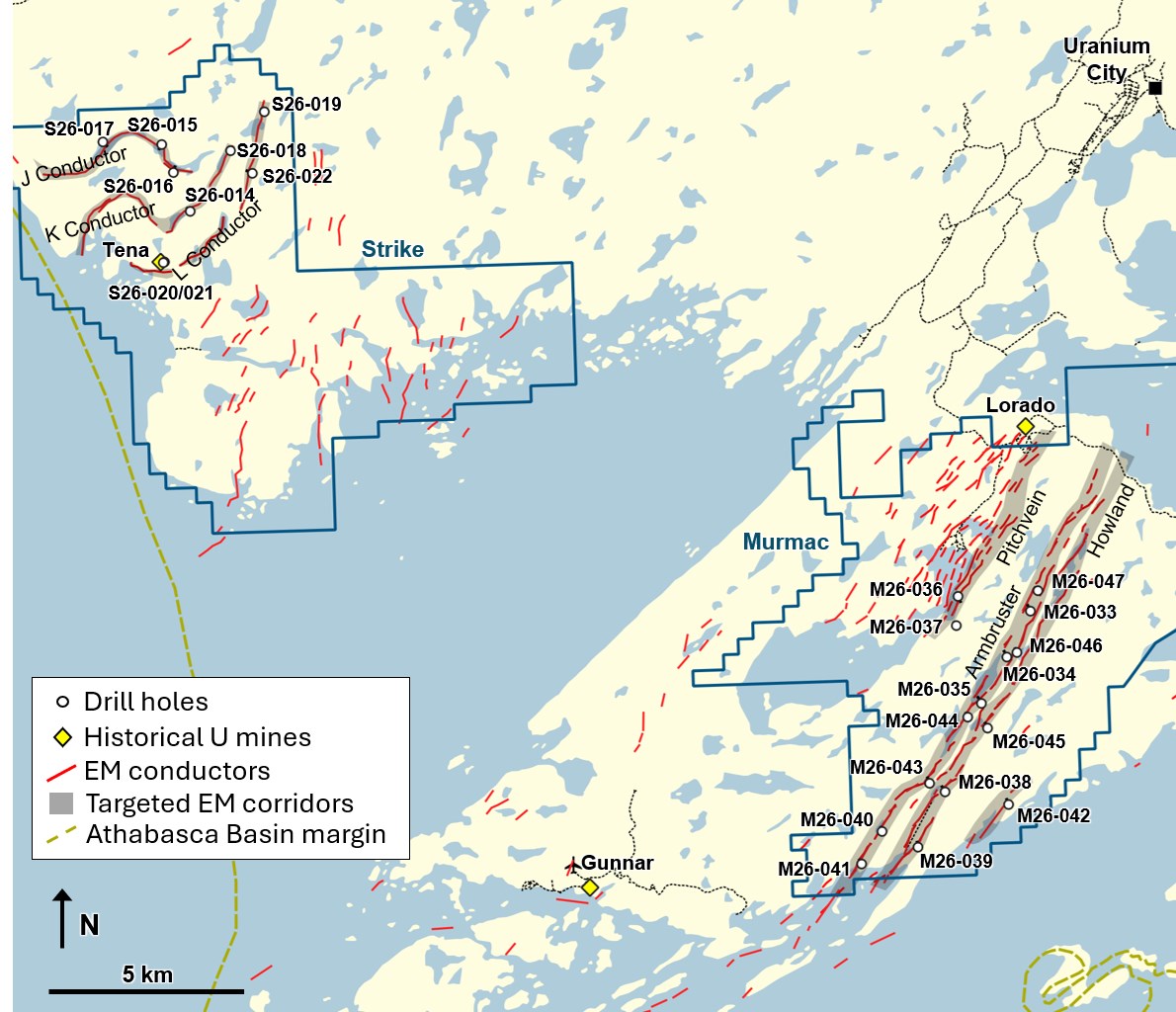
The program completed 15 holes totalling 2,978.4 m at Murmac and nine holes totalling 1,548.0 m at Strike between June and September 2026 (Figure 1; Table 2). Murmac drilling tested the Pitchvein, Armbruster, Howland and Howland East targets outlined in the news release dated June 16, 2026. At Strike, drilling tested targets along the J, K and L Conductors and at Tena. Targets were selected using electromagnetic and gravity data, geological and structural interpretations, historical uranium occurrences and previous drilling results. Drilling encountered geological features commonly associated with high-grade, basement-hosted uranium mineralization related to the Athabasca Basin, including:
Table 1: Drill Hole Radiometric Highlights
(Drill hole prefixes “M” and “S” denote the Murmac and Strike projects, respectively)
| Hole ID | Radioactivity Highlights (>300 cps) | ||||||||
| From (m) | To (m) | Length (m) | cps | Lithology / Comments | |||||
| M26-037 | 131.06 | 131.87 | 0.81 | 314 | Fractured granite / gneiss. Entire intersection from 126.64 to 188.0 m (61.36 m) includes intermittent elevated radioactivity between 300 and 340 cps, averaging 269 cps. | ||||
| M26-040 | 126.95 | 127.10 | 0.15 | 310 | Heavily fractured graphitic pelite, minor pervasive and moderate fault-hosted hematization. | ||||
| 128.50 | 128.60 | 0.10 | 310 | ||||||
| S26-014 | 72.60 | 72.80 | 0.20 | 310 | Biotite-rich pelite with graphitic faulting and hematization. | ||||
| 111.27 | 111.83 | 0.56 | 378 | Faulted weakly graphitic pelitic gneiss, pervasive and fracture-hosted hematization. | |||||
| 152.47 | 152.64 | 0.17 | 340 | Faulted weakly graphitic pelitic gneiss. | |||||
| S26-015 | 173.94 | 174.12 | 0.18 | 300 | Weakly foliated pelitic gneiss. | ||||
| 174.59 | 174.96 | 0.37 | 300 | ||||||
| 175.79 | 176.00 | 0.21 | 300 | ||||||
| S26-017 | 193.78 | 193.97 | 0.19 | 305 | Structured gneiss, pervasive hematization. | ||||
| 195.17 | 195.30 | 0.13 | 305 | ||||||
| 196.56 | 196.76 | 0.20 | 305 | ||||||
| S26-020 | 22.50 | 29.30 | 6.80 | 348 | Alternating pelitic gneiss and amphibolite. Elevated radioactivity (at 60.03 m) associated with increased hematization. | ||||
| incl. | 23.40 | 24.00 | 0.60 | 737 | |||||
| incl. | 27.70 | 29.30 | 1.60 | 338 | |||||
| 34.50 | 40.10 | 5.60 | 324 | ||||||
| incl. | 35.20 | 35.40 | 0.20 | 950 | |||||
| 59.13 | 61.03 | 1.90 | 489 | ||||||
| incl. | 60.03 | 60.23 | 0.20 | 1,890 | |||||
| Note: Radioactivity values reported are total gamma from NQ drill core measured with a Super-SPEC RS-225 handheld spectrometer reported in cps. The cps values are averages for the reported drill interval unless otherwise specified. Measurements of total gamma cps are an indication of the presence of uranium, thorium and/or potassium, but may not directly correlate with chemical uranium assays. Total gamma cps results are preliminary in nature and may not be used directly to quantify uranium concentrations in the drill core samples. True thicknesses of the drill core intersections are yet to be determined. | |||||||||
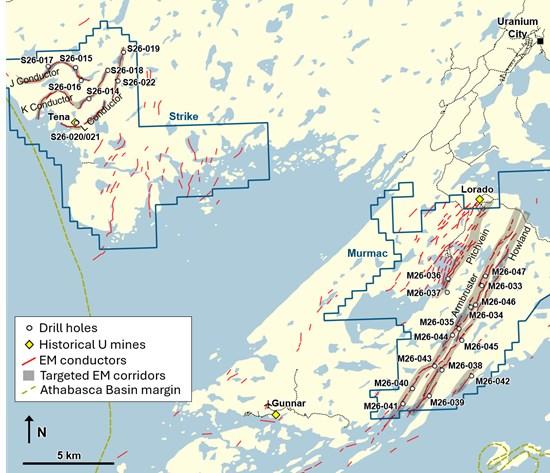
Figure 1: Drill Collar Locations.
To view an enhanced version of this graphic, please visit:
https://images.newsfilecorp.com/files/8126/322223_8aa9a8ebd43a4aaa_001full.jpg
Summaries for Drill Holes with Elevated (>300 cps) Radioactivity
M26-037: Tested target P8 in the Pitchvein Corridor at Murmac. The targeted graphitic pelite (electromagnetic conductor) was intersected from 159.43 to 167.98 m, between more competent granite/gneiss units. A maximum radioactivity reading of 340 cps (Table 1) was recorded within a larger interval from 131.06 to 131.87 m that averaged 314 cps over 0.81 m. Numerous other anomalous (>300 cps) intervals were present intermittently in the interval 126.64 to 188.00 m, with a cumulative total of 7.54 m of core returning anomalous values in this 61.36 m interval.

Figure 2: Hole M26-037 (target P8), 129.90 to 134.34 m. Intermittent anomalous radioactivity hosted in structured granite/gneiss.
To view an enhanced version of this graphic, please visit:
https://images.newsfilecorp.com/files/8126/322223_8aa9a8ebd43a4aaa_002full.jpg
M26-040: This hole tested target A1, a gravity low at the south end of the Armbruster Corridor at Murmac. The targeted graphitic pelite was intersected from 91.41 to 138.04 m down hole. Anomalous radioactivity is hosted at the base of this unit in close proximity to its contact with an underlying highly competent quartzite, associated with intense hematization and faulting.

Figure 3: M26-040 (target A1) radioactive intersections (highlighted in red, see Table 1) within the interval 126.45 to 130.70 m down hole. Anomalous intervals, hosted in graphitic pelite, are associated with hematization and intense fracturing. Prior drilling results are provided for geological context and are not necessarily indicative of results from current drilling.
To view an enhanced version of this graphic, please visit:
https://images.newsfilecorp.com/files/8126/322223_8aa9a8ebd43a4aaa_003full.jpg
S26-014: Tested target K5 on the K Conductor at Strike, an electromagnetic high anomaly approximately 500 m along strike from hole S22-013, which returned 0.43% U₃O₈ over 0.10 m from 145.70 to 145.80 m in Fortune Bay’s 2022 drilling (see news release dated December 7, 2022). True thickness of that historical drill core interval has not been determined. Three zones of anomalous radioactivity were intersected in S26-014 (Table 1), including 378 cps over 0.56 m from 111.27 to 111.83 m down hole (Figure 4). This intersection, hosted in graphitic pelite, is associated with intense fracturing and minor pervasive and fault-associated hematization.

Figure 4: S26-014 interval from 110.48 to 115.10 m down hole with radioactive intersection (Table 1) highlighted in red.
To view an enhanced version of this graphic, please visit:
https://images.newsfilecorp.com/files/8126/322223_8aa9a8ebd43a4aaa_004full.jpg
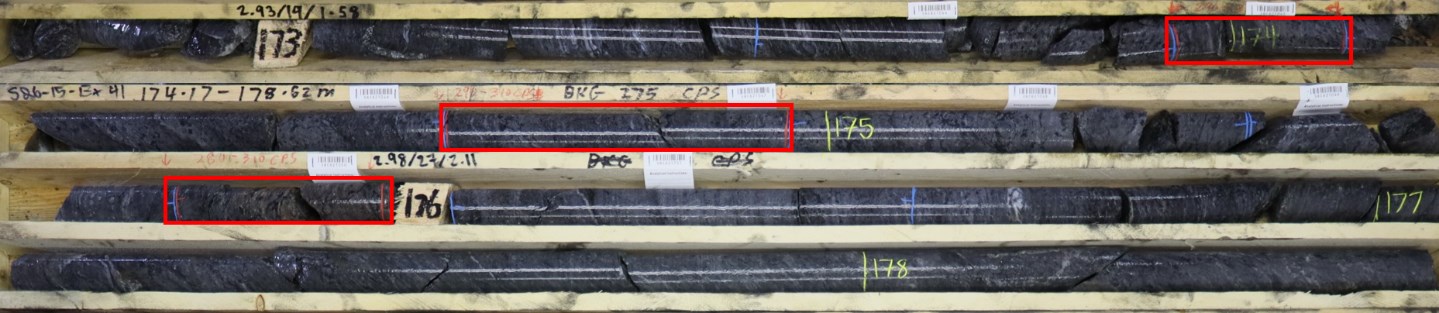
S26-015: This hole tested target J5 on the J Conductor at Strike. Radioactivity of 300 cps was reported in three discrete intervals (Table 1; Figure 5), hosted in pelitic gneiss underlying a heavily structured, mylonitized granite.
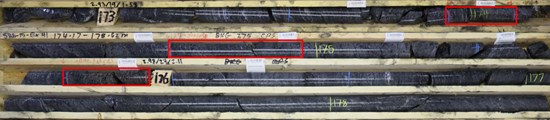
Figure 5: S26-015 radioactive (highlighted in red, see Table 1) intersections in pelitic gneiss within the interval 172.70 to 178.62 m down hole.
To view an enhanced version of this graphic, please visit:
https://images.newsfilecorp.com/files/8126/322223_8aa9a8ebd43a4aaa_005full.jpg
S26-017: Tested target J4 on the J Conductor at Strike. Anomalous radioactivity (Table 1, Figure 6) is hosted in pelitic gneiss and is associated with pervasive and fracture-hosted hematization and significant faulting.

Figure 6: S26-017 radioactive intersections (highlighted in red, see Table 1) in pelitic gneiss within the interval 192.58 to 196.77 m down hole.
To view an enhanced version of this graphic, please visit:
https://images.newsfilecorp.com/files/8126/322223_8aa9a8ebd43a4aaa_006full.jpg
S26-020: This hole tested down-dip of the Tena historical adit at Strike. Fortune Bay drilling in 2022 highlighted the possibility of an inflection zone in the structure hosting the Tena mineralization. S26-020 was drilled targeting this zone to test for a potentially larger mineralized footprint associated with structural dilation. Anomalous radioactivity was intersected in multiple intervals as detailed in Table 1. The elevated radioactivity is hosted in pelitic gneiss and is associated with variable amounts of brittle faulting and hydrothermal alteration. Figure 7 shows radioactivity averaging 1,890 cps over 0.20 m (60.03 to 60.23 m) within a broader interval averaging 489 cps over 1.90 m (59.13 to 61.03 m) down hole, associated with faulting and hematization.

Figure 7: S26-020 (Tena) interval averaging 1,890 cps over 0.20 m in faulted and hematized pelitic gneiss.
To view an enhanced version of this graphic, please visit:
https://images.newsfilecorp.com/files/8126/322223_8aa9a8ebd43a4aaa_007full.jpg
Table 2: Murmac and Strike Drill Hole Information
| Hole ID | Project | Target ID | Easting | Northing | Azimuth | Dip | Length (m) |
| M26-033 | Murmac | A12 | 632152 | 6592274 | 335 | -45 | 231.6 |
| M26-034 | A8 | 631526 | 6591054 | 335 | -45 | 235.4 | |
| M26-035 | A5 | 630852 | 6589823 | 330 | -45 | 262.1 | |
| M26-036 | P4 | 630229 | 6592666 | 155 | -45 | 210.2 | |
| M26-037 | P8 | 630183 | 6591890 | 330 | -60 | 209.1 | |
| M26-038 | H3 | 629884 | 6587474 | 330 | -45 | 221 | |
| M26-039 | H14 | 629165 | 6586006 | 350 | -45 | 188 | |
| M26-040 | A1 | 628210 | 6586423 | 345 | -45 | 161 | |
| M26-041 | A27 | 627668 | 6585560 | 330 | -45 | 169 | |
| M26-042 | HE1 | 631572 | 6587139 | 340 | -45 | 200 | |
| M26-043 | A26 | 629473 | 6587702 | 340 | -45 | 217 | |
| M26-044 | A25 | 630487 | 6589459 | 335 | -45 | 161 | |
| M26-045 | H19 | 631014 | 6589167 | 335 | -45 | 200 | |
| M26-046 | A24 | 631794 | 6591176 | 335 | -45 | 158 | |
| M26-047 | A23 | 632351 | 6592817 | 315 | -45 | 155 | |
| S26-014 | Strike | K5 | 609830 | 6602890 | 315 | -45 | 161 |
| S26-015 | J5 | 609073 | 6604664 | 210 | -50 | 200 | |
| S26-016 | J6 | 609383 | 6603921 | 15 | -45 | 221 | |
| S26-017 | J4 | 607509 | 6604733 | 135 | -45 | 202 | |
| S26-018 | K7 | 610902 | 6604500 | 330 | -50 | 161 | |
| S26-019 | L4 | 611799 | 6605534 | 320 | -45 | 151 | |
| S26-020 | Tena | 609145 | 6601546 | 345 | -45 | 101 | |
| S26-021 | Tena | 609116 | 6601528 | 340 | -60 | 131 | |
| S26-022 | L3 | 611481 | 6603900 | 295 | -45 | 220 | |
| Notes: Coordinates are reported in UTM Zone 12N (NAD83 datum). Azimuths are referenced to true north. Murmac target prefixes denote: A = Armbruster Corridor; H = Howland Corridor; P = Pitchvein Corridor; and HE = Howland East Conductor. Strike target prefixes J, K and L refer to the corresponding conductors identified by airborne electromagnetic surveying (Figure 1). |
|||||||
Next Steps
Drill core samples have been collected systematically from all zones with radioactivity greater than 300 cps and have been submitted to SRC Geoanalytical Laboratories in Saskatoon for U₃O₈ assay and multi-element characterization. The Company will integrate these results with detailed geological logging to prioritize follow-up targets and assess additional regional targets for future drilling.
Option Agreement
As previously announced, Manhattan has earned a 51% interest in the Murmac and Strike Projects under an option agreement with Fortune Bay Corp., which continues to serve as operator. Manhattan has the right to increase its interest to 70% by satisfying the remaining requirements under the option agreement. For further details regarding the option agreement, see the Company’s previous news releases.
Technical Disclosure
Preliminary radiometric results represent total gamma from NQ drill core measured with a Super-SPEC RS-225 handheld spectrometer reported in cps. Measurements are typically collected over 0.10 to 0.15 metre intervals through areas of anomalous radioactivity (defined as >300 cps). Longer intervals with less variation are shown as length-weighted averages for simplicity.
Core is removed from the core box and moved, if necessary, to a location where the instrument reads below background, and the measurement is collected by placing the sensor against the core at the required location. The drill cores are subject to comprehensive logging and sampling to characterize mineralization, alteration and structure. Drill core samples have been submitted to the Saskatchewan Research Council (“SRC”) Geoanalytical Laboratories (ISO/IEC 17025:2017 accredited) for uranium assay and multi-element characterization.
Further details regarding the historical uranium occurrences noted in this news release (historical mines in Figure 1) can be found within the Saskatchewan Mineral Deposit Index (SMDI).
Photographs of drill core in Figures 2 through 7 are provided for illustrative purposes only. Photographs and visual observations are not reliable indicators of uranium grade or continuity and should not be relied upon as substitutes for chemical assay results. Assay results for the current program are pending.
Qualified Person
The technical and scientific information in this news release has been reviewed and approved by Galen McNamara, P.Geo., CEO and a director of Manhattan, who is a Qualified Person as defined by National Instrument 43-101 – Standards of Disclosure for Mineral Projects. Mr. McNamara is not independent of Manhattan under NI 43-101.
About Manhattan Uranium Discovery Corp.
Manhattan Uranium Discovery Corp. (TSX-V: MANU) (OTCQB: MAUUF) (FSE: J5B0) is a newly consolidated North American uranium company committed to the discovery, development, and advancement of high-quality uranium assets. Following the successful acquisitions of Urano Energy and Pegasus Resources, Manhattan now holds a premier portfolio of 15 past-producing uranium mines across 25 underexplored properties covering 25,099 acres in the United States, complemented by high-grade exploration potential in Canada’s Athabasca Basin. Backed by an elite technical and management team with decades of uranium discovery, project advancement, and capital markets experience, Manhattan is strategically positioned to capitalize on the growing demand for domestic uranium and the American nuclear renaissance. For more information about Manhattan, please visit: www.manhattanuranium.com.
About Fortune Bay
Fortune Bay Corp. (TSXV: FOR) (FSE: 5QN) (OTCQB: FTBYF) is a Canadian mineral exploration and development company with assets in Canada and Mexico. The Company’s primary focus is advancing the Goldfields Gold Project in Saskatchewan, Canada. Fortune Bay also holds the Poma Rosa Gold-Copper Project in Chiapas, Mexico, as well as an optioned uranium project portfolio in the Athabasca Basin of Saskatchewan. Fortune Bay continues to evaluate and advance its portfolio in a disciplined manner while maintaining a strong technical foundation and prudent capital management. For more information, please visit www.fortunebaycorp.com or contact info@fortunebaycorp.com.
Neither the TSX Venture Exchange nor its Regulation Services Provider (as that term is defined in the policies of the TSX Venture Exchange) accepts responsibility for the adequacy or accuracy of this release.
Follow Manhattan on social media for the latest updates
On behalf of Manhattan Uranium Discovery Corp.
“Galen McNamara”
Chief Executive Officer and Director
604-288-8046
Info@manhattanuranium.com
Fury Gold Mines Limited (TSX: FURY) (NYSE American: FURY) is pleased to announce first assay results... READ MORE
Ero Copper Corp. (TSX: ERO) (NYSE: ERO) is pleased to announce its operating and financial results ... READ MORE
Wesdome Gold Mines Ltd. (TSX: WDO) (OTCQX: WDOFF) today provides an update on its exploration and i... READ MORE
Osisko Metals Incorporated (TSX: OM) (OTCQX: OMZNF) (FRANKFURT:0B51) is pleased to announce new ana... READ MORE
Kirkland Lake Discoveries Corp. (TSX-V: KLDC) (OTCQB: KLKLF) is pleased to announce new diamond dri... READ MORE