







Australian-born, London-based author and founder of Amanacard, Dr Edwina Thompson brings her new book and a unique perspective on community gains from responsible artisanal mining to IMARC 2026 in Sydney.
The Other Side of the Coin: Trust, Money and Judgement in the Places the Banks Left Behind is Thompson’s second book. She says it draws on more than 20 years working “where conventional financial systems struggle to reach people”.
Amanacard is the social impact enterprise she founded 10 years ago. Amana is derived from an Arabic word meaning trust.
Thompson will be joined on a panel examining environmental and community benefits of responsible artisanal and small-scale gold mining by Global Initiative Against Transnational Organised Crime director of extractives, Marcena Hunter, Sustainable Minerals Institute senior research fellow Dr Fitsum Weldegiorgis and Perseus Mining chief corporate affairs & sustainability officer, Melanie Pollard.
World Gold Council chief strategy officer Terry Heymann is moderating the discussion.
Mining Beacon editor Richard Roberts caught up with Thompson ahead of IMARC.
Richard Roberts: I am interested in the book you’ve just published and your panel discussion. Chapter 9 of the book draws on your experience around oil and gas operations in Papua New Guinea. You ask whether the systems companies use to track machinery, production and payments could also help neighbouring communities build reliable incomes and records of their own. Companies would argue they already do that, at least to some extent. What does your experience say, and how does it connect with artisanal and small-scale gold mining (ASGM) and the wider trust discussion?
Edwina Thompson: You’re right that resource operations already help people build incomes. The book follows my work through resource-rich countries, from the DRC and Sudan to Afghanistan, Iraq, PNG and the Philippines. It shows the messy reality where supply chains begin. Faced with complexity and reputational risk big players can be tempted to look away or settle for a ‘theatre of compliance’. My starting point is that there is a way through, if we are prepared to do the work.
In ASGM the industry has the resources and talent to help people earn better incomes and build records of their own.
The book tells a simple story about a former SAS man heading security at an oil and gas operation in PNG. He was also a vegetarian who wanted some decent fresh food. That gave us a reason to look more closely at a supply chain supporting the core business: feeding the workforce.
Most local producers we encountered lacked formal identification, let alone bank accounts. They need cash on the day they sold. The challenge is making those purchases work within a major company’s audit requirements. Add the practical challenges of supply and food standards and you can end up shipping frozen vegetables from overseas to feed camps in what looks like a garden of Eden. Meanwhile, layers of intermediaries can obscure who gets paid for local produce.
We set up a small pilot supplying security personnel at a remote outpost. Vegetables were bought at the local market and loaded onto the chopper alongside personnel heading out on rotation. Women earned income from a straightforward procurement change: the camp needed food; people nearby could supply it. We worked on making those transactions possible and accountable.
ASGM is a different trade with a familiar payment challenge. It connects two financial worlds: at one end, gold can become a digital token in a global portfolio; at the other, it is weighed at a buying point and exchanged for banknotes a family needs that day. The mechanics have to work for the person holding the cash as well as the person holding the token.
My work makes those cash payments verifiable. A miner can receive physical cash while the purchase and payment leave a digital record. The buyer gets evidence and the miner a record of their own, without first having to change how they live and transact.
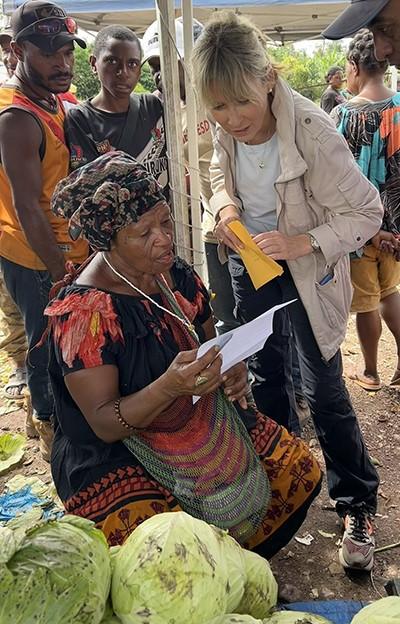
Edwina Thompson at a community vegetable market in Papua New Guinea
Across the wider resources sector I have seen a bank branch operating alongside a major project while families still struggled to receive their royalties. Banking infrastructure alone does not resolve entitlement, distribution or access. A company’s payment record and a family’s experience of receiving its share can be very different things. That gap can undermine trust in the whole operation.
That is the thread through the book: following the money to see who actually benefits. It means examining who controls distribution and asking awkward questions about the gaps. In my experience, too few are willing to follow the money that far.
Richard Roberts: IMARC has a lot of experienced mining people in attendance. It also has a large cohort of next-generation professionals and potential leaders. What should newcomers take away from your book?
Edwina Thompson: Go out of your way to read and watch the testimony of people who have lived with resource operations in the place you are entering. Seek out accounts of earlier projects, including from people who have spent years trying to get someone further up the supply chain to listen.
Being a new employee, or working for a new operator, does not make that history irrelevant. You are starting a job; the community is continuing a relationship with the industry that may stretch back generations.
Make a deliberate effort to hear women, including those who are absent from formal meetings or whose experiences are filtered through someone speaking on their behalf. Listen to what they say about their work, safety, land, water and the money their families were supposed to receive.
Some of those accounts you will not be able to un-read or un-watch, which is a good thing. Let them inform the questions you ask, the assurances you accept and the way you speak to people.
I hope readers take from the book the discipline of looking beyond what reaches their desk and their immediate remit. Technical expertise is critical. So is understanding what the operation means to its neighbours. You may fly in and fly out but they live with its consequences between your visits and long after your assignment ends.

Richard Roberts: What can experienced mining people take away and apply?
Edwina Thompson: The same invitation applies. Experience helps you understand why change is difficult, but it can also make familiar problems feel inevitable. Keep making time to hear people whose accounts challenge that view. You know how the organisation works and where decisions can be influenced. Use that knowledge. When people across an operation keep asking whether commitments have been honoured, those questions become harder to set aside.
Where your role allows, follow financial commitments through to the intended recipient. For royalties, compensation or other agreed benefits, be clear about who is entitled to what, how distribution works and what evidence confirms receipt. Where the figures do not reconcile, find someone who can take responsibility for investigating and resolving the gap.
Treat this as an operational issue. Unresolved payment disputes can feed grievances and disrupt operations. Finance, procurement, community relations and security teams need a shared understanding of those risks.
In ASGM, Amanacard is proposing an independently evaluated test at an existing gold-buying point, with a potential host identified in PNG. It would link seller verification, clear purchase terms and accountable cash payment. The buying partner would fund purchases of mercury-free gold and manage the cash float; we would support verification and payment records. We would measure what sellers keep, how quickly they receive it and whether they choose to return. Implementation and funding remain to be agreed.
Richard Roberts: Has mining improved on community trust over the past decade?
Edwina Thompson: My view is anecdotal, drawn from what I have seen on the ground, particularly in PNG. In those communities, trust remains low. I would be cautious about claiming substantial improvement.
One reason is that communities have longer memories than the organisations operating around them. Leases change hands, companies merge and management moves on.
Corporate knowledge fragments; families remember the operators, the promises and what happened to their land. In other words the company name or JV may change and the community still lives with what happened. Where that includes sexual violence, corruption or damage to water and food sources, a new owner does not automatically get a clean slate.
It reminds me of Afghanistan: personnel rotating through military and political missions while communities understood each arrival through generations of experience with outside powers. Everyone brings a partial picture, but some remain to live with the consequences after others rotate out.
Mining companies see global markets, investment cycles and improvements across their operations. Families judge what has changes where they live: can they drink the water, grow food, earn a living and obtain the benefits they were promised? They may see considerable wealth being generated without a comparable improvement in their own circumstances. Some may feel materially worse off.
That is why I am concerned when responsible sourcing becomes a reason to exclude artisanal miners because engagement is too complicated. The legal and operational challenges are real. But withdrawal leaves their need for income intact and can push them towards less scrupulous buyers. People still need cash, especially where their subsistence livelihoods have been disrupted.
Rebuilding trust means addressing that history and making present commitments checkable. Do families receive their royalty shares? Are miners paid the agreed amount, on time, in money they can use? Can people safely challenge a missing payment or report harm and get it addressed? Those commitments need to survive changes of ownership.
My part is following the money all the way to the family. That is where a commitment becomes something people can judge against their own experience.
Michael Fox interviews Peter Cashin, President and CEO of Aurigin... READ MORE
In this presentation, Jeffrey Christian of CPM Group discusses gold’s break b... READ MORE
In this week’s Weekly Perspective, David Morgan examines mounti... READ MORE
Leading international IT services and technology company HCLTech ... READ MORE