








Blue Star Gold Corp. (TSX-V: BAU) (OTCQB: BAUFF) (FSE: 5WP0) announces final results from its 2026 Phase 2 Drill Program, including significant step-out intersections at the North Fold Nose deposit, follow-up drilling at North Nutaaq, and maiden drilling at Roma Main. The results highlight opportunities for resource expansion and new discoveries across several priority gold targets. Blue Star is a leading explorer in Canada’s North, with projects strategically located along the proposed Grays Bay Road in the High Lake Belt, West Kitikmeot Region of Nunavut (Figure 1).
Highlights
“The second half of our 2026 drill program delivered encouraging results across several targets in the High Lake Belt,” said Grant Ewing, CEO of Blue Star. “From the new discovery at Auma-Bamako and significant step-out intersections at North Fold Nose, to additional high-grade results at North Nutaaq, we have made meaningful progress in advancing our exploration targets. Of particular interest is the potential for additional gold discoveries along the largely untested 2.5-kilometre continuation of the mineralized contact south of NFN. These results reinforce the opportunity for both resource expansion and new discoveries across our properties.”
Discussion of the NFN Drilling
The NFN deposit represents a small component of Blue Star’s current Mineral Resource Estimate (News Release May 21, 2026). Mineralization is hosted along a sheared contact between mafic volcanic and metasedimentary units at the northern end of the approximately 6 kilometre (km) long Ulu Fold. The mineralized contact dips steeply along the eastern limb of the syncline, providing a prospective horizon for exploration along strike and down dip.
Three holes were drilled in 2026 to test the southern extension of NFN mineralization, targeting Loupe EM anomalies approximately 100 m and 230 m south of the existing resource (Figure 2). An undercut hole at the 100 m step-out tested down-dip continuity.
Drillhole 26HND001 intersected the mineralized volcanic-sedimentary contact approximately 100 m below surface, returning 8.0 m of 2.94 g/t Au from 183 m downhole, including 1.8 m of 10.91 g/t Au. Hole 26HND002, a 110 m undercut, returned 6.0 m of 8.18 g/t Au, including 1.0 m of 47.10 g/t Au. These results indicate the presence of higher-grade mineralization at depth. Hole 26HND003, drilled approximately 230 m south of the existing resource, intersected the prospective contact approximately 150 m below surface, returning 1.6 m of 2.62 g/t Au, including 0.5 m of 8.09 g/t Au (Figure 3).
The 2026 drilling intersected gold mineralization up to 230 m south of the current NFN resource, strongly supporting the potential for resource expansion. Mineralization remains open along strike to the south and at depth, with further drilling required to establish grade continuity and evaluate potential inclusion in future mineral resource estimates.
Beyond the immediate NFN resource expansion potential, the prospective volcanic-sedimentary contact and associated shear structure extend approximately 2.5 km south of the deposit and remains largely untested (Figure 4). The Loupe EM survey has identified several anomalies along this prospective horizon, providing additional targets for follow-up exploration. The continuity of this favourable geological setting, together with the recent step-out drill results, highlights the potential for additional NFN-style gold mineralization along the broader trend.
Discussion of the Nutaaq Drilling
Gold mineralization at North Nutaaq is characterized by northeast-southwest trending tension veins hosted within a thick, locally magnetic gabbro sill on the eastern limb of the Ulu anticline. The gabbro hosts both Flood Zone style mineralization and Nutaaq style polymetallic sulphide veins with locally high gold grades. The Nutaaq Zone resource occupies a 200 m section of the sill, less than 1 km from the Flood Zone deposit, within the broader 1.6 km Nutaaq trend.
Two additional drill holes were completed at North Nutaaq during the Phase 2 program, following up on previous results from 25UND002 which returned 5.7 m of 7.31 g/t Au including 1.8 m of 21.1 g/t Au (News Release October 1, 2025), and 26UND003 returning 8.66 g/t Au over 1.2 m from 49.8 m depth and 2.56 g/t Au over 8.0 m from 74.0 m depth (News Release August 20, 2026).
Hole 26UND006 intersected several altered and mineralized structures within the gabbro, returning 1.4 m of 1.00 g/t Au from 14.6 m downhole, 2.2 m of 9.95 g/t Au from 49.8 m, and 2.3 m of 1.67 g/t Au from 134.7 m. Hole 26UND007, an undercut of 26UND006, returned 1.4 m of 1.77 g/t Au from 44.4 m downhole, 7.0 m of 3.01 g/t Au from 53.0 m, including 1.7 m of 10.92 g/t Au, and separate intervals of 2.2 m of 1.20 g/t Au and 4.1 m of 3.00 g/t Au.
The 2026 drilling intersected multiple gold-bearing structures over more than 300 m of strike length at North Nutaaq. Preliminary interpretation suggests higher grades may be concentrated toward the eastern portions of these structures, providing a potential vector for future drilling. With much of the 1.6 km Nutaaq trend remaining underexplored, opportunities exist to extend known mineralization and test parallel structures within the eastern limb of the Ulu Fold.
Discussion of the Roma Main Prospect
The Roma Main prospect is located on the eastern margin of the High Lake Belt, approximately 2.2 km from the proposed Grays Bay Road and 3 km from the High Lake volcanogenic massive sulphide (VMS) deposit. The prospect comprises an approximately 2 km long gold-bearing quartz vein trend hosted in granodiorite near the greenstone belt contact. Historical exploration returned high-grade gold intersections from shallow drilling.
Blue Star’s maiden drill program consisted of two holes totalling 419 m, testing the northern portion of the prospect for extensions of the historical mineralization along strike and at depth, including potential en-echelon and parallel vein structures. Holes 26RMD008 and 26RMD009 intersected multiple quartz veins within altered granodiorite. Hole 26RMD009 returned 2.7 m of 0.88 g/t Au, including 1.0 m of 1.43 g/t Au and 0.5 m of 1.69 g/t Au, while hole 26RMD008 returned 0.4 m of 3.89 g/t Au.
With only a small portion of the approximately 2 km trend tested by modern drilling, exploration potential remains along strike, at depth, and within parallel vein structures and the interpreted volcanic contact. Further geological interpretation will guide future drill targeting.
Next Steps
Final compilation of the 2026 exploration results and updated geological models will guide future drill targeting. At NFN, drilling will focus on resource expansion along strike and at depth, including the southern step-out extensions. Additional exploration will evaluate the largely untested 2.5 km continuation of the prospective volcanic-sedimentary contact to the south, incorporating Loupe EM results and geological interpretation to refine future drill targets. At North Nutaaq, future work will evaluate the continuity of higher-grade mineralization and test additional structures along the broader Nutaaq trend. At Roma Main, integration of drilling, historical data and surface mapping will guide further exploration of the approximately 2 km trend, with a focus on identifying parallel veins and defining the location of the untested volcanic contact.
Table 1: Drill Collars
| Hole ID | Easting | Northing | Elevation | Azimuth | Dip | Length (m) | Target |
| 26HND001 | 500679 | 7425495 | 422 | 95 | -50 | 208 | NFN |
| 26HND002 | 500679 | 7425495 | 422 | 95 | -68 | 320 | NFN |
| 26HND003 | 500692 | 7425382 | 428 | 90 | -50 | 242 | NFN |
| 26RMD008 | 509693 | 7473712 | 315 | 240 | -48 | 234 | Roma Main |
| 26RMD009 | 509646 | 7473624 | 320 | 240 | -48 | 185 | Roma Main |
| 26UND006 | 500797 | 7422012 | 447 | 130 | -48 | 164 | North Nutaaq |
| 26UND007 | 500797 | 7422012 | 447 | 130 | -63 | 161 | North Nutaaq |
Note: Collar locations are in UTM NAD83, Zone 12N coordinates.
Table 2: Summary of Assay Results
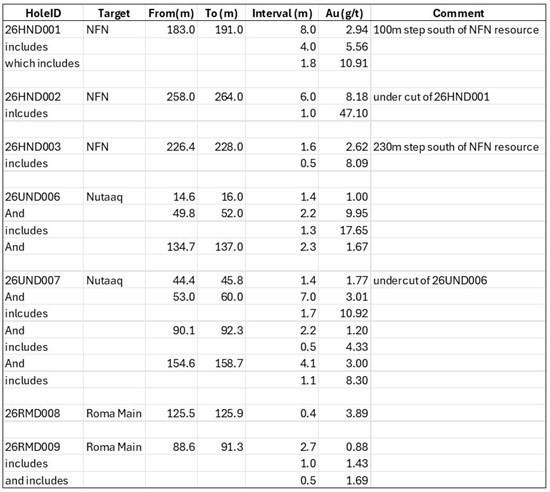
Intervals are down hole lengths; there has been insufficient drilling to determine true thicknesses.
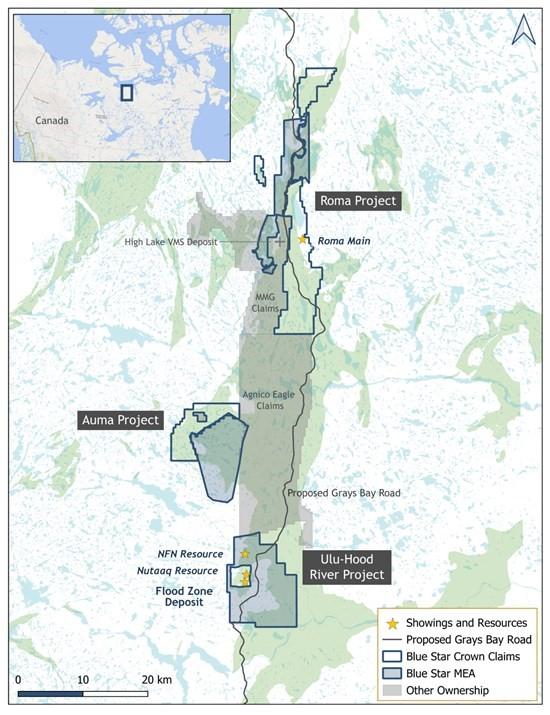
Figure 1: Location Map Showing Blue Star’s Landholdings.
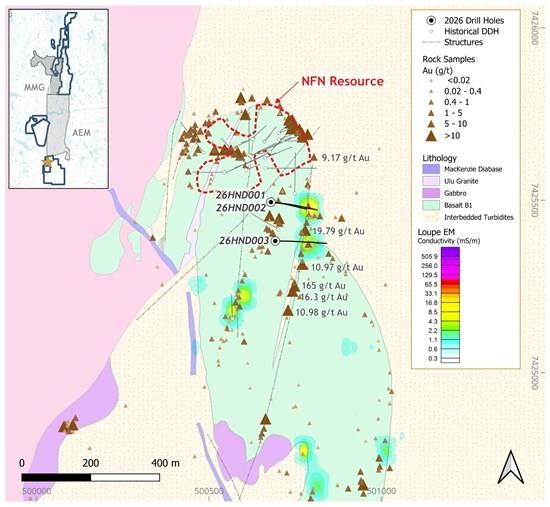
Figure 2: North Fold Nose Drill Holes Shown on Loupe EM Data, Overlain with Gold Grades from Rock Samples.
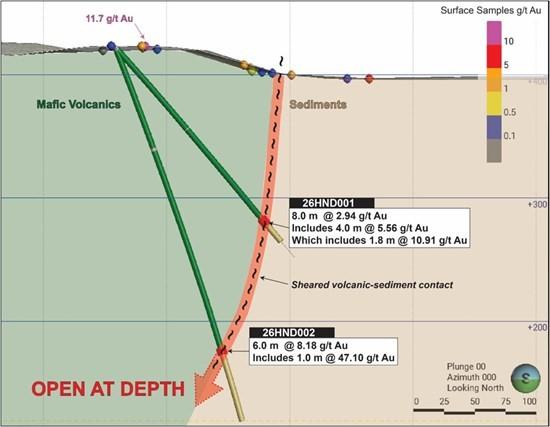
Figure 3: Vertical Cross Section of Drill Holes 26HND001, and 26HND002, North Fold Nose.
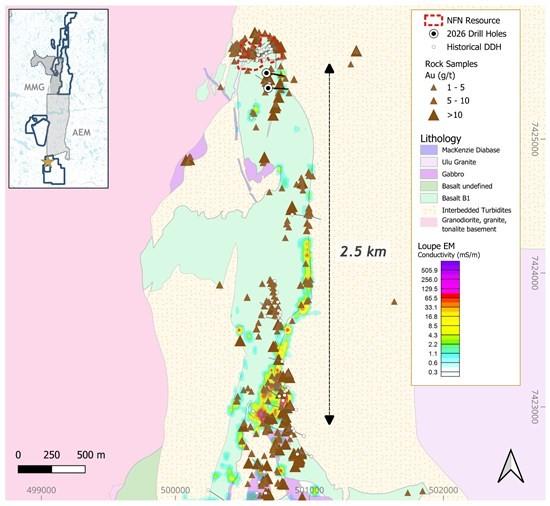
Figure 4: NFN Geology, Shown on Loupe EM Data, Overlain with Gold Grades from Rock Samples.
Sampling, Assaying & QA/QC
Blue Star drilled NQ (47.6 mm) size core in 2026. All drill core samples are sawn in half with one half retained as core record and the other half submitted for analysis. Blue Star samples are delivered under chain of custody to ALS Geochemistry in Yellowknife, NT for sample preparation which are then forwarded to ALS Canada Inc. in North Vancouver, BC for final analysis. Samples are prepared using method PREP-31 (crushing and pulverising) and analysed using methods Au-AA26 (50-gram fire assay with atomic absorption finish) and ME-MS61 (48 element four acid digestion with ICP-MS finish). Over-limit results for non-gold elements are re-analysed using an ore-grade four-acid digestion with ICP-AES finish. The work is being conducted using industry standard procedures, including a quality assurance and quality control (“QA/QC”) program consisting of the insertion of certified standards, blanks and duplicates into the sample stream.
Trish Toole, P. Geo. and Exploration Manager for Blue Star, is a Qualified Person under National Instrument 43-101 (“NI 43-101”) and has reviewed and approved the technical information contained in this news release.
About Blue Star Gold Corp.
Blue Star is a mineral exploration and development company focused on Nunavut, Canada. The Company controls over 420 square kilometres of highly prospective and underexplored mineral properties in the High Lake Greenstone Belt. Its principal assets include the Ulu Gold Project – comprised of the Ulu Mining Lease and Hood River Property, and the Roma and Auma Projects. The Ulu Mining Lease hosts the high-grade Flood Zone Gold Deposit, and the Company’s broader land package contains numerous high-priority gold and critical mineral targets, providing substantial upside potential for Mineral Resource expansion.
Blue Star’s projects are strategically located 40-100 km south of the proposed Grays Bay deep-water port, with the planned all-weather Grays Bay Road corridor passing very close to the Company’s Projects. The Grays Bay Road and Port Project was recently referred to the Major Projects Office. Prime Minister Mark Carney created the Office last year to fast-track infrastructure projects that are deemed to be of national importance.
Argenta Silver Corp. (TSX-V: AGAG) (OTCQX: AGAGF) (FSE: T1K) is p... READ MORE
Thunder Gold Corp. (TSX-V: TGOL) (FSE: Z25) (OTCQB: TGOLF) is ple... READ MORE
Latest Drilling Results from Lynx Include 402 Metres of 0.20% Nic... READ MORE
Fury Gold Mines Limited (TSX:FURY) (NYSE American: FURY) is pleas... READ MORE