







Bullion Gold Discoveries Corp. (TSX-V: BGD) is pleased to announce the assay results of two diamond drill holes of its validation drilling campaign at its 100%-owned Terragold property, located approximately 12 km south of the municipality of Senneterre, Quebec, in the prolific Abitibi Greenstone Belt.
Click LINK to view the Terragold 2026 validation campaign 3D geological model.
DDH Assay Results Highlights:
Table 1: DDH Assay Results
| DDH | From (m) | To (m) | Width1 (m) | Au (g/t) | Ag (g/t) | Mo (ppm) | Zone |
| TG-03 | 33.7 | 40.7 | 7.0 | 0.45 | 0.33 | 19 | JJ Zone |
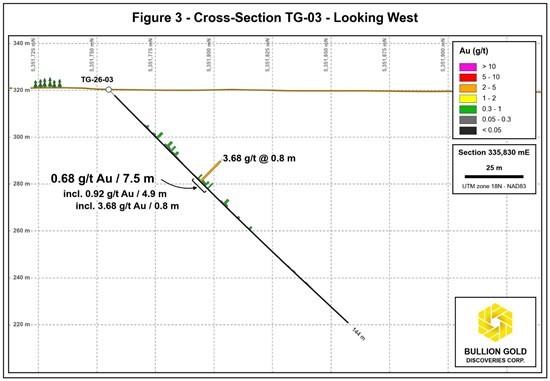
| 53.0 | 60.5 | 7.5 | 0.68 | 0.62 | 4 | ||
| including 54.0 | 58.9 | 4.9 | 0.92 | 0.72 | 4 | ||
| including 55.5 | 56.3 | 0.8 | 3.68 | 3.00 | 17 | ||
| TG-04 | 70.4 | 124.0 | 53.6 | 0.60 | 0.93 | 17 | JJ Zone |
| including 85.0 | 112.5 | 27.5 | 0.97 | 1.46 | 26 | ||
| including 89.0 | 102.4 | 13.4 | 1.73 | 2.64 | 48 | ||
| including 91.0 | 95.4 | 4.4 | 3.80 | 4.91 | 138 | ||
| including 95.1 | 95.4 | 0.3 | 22.00 | 38.60 | 257 |
Simon Britt, president and CEO of Bullion, commented: “Multi-element assay results reveal a distinctive geochemical signature in which gold (Au) is correlated with silver (Ag) and molybdenum (Mo). The marked molybdenum enrichment (reaching up to 257 ppm in DDH TG-04 high-grade interval of 22.00 g/t Au and 38.60 g/t Ag over 0.3 m) suggests the mineralizing fluids were high-temperature and magmatic in origin. This intrusion-related gold signature confirms that the Uniacke deformation corridor, a deeply rooted Archean-age structural corridor of the Abitibi Greenstone Belt, hosts a mineralized system at depth. Evaluating the full geochemical signature of the mineralized system was one of three main goals of the validation campaign. Our understanding is growing with every new DDH assayed. Assay results of the remaining 26 DDH will be disclosed on a rolling basis in the upcoming weeks.”
Figure 1: Plan View of Terragold DDH
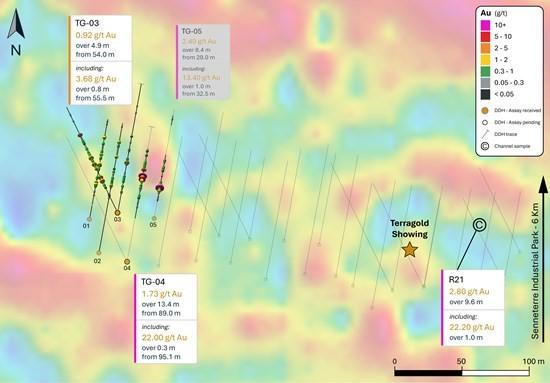
Table 2: DDH Collars
| DDH | Azimuth ° | Dip ° | Length (m) | UTM – East | UTM – North | Elevation (m) |
| TG-03 | 10 | -45 | 144 | 335825 | 5351755 | +320 |
| TG-04 | 10 | -45 | 150 | 335832 | 5351717 | +321 |
Geological Setting, Alteration, and Mineralization Model
Results from DDH TG-04 refine the metallogenic model of the Terragold project. Gold mineralization displays a magmatic-hydrothermal affinity linked to a competency (rheology) contrast within the Uniacke deformation corridor.
The system is located within a network of felsic intrusions (QFP dykes) injected into an andesitic basalt sequence. During regional deformation, the basalts responded in a ductile manner (shear zones/mylonitization), whereas the more rigid QFP dykes responded in a brittle manner. This fracturing created open-space volume serving as a structural trap (stockwork) for the precipitation of hydrothermal fluids, corresponding to the 53.6 m mineralized envelope.
The hydrothermal system displays defined zonation:
In DDH TG-04, mineralization is primarily hosted within a QFP intrusion showing silica-sericite alteration (from 79.0 m to 95.4 m), with sulphides disseminated and concentrated along vein selvages (1% to 3% fine- to medium-grained euhedral pyrite).
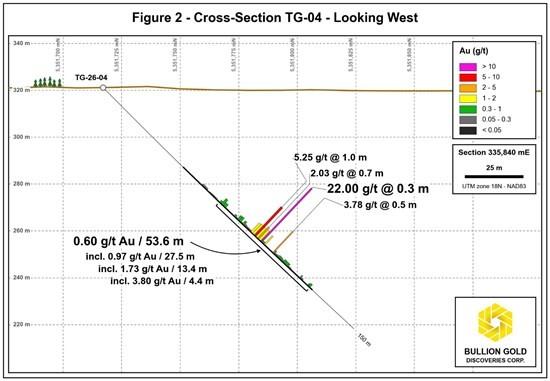
DDH TG-03, located 38 m north of DDH TG-04, shows the lateral continuity of sheared structures and pyritized horizons associated with thin secondary felsic dykes, intersecting 7.5 m at 0.68 g/t Au (including 4.9 m at 0.92 g/t Au and 0.8 m at 3.68 g/t Au).
About the Terragold Project
The Terragold project (38 claims – 2,058 ha) is located approximately 12 km south of the municipality of Senneterre in Abitibi (Québec, Canada) within a major, deeply rooted Archean-age structural corridor of the prolific Abitibi Greenstone Belt. The Terragold showing, discovered in the early 1960s, has been intersected by drilling over a strike length exceeding 2 kilometres and to a depth of approximately 250 metres and has seen very limited exploration activity since 1984. The gold mineralized corridor, associated with a quartz-feldspar porphyry system, remains open in all directions. The potential of the system is supported by a historical 245 kg bulk sample grading 4.84 g/t Au, confirming the presence of gold mineralization at surface.
Technical Disclosure
The drilling program was managed by Explo-Logik of Val-d’Or, Québec. Core samples were split in half, and one half was sent for analysis to AGAT Laboratories in Val-d’Or, Québec, an independent commercial laboratory certified under ISO/IEC 17025 standards. Sample preparation includes crushing to 90% passing 2 mm and pulverizing to 90% passing 75 µm. Gold analyses were performed by 50 g fire assay with an Atomic Absorption Spectroscopy (AAS) finish. Samples with elevated gold grades (> 10 g/t Au) were re-analyzed by fire assay with a gravimetric finish. The screened material is split and analyzed by fire assay with ICP-OES finish to extinction. Bullion strictly adheres to industry-standard Quality Assurance and Quality Control (QA/QC) procedures. Certified reference materials (standards), blank samples, and field/laboratory duplicates are systematically inserted into the sample sequence to monitor analytical precision and accuracy. The reported widths correspond to core lengths and may not be representative of the true width or overall grade of mineralization across the Terragold Project.
Qualified Person
The scientific and technical information disclosed in this news release has been reviewed and approved by Ms. Suzie Tremblay, a member in good standing of the Ordre des géologues du Québec (OGQ No. 10664), who is a “Qualified Person” within the meaning of National Instrument 43-101 – Standards of Disclosure for Mineral Projects. All geoscientific activities related to the Terragold Project are carried out under the supervision of Ms. Suzie Tremblay, Vice-President of Explo-Logik.
About Bullion Gold Discoveries Corp.
Bullion Gold Discoveries Corp is a Québec-focused mineral exploration company advancing a portfolio of gold and polymetallic projects located in some of the province’s most prospective mining districts. The Company’s strategy is centered on creating shareholder value through discovery success by applying modern geological interpretation, disciplined exploration practices and strategic partnerships.
The Company holds a 100% interest in the Terragold (Au), Langlade (Cu, Zn, Au, Ag), and Bodo (Cu, Zn, Au, Ag) projects. The Bousquet (Au) project is under option to Olympio Metals (ASX: OLY).
Peter recently took to the Metals Investor Forum stage for a must-watch ... READ MORE
Power Metallic Mines CEO Terry Lynch joins Ellis Martin for an update on... READ MORE
RPX Gold Inc. (TSX-V: RPX) (OTCQB: RDEXF) is pleased to announce ... READ MORE
SAGA Metals Corp. (TSX-V: SAGA) (OTCQX SAGMF) (FSE: 20H) a North ... READ MORE