






NordX Metals Corp. (CSE: NRDX) (OTCQB: NRDMF) (FSE: 0UL0) is pleased to announce that assay results from the first diamond drillhole in an ongoing diamond drilling program have been received at its 100%-owned Riutta project, near Joensuu in eastern Finland.
Highlights:
Jon Franklin, President and Director of NordX, commented: “We are very pleased with the results from SWM26001, which was collared approximately 40m north of historical drillhole AREVA DH1. This drill program aims to systematically test zones of uranium mineralization identified by AREVA (now Orano) through trenching and drilling in 2007 and 2008. Uranium mineralization at shallow depths has been historically recorded over 450m of strike within a larger 3.6 kilometre trend. This first hole returned significant uranium mineralization at shallow depth and supports our revised structural interpretation of the Riutta system. We look forward to receiving assays from the remainder of the holes in our current drill program.”
Riutta Drill Program
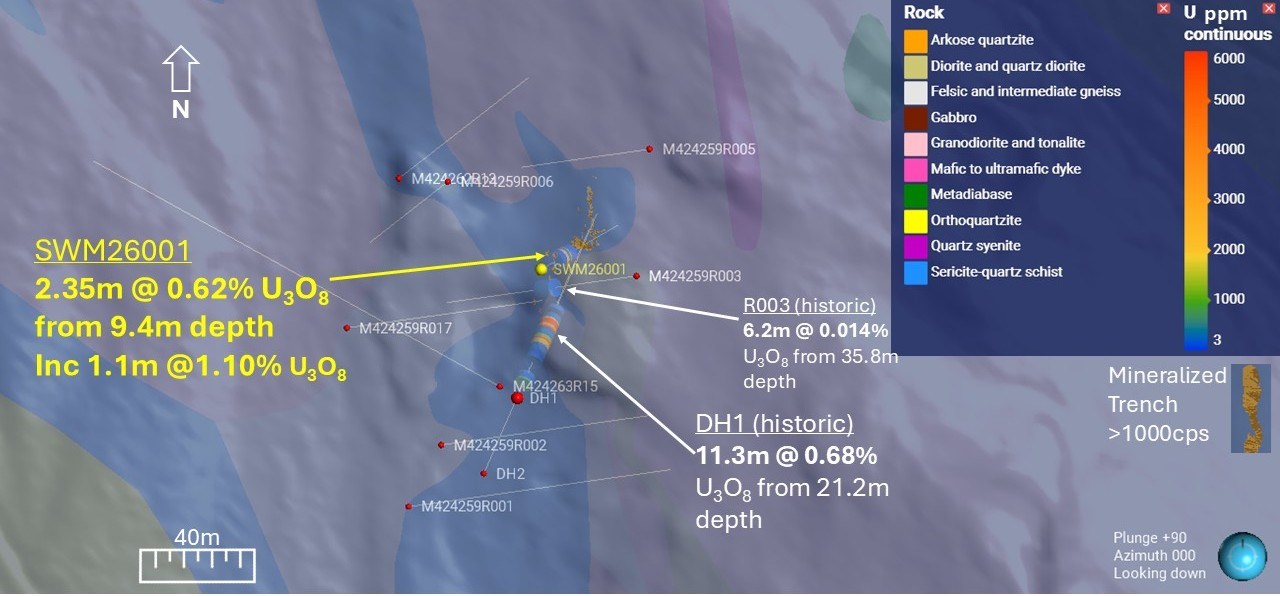
Drill results have been received for only one drillhole to date: SWM26001. This drillhole reached a total depth of 39m and was drilled at an azimuth of 060° and an inclination of -45°. It was designed to test the potential for a NNW-SSE striking structure that dips steeply to the WSW. The intercept supports this revised mineralized trend orientation, which loosely connects historical drillholes AREVA DH1 and R003 with SWM26001 (see Figure 1). Reported intervals are downhole lengths; true widths have yet to be determined.
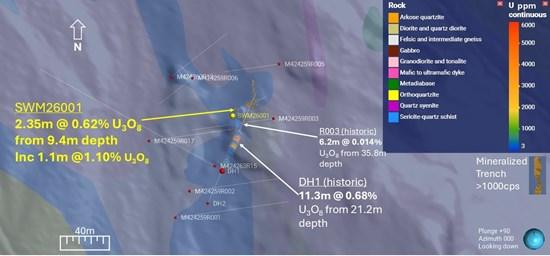
Figure 1. Riutta project map showing the Ristimonttu prospect with historical drilling, mineralized trenches, surface geology and downhole assay results. Historical results shown have not been independently verified by a Qualified Person and should not be relied upon.
To view an enhanced version of this graphic, please visit:
https://images.newsfilecorp.com/files/11951/316440_af4c9cb5d4567965_001full.jpg
To date, the Company has drilled 19 diamond drillholes totalling approximately 995m. The drill program is on track to finish within the next two days and will comprise 20 holes for a total of approximately 1,070m. The drill program has been designed to test three target areas, Ristimonttu, Unimonttu and Kolmosviuhka, prioritised through the integration of historical data including drill logs and analyses, geophysics including detailed IP, geochemical sampling and geological reinterpretation of the project area. All target areas contain historical drill intercepts containing uranium.
NordX’s structural interpretation suggests that most historical drilling completed at Riutta by Atomienergia Oy in the late 1950s, Outokumpu Oy in the early 1960s, Geological Survey of Finland in the 1980s and AREVA (now Orano) in 2007 and 2008 did not effectively test the principal parts of the mineralized system, including having been drilled sub-parallel to key uranium-bearing structures. The Company believes these orientations and collar locations limited the effectiveness of earlier drilling in testing geometry and continuity of the uranium-bearing structures. The 2026 program employs revised azimuths based upon this revised interpretation, intended to directly intersect these structures at both the known and new target areas. These new, historically untested targets were generated through the integration of property wide geophysical data, geochemical sampling and structural mapping.
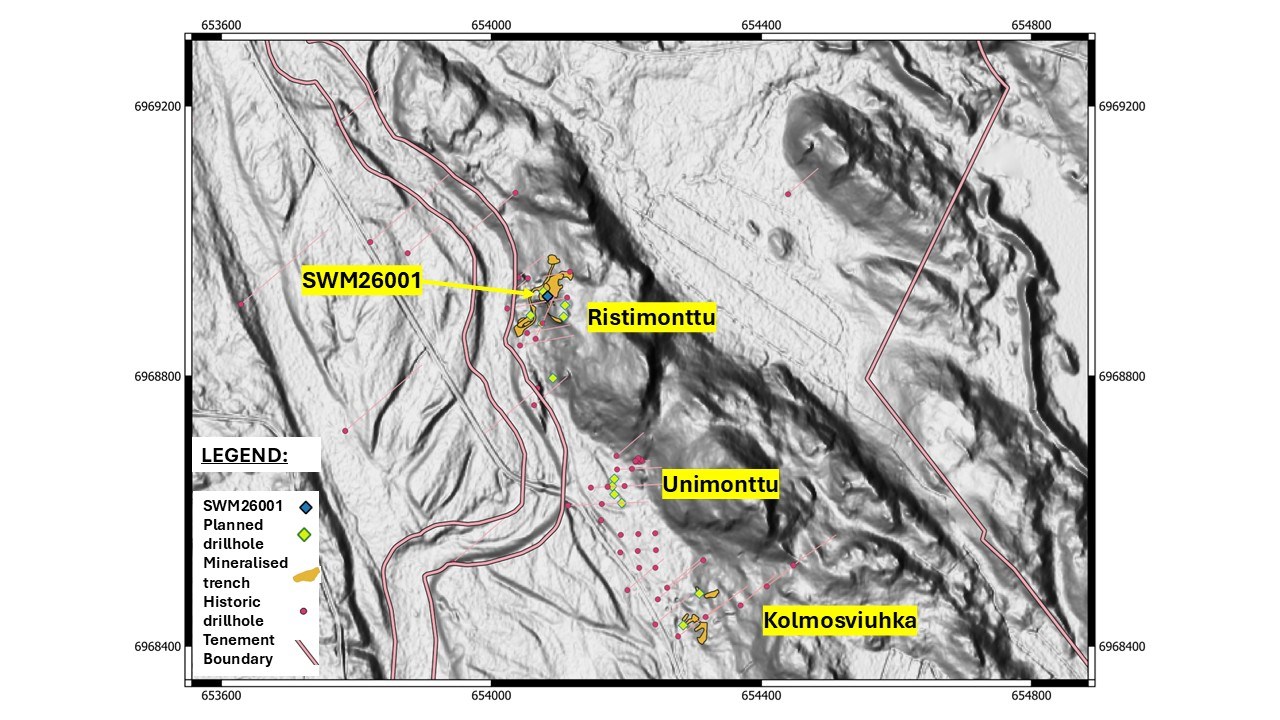
The principal target areas are summarized below (see Figure 2; these historical results have not been independently verified by a Qualified Person and should be viewed with caution):
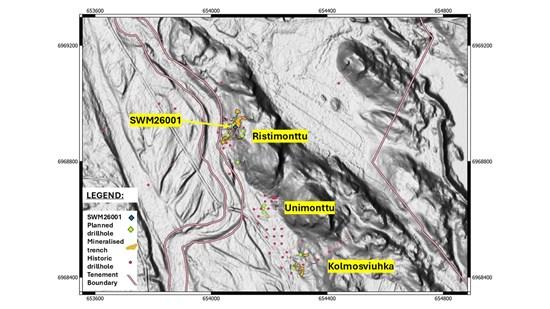
Figure 2. Riutta project map with historical drilling, mineralized trenches and the locations of completed and planned drillholes.Historical results shown have not been verified by a Qualified Person and should not be relied upon.
To view an enhanced version of this graphic, please visit:
https://images.newsfilecorp.com/files/11951/316440_af4c9cb5d4567965_002full.jpg
Riutta Uranium Project History
The Riutta uranium occurrence was discovered in 1958 through radiometric boulder tracing. Four exploration campaigns followed: Atomienergia (1958-59); Outokumpu Oy (1960-63); the Geological Survey of Finland (1983-88); and AREVA (2007-08), totalling 65 drillholes for a total of 6,275m, only 10 of which were drilled since 1988. Over 500 mineralized boulders have been located at Riutta, more than one hundred assaying above 1% uranium, and trenching at the Ristimonttu and Unimonttu prospects has exposed pitchblende veins and pockets. Significant historical drill intercepts at Riutta include AREVA DH1 which intersected 11.3m at 0.68% U3O8 from 21.20 to 32.50m including 3.7m grading 1.52% U3O8 between 28.30 and 32.00m at the Ristimonttu prospect. The estimated true thickness of the interval is 8.6m. Other notable historical intercepts include DH-324, which intersected 3.6m at 1.11% U3O8 between 42.00m and 45.60m (including 0.35m at 9.79% U3O8between 42.60m and 42.95m) at the Unimonttu prospect; drillhole AE-7 intersected 2m grading 0.2% U3O8 from 62.8m downhole including 0.5m at 0.66% U3O8 from 63.8m downhole at the Kolmosviuhka prospect, located 260m and 450m SSE of drillhole AREVA DH1, respectively (see Figure 2). The Company cautions that a Qualified Person has not independently confirmed these historical results and that it is likewise unaware of the analytical facility that produced them or of any quality assurance – quality control measures implemented by the company that completed this historical work, and that consequently these results should not be relied upon.
Riutta Uranium Project Mineralization
Uranium mineralization at Riutta occurs as thin pitchblende veins (up to a few mm wide) infilling fractures and micro-breccias within a sericite-quartz schist host rock. The bedrock comprises Archean granitoids and gneisses overlain by Paleoproterozoic quartzitic metasediments, cut by mafic to ultramafic dykes. Riutta is interpreted as a structurally controlled, low-temperature hydrothermal uranium system, with an extensive alteration mineral halo including epidote, chlorite, quartz, sericite, albite, potassium feldspar, carbonate, and clinozoisite.
Sampling Protocol and Assay Method
Drill core was logged and marked to show where core was to be half-core sampled, using an automated diamond-blade saw. Cut sections were bagged, assigned sample IDs, and logged in a sample register. Automatic diamond-blade sawing took place at Palsatech’s core logging facility in Kemi, Finland; samples were then transported to CRS Laboratories Oy in Kempele, near Oulu, for preparation and assay. CRS Laboratories Oy is independent of NordX. On receipt, samples were screened for surface radioactive dose rate, and those exceeding 3.0 µSv/h were prepared under CRS’s procedure for naturally occurring radioactive material (NORM). At CRS, samples were dried, crushed to 2 mm, split to a 450 g sub-sample using a rotating sample divider attached to the crusher, and pulverised to 85% passing 75 µm (method PRP-924) prior to multielement analysis. Samples were analysed by four-acid digestion with an ICP-MS finish for a 40-element suite including uranium and thorium (in-house method 4A-MS12).
CRS Laboratories Oy is a testing laboratory accredited by the Finnish Accreditation Service (FINAS) under EN ISO/IEC 17025 (T342); within method 4A-MS12 the elements in the scope of accreditation are Co, Cu, Mo, Ni, Pb, V and Zn, and uranium results are reported as non-accredited determinations. Results exceeding the upper limit of method 4A-MS12 (10,000 ppm U, equivalent to 1% U) were re-analysed by the same method following an additional dilution step. The laboratory has advised that the additional dilution may increase the measurement uncertainty of these results relative to samples analysed at the standard dilution, but that the results are valid within the analytical method and dilution procedure applied. These results are reported as quantitative values with this qualification.
A QAQC program monitored sampling, preparation and assay quality throughout the sampling campaign. Two OREAS certified reference standards, one core duplicate and one blank were inserted into the sample stream, together representing four of the 13 samples submitted for analysis (30.8%). Both certified reference standards returned values within two standard deviations of their certified values. The blank, which was submitted immediately following the highest-grade sample in the hole, returned 2.0 parts per million uranium against an expected value of 0.24 parts per million for the olivine diabase material used, indicating minor cross-contamination during sample preparation. The laboratory has been notified and has confirmed that more thorough cleaning will be carried out between samples for the remainder of the drill program assays. The Company does not consider this result material to the assays reported, as 2.0 parts per million uranium is several orders of magnitude below the grades of the mineralized intervals disclosed in this news release. The core duplicate pair (samples 1509 and 1510) returned 4,106 parts per million and 3,202 parts per million uranium respectively, a relative percent difference of 24.7%, which exceeds the 20% threshold generally applied for acceptance. This variance is interpreted to reflect the narrow, millimetre-scale pitchblende veining that characterises mineralization at Riutta, which can produce a pronounced nugget effect between half-core duplicates. Apart from the blank and duplicate results described above, no issues were identified that would materially affect the reliability of the assay dataset.
Uranium assays are reported in this news release as U3O8, converted from the laboratory-reported elemental uranium (U) values using the factor U3O8 = U × 1.17924.
Table 1. Assay Results for Drillhole SWM26001
| Drillhole ID | Sample ID | From (m) | To (m) | Length (m) | QAQC | U3O8 (ppm) |
| SWM26001 | 1501 | 7.4 | 8.4 | 1 | 62.5 | |
| SWM26001 | 1502 | 8.4 | 9.4 | 1 | 69.6 | |
| SWM26001 | 1503 | OREAS-124 | 2,153.3 | |||
| SWM26001 | 1504 | 9.4 | 9.9 | 0.5 | 8,350.2 | |
| SWM26001 | 1505 | 9.9 | 10.5 | 0.6 | 13,183.9 | |
| SWM26001 | 1506 | Blank | 2.4 | |||
| SWM26001 | 1507 | 10.5 | 11.25 | 0.75 | 159.2 | |
| SWM26001 | 1508 | OREAS-124 | 2,063.7 | |||
| SWM26001 | 1509 | 11.25 | 11.75 | 0.5 | 4,842.0 | |
| SWM26001 | 1510 | 11.25 | 11.75 | 0.5 | Core Duplicate | 3,775.9 |
| SWM26001 | 1511 | 11.75 | 12.5 | 0.75 | 102.6 | |
| SWM26001 | 1512 | 12.5 | 13.5 | 1 | 11.8 | |
| SWM26001 | 1513 | 13.5 | 14.5 | 1 | 11.8 |
Qualified Person
The scientific and technical information in this news release has been reviewed and approved by Avrom E. Howard, MSc, PGeo (Ontario), Principal Geologist at Nebu Consulting, LLC, an independent US-based mineral exploration consulting firm. Mr. Howard is independent of NordX, and is a Qualified Person as defined by National Instrument 43-101. Mr. Howard has verified the data disclosed in this news release, including the sampling, analytical and QAQC data, by reviewing the laboratory assay certificates, QAQC results and drill logs. Mr. Howard has not verified the historical data disclosed in this news release, as described under “Riutta Uranium Project History”.
About NordX Metals Corp.
NordX is an exploration and development company advancing uranium, lithium, and rare earth projects in politically stable jurisdictions with the infrastructure to support rapid, cost-effective exploration, development, and production.
The Company’s consolidated financial statements and related management’s discussion and analysis are available on the Company’s website at https://nordxmetals.com or under its profile on SEDAR+ at www.sedarplus.ca.
On Behalf of NordX Metals Corp.
“Andrew Bowering”
Interim Chief Executive Officer
Telephone: +1-604-428-6128
Email: ir@nordxmetals.com
Chibougamau Independent Mines Inc. (TSX-V: CBG) (Germany: CLL1) (OTCMKTS: CMAUF), herein called Chib... READ MORE
Libra Energy Materials Inc. (CSE: LIBR) (OTCQB: LIBRF) (FSE: W0R0) is pleased to announce that it ha... READ MORE
Atico Mining Corporation (TSX-V: ATY) (OTC: ATCMF) is pleased to announce the Company’s ent... READ MORE
Largo Inc. (TSX: LGO) (NASDAQ: LGO) announces the closing of its previously announced registered di... READ MORE
ICG Silver & Gold Ltd. (CSE: ICG) (FSE: JI0) (OTC Pink: ICGSF) is pleased to announce assay resu... READ MORE