








Cupani Metals Corporation (CSE: CUPA) (OTCQB: CUPIF) is pleased to provide an update on its summer drilling campaign at its Blue Lake Project, located 65 kilometres from Schefferville, Quebec. Of the first four holes drilled this summer, three intersected magmatic massive sulphides at the base of mineralized ultramafic flows / subvolcanic sills. The newly intersected mineralization is located more than one kilometre southeast of historical mineralized lenses. All four holes tested targets within a high-priority corridor that remains open and largely untested along a strike length of at least sixteen kilometres (10 miles). The newly intersected massive sulphide horizons, and the general stratigraphy hosting them, are roughly horizontal.
Highlights
Jacquelin Gauthier, VP Exploration, commented: “Our summer drilling program has been highly successful to date, with 3 of 4 holes intersecting massive sulphides at the base of the ultramafic units. These results clearly validate our new geological interpretation and confirm that we are exploring a robust metallogenic system with the potential to produce thick, significant intersections.”
CEO Brian Bosse adds: “These holes show Cupani understands how this system is organized. Intercept thickness should evolve this copper – nickel exploration project from interesting to evident; it is roughly horizontal and remains open for miles.”
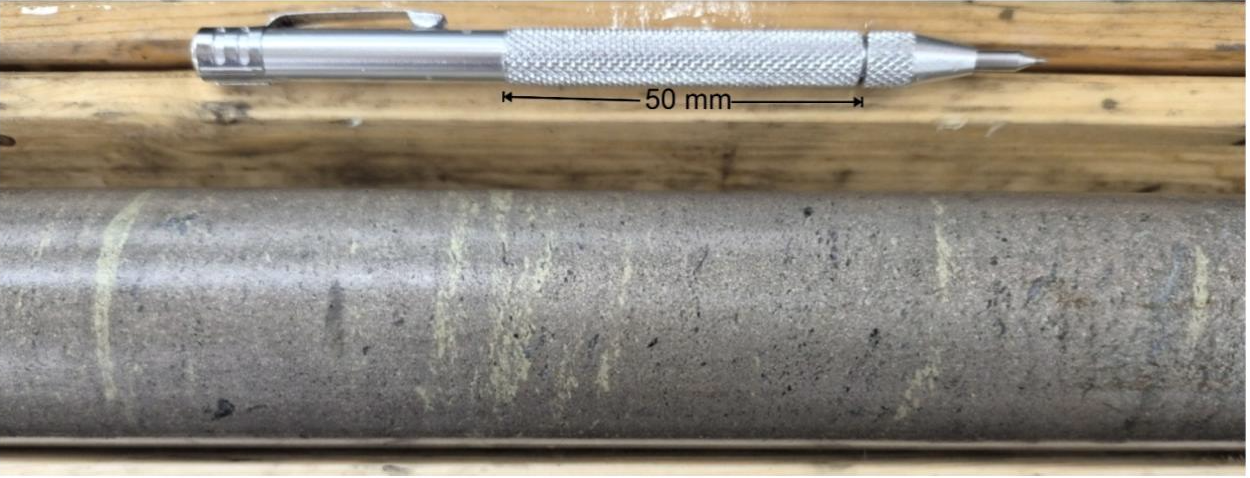
Figure 1: Photograph of the 2.45 meters thick chalcopyrite-bearing massive sulphide horizon 80-85 degrees to core axis located at the base of a sulphide bearing (blebs and disseminations) olivine pyroxenite. From 159. 1 to 161.55 meters in hole CUP26-010.

Figure 2: Close-up Photograph of the massive sulphides with chalcopyrite concentrated in1 to 3 mm bands parallel to the contacts at 80-85 degrees to core axis on average. Center of photograph is at 159.7 meters in hole CUP26-010. The small black spots in the massive sulphides are magnetite; the pyrrhotite is not magnetic.
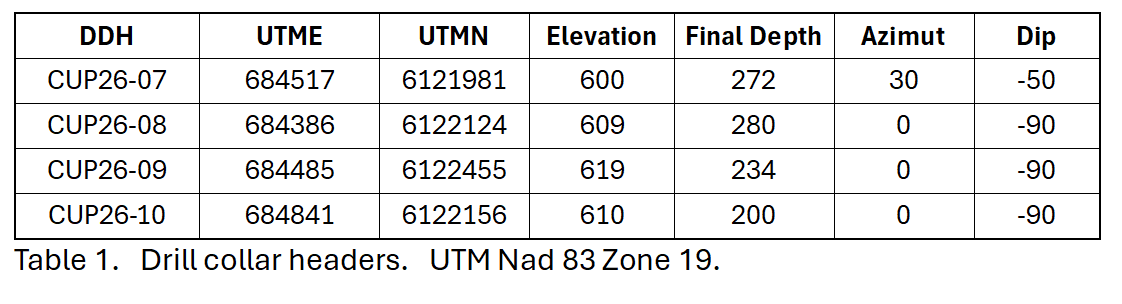
To date, four diamond drill holes have been completed this summer in the Blue Lake Southeast sector.
CUP26-07 was designed to test the up-dip extension of the newly discovered mineralized horizon intersected in hole CUP26-06 (read press release June 3, 2026). It entered a volcano-sedimentary sequence followed by a 67-meter-thick ultramafic unit with the percentage of disseminated and blebby sulphides increasing at depth until the massive sulphide horizon (1.8 meters thick). The hole ended in felsic pyroclastics and a gabbro
CUP26-08 targeted a strong magnetic and EM anomaly, 200 meters to the NW of holes CUP26-07 (and 6), along the same magnetic trend. This hole started in a volcano-sedimentary sequence with sulphidic sediments before entering a 150 meters thick ultramafic unit with magmatic sulphides locally consisting of disseminations and blebs. A 0.5-meter massive sulphide horizon was intersected at the base of the ultramafic and at the contact with felsic pyroclastics. This hole ended in gabbro.
Hole CUP26-09 targeted coincident weak magnetic and EM anomalies. This DDH was collared 230 meters NW of hole CUP26-04 on the same magnetic trend. It collared into a mineralized ultramafic with sulphide disseminations and blebs followed by a sedimentary and tuffaceous sequence with sulphides and cherty exhalites. This hole then entered an ultramafic flow, then a differentiated ultramafic and mafic intrusion that was unmineralized.
CUP26-10 was collared 244 meters to the SE of hole CUP26-04 on the same magnetic trend, and 376 meters NE of hole CUP26-07 and 6. This hole started in 29.7 meters of mineralized ultramafic with disseminated and net textured sulphides, then 23.3 meters of basalt before entering 89 meters of an ultramafic with percentage of disseminated sulphides increasing with depth. The next unit intersected was 10 meters of a felsic pyroclastic, then a 0.6-meter mineralized pyroxenite followed by 2.45 meters of magmatic sulphides and another pyroxenite unit over 7.3 meters. The hole ended in a gabbro.
Figure 3: Location map of Cupani’s holes drilled in 2026 with historic mineralised zones. The background is the shaded vertical gradient Magnetic map from the 2011 VTEM survey over the area. Vertical section A-A’ is shown in figure 4.
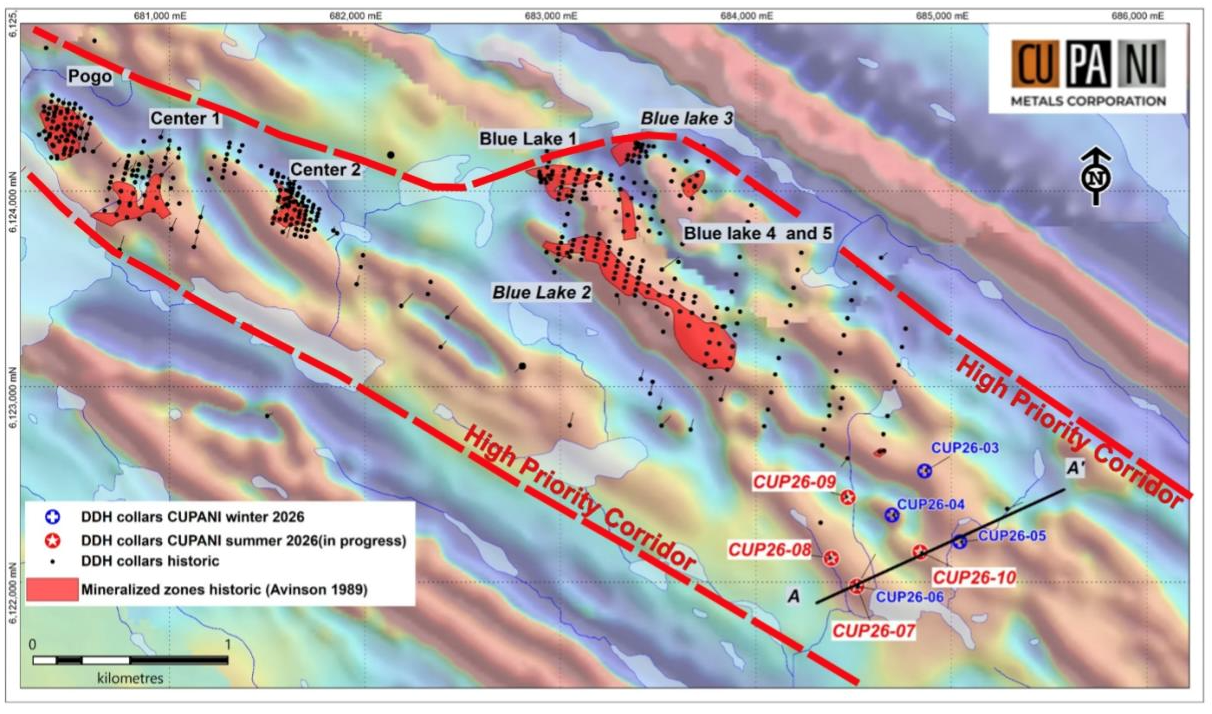
Figure 4: Section oriented 65 degrees looking to the NW showing holes drilled in 2026 and a historic hole B-8 (not analysed). Copper equivalents were calculated with the following formulae at metal prices from May 1, 2026.
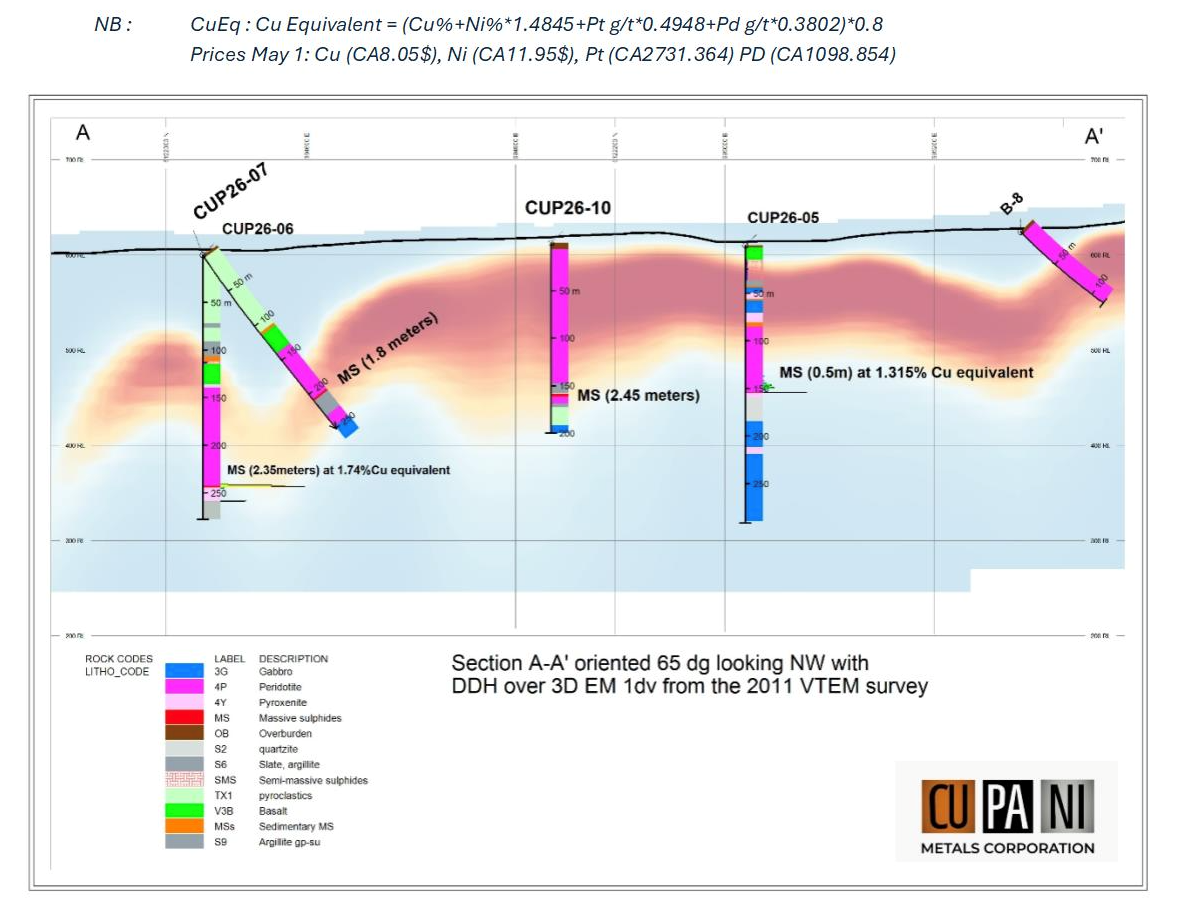
Drilling remains ongoing for the next few weeks. The drilling campaign has successfully confirmed the effectiveness of Cupani’s targeting strategy, with massive sulphide horizons intersected at the base of ultramafic units. The contacts of the sulphide zones are close to perpendicular to core axis of the vertical holes and should be considered close to true thickness. These massive sulphides are overlain by significantly broader intervals of disseminated, net-textured and blebby sulphides within the overlying ultramafic sequence.
Samples from the best massive sulphides intervals are being sent for rush laboratory analysis to ALS global in Val d’Or. Assay results are expected in the coming weeks and will be reported in a subsequent news release.
Qualified Person
The preparation of this Press Release was directly supervised by Jacquelin Gauthier P. Geo, Cupani’s VP of exploration. He verified and approved all technical and scientific information of the final edition. He is acting as the Company’s qualified person within the meaning of National Instrument 43-101 – Standards of Disclosure for Mineral Projects.
About CUPANI
CUPANI Metals Corp. provides shareholders with long-term capital growth exposure by investing in mineral exploration properties. The Company is listed on the CSE under the symbol “CUPA” and on OTCQB under the symbol “CUPIF”. To learn more about the Company please visit http://www.CUPANImetals.com or contact CEO Brian Bosse via email brian@cupanimetals.com or phone 416 844 5712.
Cupani’s 100% owned Blue Lake copper nickel PGE project in Quebec covers 682 square kilometers of exploration claims (260 square miles). During the 1980s certain sections of Blue Lake project were explored by La Fosse Platinum. They drilled hundreds of exploration holes, excavated a 350 metre (1000 foot) Adit, conducted geochemical, geophysical and geologic surveys and metallurgy testing. The surface projection of discovered mineralization as well as historical drill locations are shown and comprise an area less than 10 square kilometers.
Most people hear “critical minerals” constantly, but few und... READ MORE
Nickel may be one of the most overlooked opportunities in mining. In a r... READ MORE
The Di-As-funded program will evaluate the recovery potential of ... READ MORE
Lahontan Gold Corp. (TSXV:LG) (OTCQB:LGCXF) (FSE:Y2F) is pleased... READ MORE