








Highlights of Omai Project Preliminary Economic Assessment
Omai Gold Mines Corp. (TSX-V: OMG) (OTCQB: OMGGF) is pleased to announce positive results from its Preliminary Economic Assessment for its 100%-owned Omai Property, in Guyana, South America. The PEA mine plan incorporates both the Wenot open pit deposit and the adjacent Gilt underground deposit. These support production averaging 351,488 ounces of gold per year over an 18-year mine life, with peak year production of 435,667 ounces. Total combined production from the two deposits is estimated at 6,326,775 ounces of payable gold. At a base case gold price of $3,600/oz, the project has an after-tax Net Present Value5% of $4.0 billion, a 24% Internal Rate of Return, and a payback period of 4.1 years. At the recent spot price of $4,200/oz, the after-tax NPV5% increases to $5.5 billion, IRR increases to 30% and the payback reduces to 3.4 years.
Elaine Ellingham, President and CEO comments: “We are very pleased to deliver this PEA, which reinforces the potential for Omai to become a very large-scale mining operation with a clear path to bringing significant economic benefits to the people of Guyana. This project’s proposed initial $1.4 billion investment into Guyana, equivalent to over GUY$300 billion would create many quality jobs and spin-off economic development within the interior of the country, while providing solid returns for investors.
This economic study encompasses both the large Wenot superpit and the adjacent underground Gilt deposit, demonstrating potential for total gold production of 6,327,000 oz over an 18 year mine life. This PEA serves as an important milestone and provides a base from which we intend to advance the project on multiple fronts towards a feasibility study. As a past-producer, Omai has many benefits giving it a leg up to re-development, including highway access, a cleared site, an on-site airstrip, a tailings facility, known metallurgy, and the unique confidence that comes from a historical record of economic gold extraction.
A very significant advancement for the project occurred less than one year ago, in August 2025. At that time, we announced our fourth Mineral Resource Estimate for Omai, reporting an impressive 88% increase to the total MRE. The major expansion to the size of our open pit Wenot deposit firmly established Omai as one of the largest undeveloped gold projects in the Guiana Shield. Less than one year later, and following our 5th MRE update, we are very pleased to deliver this PEA that supports the upcoming steps towards a feasibility study, and then onward to a potential production decision and construction.
At the same time, drilling has continued with five rigs and an additional 77 drill holes have already been completed at Wenot that are not included in the MRE that forms the basis of this PEA. This leaves room for further growth and optimization. The Omai Gold team has consistently delivered for our stakeholders and with this PEA complete, we will continue to advance on a number of fronts towards our next ambitious milestones.”
PEA Overview
The Omai Gold Project PEA envisions a combined open pit mine at the Wenot shear-hosted gold deposit and an underground mine at the adjacent intrusion-hosted Gilt gold deposit. Onsite milling and processing is planned with capacity at 25,000 tonnes per day (“tpd”) for the mined material. Annual gold production averages 351,488 ounces of gold per year over an 18-year mine life, with peak year production of 435,667 ounces. Total combined production from the two deposits is estimated at 6,326,775 ounces of payable gold. Initial capital in the PEA is $1.426 billion, with sustaining and growth capital of $928 million over LOM. Average cash operating costs3 are estimated at $1,501/oz gold and AISC1 at $1,608/oz.
At the Wenot open pit, approximately two years of pre-production are followed by 18 years of commercial production, using conventional truck-and-shovel bulk mining methods. The open pit operation is expected to extract 134.1 million tonnes at 1.08 g/t Au containing 4.641 million ounces of gold over the mine life.
Development of the Gilt underground mine will commence in Year 1 of plant operations, with underground feed available from Year 3, ramping toward a target production rate of 4,000 tonnes per day. The underground mine is expected to extract approximately 22.6 Mt averaging 2.98 g/t Au, containing 2.164 Moz of gold, using primarily drift-and-fill mining with cemented paste backfill. Production from the two mines will be processed through a 25,000 tpd carbon-in-leach gold plant, giving an annual throughput of 9,125,000 tonnes at full production.
Financial and operating metrics from the PEA are presented in Table 1, sensitivity of the financial metrics to the gold price is shown in Table 2, and cumulative cash flows and annual gold production are shown in Figure 1:
The PEA is preliminary in nature and includes inferred mineral resources that are considered too speculative geologically to have the economic considerations applied to them that would enable them to be categorized as mineral reserves, and there is no certainty that the PEA will be realized. Mineral resources that are not mineral reserves (“Mineral Reserves”) do not have demonstrated economic viability.
Table 1. Financial and Operating Metrics from the PEA1,2,3
| 2026 Omai Gold Project Preliminary Economic Assessment (PEA) Highlights | ||
| Production | units | Value |
| Mine life | years | 18.0 |
| Total gold production | oz | 6,326,775 |
| Average annual gold production | oz | 351,488 |
| Total mineralization mined | kt | 156,670 |
| Total waste mined | kt | 788,434 |
| Total material mined | kt | 945,104 |
| Total waste-to-mineralization (Wenot) | ratio | 5.88 |
| Average gold grade | g/t | 1.35 |
| Average gold grade – Wenot (19% mining dilution included) | g/t | 1.08 |
| Average gold grade – Gilt (with mine dilution) | g/t | 2.98 |
| Gold Process Recovery | % | 93% |
| Average Process Plant throughput | Tpd | 25,000 |
| Operating Costs | ||
| Mining cost (Total Material) | US$/t | $3.28 |
| Mining cost (Mineralization) | US$/t | $22.57 |
| Processing Cost | US$/t | $14.37 |
| G&A cost | US$/t | $4.25 |
| Total cost processed | US$/t | $49.58 |
| Total cash cost (per ounce sold) | US$/oz | $1,501 |
| Mine-site all-in-sustaining cost (per ounce sold) | US$/oz | $1,608 |
| Capital Costs | ||
| Initial capital expenditure (Initial Capex) | US$ billion | $1.427 |
| Growth Capital (underground mining) | US$ million | $293 |
| Sustaining capital expenditures | US$ million | $636 |
| Net reclamation costs (cost less salvage value) | US$ million | $41 |
| Total capital expenditure – life of mine | US$ billion | $2.396 |
| Base Case Economic Analysis: $3,600 per ounce Gold Price | ||
| IRR (after-tax) | % | 24.0 |
| NPV @ 5% discount rate (after-tax) | USD billion | $4.0 |
| Payback (years) | Years | 4.1 |
Table 2. Analysis of Sensitivity to Gold Price4,5
| Base Case | ||||||||
| Gold Price | US$/oz | 3,000 | 3,300 | 3,600 | 3,900 | 4,200 | 4,500 | 5,000 |
| After Tax NPV5% | US$ ‘000 | 2,444,932 | 3,206,175 | 3,966,422 | 4,726,593 | 5,484,923 | 6,243,253 | 7,507,136 |
| Payback | Years | 5.3 | 4.6 | 4.1 | 3.7 | 3.4 | 3.1 | 2.8 |
| After-Tax IRR |
% | 18% | 21% | 24% | 27% | 30% | 32% | 36% |
| EBITDA (LOM) |
US$ Millions |
9,748 | 11,504 | 13,259 | 15,015 | 16,770 | 18,526 | 21,452 |
| Free Cash Flow (LOM) | US$ Millions |
5,460 | 6,777 | 8,094 | 9.411 | 10,728 | 12,044 | 14,239 |
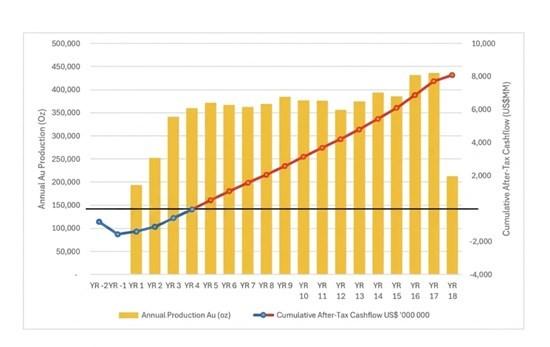
Figure 1. Cumulative Cash Flows and Annual Gold Production
Property Description, Location and Access
The Omai Gold Project is located approximately 165 km south of Guyana’s capital city of Georgetown. Omai is connected to the two major towns of Georgetown and Linden by a newly paved highway extending to within 10km of the property Figure 2. A well-maintained dirt road extends to the east side of the Essequibo River where a pontoon barge crosses the Essequibo River to arrive on the Eastern Flats portion of the Omai Gold Property. The Omai Property is also accessible by air in 35 minutes from Georgetown to a 1,000m airstrip located on the Omai property.
The closest communities include Mile 58 and Linden. Mile 58 is a small village located about 25 km by road towards Georgetown with a population of less than 300. Linden, located 85 km from Omai, is the second largest city in Guyana with a population of approximately 42,000, and is a long-established mining community with active open pit bauxite mining.
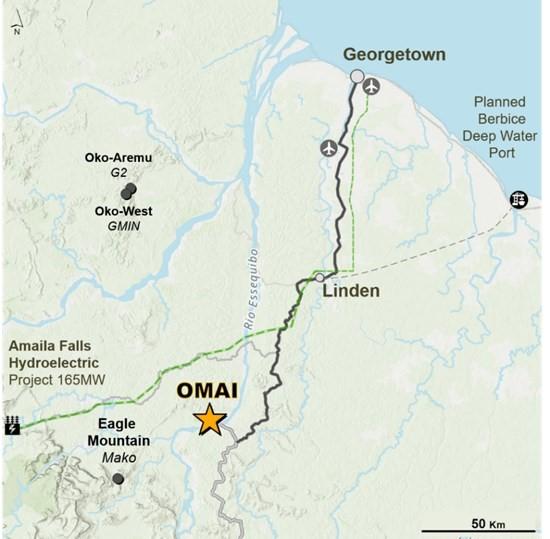
Figure 2. Project Location Map
Mineral Resource Estimate
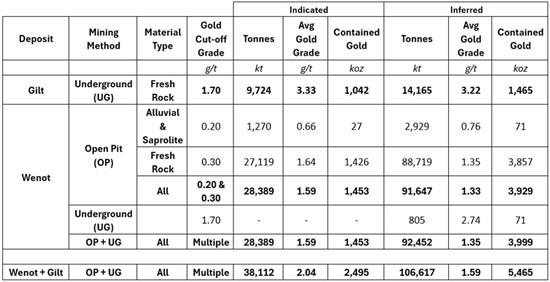
This PEA is based on the Mineral Resource Estimate (“MRE”) announced April 14, 20266, for the Omai Property, comprised of 2.495 Moz Au averaging 2.04 g/t Au (in 38.1 Mt) in the Indicated category and a further 5.465 Moz Au averaging 1.59 g/t Au (in 106.6 Mt) in the Inferred category. This includes both the Wenot shear-hosted deposit (open pit) and the adjacent Gilt intrusion-hosted deposit (underground).
The Wenot deposit comprises 1.453 Moz averaging 1.59 g/t Au (28.4 Mt) in the Indicated category and a further 4.00 Moz averaging 1.35 g/t Au (92.4 Mt) in the Inferred category. The Gilt deposit hosts an Indicated MRE of 1.04 Moz of gold averaging 3.33 g/t Au (9.7 Mt) and Inferred of 1.47 Moz of gold averaging 3.22 g/t Au (14.2 Mt).
Table 3. April 2026 Mineral Resource Estimate
Notes to Accompany the April 2026 Mineral Resource Estimate:
Production Profile
This Omai PEA supports a combined open pit and underground mining scenario for production averaging 351,488 ounces of gold per year over an 18-year mine life, with peak year production of 435,667 ounces. Total combined production from the two deposits is estimated at 6,326,775 ounces of payable gold with an average head grade over the life of the mine of 1.35 g/t Au shown in Figure 3. Production in the first two years achieves 25,000 tpd using the lower grade stockpiles that are built up during the construction / pre-strip period. This material is replaced by higher grade production from underground from year 3 onwards.
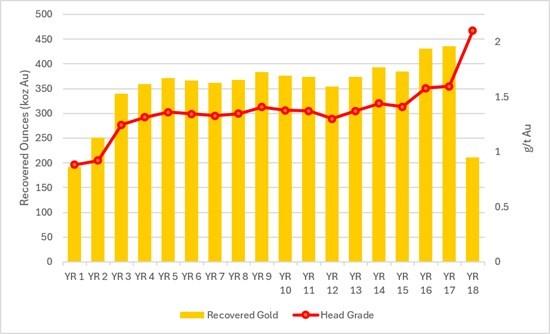
Figure 3. Combined O/P and U/G Recovered Gold Ounces and Head Grade
Mining
Open Pit Mining
Wenot is a previously mined, near-surface gold deposit, well-suited to conventional open pit truck-and-shovel mining methods. Owner-operated mining is assumed. The PEA mine plan contemplates approximately two years of pre-production followed by 18 years of commercial production.
The ultimate “superpit” is approximately 2.4 km long, 1.1 km wide, and 550 m deep, with mining progressing through three phases to achieve the final pit limits. The mine plan is based on a conventional bulk mining approach using large-scale equipment, including four 20 m³ hydraulic shovels, three 25 m³ wheel loaders, and seventy-four 135 t haul trucks, over the life of the mine.
Total material movement from the open pit over the mine life is estimated at 922.5 Mt, including mineralized material and waste, with an average LOM strip ratio of 5.9:1. Strategic and focused drilling over the past couple years has led to the identification of additional and expanded gold zones within the Wenot deposit, that resulting in a lower strip ratio than anticipated.
The average mining rate is approximately 126 ktpd, peaking at 175 ktpd. The open pit production schedule is designed to provide consistent feed to the processing plant at an annualized rate of 9.125 Mt, equivalent to 25,000 tpd, in coordination with planned underground production and while prioritizing higher-grade feed where practical.
Pit optimization and mine planning were conducted using conventional industry-standard methods to define the mineable quantities at a gold price of $3,500/oz. The mineable material quantities include both Indicated and Inferred Mineral Resources, reported at a cutoff grade of 0.27 g/t Au. The lower average mineable gold grade for the open pit of 1.08 g/t Au versus the higher corresponding MRE grades largely reflects the 19% mining dilution that was applied. A total of 134.1 Mt grading 1.08 g/t Au containing 4.641 Moz Au will be extracted from the open pit mine, for 4.315 Moz Au recovered, as shown in Figure 4.
Underground Mining
The PEA envisions the Gilt deposit to be mined using underground mining methods. The deposit is a series of horizontal lenses of mineralized rock stacked vertically within an intrusive stock and extending into the surrounding volcanic rocks. The lenses vary in thickness from 1.0 m to greater than 20.0 m. The Gilt underground deposit is separated from the upper past-producing open pit by a late diabase dyke that dips to the south at approximately 24 degrees.
Based on the type of deposit, drift-and-fill mining was selected as the preferred mining method. Alternative mining methods, including longhole open stoping will be evaluated in greater detail in future studies. The deposit has sufficient strike length to support primary, secondary, and tertiary development in the stoping areas.
The mine plan provides access via twin ramps from surface that will be used for personnel and material movement. Ventilation will be provided by two vent raises for exhaust, using the ramp as the intake. Development and production material handling was assumed to be done using a railveyor system, and haul trucks. Production will be drilled using face drills (Jumbos). Cemented paste fill will be the backfill method.
The target mining rate from the underground is 4,000 tpd. Underground development will commence in Year 1 of plant operations, and production will commence in Year 3. A total of 22.6 Mt grading 2.98 g/t Au containing 2.164 Moz Au will be extracted from the underground mine, for 2.012 Moz Au recovered.
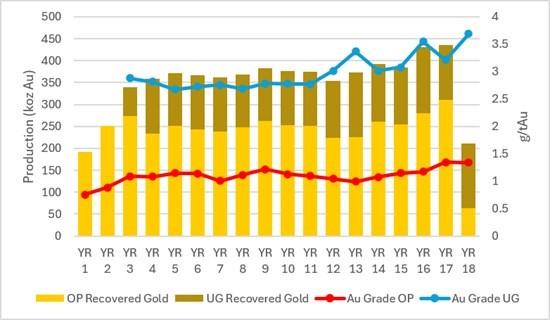
Figure 4. Recovered Gold and Gold Grades from OP and UG
Processing
The PEA anticipates a conventional 25,000 tpd processing facility based on a standard metallurgical flowsheet, consisting of grinding, gravity separation, and carbon-in-leach followed by detox to produce gold dore.
Primary crushing would be via a gyratory crusher followed by a Semi Autogenous Grinding and Ball Mill circuit with gravity concentration. Tailings will be treated and used either as an ingredient for paste fill or sent to a tailings storage facility. The processing plant is expected to operate for 18 years in the current mine plan. Average gold recovery is estimated at 93% based on historical recoveries and results from recent metallurgical test work which indicate clean, non-refractory gold mineralization, free of deleterious components. Optimal recovery is achieved at 32-hour leach retention time.
Power
A total of 60 MW of installed capacity is planned for the initial phase of the Project, with an additional 14MW of capacity required to support the underground mine and other associated systems. The Project’s base case scenario assumes all power is generated on-site using heavy fuel oil (HFO) generators.
The proposed Amaila Falls hydropower project lies approximately 80 km west of the Omai property, with the proposed transmission line to run within 20 km of the Omai site. The Government of Guyana recently closed a tender process and development awaits funding. A 300 MW gas-to-energy plant is under construction near Georgetown. A second phase of the development envisions a future compressed natural gas plant (CNG). Timelines for these projects may not initially meet Omai’s timelines. Alternative power supply options will be monitored and considered in future studies.
Operating Costs
LOM operating costs are estimated at $1,228 per ounce of gold produced, exclusive of royalty costs and refining costs. Including these, the total cash operating cost3 is estimated at $1,501 per ounce. The LOM AISC1 is estimated to be $1,608 per ounce of gold produced, based on average annual gold production of 351,488 ounces over the 18-year LOM, as shown in Figure 5.
Table 4. Operating Costs1,3
| Operating Cost Table | |||
| LOM (US$ million) | Unit Costs (US$/t processed) |
Unit Costs (US$/oz Au) | |
| Mining Costs – OP | 3,026 | 22.57 | 701 |
| Mining Costs – UG | 1,825 | 80.82 | 907 |
| Combined Mining Costs | 4,851 | 30.96 | 767 |
| Processing Cost | 2,251 | 14.37 | 356 |
| G&A Cost | 723 | 4.25 | 105 |
| Total Site Costs | 7,825 | 49.58 | 1,228 |
| Dore Transport & Refining | 44 | 0.28 | 7 |
| Royalties | 1,456 | 10.74 | 266 |
| Total Operating Costs | 9,325 | 60.60 | 1,501 |
| Sustaining Capital | 636 | 4.06 | 100 |
| Closure and Reclamation | 41 | 0.26 | 6 |
| All in Sustaining Costs (AISC) | 10,000 | 64.92 | 1,608 |
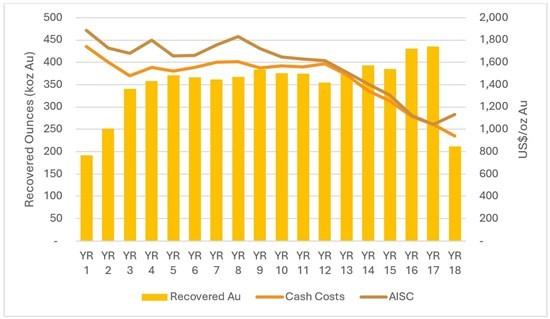
Figure 5. Annual Gold Production and Operating Cost Per Ounce (Cash Costs and AISC)
Capital Costs
The initial capital costs are estimated at $1.427 billion, including a contingency of $285 million (25%). Growth capital for the underground is estimated at $293 million with sustaining capital for open pit and underground mining, and other site facilities at $635 million. Reclamation and closure capital costs are estimated to be $41 million.
The main components of the $1.427 billion initial capital costs include: direct costs of $394 million for the processing plant equipment and buildings, $274 million for open pit mobile equipment, mine infrastructure and mine development, $177 million for site infrastructure (including roads, power plant and substation, airstrip and permanent camp), and $296 million for indirect costs (35% of total direct costs); contingency of $285 million is also included in the initial capital costs.
Table 5. Capital Costs
| Capital Costs Table | |
| Initial Capital Costs | Amount (US$ millions) |
| Direct Costs | |
| OP Mining | 275 |
| Process Plant | 394 |
| Infrastructure | 177 |
| Total Direct Costs | 845 |
| Indirect Costs | 296 |
| Total Direct and Indirect Costs | 1,141 |
| Contingency | 285 |
| Total Initial Capital | 1,427 |
| Growth Capital – UG Mining | 293 |
| Sustaining (Op + UG) | 636 |
| Reclamation and closure | 41 |
| Total Capital Costs | 2,396 |
On-Site Infrastructure
Infrastructure for the PEA comprises a 25,000 tpd process plant, power plant, assay laboratory, and a 500-person permanent camp to support mining operations. Additional facilities will include administrative offices, warehouses, maintenance shops, and medical and environmental services.
Relocation of the current airstrip will be required due to proximity to the Wenot pit. Costing includes support for fuel storage and airstrip relocation.
Tailings and Water Management
Tailings will be deposited in four locations over the LOM. During the initial years of operation, the previously mined-out Fennel pit (at the Gilt deposit) will be used to store tailings. A portion of Fennel pit will be maintained for water management. The existing tailings storage facility referred to as TSF2, which was used at the end of previous mining activities, was evaluated and deemed suitable for use as an initial TSF. Capacity remains for two, five-metre raises that augment the existing dams, consistent with the original design. Later in the LOM, this facility will be expanded in accordance with geotechnical, water catchment, and environmental criteria to form TSF3. The location of this expansion has already been identified. The design will consider water management strategies for both the operational and closure phases. Ongoing technical studies and field investigations will inform future refinement of location and design. Some tailings will also be converted into paste backfill for use at the Gilt underground.
The water management system envisioned for the PEA separates contact water from non-contact water. Non-contact water is redirected away from site infrastructure using diversion channels. Contact water, primarily from the pit and water storage facility will be collected in a central pond and treated as required prior to discharge and usage.
Workforce
The workforce for the mine is expected to be sourced primarily locally. Local populations have extensive experience with and knowledge of open pit mining. The peak direct workforce during operations is anticipated to be approximately 900 personnel, including open pit and underground mining, processing plant, and associated site facilities personnel. During construction, indicative estimates show that the workforce could total from 1,500 to 2,000 personnel.
Next Steps
The Omai project continues to be advanced as expeditiously as possible with the following activities planned or underway:
Geological work includes:
Engineering & permitting work includes:
Technical Report
The effective date of the PEA is July 31st , 2026, and an NI 43-101 technical report relating to the PEA will be filed on SEDAR+ (www.sedarplus.ca) within 45 days of this news release.
Qualified Persons
The preliminary economic assessment was prepared by SLR Consulting (Canada) Ltd. (SLR). The technical content in this press release has been reviewed by the following qualified persons (QP): David M. Robson, P.Eng., Goran Andric, P.Eng., Jeff Sepp, P.Eng., Linda Dufour, P.Eng., Stephan Theben, Dipl.-Ing. SME RM, and Alan J. San Martin, P.Geo.
Elaine Ellingham, P.Geo., is a Qualified Person (QP) under National Instrument 43-101 “Standards of Disclosure for Mineral Projects” and has reviewed and approved the technical information contained in this news release. Ms. Ellingham is a director and officer of the Company and is not considered to be independent for the purposes of National Instrument 43-101.
ABOUT OMAI GOLD
Omai Gold Mines Corp. is a Canadian gold exploration and development company focused on rapidly expanding the two orogenic gold deposits at its 100%-owned Omai Gold Project in mining-friendly Guyana, South America. The Company has established the Omai Gold Project as one of the fastest growing and well-endowed gold camps in the prolific Guiana Shield.
In April 2026, the Company announced an updated NI 43-101 Mineral Resource Estimate7 (MRE) which included expansions to both the Wenot Deposit and Gilt Deposit. Most significantly, the Wenot Indicated MRE increased 49.8% to 1,453,000 ounces (“oz”) of gold with an average grade of 1.59 g/t Au, contained in 28.4 million tonnes (“Mt”) and the Wenot Inferred MRE increased 7.6% to 3,999,000 oz grading 1.35 g/t Au, contained in 92.4 Mt. Similarly, the adjacent Gilt Deposit saw an overall increase in ounces over the previous MRE. Gilt’s Inferred MRE increased 120% to 1,465,000 oz averaging 3.22 g/t Au (in 14.2 Mt), while the Indicated MRE decreased by 9.5% to 1,042,000 oz averaging 3.33 g/t Au (in 9.7 Mt).
Five diamond drills are working on a 50,000m drilling program for 2026: at Wenot the focus is to further test the limits of the deposit, including both east and west, and to work to convert the large Inferred MRE to Indicated. Additional drilling will continue to explore certain known gold occurrences for possible near-surface higher-grade satellite deposits. The Omai Gold Mine produced over 3.7 million ounces of gold from 1993 to 20058, ceasing operations when gold was below US$400 per ounce. The Omai site significantly benefits from existing infrastructure, including an on-site airstrip, and is connected by road to the two largest cities in Guyana, Georgetown and Linden.
Brutus Mining Inc. (CSE: BRU) (FSE: ZI3) is pleased to announce that it has closed its non-brokered ... READ MORE
Jaguar Uranium Corp. (NYSE American: JAGU) is pleased to announce an independent Mineral Resource E... READ MORE
Auro Metals Inc. (TSX-V: AURO) (OTCQB: AURFF), is pleased to announce the assay results of the fina... READ MORE
Endeavour Silver Corp. (NYSE: EXK) (TSX: EDR) is pleased to announce that repairs to the primary bal... READ MORE
Scorpio Gold Corp. (NASDAQ: SGLD) (TSX-V: SGLD) (OTCQB: SRCRF) (FSE: RY9) is pleased to announce re... READ MORE